
Graphite–PE Composite Mixing in a Nylon Planetary Jar
Test period: December 2025
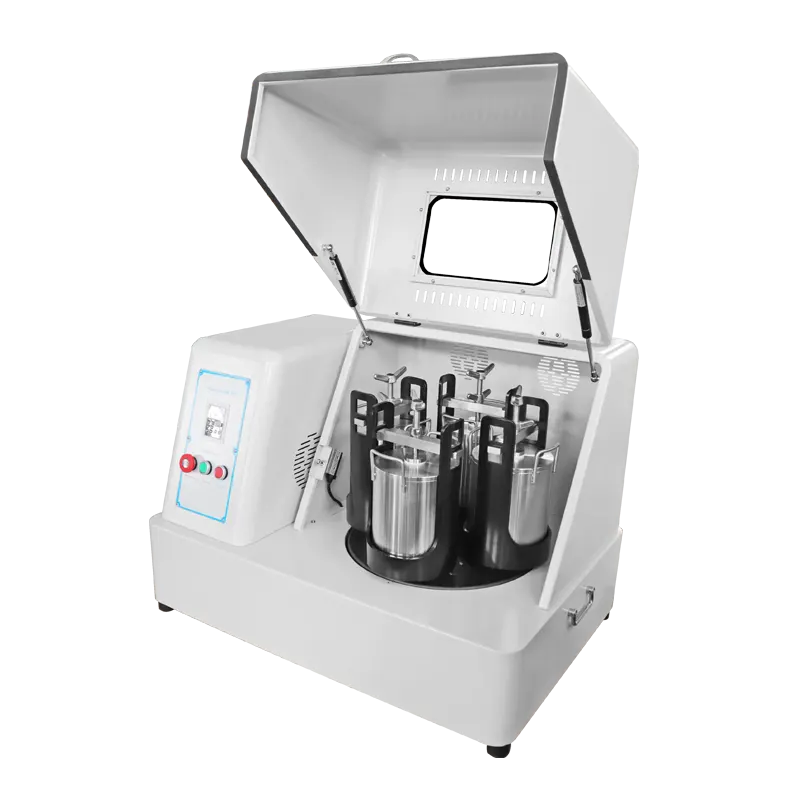
A graphite–polyethylene batch was processed with zirconia balls in a white nylon jar on a TENCAN XQM planetary ball mill. The customer visually confirmed that the material met the intended requirement after 5.5 hours of processing.
Sample analysis and experimental objective
The batch combined 70 g graphite with 30 g PE. Unlike a brittle mineral grinding task, this experiment concerned the appearance and processing of a mixed carbon–polymer system. Graphite and a polymer component can respond differently to mechanical input, so visual appearance, temperature and component distribution deserve attention. The available acceptance evidence was customer visual assessment, rather than a numerical particle-size or compositional-uniformity test.
Equipment and test conditions
| Mill | TENCAN XQM-series planetary ball mill |
|---|---|
| Composition | 70 g graphite + 30 g PE; total 100 g |
| Jar | 1 L white nylon |
| Media | Zirconia balls, 10 mm and 5 mm in equal stated proportions |
| Ball-to-material ratio | 15:1 |
| Method | Dry processing |
| Speed setting | 500 rpm |
| Run mode | 5 minutes running / 1 minute pause |
Experimental observations and results
| Processing point | Assessment |
|---|---|
| 5.5 hours | Customer visual confirmation that the intended requirement was met |
This is a successful visually accepted processing trial. No D50, D90, coating thickness, conductivity or chemical reaction result was measured, so none can be inferred. The relevant processing point is 5.5 hours; it should not be interpreted as a quantified production throughput.
Why this equipment was selected
The TENCAN Vertical square planetary ball mill combines impact and mixing action for exploratory composite preparation. A TENCAN nylon planetary mill jar with zirconia media is relevant where direct steel contact is undesirable. The 1 L jar also allows this particular batch and ball charge to be evaluated together, subject to the machine’s permitted total loading.
Practical precautions
- Monitor temperature because the PE component can respond to accumulated heat and mechanical input.
- Balance opposing stations and verify that the total jar and media mass is within the machine limit.
- Check recovered material at several positions before treating visual consistency as batch uniformity.
- For subsequent development, define measurable acceptance criteria such as composition distribution, morphology or application-specific performance.
Could another TENCAN machine be a better fit?
If the actual goal becomes gentle bulk blending with minimal mechanical modification, the TENCAN lab roll ball mill could be tested as a lower-intensity alternative. If temperature control becomes the limiting requirement, consider the TENCAN Low temperature planetary grinding machine. Neither alternative was compared in this experiment, and neither should be described as a proven improvement over the accepted XQM process.
Related TENCAN equipment
Explore the equipment and accessories for planning a comparable trial. Select the machine size and jar holders to match the stated working configuration.

Interpretation: These results describe the tested sample and conditions. Equipment alternatives and process improvements above are engineering recommendations for a further trial, not additional measured results. D50 and D90, where reported, describe the measured particle-size distribution; they do not establish an absolute maximum size or a sieve-pass percentage.