
Planetary Ball Mill Guide: Working Principle, Applications and Grinding Media Selection
Planetary Ball Mill Guide: Working Principle, Applications, Model Selection and Grinding Media
A planetary ball mill is a high-energy grinding machine widely used for fine powder preparation, mixing, homogenization, mechanical alloying, mechanochemical reactions, and laboratory material research.
Compared with conventional rotating ball mills, a planetary mill generates much stronger impact, friction, and shear forces through the simultaneous revolution of the supporting disk and rotation of the grinding jars. This compound movement makes it possible to process soft, hard, brittle, and fibrous materials in both dry and wet grinding modes.
However, obtaining a reliable grinding result depends on more than the machine itself. The planetary ball mill type, rotational speed, jar material, grinding-ball material, ball-size distribution, sample loading, and processing time must all be matched to the material and the required particle size.
This guide explains the working principle of planetary ball mills, their main applications, available machine types, and practical methods for selecting grinding jars and balls.
Planetary Ball Mill Working Principle
In a planetary ball mill, each grinding jar can be regarded as a small “planet.” The grinding jars are installed on a circular supporting platform known as the planetary disk or sun wheel.
When the sun wheel revolves around the central axis of the machine, each grinding jar simultaneously rotates around its own axis in the opposite direction. This combined revolution and self-rotation generates strong centrifugal and Coriolis forces inside the jars.
The grinding balls are rapidly accelerated from one side of the jar to the other. They repeatedly collide with:
- The sample material
- The inner wall of the grinding jar
- Other grinding balls
These movements produce several particle-reduction effects at the same time:
- Impact: High-speed ball collisions break larger and brittle particles.
- Friction: Sliding contact between the balls, powder, and jar wall reduces particle size further.
- Shear: Relative movement between the media helps disperse agglomerates and layered particles.
- Compression: Particles trapped between grinding balls experience repeated pressure.
The high acceleration of the grinding media gives planetary ball mills considerably greater pulverization energy than many ordinary rotating mills. This is why they are commonly selected for ultrafine grinding, mechanical activation, and advanced material preparation.
Speed Ratio Between the Sun Wheel and Grinding Jars
For colloidal grinding and many routine laboratory applications, the speed ratio between the sun wheel and the grinding jars is commonly approximately 1:2.
This means that when the planetary disk completes one revolution, the grinding jar completes approximately two rotations in the opposite direction.
The 1:2 speed ratio provides a practical balance between impact energy, friction, grinding efficiency, temperature rise, and equipment load.
Higher-energy planetary ball mills may use speed ratios of approximately 1:2.5 or 1:3. These configurations can generate stronger grinding forces and are generally considered for:
- Mechanochemistry
- Mechanosynthesis
- Mechanical alloying
- Mechanocatalysis
- Hard or difficult-to-grind materials
- Applications requiring stronger mechanical activation
A higher speed ratio does not automatically guarantee a better result. It may also increase sample temperature, grinding-media wear, contamination risk, and mechanical load. The operating parameters should therefore be optimized according to the specific material.
Applications of Planetary Ball Mills
Planetary ball mills are suitable for grinding soft, hard, brittle, and certain fibrous materials. Depending on the sample and process requirements, they can operate in dry, wet, vacuum, or protective-atmosphere modes.
The extremely high centrifugal forces generated by planetary motion provide high grinding energy and relatively short processing times.
Fine and Ultrafine Grinding
Planetary ball mills are commonly used to reduce materials from an initial coarse powder into fine or ultrafine particles. With a suitable combination of jar material, grinding balls, speed, time, and wet-grinding medium, some materials can be processed into the submicron or nanometer range.
The achievable particle size depends on:
- Material hardness and brittleness
- Initial feed size
- Grinding jar volume
- Grinding-ball material and diameter
- Ball-to-material ratio
- Rotational speed
- Grinding time
- Dry or wet grinding conditions
- Temperature control
- Particle agglomeration behavior
Mechanochemistry and Mechanical Alloying
The strong impact and shear forces generated inside a planetary ball mill can introduce mechanical energy directly into the sample. This makes the equipment suitable for mechanochemical reactions and mechanical alloying.
Typical research tasks include:
- Solid-state reactions
- Mechanical alloying of metal powders
- Mechanical activation of minerals
- Preparation of composite powders
- Mechanocatalytic research
- Development of functional and energy-storage materials
Mixing and Homogenization
Planetary ball mills can also be used for powder mixing and homogenization. Multiple materials can be processed together to improve compositional uniformity before pressing, sintering, coating, testing, or other downstream operations.
Colloidal and Wet Grinding
During wet grinding, a suitable liquid medium is added to the grinding jar. The liquid can reduce dust, improve heat transfer, limit powder agglomeration, and assist particle dispersion.
The selected liquid must not react with the sample, grinding jar, grinding balls, or sealing components. Its influence on subsequent drying and material purity must also be considered.
Pharmaceutical and Co-Crystal Research
Planetary ball mills may be used for screening co-crystals, mixing pharmaceutical ingredients, reducing selected raw-material particle sizes, and studying mechanically induced solid-state changes.
In pharmaceutical applications, special attention must be paid to cross-contamination, cleaning, temperature rise, grinding-media wear, and material compatibility.
Common Industries and Research Fields
- Advanced materials and nanotechnology
- Battery and energy-storage materials
- Ceramics and electronic ceramics
- Metals and powder metallurgy
- Minerals and geology
- Chemicals and catalysts
- Pharmaceutical research
- Environmental sample preparation
- Universities and scientific research institutes
- Laboratory testing and quality control
Main Types of Planetary Ball Mills
Planetary ball mills are available in several structural configurations. The correct machine type should be selected according to the material characteristics, grinding objective, required fineness, batch size, and process conditions.
Four common planetary ball mill types include:
- Vertical planetary ball mill
- Full-directional planetary ball mill
- Horizontal planetary ball mill
- Dual planetary ball mill
Depending on the application, planetary ball mills can also be configured with cooling, heating, vacuum, inert-gas, or other customized devices.
Reference Table for Planetary Ball Mill Selection
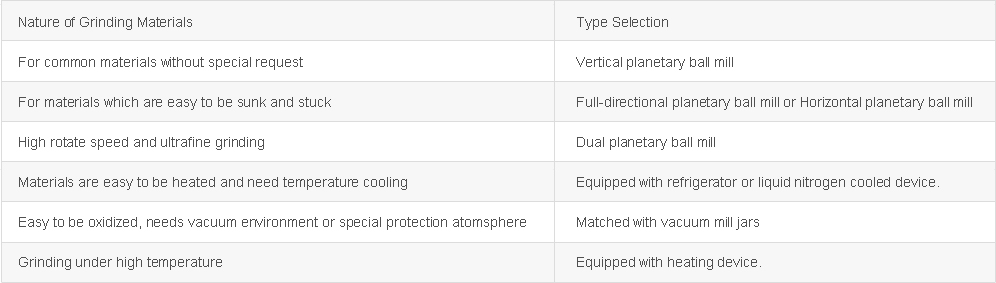
|
Vertical Planetary Ball Mill
|
Full-Directional Planetary Ball Mill
|
Horizontal Planetary Ball Mill
|
Dual Planetary Ball Mill
|
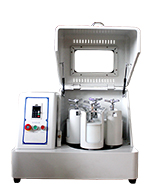

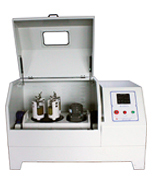
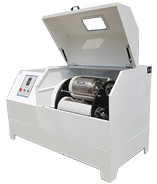
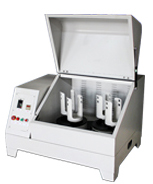
Vertical Planetary Ball Mill
A vertical planetary ball mill uses vertically arranged grinding jars mounted on the planetary disk. It is a widely used general-purpose configuration for laboratory fine grinding, mixing, homogenization, and material preparation.
It may be suitable for:
- Routine laboratory grinding
- Multiple-sample comparison
- Dry and wet grinding
- Ceramic, mineral, chemical, and metal powders
- Universities and research laboratories
Full-Directional Planetary Ball Mill
A full-directional planetary ball mill adds an additional movement of the planetary mechanism or grinding assembly. The jar position changes continuously during operation, allowing the material and grinding media to move in multiple directions.
This structure can reduce powder accumulation at specific locations inside the jar and may improve grinding uniformity for materials that tend to stick, settle, or form dead zones.
Horizontal Planetary Ball Mill
A horizontal planetary ball mill arranges the grinding jars horizontally. The structure changes the movement and distribution of the grinding media and sample inside the jars.
Horizontal models may be considered for larger laboratory capacities, longer grinding cycles, selected wet-grinding processes, or applications requiring a different movement pattern from conventional vertical machines.
Dual Planetary Ball Mill
A dual planetary ball mill uses a more complex planetary transmission structure. A large planetary disk drives a secondary planetary mechanism, increasing the movement radius and grinding intensity.
It is generally used for:
- High-energy grinding
- Hard and difficult-to-grind materials
- Mechanical activation
- Mechanical alloying
- Fine and ultrafine powder preparation
- Advanced-material research
Because dual planetary mills generate higher energy, temperature rise and grinding-media wear should be monitored carefully.
How to Select a Planetary Ball Mill
Machine selection should begin with the sample and grinding objective rather than the maximum speed or nominal jar capacity.
Before choosing a model, confirm the following information:
| Selection Factor | Information to Confirm |
|---|---|
| Material characteristics | Hard, brittle, soft, fibrous, sticky, abrasive, heat-sensitive, or reactive |
| Initial feed size | Determine whether preliminary crushing is necessary |
| Required final particle size | Coarse, fine, ultrafine, submicron, or nanometer target |
| Sample quantity | Actual powder quantity per jar and number of samples per batch |
| Grinding mode | Dry, wet, vacuum, or inert-atmosphere grinding |
| Contamination limit | Identify which metallic or non-metallic impurities are unacceptable |
| Temperature sensitivity | Determine whether programmed pauses or cooling are required |
| Process objective | Grinding, mixing, homogenization, mechanical alloying, or mechanochemistry |
Selection of Grinding Balls
Grinding-ball selection has a direct influence on grinding energy, processing time, wear, contamination, and final powder quality.
Grinding balls should be selected according to the following factors:
- The grinding-ball material should not introduce unacceptable impurities into the sample.
- The balls must provide suitable resistance to temperature, wear, corrosion, and the selected grinding liquid.
- The density and hardness of the grinding media should generally be greater than those of the material being processed.
- The balls should be compatible with the grinding-jar material.
- The ball diameter should match the initial feed size and required final fineness.
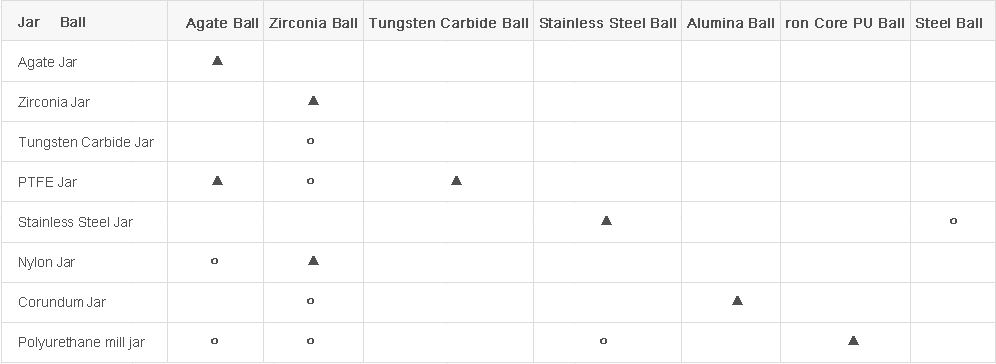
Matching Table for Jars & Balls
Notes:
▲ means the best matching option.
○ means a suitable matching option.
Important Factors When Matching Jars and Balls
Contamination Control
Wear particles from the grinding balls and jar may enter the sample. The selected combination should therefore avoid impurities that could interfere with material performance or subsequent analysis.
For example:
- Stainless steel may introduce iron, chromium, or nickel.
- Tungsten carbide may introduce tungsten or cobalt, depending on composition.
- Alumina may introduce aluminum-containing impurities.
- Zirconia may introduce zirconium-containing wear particles.
- Agate may introduce silica-related impurities.
Hardness
The grinding media should normally be harder than the sample. If the ball material is too soft, the balls may wear rapidly without transferring sufficient energy to the material.
Extremely hard balls used inside a relatively soft jar may accelerate jar wear. The complete ball-and-jar combination must therefore be evaluated together.
Density
Higher-density grinding balls generally provide greater impact energy at the same speed and diameter. Tungsten carbide, zirconia, and stainless steel can generate stronger individual impacts than lower-density polymer balls.
Lower-density media may be more appropriate for soft materials, gentle mixing, and processes where excessive impact could damage the sample.
Chemical Compatibility
During wet grinding, the balls and jar must resist the selected liquid medium. Acids, alkalis, solvents, water, oils, and other liquids may react differently with metals, ceramics, and polymers.
Recommended Grinding-Ball Size Distribution
A mixture of different ball sizes is generally more effective than using only one diameter.
A commonly recommended starting ratio by weight is:
- Large grinding balls: approximately 20%
- Medium grinding balls: approximately 50%
- Small grinding balls: approximately 30%
Large balls provide stronger impact and help break the larger feed particles. Medium balls support general particle reduction, while small balls create more contact points for fine and ultrafine grinding.
The final ratio should be optimized according to:
- Initial particle size
- Material hardness
- Grinding-jar capacity
- Target fineness
- Dry or wet process
- Grinding time
- Material agglomeration behavior
Typical Grinding-Jar and Ball Combinations
Tungsten Carbide Grinding Jars
Tungsten carbide balls and zirconia balls are suitable for tungsten carbide jars.

Tungsten carbide jars provide very high hardness and density. They are commonly considered for hard, brittle, and abrasive materials.
Tungsten carbide balls provide strong impact energy and good material compatibility with the jar. Zirconia balls may also be selected when a different contamination profile or grinding-energy level is required.
The possibility of tungsten, cobalt, or zirconium contamination must be evaluated according to the sample and jar composition.
Polyurethane Grinding Jars
Polyurethane mill jars can be matched with iron-core polyurethane balls, agate balls, stainless steel balls, and zirconia balls.
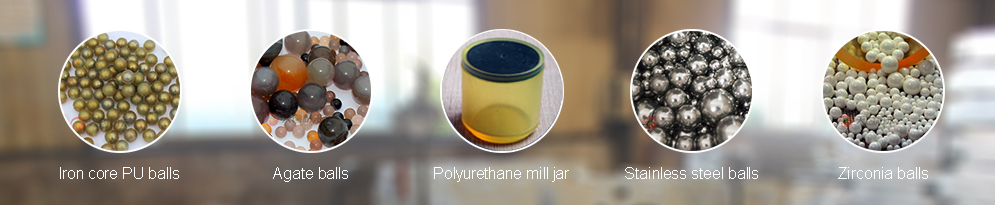
Polyurethane jars provide good wear resistance, lower operating noise, and reduced direct contact between the sample and metal.
The grinding-ball material can be selected according to the required impact energy:
- Iron-core polyurethane balls provide greater density while maintaining a polyurethane contact surface.
- Agate balls may be used for selected low-contamination applications.
- Stainless steel balls provide stronger impact but may increase jar wear and metallic contamination risk.
- Zirconia balls provide higher density, hardness, and wear resistance.
Stainless Steel Grinding Jars
Stainless steel mill jars can be matched with stainless steel balls and steel balls.

Stainless steel jars and balls provide high strength, durability, and relatively high grinding energy. They are widely used for metal powders, general industrial materials, minerals, and applications where metallic contamination is acceptable.
This combination may be unsuitable when iron, chromium, nickel, or other metallic elements would affect the purity, color, electrical properties, or chemical analysis of the sample.
Practical Loading and Operating Recommendations
Do Not Fill the Jar Completely
Nominal jar volume is not equal to the effective sample capacity. Space must be reserved for the grinding balls and their movement.
Overloading the jar can reduce impact efficiency, increase temperature, place excessive load on the machine, and cause leakage or unstable grinding.
Balance Opposite Grinding Stations
Grinding jars installed opposite each other should have the same total weight. The jar, lid, grinding balls, and sample must all be included when balancing.
Improper balancing may cause excessive vibration, noise, bearing load, and damage to the planetary transmission.
Begin with Moderate Parameters
Do not immediately use the maximum rotational speed. Begin with a moderate setting and evaluate:
- Particle-size reduction
- Sample temperature
- Material sticking
- Powder agglomeration
- Jar and ball wear
- Machine vibration
Speed, time, ball size, and loading can then be adjusted gradually.
Control Temperature During Long Grinding Cycles
High-energy grinding generates heat. Heat-sensitive materials may require programmed pauses, lower speed, shorter grinding cycles, external cooling, or a specially configured temperature-control system.
Prevent Cross-Contamination
Clean the grinding jars, balls, lids, seals, and tools thoroughly between different materials. Dedicated grinding sets should be considered for pharmaceutical, food, electronic, high-purity, or analytical applications.
Frequently Asked Questions
What is the main advantage of a planetary ball mill?
Its main advantage is the high grinding energy created by the simultaneous revolution of the planetary disk and opposite rotation of the grinding jars. This allows relatively rapid fine grinding, mixing, and mechanical activation.
Can a planetary ball mill be used for wet grinding?
Yes. A suitable liquid medium can be added to the grinding jar. The liquid, jar, balls, lid, and sealing materials must be chemically compatible with the sample.
Can a planetary ball mill produce nanoparticles?
Some materials can be processed into the nanometer range, but the actual result depends on material properties, feed size, jar and ball materials, speed, time, grinding mode, temperature, and agglomeration behavior.
Is a higher speed always better?
No. Excessive speed may increase heat, wear, contamination, agglomeration, and mechanical load. Effective grinding requires a suitable combination of speed, time, media size, media quantity, and sample loading.
Which planetary ball mill type should be selected?
Vertical models are suitable for many general laboratory applications. Full-directional models may improve movement uniformity, horizontal models provide a different media distribution pattern, and dual planetary mills provide higher grinding energy for more demanding applications.
Why should different grinding-ball sizes be mixed?
Large balls provide strong impact for coarse particles, while small balls provide more contact points for fine grinding. Combining several sizes creates a more complete particle-reduction process.
Conclusion
A planetary ball mill generates high grinding energy through the opposite revolution and rotation of the planetary disk and grinding jars. This movement produces strong impact, friction, shear, and compression forces, making the equipment suitable for fine grinding, ultrafine grinding, mixing, homogenization, mechanical alloying, and mechanochemical research.
The correct machine type and grinding configuration should be selected according to the material, feed size, target particle size, sample quantity, contamination restrictions, temperature sensitivity, and grinding mode.
Grinding jars and balls must also be matched carefully. Hardness, density, chemical compatibility, wear resistance, contamination, and ball-size distribution all influence the final result.
By selecting the appropriate planetary ball mill, grinding jar, grinding media, speed, loading ratio, and processing time, laboratories can improve grinding efficiency, reduce contamination, and obtain more stable and repeatable powder-processing results.