
Full-Directional Planetary Ball Mill Guide
A planetary ball mill that moves the grinding jars in a single plane can still leave you with a familiar set of problems: powder packed against the jar wall, a particle size distribution much wider than the median value suggests, and results that drift from one run to the next. Those symptoms rarely come from the nominal speed of the machine. They come from how the media and the sample move inside the jar, and from the parts of the jar volume that the grinding charge never reaches efficiently.
Full-directional planetary mills were developed to address that limitation directly. Instead of counter-rotating on a fixed axis alone, the grinding jars change orientation during the run, so the charge is repeatedly re-oriented rather than settling into a stable orbit. Energy is distributed more evenly through the jar volume, which matters most when a sample is cohesive, fibrous, low in bulk density, or simply difficult to keep moving. The heavy-duty full-directional planetary ball mill from TENCAN is one example of this machine class, and it is a useful reference point for the motion principles discussed below.
How Full-Directional Motion Differs from Standard Planetary Grinding
The standard planetary grinding mechanism
Every planetary ball mill shares the same basic geometry. A sun wheel turns in one direction while each jar rotates on its own axis in the opposite direction. Because the jar spins while it orbits, the grinding media are pressed against the outer wall of the jar and then scraped away, so the charge is constantly lifted, thrown, and rolled. The acceleration acting on the media inside the jar can be many times that of gravity, which is why a benchtop planetary mill can reduce a hard powder far faster than a simple tumbler holding the same jar volume.
The energy delivered in this arrangement is a mixture of impact and friction. Where media strike the jar wall at high relative velocity, brittle particles fracture; where media roll and slide against one another, particles are sheared and abraded. How much of each mechanism you get depends on the rotation ratio between the sun wheel and the jars, the jar diameter, media density and diameter, and the degree of jar filling. These variables are not independent. Changing the media diameter changes the number of contact points, and changing the filling degree changes how much impact energy reaches the powder instead of the jar wall.
The limitation of the standard arrangement is geometric rather than mechanical. In a single-plane motion pattern the charge settles into a fairly stable path, so part of the jar volume receives intense treatment while another part — often near the lid, the center, or the inner radius — receives very little. Free-flowing brittle powders cope with this, because gravity and the media keep them circulating. Cohesive, sticky, low-density, or fibrous materials do not. They can remain in a slow-moving layer against the wall, and the mill then spends most of its energy working the media rather than the sample.
What the full-directional component adds
When the orientation of the jar body itself changes during a run, the charge cannot form a stable bed. Because the tumbling direction keeps changing, material that would otherwise cling to the wall is repeatedly dislodged and re-entrained, and the media are repositioned instead of running in a single groove. Two practical consequences follow. First, the variation in grinding intensity across the jar volume narrows, so the particle size distribution tends to be tighter at the same median size. Second, wall caking and sample hold-up are reduced, which improves recovery and shortens cleaning between batches.
The motion also changes how ductile and semi-ductile materials respond. In a single-plane pattern, a soft metal or polymer powder can be flattened into flakes and cold-welded onto the jar surface faster than it fractures. Re-orienting motion favors shear and repeated re-arrangement of the charge, so deformation is distributed rather than concentrated in one welded layer. It does not turn a ductile powder into a brittle one, but it often makes the outcome more predictable. The exact trajectory differs between models, so the motion pattern, speed range, and control options of a specific machine should be confirmed with the manufacturer rather than assumed from the category name.
Where the extra motion does not help
Full-directional motion is not automatically the better choice. If a process is limited by chemistry — for example, a phase transformation or amorphization that occurs above a certain energy threshold — or if the powder is already free-flowing and easy to reduce, additional motion complexity will not change the result much, and a simpler planetary mill may offer better value. The design also introduces more moving components and higher dynamic loads, which is why rigid frames, dependable jar clamping, and a defined maintenance routine become part of the specification instead of optional extras.
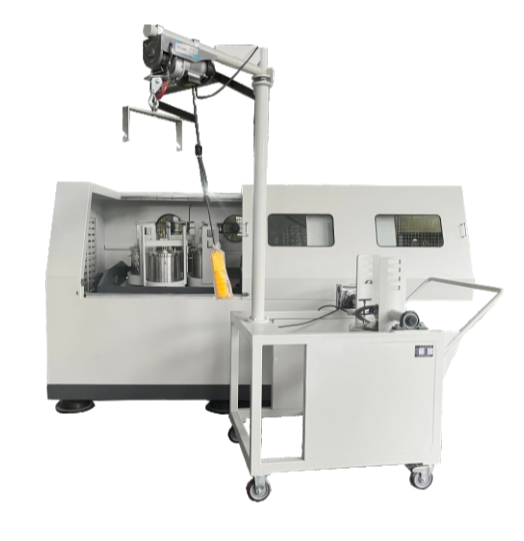
Heavy-duty full-directional planetary ball mill: jar motion is re-oriented during the run, which reduces dead zones inside the jar.
Jar Material, Media Selection, and Contamination Control
Inside a planetary mill, wear is unavoidable. The jar and the media are the grinding tools, and whatever they lose becomes part of the sample. Jar and media selection is therefore not a purchasing detail to settle later; it determines whether the final powder can meet a purity specification at all.
Two properties dominate the decision. Hardness comes first: jar and media material should be harder than the sample. When the tool is softer, the powder abrades the tool instead of the tool fracturing the powder, and contamination rises quickly while grinding efficiency falls. Density comes second. Media density sets the kinetic energy available at a given rotation speed, so a dense medium reduces size faster and delivers a harder impact, while a less dense medium is gentler and tends to do less damage to crystal structure.
Media diameter is the third lever. Large balls deliver fewer but harder impacts and suit coarse feed or very hard material. Small balls create many more contact points and are generally better for reaching fine sizes with a narrow distribution, although they lose momentum quickly when the powder load is high. Using two diameters together can improve packing and keep both impact and shear present in the charge.
| Jar / media material | Typical character | Where it is usually chosen | Points to watch |
|---|---|---|---|
| Agate | Moderate hardness, low density compared with zirconia | Soft to medium-hard samples and small batches where mild grinding is sufficient | Natural material with variable trace content; wear accelerates with hard samples |
| Zirconia (ZrO2) | High density and high hardness | Hard, abrasive powders that need faster size reduction | Higher energy also means more heat; check zirconium contamination if that element matters |
| Corundum / alumina (Al2O3) | Hard and chemically stable | General-purpose grinding of oxides and minerals | Aluminum pickup in the final powder |
| Tungsten carbide | Very high density and hardness | Very hard, brittle materials in short high-energy runs | Expensive; heavy jars increase machine load; binder metals can be contaminants |
| Stainless steel | Moderate hardness, tough | Metal powders and materials where iron or chromium is acceptable | Prone to cold welding and to iron contamination in non-metallic samples |
| Nylon, PTFE, PU | Soft and low density | Soft or metal-sensitive materials, trace-metal-free preparation | Limited grinding energy; used mainly for homogenizing rather than size reduction |
Matching the jar material to the media material also simplifies quality control. When both come from the same material family, the contamination profile is predictable and easier to interpret; when they are mismatched, the dominant wear source can change with speed and load. Dedicate jars to a material class where possible, record the running hours on each jar and set of media, and retire them before wear becomes visible, since wear rates rise sharply once surfaces roughen.
A blank run is the most practical way to quantify what a jar and media combination contributes. Grind the media alone at the time and speed you intend to use, then analyze the resulting powder. The contaminants detected in that blank are the baseline your process adds, and they indicate whether the combination is acceptable for the purity level you need.
Process Variables That Decide the Final Particle Size
Speed: energy input and where it stops paying
Grinding energy scales roughly with the square of impact velocity, so raising rotation speed is the fastest way to accelerate size reduction — up to a point. Heat generation rises just as quickly, and it changes the material being ground. Soft polymers, metals, and many organic solids deform instead of fracturing once they are warm, and solvents with low boiling points can begin to evaporate inside the jar. Higher speeds also increase jar wear, media breakage, and noise, all of which eventually show up as contamination or as a shorter service life for consumables.
A systematic approach works better than a single maximum-speed trial. Step the speed up in defined increments, keep milling time and loading constant, and measure the particle size after each step. You will normally find a range where the median size drops quickly, followed by a point where it barely moves. Additional speed beyond that point mainly adds heat and wear, so the practical operating point sits slightly below it, with time or media size used to close the remaining gap.
Time: why longer runs stop helping
Size reduction follows a curve rather than a straight line. The first stage is fast, because coarse particles have many defects and fracture easily. The curve then flattens as the remaining particles become smaller and more perfect, and in many systems it eventually reverses: fine particles have high surface energy, and without a dispersant or a suitable liquid they re-agglomerate almost as quickly as they are created. When that happens, a laser diffraction result can move backward even though the mill has been running longer.
Milling time should therefore be defined by the plateau, not by convenience. Sample the powder at intervals — by stopping the mill, or by running several short batches in parallel jars under identical conditions — and stop at the point where the distribution stops improving. Long, unattended runs also raise jar temperature, compress lid gaskets, and increase the risk of sample loss through a seal that was never designed for continuous heat.
Ball-to-powder ratio and jar filling
Two filling values control the mechanics: how much of the jar volume the media occupy, and how much powder fills the spaces between them. An overfilled jar cushions the media, so impacts are absorbed by the powder bed before they can fracture particles. An underfilled jar lets media strike each other and the jar wall directly, which wastes energy and accelerates wear on both the tool and the sample.
Many laboratories start with media filling roughly one third of the jar volume, add powder to fill the interstices, and then adjust the mass ratio from run to run. Treat that starting point as a variable rather than a rule, because the same jar behaves differently with a dense oxide, a light organic powder, or metal flakes. A useful practical signal is the sound of the mill and the appearance of the charge after the run: a powder that has barely moved, or media that come out polished and dry with almost no powder between them, both indicate that the loading needs adjustment.
Dry or wet grinding
Wet grinding is usually the more effective route to fine sizes. The liquid separates particles, limits re-agglomeration, carries heat away from contact zones, and suppresses dust, and it creates the option of adding a dispersant that keeps the suspension stable at fine sizes. The costs are equally real: solvent handling and disposal, a drying step, possible chemical interaction with the powder, and slurry viscosity that must stay low enough for the charge to keep moving.
Dry grinding is simpler to run and avoids the drying step, and it is the only option for powders that must remain dry or that react with the available liquids. Its weak points are caking, dust, slower heat removal, and a stronger tendency to agglomerate at fine sizes. Cohesive powders in dry mode benefit most from re-orienting jar motion, and they usually respond better to short cycled runs than to one long continuous run.
Temperature, atmosphere, and jar handling
Even without external heating, a jar gets warm: friction and impact convert mechanical energy into heat, and the temperature inside the jar can be noticeably higher than the ambient reading in the room. Where heat sensitivity matters, three adjustments are available. Lower the speed and extend the time, run in cycles so the jar can shed heat between intervals, or use equipment designed for low-temperature work with liquid nitrogen when the material requires it.
For oxygen- or moisture-sensitive powders, jars should be loaded in an inert atmosphere and sealed before milling, which makes the lid gasket a process component rather than an accessory. Check lid torque, inspect gaskets for cuts and permanent deformation, and confirm after every run that the jar still holds powder and solvent. A gasket that has been compressed beyond its elastic range will not recover, and the leak usually appears on the next batch rather than the current one.
Heavy-Duty Design: What Long Runs and Large Jars Demand
A mill that runs one small jar for ten minutes has modest mechanical demands. A mill that carries several large jars, or one heavy jar at high speed for hours, does not. The first difference is the dynamic load. The frame, sun wheel, and clamps all see repeated acceleration, and a light structure flexes under that cycling. Flexing shows up as noise, as vibration, and eventually as a clamp that has lost its preload and a jar that no longer sits correctly in its station.
Jar clamping and lid sealing are the two areas operators should understand best. The clamp must hold the jar against the forces of the run without deforming the jar body, and the gasket must seal against solvent, vacuum, or internal pressure depending on the process. Overtightening is as much a risk as undertightening, because an over-compressed gasket takes a permanent set and stops sealing reliably.
Safety design scales with mass as well. Interlocks that prevent operation with an open lid, over-temperature protection, and a housing able to contain a failed jar are standard expectations on heavy-duty equipment; they should be verified before purchase rather than after. The same applies to the control system: programmable speed, time, and cycling make a process reproducible, while a machine that only offers a start button forces the operator to guess.
Maintenance planning follows from the same logic. Keep a record of running hours, listen for changes in sound, and check clamp alignment and bearing temperature on a schedule rather than in response to a failure. Consumables such as gaskets, media, and spare jars should be stocked, so that a worn gasket never forces a compromise with a running process. Where a mill is used for several materials, dedicated jars per material class reduce cross-contamination more effectively than any cleaning routine.
Adding full-directional motion to a heavy-duty platform brings the trajectory advantage described earlier at the cost of additional mechanisms. That trade is reasonable when the materials are difficult to mill, when batch-to-batch consistency matters, or when the same platform must handle both brittle oxides and cohesive or ductile powders. It is less reasonable for routine size reduction of free-flowing powders that respond well to a conventional planetary mill.
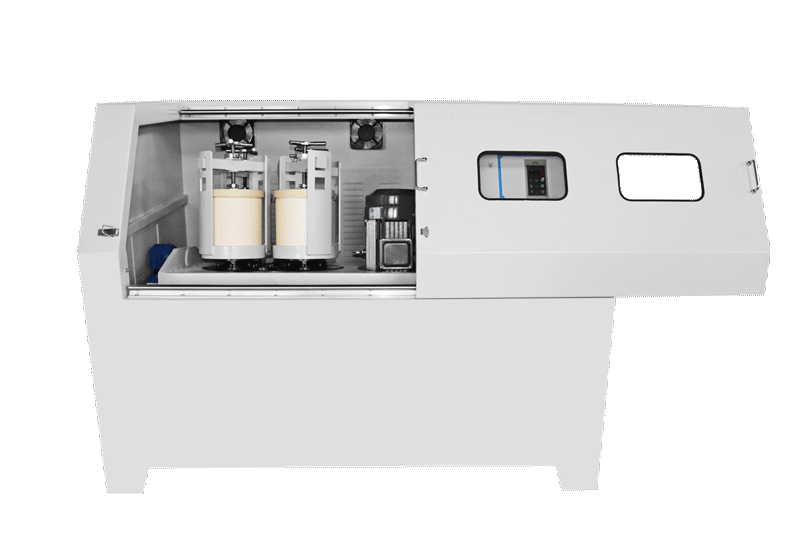
Multiple jar stations allow parallel runs under identical settings, which is the fastest way to compare grinding recipes.
Selection Criteria for a Full-Directional Planetary Ball Mill
Choosing this type of mill is not a matter of picking the largest model on the list. The machine is defined by the combination of jar volume and station count, the motion it produces, the range of controllable parameters, and the load it can carry continuously.
| Requirement | What to confirm before ordering |
|---|---|
| Target median and top particle size | Achievable size depends on media, liquid, and energy input; verify by trial on your own powder |
| Sample hardness and abrasiveness | Jar and media material, plus a wear allowance in the operating cost |
| Contamination budget | Jar and media chemistry, dedicated jars, and a blank-run baseline |
| Batch size per jar | Jar volume and the powder mass that can still be milled efficiently |
| Samples per day | Station count multiplied by cycle time, minus loading, cleaning, and cooling time |
| Wet or dry process | Seal and gasket compatibility with the chosen solvent |
| Heat sensitivity | Cooling intervals, cycled programming, or a low-temperature configuration |
| Atmosphere control | Ability to load and seal jars prepared in a glove box |
| Reproducibility | Programmable speed, time, and cycling; repeatable clamping |
| Future scale-up | How results transfer to larger or continuous mills |
Two of these rows deserve more attention than they usually receive. The first is throughput. A multi-station mill does not deliver one finished sample per station per cycle once loading, unloading, cleaning, media recharging, and cooling between runs are counted. For difficult materials the real bottleneck is often preparation and cleaning, not grinding, and the honest way to plan capacity is to measure a full cycle from empty jar to analyzed sample.
The second is scale-up. A recipe that reaches a fine size in a small laboratory jar will not reproduce automatically in a production-scale mill, because the energy per unit mass, the cooling surface per unit volume, and the residence time distribution all change with size. If a process is expected to move to production, choose equipment whose parameters can be matched across scales, and plan pilot trials before a purchase decision is finalized.
For work that combines difficult-to-mill materials with larger jar loads, a heavy-duty full-directional planetary ball mill provides both the motion and the structural margin described above. Smaller laboratory models remain the better choice for routine sample preparation, where a simple, well-controlled planetary mill does the job at lower cost.
Troubleshooting Common Grinding Problems
Most grinding problems fall into a small number of recognizable patterns, and most of the fixes move the process in the same direction: reduce the severity of individual impacts and improve how well the charge mixes, rather than simply adding more energy.
| Symptom | Likely cause | What to adjust |
|---|---|---|
| Median size stalls above target | Energy input too low for the material, media too large, or the powder load cushions impacts | Increase speed in steps, reduce media diameter, lower the ball-to-powder ratio, or switch to wet grinding |
| Powder cakes on the jar wall | Static zones in single-plane motion, dry grinding of a cohesive powder, or residual moisture | Use wet grinding or a dispersant, select re-orienting jar motion, run in short cycles, dry the sample first |
| Contamination appears in analysis | Jar or media wear, hardness mismatch, excessive milling time | Choose harder jar and media, dedicate jars, shorten the run, and quantify the baseline with a blank |
| Sample leaks or the lid loosens | Worn or over-compressed gasket, overfilled jar, insufficient clamp load | Replace gaskets, reduce the fill level, verify clamp torque |
| Results vary between identical runs | Variable fill, uneven media charging, worn media, temperature drift | Weigh powder and media each run, replace worn media, control the interval between runs |
| Jar becomes very hot | Speed too high, too much powder, insufficient cooling intervals | Reduce speed, cycle the run, reduce the load, and check that cooling is actually working |
Change one variable at a time when working through this list. If speed, media size, and milling time are adjusted together, the resulting data will not tell you which change produced the improvement, and the recipe cannot be reproduced later by someone else. Write down the jar material, media diameter and mass, powder mass, liquid and dispersant, speed, time, and interval pattern for every trial; those records are what make a process transferable.
It is also worth checking the simplest explanations first. A jar that was not sealed correctly, a set of media that has already run hundreds of hours, or a powder that absorbed moisture while standing open will all produce results that look like a grinding problem but are actually a preparation problem.
Validating a Grinding Recipe Before You Scale
Before committing to a machine or a recipe, run a small controlled experiment. Fix the jar and media, then test speed, time, and ball-to-powder ratio in a planned set of runs instead of changing several factors at once. Measure the outcome with a method that matches the target: laser diffraction for sub-sieve sizes, sieving for coarser powders, and both when the distribution spans a wide range. A median value without a distribution says very little, because the top size usually determines whether the downstream process works.
Two additional checks are inexpensive and easy to overlook. Analyze the milled powder for contamination against a blank run, so that jar and media wear are quantified rather than assumed, and confirm the phase composition if the material is sensitive to energy input. Repeat the best recipe at least three times; a single successful run is not evidence of a repeatable process.
Scale-up should be treated as a separate validation step. Energy per unit mass, heat removal, and residence time do not change linearly with jar volume, so a recipe that works in a small jar normally needs re-tuning at a larger size. If production is the eventual goal, keep the parameters that were varied during development documented in a way that can be reproduced on the larger platform.
The final decision rests on your own material. Suppliers can advise on jar and media combinations that have worked for comparable powders, and the heavy-duty full-directional planetary ball mill specification covers the motion, jar capacity range, and control features that matter for difficult samples, but only a trial on your powder shows whether the target size and purity are reachable. Set up that trial with a defined particle size target, a contamination limit, and a repeatability requirement, and the selection decision becomes a matter of comparing measured results rather than comparing catalog descriptions.