

Product features
Adjustable roll gap
Change the distance between the rolls to suit the required discharge size, within the selected configuration.
Selectable contact surfaces
Match the roll material and surface to feed hardness, abrasion and the permitted contamination level.
Two-roll compression
Opposing rolls combine compression, splitting and friction to reduce suitable medium-hard and brittle materials.
Accessible mechanical layout
The roll, transmission and adjustment assemblies provide defined inspection points for routine maintenance and wear checks.
Applications
Mineral preparation
Reduce coal and ore before subsequent milling or analysis, checking feed size and moisture against the chosen model.
Building-material trials
Process limestone, gypsum or slag samples to establish suitable feed for downstream powder preparation.
Chemical raw materials
Evaluate brittle raw materials such as coke or fertilizer ingredients, confirming compatibility and material flow first.
Evaluating results
Discharge distribution
Measure the complete size distribution after each gap adjustment; a nominal gap alone does not describe every particle.
Fines generation
Compare the fine fraction with the downstream requirement when selecting roll surface and feed conditions.
Wear and contamination
Inspect roll surfaces and test sensitive elements where wear could affect the product or analytical result.
These are evaluation points for a sample trial, not measured results for a specific sample. Confirm performance under your actual operating conditions.
How it works
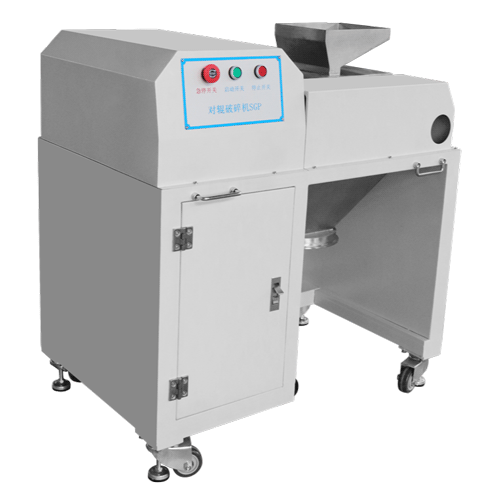
Feed enters the nip
Meter suitable material into the space between the two rotating rolls without exceeding the model's feed limit.
Compression reduces the feed
Counter-rotation draws material inward, where squeezing, shearing and splitting break it into smaller pieces.
Product leaves the gap
Reduced material exits beneath the rolls; inspect the discharge before choosing the next gap setting.
Construction and configuration
Fixed and adjustable rolls
One roll provides a reference position while the opposing assembly allows the working gap to be adjusted.
Motor and transmission
The drive transfers motor rotation to the rolls; inspect the transmission and bearings according to operating instructions.
Gap and spring assembly
Confirm the fitted adjustment and overload-release arrangement, and maintain the prescribed spring setting for the selected machine.
More product images

Technical specifications
Compare the listed specifications and configurations. Scroll horizontally to view the complete table.
Specification table 1
| Roll material | Stainless steel | Corundum (high alumina ceramic) | Nylon |
|---|---|---|---|
| Roll size | Φ200×240(mm) | φ240x240(mm) | φ240x240(mm) |
| Roller speed | 52r/min | 52r/min | 52r/min |
| Feeding particle size | ≤20 mm (multiple roller alignment for low hardness and brittle materials) ≤10 mm (according to the characteristics of crispy materials) ≤5 mm (high and low hardness crispy materials) | ≤10 mm (according to the characteristics of crispy materials) | ≤10 mm (according to the characteristics of crispy materials) |
| Discharge particle size | ≥150um | ≥150um | ≥150um |
| Production volume | 300 kg/H (related to material characteristics) | 300 kg/H (related to material characteristics) | 300 kg/H (related to material characteristics) |
| Motor power | 1.5 kW | 1.5 kW | 1.5 kW |
| Overall dimensions | About 950*620*970 | About 950*620*970 | About 950*620*970 |
| Equipment weight | About 220 kg | About 220 kg | About 220 kg |
Confirm the selected model, power supply, contact materials and operating conditions before ordering. Performance depends on the material and process.