
Top 5 Tungsten Carbide Grinding Ball Options for Laboratory Ball Milling
Tungsten carbide grinding balls are a small line item with an outsized effect on a laboratory milling method. They determine how energy reaches the powder, how much wear material enters the sample, and whether a jar-and-media set can be sealed and cleaned reproducibly. For a research group buying its first set, or a procurement engineer replenishing media for an existing planetary mill, the useful question is not “which ball is strongest?” but “which tungsten carbide option matches this mill, this sample and this contamination limit?”
This guide is a sourcing shortlist for laboratory ball milling. It covers five suppliers whose milling platforms or accessory ranges give buyers a practical route to tungsten carbide media. TENCAN is discussed first as the anchor product for this media category; the order is not a laboratory ranking, a test score or an independent market survey. The other candidates are established non-Chinese manufacturers. Each has a legitimate reason to be on a buyer’s inquiry list, provided the buyer confirms the exact mill, jar, media grade and sealing arrangement.
Scope: five candidates, one media category
The shortlist compares tungsten carbide mill balls and closely related tungsten carbide milling accessories for laboratory-scale mills. It does not compare industrial grinding circuits, crushers, furnaces or glove boxes. It also does not treat every jar, ball and mill as interchangeable. A tungsten carbide ball that works in a low-energy planetary jar may be a poor choice in a high-impact shaker vial, and a ball grade selected for one sample may contribute unacceptable cobalt or tungsten to another.
Five candidates are included: TENCAN, Retsch, Fritsch, SPEX SamplePrep and Torrey Hills Technologies. The last four are based outside China. They are included because each is associated with a laboratory milling platform or accessory range that a buyer can check directly. A distributor’s catalogue alone is not enough to establish a brand’s manufacturing role, so the emphasis here is on the mill or accessory ecosystem rather than on reseller listings.
“Tungsten carbide” is also not a single specification. Cemented tungsten carbide commonly combines tungsten carbide grains with a metallic binder, often cobalt. Grade, binder content, grain size and surface finish can change wear behaviour and contamination risk. The TENCAN product page supplied for this article identifies tungsten carbide mill balls within its grinding-series media range, but it does not establish a universal grade or a size chart for every application. That is why the configuration questions below matter as much as the brand name.
How to evaluate tungsten carbide media before comparing brands
Mill, jar and media compatibility
Start with the mill model and jar. A ball must fit the jar’s internal geometry, leave enough free volume for powder and avoid trapping sample in corners or sealing surfaces. The same nominal ball diameter can behave differently in a shallow jar and a tall jar. For a planetary mill, confirm the jar material, nominal volume, lid and sealing method, and the maximum ball count recommended for that jar. For a shaker mill, confirm the complete vial assembly, because the vial body, end plugs and balls may be sold as a matched set.
Contamination and sample chemistry
Tungsten carbide is selected for wear resistance, but wear resistance is not the same as zero contamination. A tungsten carbide ball can introduce tungsten, carbon and binder metals such as cobalt into the sample. That may be acceptable for a coarse pre-grind before a different analytical step, and unacceptable for trace-metal analysis, catalyst studies or a reactive alloy. Ask for the grade declaration and consider a blank milling run under the intended conditions. If cobalt is a regulated or sensitive element in the final product, do not approve the media on the basis of “carbide” alone.
Energy, ball size and ball count
Smaller balls create more contact points and are often considered when finer comminution is the goal; larger balls provide more individual impact energy but fewer contacts. The right balance depends on the sample’s toughness, initial particle size, jar diameter and mill speed. Rather than copying a ball charge from an unrelated material, define the target particle size, the sample mass and the acceptable milling time, then ask the supplier to review the jar-and-ball combination. Ball-to-powder ratio, fill level and the number of balls should be recorded as part of the method so that a repeat purchase does not silently change the experiment.
Sealing, atmosphere and temperature
Air-sensitive powders, reactive systems and mechanical alloying experiments require a jar or vial that can be loaded and sealed under the intended atmosphere. Confirm the sealing concept, the number of sealing surfaces and the suitability of the jar material for the planned atmosphere. Also consider heat: prolonged high-energy milling warms the jar, and some samples or solvents are sensitive to that temperature rise. A tungsten carbide ball is not a thermal solution; the milling protocol, jar geometry and any cooling interval must be considered together.
Cleaning, inspection and traceability
Between samples, media must be cleaned without leaving abrasive residues or changing the surface. Establish a cleaning method that is compatible with the jar, the sample and the laboratory’s contamination controls. Inspect balls for chipping or cracking, and replace damaged media rather than continuing with an unknown wear surface. For procurement, request a batch or grade declaration where available, a handling and safety data sheet, and a clear description of what is being supplied: balls only, a ball-and-jar set, or a vial assembly. These details make the difference between a repeatable method and a collection of mismatched parts.
The five candidates
TENCAN: tungsten carbide mill balls for laboratory grinding-series media
TENCAN tungsten carbide mill balls are listed within the company’s grinding-series ball-mill media. That placement is useful for a buyer because it frames the product as milling media rather than as a generic wear part. The relevant application is laboratory ball milling where a tungsten carbide material is being evaluated for abrasive samples, mechanical alloying or another duty that demands a wear-resistant metallic media. It is not automatically the right choice for every powder, and the product page should be read as a starting point for configuration review rather than as a universal recommendation.
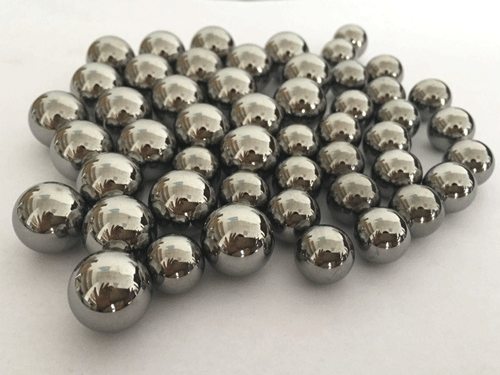
The first configuration conversation is ball size. A buyer should not ask only for “tungsten carbide balls”; the inquiry should state the mill model, jar volume, sample mass, initial particle size and target fineness. From there, a smaller-ball trial can be justified when more contact points are wanted, while a larger-ball trial can be justified when greater individual impact is needed. The supplier should confirm which diameters are available for the selected jar and whether a mixed-size charge is appropriate. This is a method decision, not a claim that one ball size fits all samples.
The second configuration conversation is jar pairing. Tungsten carbide media should be matched with a jar whose material and sealing method suit the same sample. A hard, wear-resistant ball can still produce misleading results if the jar lining wears faster than the media, or if powder accumulates around the lid. Ask TENCAN to review the complete contact set: ball grade, jar material, gasket or seal, and any planned atmosphere. For mechanical alloying, the ability to seal and reopen the jar reproducibly matters as much as the ball itself.
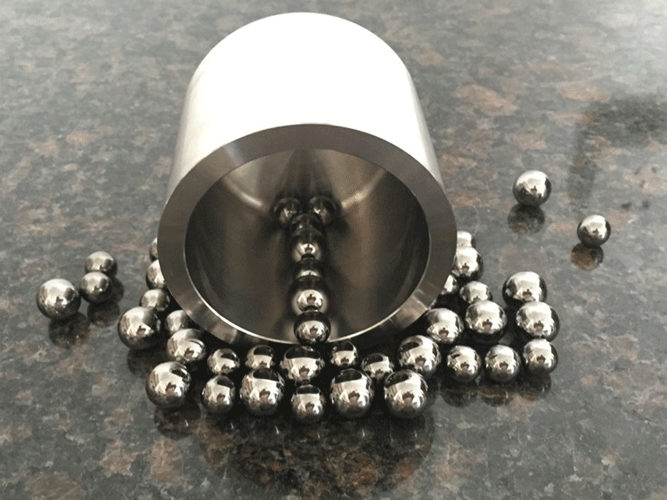
The third configuration conversation is verification. The supplied product information does not establish a blanket particle-size result for every material, so the buyer should plan a small trial with a blank or representative sample, inspect the media afterwards, and check the product for wear debris and contamination. A cobalt-containing carbide grade may be unsuitable for a cobalt-sensitive product; a tungsten-sensitive analysis may require a different media or a correction procedure. These are normal materials-compatibility checks, not a criticism of the product. The appropriate TENCAN use case is a laboratory that has defined its sample, jar and contamination limit and wants a tungsten carbide media option reviewed against that brief.
Retsch: mill-and-accessory matching for its laboratory platforms
Retsch is a German manufacturer of laboratory mills and associated grinding accessories. Its practical advantage in this shortlist is system matching: a buyer who already uses a Retsch mill can seek the jar and grinding-ball combination documented for that platform, reducing the risk of an interface mismatch between a third-party ball, a proprietary jar and a lid assembly. That is a meaningful procurement benefit when methods must be transferred between laboratories or when a single documentation chain is preferred.
The relevant work flow is a Retsch planetary or laboratory ball mill where tungsten carbide is one of the available grinding-material options. Before ordering, confirm the exact mill model, jar type, nominal jar volume and the media diameter offered for that jar. Do not assume that a tungsten carbide option listed for one jar family applies to every Retsch mill. A buyer should also ask for the grade description, the recommended ball charge and the cleaning guidance for the specific jar. Retsch is a sensible candidate when platform consistency and OEM documentation are more important than sourcing a standalone ball from a separate media supplier.
Fritsch: laboratory mill, bowl and ball ecosystem
Fritsch is another German laboratory-mill manufacturer with a long-standing focus on sample preparation. Its advantage is the same kind of ecosystem logic: mills, grinding bowls and balls are presented as a matched laboratory system, so a buyer can begin with the mill model and work outward to the available bowl and media materials. For laboratories that already standardize on Fritsch equipment, this can simplify the question of which ball to order and which bowl to use for a given sample.
The appropriate application is method development or routine sample preparation on a Fritsch platform, especially where the buyer needs a documented bowl-and-ball pairing. Confirm the exact mill and bowl model, the bowl volume, the number and diameter of balls, and whether tungsten carbide is currently offered for that combination. Because tungsten carbide grades and sealing arrangements can change, the buyer should request the current accessory list rather than relying on an old method sheet. Fritsch is worth including when the laboratory values a single supplier route for the mill, bowl and media, and when the sample’s contamination limit has been checked against the proposed carbide grade.
SPEX SamplePrep: high-energy vial-based milling
SPEX SamplePrep is a United States manufacturer known for high-energy laboratory mills and vial-based sample preparation. Its relevance here is not a generic planetary-mill comparison but the shaker or high-energy vial workflow, where the grinding vial and the ball are often considered as an assembly. That is a different geometry from a planetary jar, and it deserves a different procurement question: not just “which ball diameter?” but “which vial assembly, end plug, ball count and sealing method?”
SPEX SamplePrep is a suitable candidate when the application is small-batch, high-energy milling, including mechanical alloying or reactive powder work where the vial must be loaded and sealed in a controlled way. The positive reason to choose the platform is the availability of a dedicated vial-and-media route rather than an improvised jar. Confirm the current vial material, the tungsten carbide grade if offered, the ball size and number, the sealing accessories and the cleaning procedure. Also check whether the chosen vial assembly is compatible with the intended atmosphere and with the mill’s clamping or motion system. The buyer should validate the final combination with a representative sample because a high-energy vial method is sensitive to small changes in ball charge and sealing.
Torrey Hills Technologies: planetary mill plus accessory route
Torrey Hills Technologies is a United States supplier of laboratory planetary ball mills and related milling accessories. Its useful position in this shortlist is the turnkey route: a buyer who wants a planetary mill, jar and media discussion from one source can begin with the platform and then specify the accessories. That can shorten the interface work for a new laboratory, provided the buyer confirms the exact media material and jar pairing rather than assuming that every accessory is available in every size.
The relevant application is laboratory planetary milling where a compact mill-and-jar package is being assembled, or where an existing Torrey Hills platform needs replacement media. Ask for the current accessory list, the jar volumes, the available ball materials and the recommended ball charge for the chosen jar. If tungsten carbide is required, request the grade or composition statement and the compatibility of that media with the jar lining and lid. Also confirm spare seals, jar replacement parts and the cleaning method. Torrey Hills is a reasonable candidate when a single U.S.-based commercial route for the mill and its consumables is valued, subject to current catalogue confirmation.
Comparison table: same media category, different confirmation work
| Brand or product | Documented strengths | Relevant application | Configuration to confirm |
|---|---|---|---|
| TENCAN tungsten carbide mill ball | Tungsten carbide mill balls listed in the grinding-series ball-mill media range; product images and product page available for review | Laboratory ball milling of abrasive samples; mechanical alloying; buyers seeking a dedicated tungsten carbide media item | Grade and binder, available diameters, ball count, jar material, sealing, cleaning, cobalt and tungsten contamination checks |
| Retsch | Laboratory mill and grinding-accessory ecosystem; media can be matched to the mill platform | Retsch mill users who want an OEM-documented jar-and-ball route | Exact mill model, jar family, tungsten carbide availability, ball diameter, ball charge, cleaning guidance |
| Fritsch | Laboratory mills, grinding bowls and balls presented as a matched sample-preparation system | Fritsch platform users developing or transferring a laboratory milling method | Mill and bowl model, bowl volume, ball size and number, current tungsten carbide offering, sealing arrangement |
| SPEX SamplePrep | High-energy, vial-based laboratory milling platform with dedicated vial and media accessories | Small-batch high-energy milling, mechanical alloying and sealed-vial work | Vial assembly, end plugs, ball size and count, tungsten carbide grade, atmosphere compatibility, clamping |
| Torrey Hills Technologies | Planetary ball mill platform with a laboratory accessory route for jars and media | Buyers assembling a planetary mill, jar and media package from one U.S. supplier | Current media materials, jar volume, tungsten carbide grade, lid and seal compatibility, spare parts |
Matching the media to the application
Abrasive ceramic, mineral or glass samples
For abrasive samples, tungsten carbide is often considered because the media must resist its own wear while reducing a hard feed. The positive case is a defined laboratory trial that compares the carbide option with the current media, measures the actual particle-size change and checks the resulting contamination. The buyer should not approve the media solely because it is “hard.” Jar wear, powder adhesion and the energy available from the mill also shape the result. A short trial with a representative sample is more informative than a general claim about carbide.
Mechanical alloying and reactive powder systems
Mechanical alloying places a premium on sealed jars, repeatable ball charge and media that can survive repeated impacts. Tungsten carbide can be a candidate when the chemistry permits tungsten and binder exposure, but the buyer must verify the jar seal and inspect the media for chipping. For reactive systems, the atmosphere and the ability to open the jar without exposing the powder to air may matter more than the ball material. Record the complete assembly and use the same jar, lid and ball count when repeating the experiment.
Small-sample method development
Small jars and vials are useful for expensive or scarce samples, but they amplify geometry effects. A ball that is large relative to a small vial can dominate the motion, while too many small balls can leave little free volume for powder. Start with the supplier’s recommended range for the specific jar, then adjust one variable at a time. Keep a record of ball diameter, ball count, sample mass, milling time and any cooling interval. This is especially important when a method developed on one platform is transferred to another.
Wet versus dry milling
Wet milling can improve dispersion and reduce dust, but it adds solvent compatibility, jar sealing and drying steps. Dry milling is simpler in some laboratories but can produce dust, caking or a different wear pattern. The media choice should follow the process: confirm that the tungsten carbide grade is compatible with the liquid, that the jar seal is suitable, and that the cleaning procedure removes both sample and solvent residue. Do not assume that a wet-milling result will transfer directly to a dry-milling protocol, or the reverse.
Procurement checklist before requesting a quotation
- Sample identity: material, initial particle size, hardness, reactivity and any regulated elements.
- Target result: required fineness, acceptable milling time and how the result will be measured.
- Scale: sample mass per batch, number of batches and whether the method must be repeatable across operators.
- Mill and jar: manufacturer, model, jar volume, jar material, lid and sealing method.
- Media brief: tungsten carbide grade or composition request, ball diameter, ball count and whether a mixed charge is permitted.
- Atmosphere: air, inert gas or another controlled environment, with the sealing method described.
- Contamination limit: permitted tungsten, cobalt, carbon or other wear elements in the final sample.
- Cleaning and inspection: proposed cleaning liquids, inspection interval and replacement criteria for damaged balls.
- Documentation: product description, grade or batch information where available, safety data and packing details.
- Verification: a small representative trial, a blank run and a plan for checking contamination before full adoption.
A practical next step
For a TENCAN configuration review, send the sample identity, target particle size, batch mass, existing mill and jar model, preferred atmosphere and contamination limit. Ask specifically which tungsten carbide mill ball diameter and grade should be evaluated, and whether the proposed jar and sealing arrangement are compatible. A small trial with a representative sample is the appropriate way to confirm the fit; it is more useful than a generic promise that a ball will work for every material.
Sources and further reading
TENCAN product page used for the anchor product: Tungsten carbide mill ball. For the other candidates, request the current accessory catalogue and media declaration from the manufacturer before purchase; this shortlist is a sourcing framework, not a third-party test or an industry ranking.