
Vertical Square Planetary Ball Mill Selection
A laboratory grinding problem rarely arrives as a clean question. It usually arrives as a target particle size, a limited sample mass, a material that is either too hard, too soft, too reactive or too heat-sensitive, and a deadline. A vertical square planetary ball mill is one of the few bench-top platforms that can address several of those constraints at the same time, because it grinds several samples in parallel using a mechanically simple but kinetically aggressive motion.
Understanding where that aggressiveness comes from, and how to keep it under control, is the difference between reproducible results and a jar full of caked powder. The sections below explain the working principle of the machine, how jar and media choices influence contamination and fineness, which parameters actually change particle size, which problems appear most often in real laboratories, and which configuration decisions should be settled before a purchase order is written.
How a Vertical Square Planetary Ball Mill Grinds Material
A planetary ball mill takes its name from the motion of the grinding jars. Each jar is clamped onto a rotating carrier, usually called the sun wheel or planet disk, while the jar itself turns around its own axis in the opposite direction. The result is a compound motion in which the grinding balls inside each jar are alternately lifted, thrown against the inner wall, and rolled across it. Impact does the coarse breaking work; friction and shear refine the powder and, under favorable conditions, push it toward the sub-micron and nanometer range.
The vertical square designation describes the machine layout rather than the grinding mechanism. The drive, the planet disk and the jar clamping system are housed in an upright cabinet with a square footprint, and the jars are loaded horizontally on top of the disk. A laboratory that already owns a horizontal planetary mill will notice the difference immediately: the square vertical cabinet occupies less bench length, puts the jars at a more comfortable working height, and usually leaves room for a balance and a sieve set beside it.
The dual rotation that generates grinding energy
Energy inside a planetary jar comes from two simultaneous rotations. The disk carries the jar around the central axis, and the jar spins about its own axis. Because the two rotations oppose each other, the grinding balls experience a periodically changing acceleration field. At one point in the cycle the balls are pressed outward against the jar wall; a fraction of a second later the field weakens and they detach, travel across the jar, and strike the opposite wall or the powder bed.
The kinetic energy transferred to the powder scales with the square of the rotational speed and with the radius of the jar orbit. Doubling the disk speed does not double the energy, it roughly quadruples it, which is why a modest increase in rpm often produces a visible change in fineness. That relationship also explains why planetary milling can reach sizes that a conventional tumbling ball mill cannot approach in a reasonable time: the acceleration inside the jar can exceed many times the acceleration of gravity, so the media are not simply tumbling under their own weight.
There is a practical ceiling. As speed increases, the balls spend a larger share of each cycle pinned to the jar wall instead of moving relative to it, and the useful shear and impact per revolution begin to fall. In a planetary geometry this limit depends on the ratio between jar rotation and disk rotation, on the jar diameter, and on how much free volume remains inside the jar. It is one reason why simply running a mill at maximum speed for a long time is rarely the most efficient route to a fine powder.
What the vertical square configuration changes in practice
Frame geometry influences daily laboratory work more than most buyers expect. A vertical square planetary ball mill is normally set up as a multi-station unit, with two or four jars mounted on the same disk. That arrangement allows parallel processing of different materials or different parameter sets under identical mechanical conditions, which is valuable when comparing formulations or when several students share one instrument.
The upright cabinet also changes the way vibration and heat are managed. The motor and drive train sit below the grinding chamber, so vibration has to be absorbed by the base rather than dissipated along a long horizontal frame. Units of this type therefore depend on a rigid cabinet, a level bench and correctly balanced jar loading. An unevenly loaded disk will produce noticeably more noise and accelerated bearing wear, regardless of how well the frame itself is built.
From the operator's point of view, the loading height is the most visible benefit. Jars can be filled, weighed, sealed and clamped without bending over a low chassis, and the clamping mechanism is accessible from above, which reduces the risk of a partially secured jar working loose during a long run. This matters for safety as well as convenience: a jar that is not fully locked will move inside its holder, and the resulting imbalance is the most common cause of abnormal noise in planetary milling.
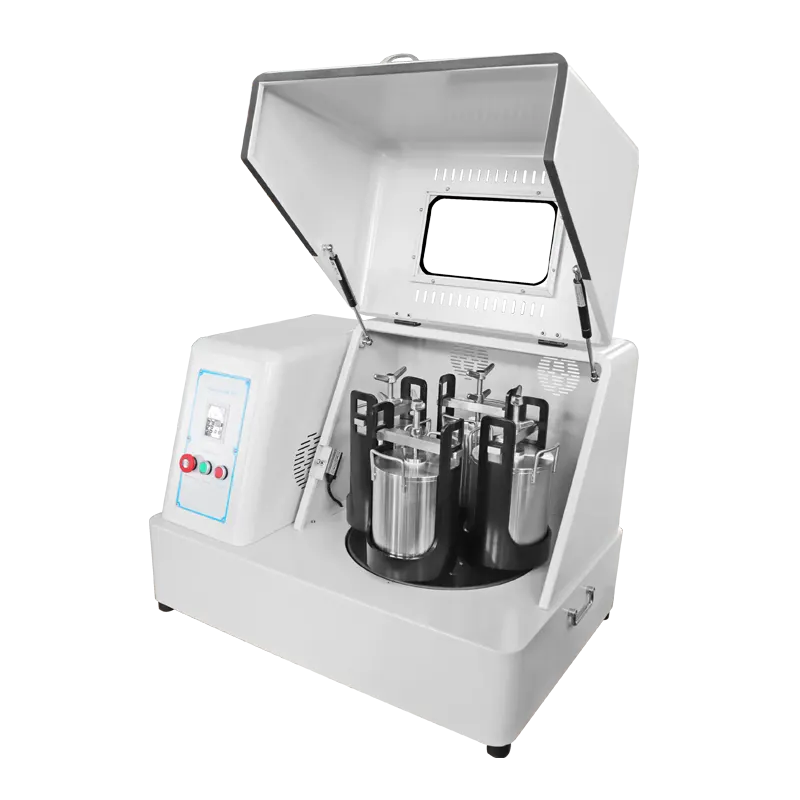
Vertical square planetary ball mill: the upright cabinet keeps the jars at a convenient working height while the planet disk carries them in a counter-rotating motion.
Matching Jars and Grinding Media to Your Material
Two decisions determine whether a milling run produces a usable powder or a contaminated, agglomerated paste: the material of the jar and the size and quantity of the grinding balls. Neither decision can be made from the mill specification alone, because both depend on the hardness, chemistry and ductility of the sample.
Jar material determines contamination, not just wear life
The general rule is that the jar and the media should be harder than the sample being ground. When this rule is respected, wear is slow and the powder stays close to its intended composition. When it is ignored, the jar becomes the sacrificial material and the sample picks up the difference, which shows up later as unexpected color, magnetic response, sintered density or chemical analysis results.
Common jar materials cover a wide range of situations. Agate jars offer very low contamination and are a sensible default for soft to medium-hard brittle materials in geochemistry and mineralogy, but they are not the right choice for hard ceramics or cemented carbides. Zirconia jars are dense and tough, tolerate abrasive powders well, and are widely used where a combination of low contamination and high grinding energy is needed. Corundum and alumina-lined jars are economical and abrasion resistant for many oxide powders. Stainless steel jars resist impact and are convenient for metals and alloys, but they can release iron and chromium into the sample. Tungsten carbide jars are extremely hard and very dense, which makes them effective for hard brittle materials, though they are heavy and should be selected with attention to the binder phase. Nylon, polyurethane and PTFE jars are reserved for soft, reactive or metal-sensitive samples, where the lower density of the jar material limits achievable grinding energy but keeps contamination minimal.
For a laboratory that grinds many different materials, the practical approach is to keep at least two jar sets: one dense ceramic set such as zirconia or corundum for hard powders, and one agate or polymer set for samples where iron and heavy-metal contamination must be avoided. The vertical square planetary ball mill accepts interchangeable jars, so the same machine can serve both duties without a second investment.
Ball size, ball count and the ball-to-powder ratio
Grinding media size controls the balance between impact and attrition. Large balls carry more mass and therefore deliver more impact energy per collision, which is what breaks hard, coarse particles. Small balls create many more contact points per unit volume and generate more shearing and rolling action at the powder bed, which refines an already fine powder and narrows the distribution. A single ball size is rarely optimal from coarse feed to fine product; a mixture of one larger and one smaller size is a common compromise in general laboratory work.
The number of balls matters as much as their diameter. Too few balls means the powder spends long periods sitting undisturbed; too many means there is not enough free space for the balls to accelerate, and the charge begins to behave like a solid mass. As a working guideline, the combined volume of media and powder usually occupies roughly one third to one half of the jar, leaving the remainder as free space for movement.
The ball-to-powder ratio expresses how much grinding medium is available per unit mass of sample. Higher ratios accelerate size reduction and increase the probability of reaching the finest achievable size, but they also increase jar wear, heat generation and the risk of re-agglomeration in ductile materials. Low ratios are gentler and are sometimes preferred when the sample is valuable or when the target size is only moderately fine. The ratio should be recorded together with speed and time; without it, a milling recipe cannot be reproduced.
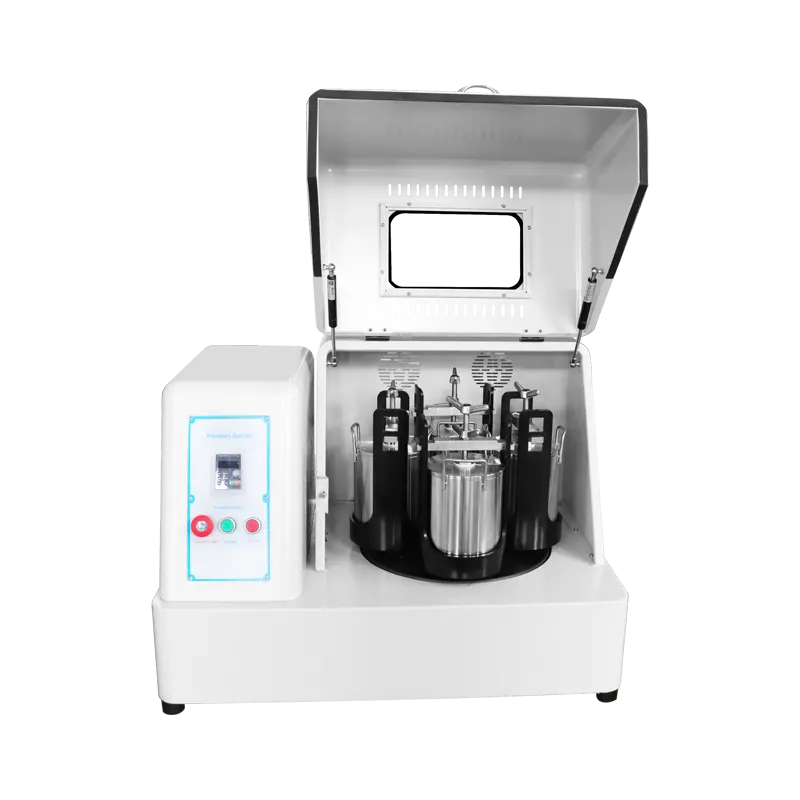
Jar material and media selection should be recorded for every run, because they affect contamination and fineness as strongly as rotational speed does.
Grinding Parameters That Decide Your Final Particle Size
Once jar and media are fixed, four parameters control the outcome: rotational speed, milling time, the dry or wet condition of the charge, and the way the run is segmented into cycles. Each of them interacts with the others, so changing two at once makes the result difficult to interpret.
Rotation speed and the effective grinding ceiling
Speed is the most powerful single variable. Because transferred energy rises with the square of rotational speed, a step from low to medium speed can shorten the time needed to reach a target size more than proportionally. Operators often start at a moderate speed to establish a baseline, then increase it in steps while monitoring particle size after each interval.
The ceiling is set by the point at which the media stop moving relative to the jar wall. Beyond that point, additional speed adds heat and wear but little comminution. Jar diameter is part of this picture: a large jar has a longer distance for balls to travel and can absorb more energy before the charge is pinned, while a small jar reaches its useful limit at a comparatively lower setting. This is why the same numerical speed is not equivalent across different jar sizes, and why recipes should be described in terms of the specific jar used.
Milling time, cycles and heat buildup
Size reduction is fast at the beginning and slow at the end. In most laboratory work, the first portion of the run removes the majority of the coarse fraction, and each subsequent interval delivers a smaller improvement. Two effects cause this plateau. First, the remaining coarse particles become a small fraction of the total mass and are struck less often. Second, once the powder is fine, the dominant process switches from breakage to re-welding, and agglomerates begin to form faster than they are broken down.
For that reason, long continuous runs are usually less efficient than segmented runs of comparable total duration. Running in cycles with short pauses allows the jar content to cool and lets the charge redistribute, and it also gives the operator a chance to sample the powder and check whether the target has already been reached. Temperature is the main argument for segmentation. A sealed jar has no active cooling path, so mechanical energy converted into heat accumulates in the powder and the jar wall. Heat-sensitive polymers, hydrates, pharmaceutical actives and some battery materials can degrade, recrystallize or react during a long uninterrupted run. Where low-temperature milling is essential, dedicated solutions such as a liquid nitrogen planetary ball mill keep the grinding chamber cold throughout the process.
Dry milling versus wet milling
The condition of the charge changes both the mechanism and the practical handling of the product. Wet milling suspends the powder in a liquid carrier, which separates particles, reduces cold welding, and allows the finest sizes to be reached. It also suppresses dust and keeps the jar wall cleaner. The trade-offs are solvent compatibility with the jar and gasket material, the need for a drying or filtration step, and the possibility that the liquid reacts with the sample. Dry milling is simpler and faster to set up, and it is the natural choice when the powder must remain chemically untouched, but it is prone to caking, dust and agglomeration, especially with ductile metals and soft polymers.
| Factor | Dry milling | Wet milling |
|---|---|---|
| Typical achievable fineness | Moderate; limited by agglomeration | Finer; limited by media and speed |
| Agglomeration risk | High for ductile or soft materials | Low; particles stay separated |
| Contamination risk | Higher jar and media wear | Lower wear rate |
| Post-processing | Direct use after sieving | Requires drying or filtration |
| Best suited to | Brittle oxides, minerals, ceramics | Metals, polymers, nano-scale targets |
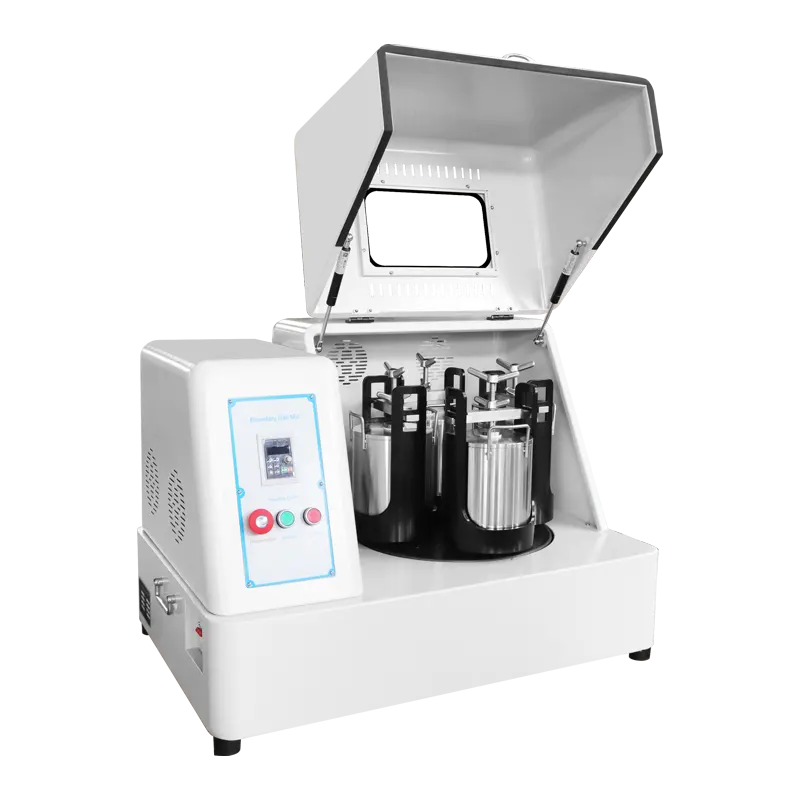
Jar clamping and drive arrangement: correct loading and full locking prevent imbalance, noise and powder loss during long grinding cycles.
Diagnosing Common Problems in Planetary Ball Milling
Most difficulties reported by laboratories fall into a small number of categories. Recognizing the cause shortens troubleshooting considerably compared with changing settings at random.
- Particle size stops improving. This usually means the run has entered the re-agglomeration regime rather than the breakage regime. Reducing the total continuous run time, adding short pauses, lowering the ball-to-powder ratio or switching to wet milling normally restarts progress.
- Wide or bimodal size distribution. A single ball diameter and an overfilled jar are the usual causes. Free space for media acceleration and a two-size ball charge both help narrow the distribution.
- Unexpected change in color or magnetic response. This indicates contamination from the jar or media. Checking whether the jar material is harder than the sample, and reducing speed or time, are the first steps; switching to a more wear-resistant jar such as zirconia or corundum is the more durable fix.
- Cold welding and caking with ductile metals. Dry milling of soft metals causes particles to weld instead of fracture. A liquid carrier, a process control agent, or a lower energy setting with longer cycling usually solves it.
- Powder sticking to the jar wall. Static charge and humidity are common contributors. Adding a small amount of liquid, drying the sample, or reducing the powder mass per jar often resolves it.
- Abnormal noise or vibration. Almost always an imbalance problem: unequal powder or media mass between jars, a jar that is not fully clamped, or a worn gasket. The machine should be stopped and the loading rebalanced before continuing.
- Media chipping or breakage. Ceramic balls can chip if the jar is operated far above its intended energy level or if the balls are degraded. Broken fragments abrade the jar and contaminate the product, so the media charge should be inspected regularly and replaced as a set.
Recording speed, time, cycle pattern, jar material, ball size, ball mass and sample mass for every run makes these diagnoses much faster. When a result cannot be repeated, the missing variable is nearly always one of these, not the machine itself.
Selecting the Right Configuration for Your Laboratory
Configuration decisions are easier when they are framed as questions about the material and the workflow rather than about the machine alone.
Start from the sample, not from the specification sheet
Four sample properties drive the selection. Hardness determines whether a dense ceramic jar is required. Ductility determines whether wet milling or a process control agent will be needed. Sensitivity to heat or atmosphere determines the cycle pattern and whether a temperature-controlled or inert-atmosphere solution is more appropriate. Value and available quantity determine how much material can be committed to a single run, which in turn sets the smallest practical jar volume.
Match jar volume to realistic batch sizes
A common mistake is to buy the largest jar the machine can carry and then fill it only partly. Because the charge needs free volume to move, a jar filled to the top grinds poorly, and a half-filled large jar is less efficient than a properly loaded smaller one. It is more useful to determine the working charge mass first, then select the jar size that holds that mass at roughly one third to one half fill, and finally confirm that the machine can carry the required number of jars.
Multi-station arrangements change the calculation. A four-station disk allows four independent samples per run, which is valuable for statistical work and method development, but each jar must still be loaded with a matched mass to keep the disk balanced. Purchasing several smaller jars rather than one large jar often gives more experimental flexibility for the same investment.
Confirm the supporting conditions
Planetary milling is a high-energy process, so the installation environment matters. The bench must be level and rigid, the power supply should be stable and matched to the machine, and the unit should not share a bench with a balance or a sensitive instrument. Access to a fume hood or a glove box is worth planning for if solvents, reactive powders or oxygen-sensitive materials will be processed.
| Material type | Suggested jar | Suggested media | Preferred condition |
|---|---|---|---|
| Geological and mineral samples | Agate | Agate, mixed sizes | Dry or wet |
| Hard ceramics and oxides | Zirconia, corundum | Zirconia, corundum | Wet preferred |
| Metals and alloys | Stainless steel, tungsten carbide | Same material as jar | Wet with process control additive |
| Polymers and soft organics | Nylon, PTFE, PU | Zirconia, small diameter | Dry with short cycles |
| Heat-sensitive or reactive powders | Sealed jar with compatible lining | Small zirconia balls | Temperature-controlled or inert |
Before committing to a configuration, it is worth requesting a trial milling on the actual sample. A supplier who already has the corresponding jar types can run the material and return a particle size result, which removes most of the uncertainty from the selection. The vertical square planetary ball mill from TENCAN is offered as part of a broader planetary grinding platform, and TENCAN also supplies matching jars and grinding media in agate, zirconia, corundum, stainless steel, tungsten carbide, nylon and PTFE, so the jar and media decision can be made together with the mill rather than afterwards.
Questions Buyers Ask Before Ordering
How many jars can be ground at the same time?
Vertical square planetary ball mills are built as multi-station machines, typically carrying two or four jars on a single planet disk. The exact number depends on the jar volume selected. When several jars are used simultaneously, they should be loaded to comparable mass so that the disk stays balanced.
Can one machine grind both hard ceramics and soft polymers?
Yes, provided the jars and media are changed accordingly. The jar material is the deciding factor for contamination and wear, while speed, media size and cycle pattern are adjusted for the sample. Keeping separate jar sets for hard and contamination-sensitive materials is the standard laboratory practice.
What is the smallest particle size that can be expected?
There is no universal figure, because the achievable size depends on the hardness and brittleness of the material, the density of the media, the ball-to-powder ratio, the rotational speed, and whether the process is run dry or wet. Sub-micron results are commonly reported for brittle materials milled wet with dense media, but the only reliable answer for a specific powder is a controlled trial under the intended conditions, followed by particle size analysis.
Practical Steps Before You Fix a Grinding Recipe
A recipe that works on one powder in one jar is not automatically transferable to another material or another jar size. Three habits make the transition manageable. First, fix the variables that do not need to change during method development, and change only one parameter per trial, starting with speed. Second, sample the powder at intervals rather than grinding to a fixed time, since the useful endpoint is usually earlier than expected and over-grinding is difficult to reverse. Third, document the full set of conditions, including jar material, ball diameter, ball mass relative to powder mass, liquid carrier if used, and the cycle pattern.
It is equally important to accept the physical limits of the process. Dry milling of a soft ductile metal will not reach the same fineness as wet milling of a brittle oxide, no matter how the machine is configured. Matching the jar and media to the material, choosing between dry and wet processing deliberately, and using segmented cycles to control heat are the decisions that most often determine whether a laboratory planetary mill becomes a routine tool or a source of inconsistent results.
For laboratories that need to compare several formulations in parallel, or that process a mix of hard ceramics and contamination-sensitive powders, a multi-station vertical square planetary ball mill combined with a small set of matched jars covers a wide working range without occupying much bench space. Reviewing the available planetary ball mill configuration together with the corresponding jar and media options is the most efficient way to confirm that the intended grinding task falls inside the machine capability before the equipment is ordered.