

Product features
Low-speed drive
The gearbox supplies low-speed, high-torque motion to the cutter shafts for tearing and shearing selected solid materials.
Compact model choices
Two listed EB configurations offer different blade counts, drive ratings and chamber dimensions for matching the feed.
Multiple cutting blades
The cutter assembly uses multiple blades to engage bulky pieces and reduce them into more manageable fragments.
Accessible discharge
Shredded material leaves through the lower outlet, allowing the collection arrangement to be planned around the installation.
Applications
Plastic recycling preparation
Reduce suitable plastic parts or containers before sorting and subsequent recycling operations; confirm wall thickness and dimensions.
Rubber pieces
Trial selected rubber feed to assess cutting behavior, elastic recovery and the tendency to wrap around shafts.
Paper and wood waste
Prepare compatible paper, cardboard or wood pieces for easier handling after confirming the permitted feed size.
Evaluating results
Fragment size
Measure the distribution and shape of the shredded pieces against the requirements of the next process.
Shaft loading
Observe drive loading and feed interruptions with representative pieces rather than assuming capacity from motor power alone.
Material recovery
Inspect the chamber and collected output for retained material, wrapping and unwanted mixing between feed batches.
These are evaluation points for a sample trial, not measured results for a specific sample. Confirm performance under your actual operating conditions.
How it works
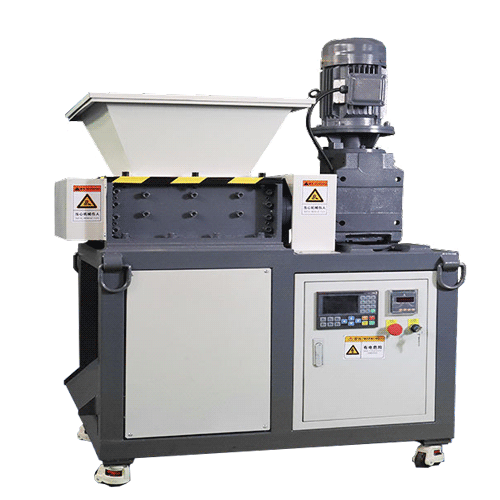
Load compatible pieces
Feed suitable material into the hopper at a controlled rate within the specified chamber and cutter limits.
Shear and tear
The motor and gearbox rotate the cutter assembly, which engages and breaks the incoming material.
Collect the output
Pieces fall from the discharge opening; assess whether further screening or shredding is needed for the application.
Construction and configuration
Blade arrangement
The EB variants list different blade materials and counts; match these details to the proposed feed.
Gearbox transmission
A reduction drive provides the low operating speed and torque used by the cutting mechanism.
Hopper and frame
Check hopper opening, outlet clearance and frame dimensions when arranging loading, collection and maintenance access.
More product images


Technical specifications
Compare the listed specifications and configurations. Scroll horizontally to view the complete table.
Specification table 1
| Parameter | EB300*200 | EB400*200 |
|---|---|---|
| Motor | 3 kW-4, three-phase, 380V, 50 Hz | 4 kW-4, 1 unit, three-phase 380V, 50 Hz |
| Reducer | JL2#-32, 1 unit | JL3#-12, 1 unit |
| Electronic control | Thermal relay protection | - |
| Input speed | 16 rpm | 12 rpm |
| Input/maximum input torque | 1600Nm | 2919Nm |
| Input shaft diameter | Φ50 | Φ60 |
| Blade specifications and materials | Φ180*12, 3Cr13 (food grade) | Φ180*15,9CrSi |
| Number of blades | 24 blades | 26 blades |
| Feed bin, discharge bin | 304 stainless steel | - |
| Frame | 304 stainless steel | - |
| Other sheet metal and safety covers | 304 stainless steel | - |
| Feed opening (mm) | - | 600*500*300 |
| Discharge opening width (mm) | - | 420 |
| Discharge height above floor (mm) | - | 200 |
| Machine dimensions (L × W × H, mm) | 1080*570*1330 | 1180*650*1450 |
| Machine weight | Approximately 410 kg | about 500 kg |
| Suitable feed materials | - | Light metal products, plastic products, food waste, wooden boards, paper, etc. |
Confirm the selected model, power supply, contact materials and operating conditions before ordering. Performance depends on the material and process.