
Vacuum Kneading Machine: Paste Mixing Guide
Many paste processes fail at the point where the material stops behaving like a liquid. A formulation that mixes easily in a beaker can become stiff, lumpy, and full of entrained air when the solids content rises. The result is not only a cosmetic problem. Trapped gas changes density, heat transfer, electrical behavior, surface finish, and dimensional stability after curing or sintering.
A vacuum kneading machine is built around that reality. It combines a closed mixing vessel with a vacuum system and a high-torque agitator that repeatedly folds, stretches, and recombines a viscous mass. The aim is to wet particles, break down agglomerates, homogenize the batch, and remove gas in one controlled operation.
The focus here is on the practical engineering behind that process: why pastes resist mixing, how a vacuum kneading machine works, which configuration choices matter, and how to judge whether the equipment fits a specific material. The emphasis is on selection logic and process control rather than a list of catalog specifications.
Why high-viscosity pastes trap air and resist uniform mixing
A high-viscosity paste sits in a transitional state between a liquid and a damp solid. It may flow under gravity, but it does not circulate easily. Yield stress, thixotropy, particle crowding, and binder distribution all affect how the mass moves inside a vessel. When the agitator pushes one region, another region can remain almost stationary, especially near corners, the shaft, and the vessel bottom.
Air enters in several ways. Powder particles carry surface air and internal porosity. Loading and dumping create folds that close over gas pockets. Binder addition can form films and foam. In a low-viscosity liquid, many bubbles rise and escape; in a paste, the surrounding material is too stiff for buoyancy to work quickly. The gas stays trapped until the paste is deformed enough to expose it to the vacuum surface.
Mixing is further complicated by the way particles interact. Fine particles have a high surface area and demand more binder or solvent to reach a stable coating. If the binder is added too quickly, the mixture can form wet shells around dry clusters. Those clusters may survive normal mixing because the surrounding paste shields them from shear. A machine that only rotates the bulk mass can produce a smooth-looking surface while leaving dense, poorly wetted zones inside.
The symptoms are easy to misread. A batch may show pinholes after curing, variation in density from top to bottom, inconsistent rheology between samples, or unexpected electrical or thermal performance. Operators sometimes add more solvent to improve flow, but that changes the formulation and can increase shrinkage or weaken the final part. The better question is whether the mixing action is reaching the whole batch and whether the gas has a path out of the material.
Working principle and structure of a vacuum kneading machine
A vacuum kneading machine is not a single agitator spinning in an open tank. The working volume is enclosed so that pressure can be reduced while the agitator applies mechanical work. A typical system includes a jacketed vessel, one or more mixing elements, a sealed shaft entry, a vacuum port and trap, a discharge arrangement, and controls for agitator speed, temperature, and vacuum. The exact geometry varies by supplier and application, so the selected configuration should be checked against the material rather than assumed from the product name alone.
The mixing action is primarily bulk deformation. As the agitator turns, the paste is folded over itself, stretched between moving and stationary surfaces, sheared in narrow gaps, and pressed against the vessel wall. This repeated rearrangement does two things: it distributes binder and particles, and it continuously creates fresh surfaces for gas release. High-viscosity kneading therefore depends on torque and mechanical contact time, not only on tip speed.
Kneading action versus high-speed dispersion
A high-speed disperser is effective when the material can flow toward a fast rotating disc. It creates strong local shear and is useful for wetting powders into liquids, but it may struggle when the batch becomes a stiff paste. A vacuum kneading machine works at lower speed and higher torque, so it can move a material that would stall a conventional disperser. The trade-off is that kneading usually needs more time and closer attention to fill level and temperature.
The two approaches are not always competitors. Some processes use a disperser for initial wetting and a vacuum kneading machine for homogenization and degassing. Others need the kneader from the start because the formulation reaches a high solids content quickly. The right choice depends on the rheology curve during processing, not only on the final viscosity in the specification sheet.
Vacuum and sealing: the second half of the process
Vacuum removes gas only when three conditions are met: the gas must be exposed to the reduced-pressure space, the pressure must be low enough for the bubble to expand, and the material must be moved so that new gas pockets reach the surface. A sealed vessel with a static paste will not degas efficiently, even if the vacuum gauge shows a stable reading. Shaft seals, vessel gaskets, and discharge valves therefore matter as much as pump capacity, because a small leak can limit the achievable pressure or draw air back into the batch.
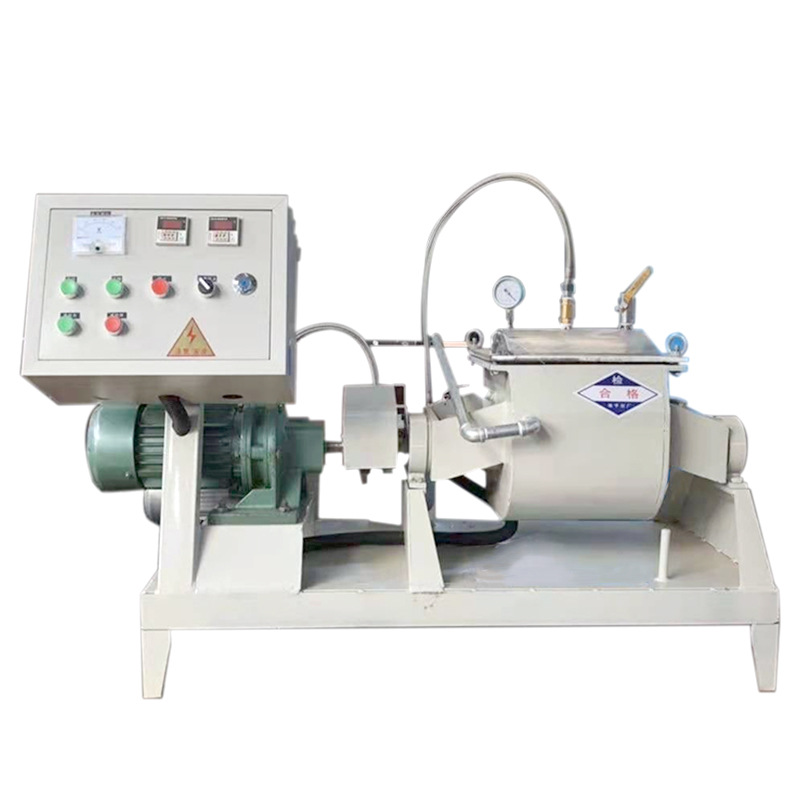
TENCAN vacuum kneading machine product view for viscous paste processing.
The TENCAN vacuum kneading machine is the reference product for this discussion. Its usable volume, agitator arrangement, vacuum system, and temperature control should be confirmed for the specific paste, because those choices determine whether the machine can wet the powder, move the batch, and reach the required end point within a practical cycle time.
What vacuum actually changes in a paste
Reducing the pressure above a paste does not pull a bubble out by itself. A gas pocket inside a viscous material is stabilized by the surrounding matrix and by surface tension. When the external pressure falls, the bubble tends to expand, but it still needs a route to the free surface. Kneading provides that route by folding the paste, thinning the walls around gas pockets, and bringing them repeatedly to the vacuum interface.
As gas leaves, the bulk density and thermal properties change. A paste that appeared to fill a mold may shrink slightly after degassing, and its heat transfer behavior can improve because gas voids are poor conductors. This is one reason density checks and controlled sample preparation are useful. A batch that looks the same can behave differently in a coating, casting, or sintering step if the residual gas content is not consistent.
Vacuum also changes the balance of volatile components. Solvents, water, and low-boiling additives can evaporate under reduced pressure, especially when the jacket is warm. That may be desirable if the goal is to remove a volatile by-product, but it can also shift the formulation. The vacuum level, temperature, and residence time should be treated as a connected set of variables. A stronger vacuum is not automatically better if it strips a necessary solvent or causes the paste to skin over.
Foaming and fill level are closely linked. If the vessel is overfilled, the paste may rise into the vacuum port or leave too little free surface for gas release. If it is underfilled, the agitator may not contact the full batch, and the material may climb the walls instead of being folded. The working fill range depends on the agitator design and the material, so it should be established during trials rather than taken from a single number.
Matching agitator, vessel, and discharge design to paste rheology
Viscosity alone is a weak description of a paste. Yield stress tells you whether the material will start to move. Thixotropy tells you whether it will thin during mixing and thicken again after standing. Particle size, particle size distribution, density, and surface chemistry influence how the powder wets and how much torque the agitator needs. A machine that handles a smooth, dense paste may struggle with a light, compressible powder or a formulation that forms lumps at the feed stage.
Particle characteristics also affect wear and clearance. Abrasive fillers can wear agitator edges, seals, and discharge surfaces, while coarse particles may bridge in narrow gaps. The vessel and agitator materials should be selected for contamination control, not only for strength. If the product is sensitive to metal contact, the wetted parts need to be reviewed before the machine is ordered. Cleaning access is part of the same decision, because a paste that is easy to mix but hard to remove can create cross-batch contamination.
Temperature control deserves early attention. Kneading a high-viscosity paste generates heat through viscous dissipation, and a jacketed vessel may be needed to remove it. If the process requires heating to reduce viscosity or to drive a reaction, the jacket must provide even heat transfer without hot spots. A large batch has less surface area per unit volume than a small one, so the same jacket temperature may not give the same product temperature after scale-up.
Seals, discharge, and sampling points are often treated as details, but they shape the operating cycle. The shaft seal must tolerate vacuum and paste contact without leaking. The discharge should empty the vessel without leaving a heel that changes the next batch. Sampling should be possible without breaking vacuum if the process is sensitive to air. These features are easier to specify before purchase than to retrofit later.
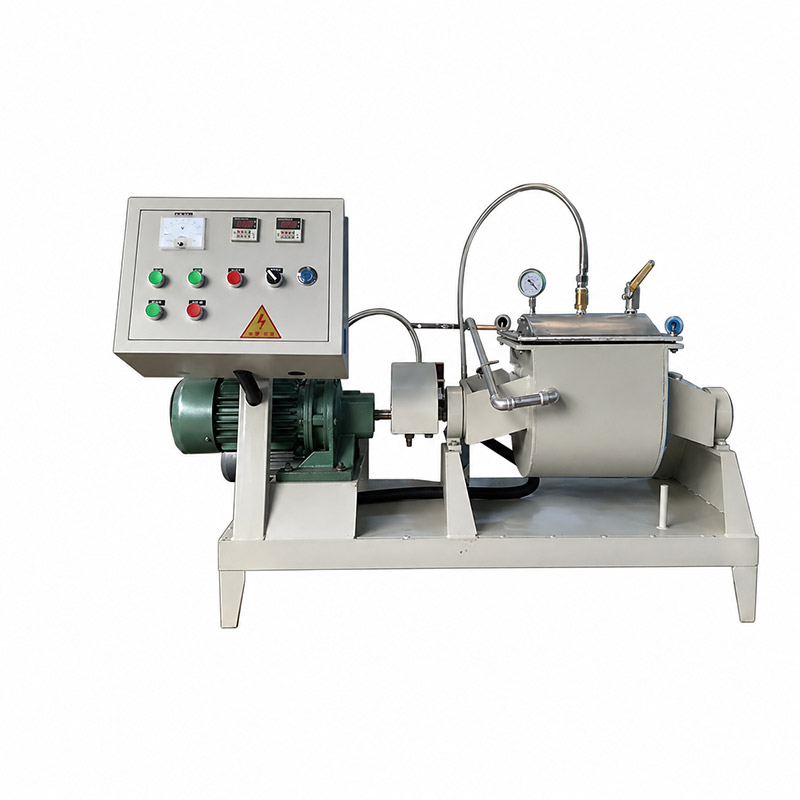
Vacuum kneading machine configuration for laboratory and pilot paste processing.
For a specific project, the vacuum kneading machine for high-viscosity paste processing should be evaluated with the intended powder, binder, solids loading, and target end point. A trial with a small representative batch is more informative than a comparison based only on nominal volume.
Process variables that determine batch quality
Once the machine is selected, batch quality depends on how the material is loaded and moved through the cycle. The same equipment can produce stable paste or inconsistent paste depending on fill level, feed order, vacuum profile, temperature, and end-point judgment. A useful approach is to treat these variables as a linked set and change one at a time during process development.
| Variable | Primary effect | Practical direction |
|---|---|---|
| Fill level | Controls free surface and agitator contact | Stay within the tested range; avoid overfilling the vacuum space |
| Feed order | Affects wetting and lump formation | Add powder and binder in stages; observe torque and texture |
| Vacuum profile | Controls gas removal and volatile loss | Use staged pull-down if foaming or solvent loss is a concern |
| Temperature | Changes viscosity, wetting, and evaporation | Hold a stable product temperature rather than a fixed jacket setting |
| Agitator speed and time | Determines shear history and energy input | Use the lowest speed that renews the surface and reaches the target |
Fill level is the first constraint. The paste must contact the agitator over the full working volume, but it also needs room to expand and fold. If the batch climbs the shaft or forms a stable dome, the lower zone may receive little exchange. Operators should record the actual working fill range for each formulation rather than assuming that a nominal percentage applies to every paste.
Feed order influences how quickly a uniform paste forms. Adding all powder to a small amount of liquid can create a stiff, dry layer that later disperses poorly. Adding liquid to a powder bed can produce channels and wet shells. A staged feed, with controlled addition and observation of torque or power draw, often gives better reproducibility. The correct sequence is material-specific and should be fixed before scale-up.
The vacuum profile should be matched to the material. A fast pull-down can cause foaming, bumping, or rapid solvent loss. A staged profile allows the paste to adjust and gives the operator a chance to observe surface movement. The hold time after reaching the target pressure is also important, because the paste may need continued kneading to expose fresh gas pockets. Vacuum without movement is usually a poor use of cycle time.
Temperature affects both rheology and stability. Warmer paste may flow more easily and release gas faster, but excess heat can cure a binder, degrade an additive, or evaporate a solvent. The control strategy should monitor product temperature where possible, not only the jacket fluid. For heat-sensitive materials, a lower jacket temperature and a longer kneading time may be safer than a high initial temperature.
End point is not simply a fixed clock time. Torque, power draw, visual texture, density, and sample rheology can all provide evidence that the batch is mixed and degassed. A sudden change in torque may indicate a change in body, while a stable torque with a rising temperature may mean the material is being overworked. The end point should be defined by the product requirement, not by the convenience of a timer.
Scale-up and quality control from laboratory to production
Scaling a paste process is not a matter of multiplying the batch size. Heat transfer area per unit volume falls as vessels grow, so a production batch may heat up faster or cool more slowly than a laboratory trial. Agitator torque, shaft speed, gap width, and vacuum pump capacity also change with scale. A process that reaches a smooth, gas-free paste in a small vessel may need a different speed profile or a longer vacuum hold in a larger one.
Useful quality checks should be practical and repeatable. Density or specific gravity can reveal differences in gas content. A simple vacuum release test, a cross-section, or a controlled film drawdown can show pinholes and lumps. Rheology measurements, particle size analysis, and thermal checks may be appropriate depending on the product. The key is to compare samples taken from the same position and at the same stage of the cycle.
A pilot trial should test more than one fill level and at least two vacuum profiles. It should include the intended feed order and a realistic discharge step. If the material is sensitive to air, the trial should also check how long the paste can be exposed before the next process step. This kind of trial produces selection data, not just a demonstration.
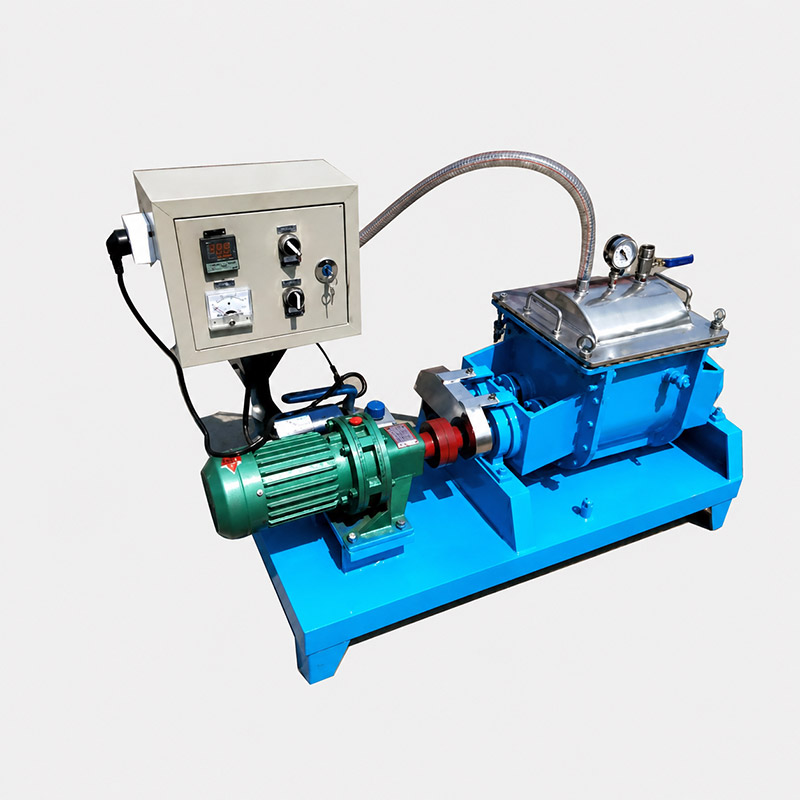
Vacuum kneading machine setup for controlled paste mixing and degassing trials.
Documentation should capture the material batch, solids loading, feed sequence, jacket temperature, vacuum profile, agitator speed, torque or power trend, and final sample results. Without that record, a successful batch is difficult to repeat. The same discipline supports troubleshooting, because it separates a formulation change from a machine or operating change.
Common operating problems and practical responses
Most vacuum kneading problems fall into a small number of categories. The paste may not degas, it may overheat, it may fail to wet out, or it may be difficult to discharge and clean. Each symptom has several possible causes, so the response should start with the record from the batch rather than with an immediate change to the recipe.
Inconsistent degassing
If the vacuum gauge reaches the target but the product still contains bubbles, the limiting factor is often surface renewal rather than pump capacity. Check whether the paste is actually folding, whether the fill level leaves enough free surface, and whether the hold time is long enough. A leak in the lid seal or shaft seal can also reduce the effective vacuum at the product. Inspect seals, hoses, and the trap before changing the formulation.
Overheating or solvent loss
High-viscosity kneading converts mechanical energy into heat. If the product temperature rises faster than expected, reduce agitator speed, shorten the high-torque stage, or improve jacket cooling. Solvent loss may appear as a viscosity increase, skin formation, or a change in density. In that case, review the vacuum level and the time at temperature together; a gentler vacuum profile may be enough if the gas load is not high.
Dead zones and incomplete wetting
Dry pockets or streaks usually indicate that part of the batch is not being exchanged. Check the fill level, the feed order, and the agitator clearance. Very fine powders may need slower addition to avoid a dry layer on the surface. If the paste climbs the shaft, the upper zone may need a different mixing element or a change in speed. Visual inspection during the trial is more useful than guessing from the final sample.
Seal wear and discharge difficulty
Seals in a vacuum kneading machine see paste, solvent, heat, and pressure differences at the same time. Wear can show up as a loss of vacuum, contamination, or a dark ring in the product. Regular inspection and a seal material compatible with the formulation are essential. Discharge problems often come from a paste that is too cold, too stiff, or allowed to stand too long. A controlled discharge temperature and a suitable vessel geometry can reduce the heel left behind.
Selection checklist for laboratory, pilot, and production work
A good selection process starts with the material, not with the largest available volume. The following points help organize the comparison:
- Working volume range that covers the smallest and largest realistic batch.
- Viscosity and yield stress at the loading, mixing, and discharge stages.
- Solids loading, particle size, particle density, and abrasion level.
- Vacuum level needed for degassing, with allowance for solvent or water removal.
- Jacket temperature range and the need for heating, cooling, or both.
- Wetted materials and contamination limits for the final product.
- Discharge, cleaning, sampling, and seal access.
- Available utilities, floor space, and operator skill level.
The machine should also be judged against the process cycle. A unit that mixes well but takes too long to clean or discharge can limit production more than a slightly slower agitator. For laboratory work, small batch loss and easy cleaning may matter more than maximum throughput. For pilot and production work, repeatability, temperature control, and maintenance access usually carry more weight.
TENCAN is the brand of Changsha Tianchuang Powder Technology Co., Ltd. Equipment selection should be based on a material trial and a clear process specification, with vacuum, temperature, fill level, and end point defined in advance. A supplier who asks for the material data and discusses operating limits is more useful than one who offers a single standard answer for every paste.
Practical questions buyers ask
Is vacuum always necessary?
No. If the paste will be used immediately and trapped gas does not affect density, appearance, or performance, mechanical kneading alone may be sufficient. Vacuum is most useful when air voids cause defects, when the product must meet a density or electrical requirement, or when the process needs to remove a volatile component.
Can one machine handle mixing and degassing?
A vacuum kneading machine can combine both functions, but the result depends on formulation and operating conditions. The agitator must renew the surface, the vacuum system must handle the gas load, and the fill level must leave room for expansion. A trial is needed to confirm that the same cycle achieves both wetting and degassing without damaging the product.
What information is needed for a trial?
Provide the formulation range, solids loading, viscosity or rheology data, particle size, solvent content, temperature limits, target batch size, and the defect that the process must avoid. Photographs or samples of the current paste are also useful. With this information, the trial can focus on the variables that matter instead of testing a generic paste that does not represent the real process.
The most reliable next step is to test the actual paste at a representative scale. Observe how it folds, how it responds to vacuum, how its temperature changes, and how it discharges. Those observations will show whether a vacuum kneading machine fits the process and which operating window should be carried forward to production.