
Multi-Station Magnetic Stirrer Buying Guide
Six beakers on the bench, one magnetic stirrer, and forty minutes until the next sampling point: this is the moment most laboratories begin looking at a multi-station unit. Stirring vessels one after another does not only consume time. It also introduces a quiet variable into every comparison, because the first sample and the sixth sample never share the same mixing history. A multi station magnetic stirrer solves that problem by running several vessels at once, but the purchase decision is rarely as simple as counting positions. Station spacing, drive architecture, vessel geometry and the way speed is set across the platform all determine what the unit can actually do in daily work.
Where Sequential Stirring Starts to Cost You Data
A single-position stirrer is not a bottleneck until several samples have to be prepared at the same time. Then the workarounds appear: a queue of beakers, a timer, and someone walking along the bench to start and stop each vessel in turn. The visible cost is bench time. The less visible cost is that the samples no longer share a mixing history. If the first vessel starts twenty minutes before the last, any comparison between them carries an uncertainty that is difficult to reconstruct later, especially when the method specifies a fixed agitation time before sampling.
Workflows that depend on that timing are common: dissolution and leaching tests, solvent extraction, suspension of pigments or electrode slurries, pH adjustment before titration, and dilution steps where a salt or a polymer must be fully dissolved before the next reagent is added. In each case, agitation is not a convenience; it is part of the metered process, and the interval between starting the first vessel and starting the last is effectively an uncontrolled variable.
The arithmetic of sequential stirring is easy to underestimate. A protocol that calls for twenty minutes of agitation across six samples consumes two hours of elapsed time if the vessels are stirred one after another. Run in parallel, those same six samples finish inside a single agitation window, and the operator is free to label vials, prepare the next batch, or begin the analysis that produced the samples in the first place.
Bench organization changes as well. Six separate stirrers mean six power leads, six footprints and six surfaces to wipe down. Inside a fume hood or on a crowded bench, that is often the real limit on throughput rather than the stirring itself. A single platform with several positions consolidates the power supply, the control interface and the spill risk into one place, provided the positions are spaced widely enough for the glassware in use.
How a Multi-Station Magnetic Stirrer Works
A multi station magnetic stirrer from Changsha Tianchuang Powder Technology Co., Ltd (TENCAN) is essentially several magnetic stirring positions built into one housing. The principle at each position is identical to that of a single-position unit. What changes is how the drives are arranged, how far apart the positions sit, and whether speed is set for the platform as a whole or for each station independently.
The Drive Principle Behind Each Position
Beneath a non-magnetic top plate, a rotating magnet, or a set of electromagnets driven in sequence, produces a moving magnetic field. A magnetic stir bar inside the vessel couples to that field and rotates with it. There is no shaft, no bearing and no dynamic seal between the motor and the liquid, which is why magnetic stirring is preferred wherever an open vessel must remain closed, protected from lubricated parts, or simply easy to clean between runs.
The coupling is not rigid. Torque is transmitted through the top plate and through the base of the vessel, and the strength of that transmission falls with distance and with the viscosity of the liquid. This single fact explains most of the behavior users notice in practice: a bar that spins freely in water may stall in a glycerol solution, a thick-walled flask may need a stronger drive than a thin beaker, and a bar that is stable at low speed may lose the field once the vortex deepens and the load increases.
Because the field is a physical quantity rather than an electrical setting, the useful upper speed of any position is defined by the point at which the bar decouples, not by the number shown on the display. Multi-position platforms make this visible: a setting that suits one position may not suit another when the vessels differ in wall thickness or the liquids differ in viscosity.
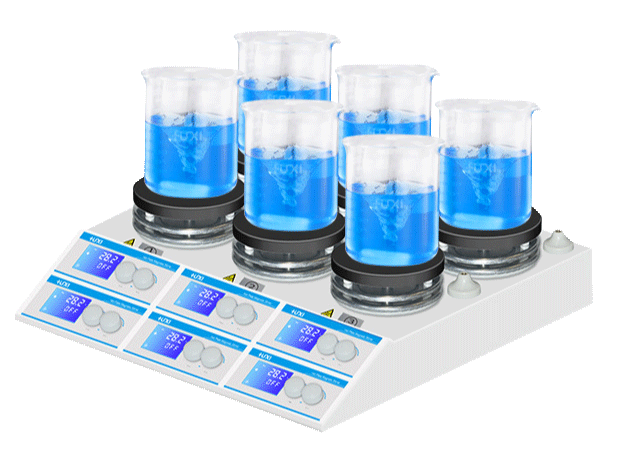
Shared Drives and Independent Drives
Multi-position platforms are generally built in one of two ways. In the first, a single motor drives every position through a belt, a gear train or a shared rotating magnet assembly, so all positions turn at the same speed. In the second, each position carries its own motor and its own control channel, which allows different speeds to be set on the same platform at the same time.
Shared-drive designs are mechanically simpler and keep the positions synchronized, which is attractive when the purpose is to compare identical samples under identical conditions. Their limitation appears when the positions carry different loads: a viscous sample can slow a shared drive slightly, and depending on how the train is designed, that effect may be felt at every position. Independent drives cost more and add electronics, but they allow a platform to run several different methods at once and to keep working when one position is empty or stalled.
Before ordering, it is worth establishing which architecture is being offered and whether speed is set globally or per position. The answer determines whether the platform suits replicate testing, method development with several formulations, or a mixture of both on the same bench.
Station Layout, Spacing and Vessel Compatibility
Station count is the specification most buyers check first and the least informative on its own. What matters is how many vessels of the size actually used will fit without touching each other, and whether each vessel can sit centered over its own drive.
Spacing Versus Glassware Diameter
Two positions are only usable if the vessels placed on them do not collide at the rim and do not overhang so far that they become unstable. A platform laid out for small beakers may effectively lose positions once tall-form flasks, separating funnels or jacketed vessels are introduced, because the widest part of the glassware sets the required center-to-center distance. The practical approach is to measure the widest vessel in the current method, add clearance for the rim and for a stir bar retriever, and then count how many of those diameters fit across the plate.
Overhang deserves attention for a second reason. A vessel larger than the plate area around its drive may still stir, but it sits less securely and is more likely to shift when the bar decouples or when the liquid is disturbed. Where vessels are tall or narrow-based, clamps or a retaining rail are a sensible addition, particularly on a platform that will run unattended for long periods.
Working Volume and Stir Bar Geometry
As a working rule, the stir bar should span roughly one third to one half of the internal diameter of the vessel. Bars that are noticeably shorter tend to leave a stagnant zone near the wall; bars that are too long for the vessel scrape the glass and can jam. Working volume per position is limited by two factors at once: the vortex that forms at higher speeds, and the coupling distance between the drive and the bar, which grows as the liquid volume raises the bar off the bottom or as a larger vessel increases the gap.
For parallel work, uniformity is more valuable than optimization at a single position. Using the same vessel type and the same bar size at every station keeps the mixing intensity comparable, so a difference observed between samples reflects the sample rather than the setup. When one position must use a different vessel or a different fill volume, treat that position as a separate condition and interpret its results accordingly.

Speed Control, Vortex Formation and Mixing Quality
Speed is the variable operators adjust most often and interpret least consistently. On a multi-position platform the question is not simply how fast the bar turns, but whether the same setting produces the same mixing behavior in every vessel.
Setting a Useful Speed
The most useful speed is usually the lowest one that keeps solids suspended and the bulk liquid in motion. Running faster than necessary adds shear, increases air entrainment and encourages the vortex to reach the bar, which is the point at which mixing quality collapses rather than improves. A practical routine is to raise the speed gradually until the solid is fully suspended and no deposit remains on the bottom, then reduce it slightly so the bar keeps a stable rotation with a shallow surface dimple.
Reading the Vortex
A shallow depression in the liquid surface indicates adequate circulation. A deep funnel that reaches down to the bar is a sign that the speed exceeds what the vessel can support, and the consequences are predictable: air is drawn into the liquid, the bar becomes noisy, and any volumetric transfer taken at that moment carries entrained gas. On a multi-position platform, comparing vortex shapes across positions is a fast diagnostic. If one position shows a much deeper funnel than the others at the same nominal setting, the cause is usually a difference in vessel diameter, fill volume or liquid viscosity rather than a fault in the drive.
When the Bar Will Not Stay Coupled
Decoupling is almost always a load problem rather than a control problem. Common causes include a liquid that is too viscous for the drive at that distance, a bar that is too small or too worn to accept torque, a vessel with a thick or uneven base, and debris or dried residue on the plate that lifts the vessel. Round-bottom flasks also behave differently from flat-bottom beakers, because the bar sits in a curved well and the gap to the drive is larger. Reducing speed, using a larger or heavier bar, or moving to a thinner-walled vessel will often restore coupling without any change to the platform itself.
Viscosity, Chemistry and Contamination Control
Magnetic stirring is a low-to-medium viscosity technique. Where a liquid becomes a paste or a thick slurry, the magnetic coupling simply cannot deliver enough torque, and a mechanical stirrer or a different mixing principle becomes the appropriate tool.
Stir Bar Selection
Stir bars are usually supplied with an inert polymer coating, of which PTFE is the most common because it is chemically resistant and has a low friction surface. The choice of shape matters more than many users expect: cylindrical bars are the general-purpose option, pivot-ring bars suit round-bottom flasks, and larger-diameter bars transmit more torque in viscous liquids. For abrasive solids, a coated bar will wear at the ends over time, and a worn bar both couples less reliably and introduces a small amount of coating debris into the sample. Bars should therefore be inspected periodically and replaced as consumables rather than kept indefinitely.
Cross-Contamination Between Positions
On a shared platform, the stir bar is the main route by which material moves from one experiment to another. Trace analysis, elemental work and any protocol involving strong dyes or biologically active compounds benefit from dedicating bars to specific stations or to specific sample types, ideally stored and labeled individually. The plate itself should be wiped after spills, since dried residue under a vessel changes the coupling gap and can also transfer material to the next flask. Where a method is sensitive to carryover, a validated cleaning step for bars and vessels is more reliable than a visual check.
Parallel Stirring Compared With Other Approaches
Multi-position magnetic stirring is one option among several, and it is worth setting it beside the alternatives before committing bench space and budget.
| Approach | Strength | Limitation | Typical fit |
|---|---|---|---|
| Multi-station magnetic stirrer | Several vessels in one mixing window, one footprint, consistent settings | Limited to low and medium viscosity; no high-shear capability | Replicate testing, dissolution, suspension, method development |
| Several single-position stirrers | Flexibility and redundancy; one failure does not stop the batch | Cabling, bench space, and setpoints that drift apart over time | Small laboratories with varied, low-volume work |
| Overhead mechanical stirrer | High torque for viscous material and larger volumes | Shaft, bearing and seal to clean; generally one vessel at a time | Pastes, slurries, scale-up studies |
| Orbital shaker | Gentle treatment of many vessels at once | Low mixing energy; no localized vortex | Cell work, extraction with fragile media |
| Roller mixer | Very gentle, no internal bar to clean | Slow, low shear, unsuitable for dissolving solids quickly | Homogenizing blood or viscous biological samples |
The comparison usually resolves into a question of energy and scale. If the method needs vigorous agitation of a low-viscosity liquid in several small vessels, a multi-position platform is efficient. If the method needs high torque, a mechanical impeller is the better answer, and no amount of magnetic coupling will substitute for it.
Selection Checklist Before You Order
Most specification errors in this category come from ordering on station count alone. The following points cover the variables that determine whether a platform will work in a specific laboratory.
- Vessel set: the largest and the smallest vessel used, including rim diameter and wall thickness.
- Simultaneous load: the number of vessels that must run at the same time, not the number that could theoretically fit.
- Speed control: whether speed is set for the whole platform or per position, and the range needed for the method.
- Liquid properties: viscosity, density and solids content at the start of the run and at the end.
- Chemical compatibility: top plate surface, bar coating and housing materials against the solvents in use.
- Temperature: ambient working conditions, and whether the protocol requires controlled temperature, in which case the configuration must be confirmed with the supplier.
- Duty cycle: continuous operation versus short runs, and whether the platform will be left unattended.
- Facilities: bench or hood footprint, power supply and socket availability.
- Spill management: access for cleaning around each position and protection of the drive area.
- Support items: supply of spare bars in the correct sizes, documentation and service arrangements.
A laboratory that runs six parallel digestions has different priorities from one that develops formulations in four different vessels at four different speeds. Writing those requirements down before comparing models makes the choice considerably clearer, and it also makes it easier to discuss the configuration of a TENCAN multi station magnetic stirrer against the actual workload rather than against a generic specification sheet.
Operating Practice and Troubleshooting
Once the platform is on the bench, most day-to-day problems fall into a small number of categories. The table below lists the symptoms that appear most often and the checks that resolve them.
| Symptom | Likely cause | Action |
|---|---|---|
| Bar spins but the liquid barely moves | Bar too small for the vessel, or speed too low to develop circulation | Increase bar length toward one half of the vessel diameter, then re-tune speed |
| Bar decouples at higher speed | Vortex load, viscous liquid, or excessive gap through the vessel base | Lower speed, use a heavier bar, or change to a thinner-walled vessel |
| One position behaves differently from the rest | Different vessel, fill volume or residue on the plate | Standardize glassware and clean the plate under that position |
| Noise and vibration | Worn bar, off-center placement, or vessel not seated flat | Replace the bar and re-center the vessel |
| Sample warms during prolonged stirring | Motor and drive heat, plus energy dissipated by the bar | Reduce speed, shorten the run, or confirm whether temperature control is required |
Two habits prevent most of these issues. The first is to record the speed setting together with the vessel type and bar size in the method notes, so that a run can be repeated rather than re-optimized. The second is to inspect bars regularly; a slightly worn bar is the most common reason a previously reliable method suddenly stops coupling.
Frequently Asked Questions
How many vessels can a multi-station magnetic stirrer run at once?
The number of drive positions is fixed by the model, but the practical number of usable vessels is usually lower and depends on glassware diameter. Wide vessels reduce the count, because positions must be spaced far enough apart that rims do not touch and each vessel can sit centered over its drive.
Can it handle viscous liquids?
Only up to the point at which magnetic coupling can transmit enough torque. Water-like and moderately viscous solutions are straightforward; pastes, thick slurries and high-solids suspensions generally require a mechanical stirrer with a shaft. Where a method sits near the limit, testing with the real material is the only reliable way to confirm performance.
Do I need a separate stir bar for every position?
Separate bars are recommended wherever carryover matters, because the bar is the part of the system that contacts the sample most intimately. Dedicating bars to positions or sample types, storing them labeled, and replacing them when worn keeps both contamination risk and coupling behavior under control.
Is a multi-station platform suitable for biological or sterile work?
Magnetic stirring itself is compatible with closed vessels and gentle suspension, but sterility depends on the vessel, the closure and the surrounding environment rather than on the stirrer alone. Where contamination control is critical, bars and vessels should be handled as consumables with a validated cleaning or sterilization step, and the platform should be placed where airflow and spill risk can be managed.
Choosing a multi-station platform is ultimately a question of matching the drive architecture, spacing and speed control to the vessels and liquids already in use. A short trial with the real glassware, the real fill volumes and the most difficult formulation on the list will reveal more about suitability than any specification table, and it is the most dependable way to confirm that a platform will deliver consistent parallel mixing rather than simply more positions.