
Semi-Circular Vertical Planetary Ball Mill: Design Advantages and Practical Selection Tips
Why the Semi-Circular Design Matters in a Planetary Ball Mill
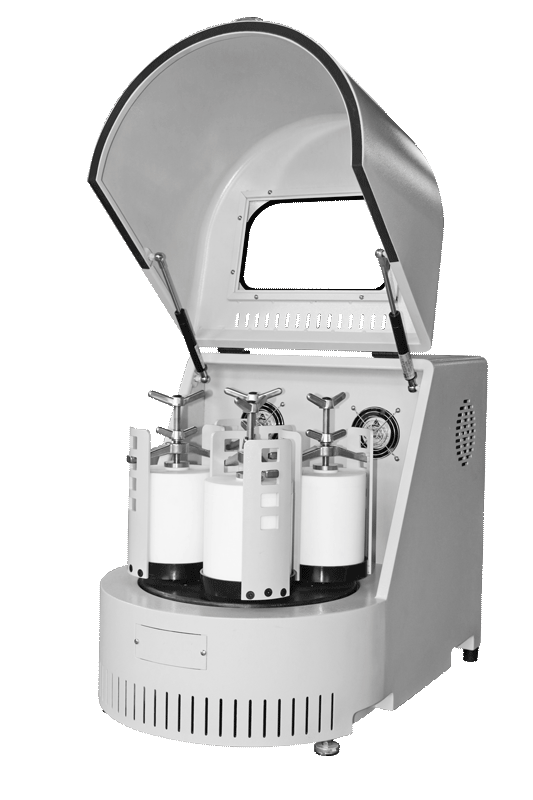
When you walk into a materials lab, you expect to see a planetary ball mill sitting on the bench. But the shape of the machine can tell you a lot about its engineering priorities. The semi-circular vertical planetary ball mill is not just a stylistic choice. Its form directly influences stability, ease of use, and the overall grinding experience.
Many researchers and procurement managers start by comparing capacity and speed, but they overlook how the geometry of the mill body affects daily operation. The semi-circular design, with its rounded front and compact footprint, addresses several practical concerns that arise in busy lab environments.
In this article, we will walk through how a semi-circular planetary ball mill works, what makes it different from square or full-directional models, and how you can decide whether it suits your powder processing tasks.
How a Planetary Ball Mill Works: The Basics
Before we focus on the semi-circular model, it helps to recall the core principle of any planetary ball mill. The name comes from the motion of the grinding jars. A main rotating disk (the sun wheel) carries several jars that also spin on their own axes in the opposite direction. This creates a powerful combination of centrifugal and Coriolis forces.
The grinding balls inside the jars are thrown against the jar walls and collide with each other, generating high-energy impacts. These impacts crush, shear, and frictionally grind the powder trapped between the balls. The result is a rapid reduction in particle size, often reaching the sub-micron or even nanometer range, depending on the material and process conditions.
Typical laboratory planetary ball mills run at a revolution speed of 50 to 435 rpm, with jar capacities ranging from 50 mL to 1 L per jar. The actual usable volume is usually about two-thirds of the jar capacity to leave room for the grinding media and the sample.
The semi-circular model follows the same planetary motion, but its construction brings additional benefits that we will discuss next.
Key Design Features of the Semi-Circular Vertical Mill
Lower Center of Gravity for Better Stability
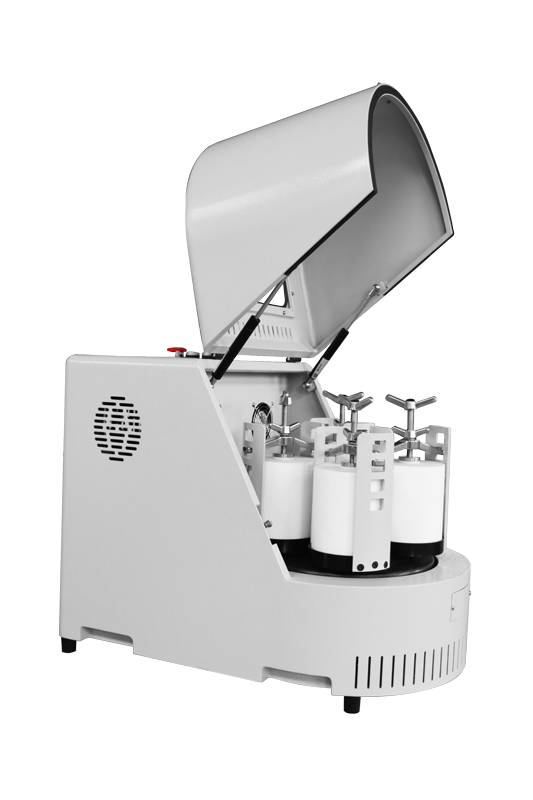
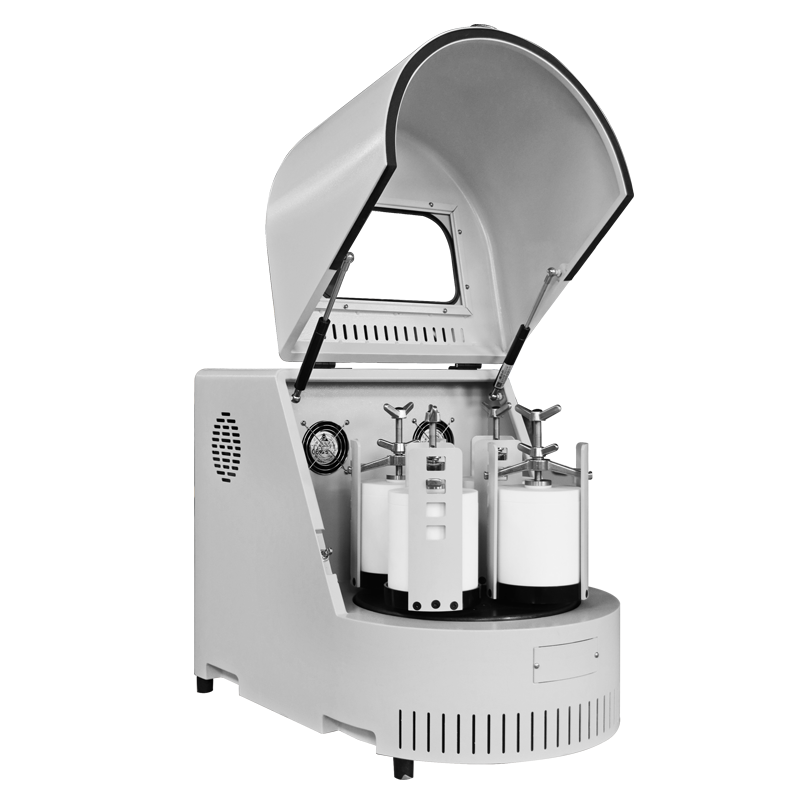
The semi-circular housing positions the main drive and the turntable closer to the base. This lowers the overall center of gravity compared to some box-shaped designs. A lower center of gravity means less vibration during high-speed operation, especially when the jars are not perfectly balanced. You can run the mill at higher speeds with less risk of the machine walking across the bench.
Compact and Easy-to-Clean Surface
The rounded front panel has fewer corners and crevices. In a lab, powder spills and dust accumulation are common. The smooth semi-circular surface makes it easier to wipe down after each use. This is a small but practical detail that lab managers appreciate when maintaining cleanliness between different projects.
Integrated Locking Mechanism
Many semi-circular models come with a clamping system that secures the jars firmly in place. The lid of the machine often forms a protective cover that also reduces noise. The ergonomic design allows you to load and unload jars without reaching too far into the machine.
Materials and Applications That Benefit from This Design
The semi-circular planetary ball mill is not limited to a single type of sample. It handles a wide range of materials, including:
- Ceramics and oxides: Alumina, zirconia, silicon carbide, and advanced ceramic precursors.
- Minerals and ores: Quartz, kaolin, limestone, and other geological samples.
- Battery materials: Cathode and anode powders, solid electrolytes, and carbon composites.
- Metals and alloys: Soft metals, brittle intermetallics, and mechanical alloying of multi-component systems.
- Polymers and organic compounds: Heat-sensitive materials can be ground with intermittent operation or under cryogenic conditions if a compatible jar is used.
For dry grinding, the semi-circular mill performs well with materials that are not too sticky. For wet grinding, you can add a suitable liquid medium (water, ethanol, or other solvents) to reduce agglomeration and achieve finer particles. The sealed jars prevent leakage during rotation.
One common application is the preparation of nano-sized powders for research. The high-energy input from the planetary motion, combined with the right choice of grinding ball size and ball-to-powder ratio, can reduce particle size to well below 100 nm. However, the final result depends heavily on the material properties and operating parameters. No single mill can guarantee a specific particle size for every material.
Selecting the Right Semi-Circular Planetary Ball Mill
When you are evaluating a semi-circular model, you need to consider several factors beyond the shape. Here are the most important ones:
Capacity and Jar Volume
Laboratory units typically come with four jar stations. Each jar can hold from 50 mL to 500 mL or more. The total batch size for a single run is typically about 100 mL to 1 L of powder, depending on the jar size and the filling ratio. If you process larger quantities, you may need a production-scale model or run multiple batches.
Speed Range and Control
The revolution speed of a semi-circular planetary ball mill is often adjustable from around 50 rpm to 600 rpm. Higher speeds generate more impact energy but also increase heat and wear. A variable frequency drive allows you to set the speed precisely and to program forward and reverse rotation, which helps to circulate the powder and avoid sticking.
Grinding Jar Material
The jar material must be compatible with your sample to avoid contamination. Common options include:
- Stainless steel: Durable and economical, but may introduce iron contamination.
- Zirconia (yttria-stabilized): Excellent wear resistance and low contamination for ceramic and oxide materials.
- Alumina: Good for abrasive materials, but more brittle.
- Agate (natural quartz): For contamination-free grinding of precious or high-purity samples.
- Nylon or PTFE: For grinding soft or organic materials, but limited wear resistance.
Many semi-circular mills accept standard jar sizes, and you can switch between different materials as needed.
Grinding Media Selection
The diameter and material of the grinding balls influence the grinding mechanism. Larger balls (10–20 mm) provide strong impact forces and are suitable for coarse grinding. Smaller balls (1–5 mm) offer more contact points and are better for fine grinding and dispersion. The ball-to-powder ratio is typically between 5:1 and 20:1 by weight, but the optimal ratio depends on the specific material and target particle size.
Vacuum or Inert Gas Protection
If your sample is sensitive to air or moisture, you can use vacuum grinding jars or fill the jar with inert gas (argon, nitrogen) before sealing. The semi-circular mill can be equipped with such jars. The sealed design maintains the atmosphere during the entire grinding process. This is critical for lithium battery materials, metal powders, and other reactive compounds.
For highly reactive or pyrophoric materials, we strongly recommend working inside a glove box or using a dedicated mill that is designed for glove box integration. Consult with your equipment supplier to ensure safety.
Comparing Semi-Circular, Square, and Full-Directional Models
You may also come across vertical square planetary ball mills and full-directional (360° rotating) models. How do they differ?
| Feature | Semi-Circular | Square | Full-Directional |
|---|---|---|---|
| Stability | High, low center of gravity | Moderate, higher center of gravity | Requires secure mounting due to 360° rotation |
| Cleaning | Easy, smooth curved surface | More corners, slightly harder to clean | Similar to square, but rotating mechanism adds complexity |
| Operation | Simple jar loading, fixed orientation | Similar to semi-circular | Allows jars to rotate with the mill, preventing sedimentation |
| Typical use | General lab grinding, routine powder processing | General lab grinding | Materials that tend to settle or stick (e.g., heavy metals, viscous slurries) |
The semi-circular model is often the best choice for most laboratory applications because it balances stability, ease of use, and cost. The full-directional model is more specialized for difficult samples that require constant mixing to prevent sedimentation. The square model is also a solid option, but the semi-circular shape offers a small ergonomic advantage.
What Information Should You Prepare Before Requesting a Quote?
If you are planning to purchase a semi-circular planetary ball mill, providing the following details to the supplier will help them recommend the right configuration:
- Material to be ground (name, composition, hardness)
- Initial particle size and target particle size
- Sample quantity per batch (weight or volume)
- Preferred grinding method: dry or wet
- Required jar and ball material (to avoid contamination)
- Need for vacuum or inert gas protection
- Expected daily operating hours
- Local voltage and frequency (e.g., 110V/60Hz or 220V/50Hz)
With this information, a technical team can select the appropriate jar size, motor power, and optional accessories. For example, if you frequently grind hard ceramics, they may recommend zirconia jars and balls to minimize wear and contamination. If you process heat-sensitive materials, they might suggest a programmable mill with pause cycles or a liquid nitrogen cooling option.
We have seen many researchers achieve excellent results with the semi-circular planetary ball mill after fine-tuning the parameters. The key is to start with a balanced set of conditions and then adjust based on the actual outcome. The equipment itself is reliable, but the process optimization is where your expertise comes in.
If you are interested in exploring the semi-circular model further, you can browse the product details at TENCAN Semi-Circular Planetary Ball Mill page. The engineers there can also provide guidance on jar materials and grinding parameters tailored to your specific application.