
Lightweight Vibrating Ball Mill: A Practical Guide for Laboratory Fine Grinding
Why Consider a Lightweight Vibrating Ball Mill for Your Lab?
In many laboratories, the need for fine and superfine grinding often arises with small sample quantities. Whether you are working on ceramic powders, battery materials, minerals, or chemical compounds, achieving consistent particle size reduction without excessive equipment bulk is a common challenge. A lightweight vibrating ball mill offers a compact and efficient solution, particularly when you need to process samples in the range of a few grams to several hundred grams per batch.
Unlike traditional tumbling ball mills that rely on rotation and gravity, a vibrating ball mill uses high-frequency oscillation to impart energy to the grinding media. This results in rapid impact and friction between the balls and the powder, enabling efficient size reduction even for harder materials. The lightweight design makes it easy to move, store, and integrate into existing lab setups, which is especially valuable in shared research facilities.
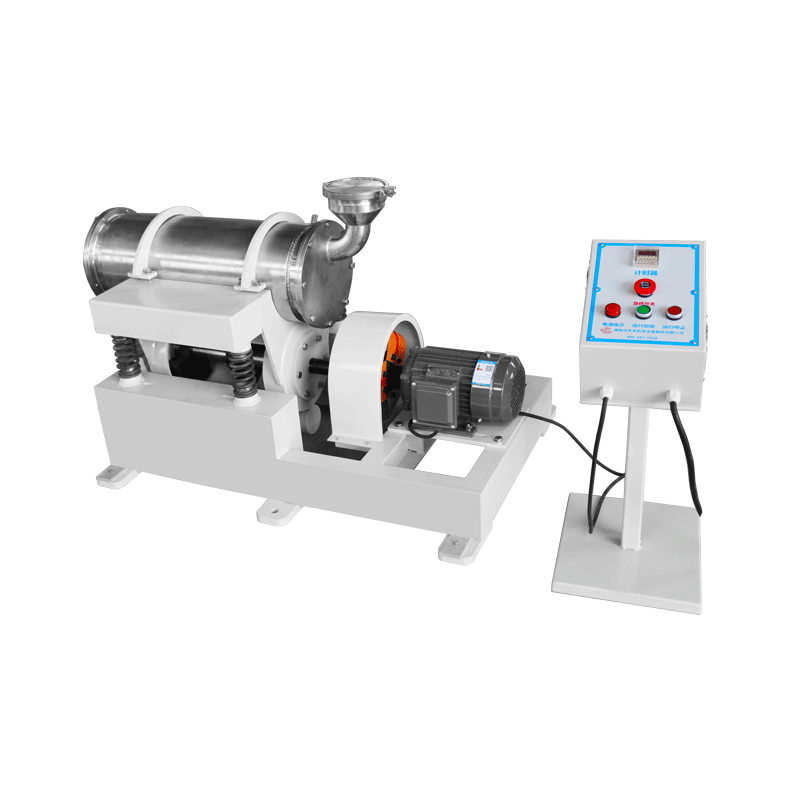
How Does a Lightweight Vibrating Ball Mill Work?
The core mechanism of a vibrating ball mill is relatively simple yet highly effective. A motor drives an eccentric shaft that generates vibration, which is transmitted to the grinding chamber. The chamber, typically made of stainless steel, ceramic, or other wear-resistant materials, contains the grinding balls and the sample. As the chamber vibrates, the balls are agitated in a teetering motion, colliding with each other and with the walls of the chamber. This action produces both impact and shear forces, which break down the particles.
One key advantage of this design is that the vibration frequency and amplitude can be adjusted to suit different materials. For example, brittle materials like silicon or quartz respond well to higher frequencies, while ductile metals may require lower frequencies to avoid excessive ball wear or sample agglomeration. The lightweight vibrating ball mill typically operates at a fixed frequency optimized for general laboratory use, but some models offer variable speed control for greater flexibility.
Because the chamber is sealed during operation, you can also perform grinding under an inert atmosphere or vacuum if the mill is equipped with a suitable jar. This is important for materials that are sensitive to oxidation or moisture absorption, such as lithium battery precursors or certain metal powders.
Key Applications in the Laboratory
Superfine Grinding for Small Batches
The lightweight vibrating ball mill is particularly well-suited for producing powders with particle sizes down to the micron and submicron range. In many cases, it can achieve a final size of one micrometer or less in a single batch operation, depending on the material and grinding conditions. This makes it a valuable tool for research areas such as:
- Material science – preparing fine ceramic powders, metal oxides, and composite materials
- Pharmaceuticals – micronizing active ingredients for better dissolution
- Chemistry – catalysts and fine chemical intermediates
- Geology and mining – pulverizing rock and ore samples for analysis
Mechanical Alloying and Mixing
Beyond simple grinding, the intense agitation within the mill can also be used for mechanical alloying – the process of blending two or more powders at the atomic level. The high-energy impacts repeatedly deform and weld the particles, creating a homogeneous alloy that may not be achievable by conventional melting. This is a common technique in the development of advanced materials, such as oxide dispersion-strengthened alloys or nano-structured composites.
Sample Preparation for Analysis
In analytical laboratories, consistent particle size is critical for techniques like X-ray diffraction (XRD), X-ray fluorescence (XRF), and infrared spectroscopy. A vibrating ball mill can quickly reduce samples to a fine, uniform powder, improving the reproducibility and accuracy of subsequent measurements. The compact size and ease of cleaning make it ideal for processing multiple samples in sequence.
Choosing the Right Lightweight Vibrating Ball Mill for Your Needs
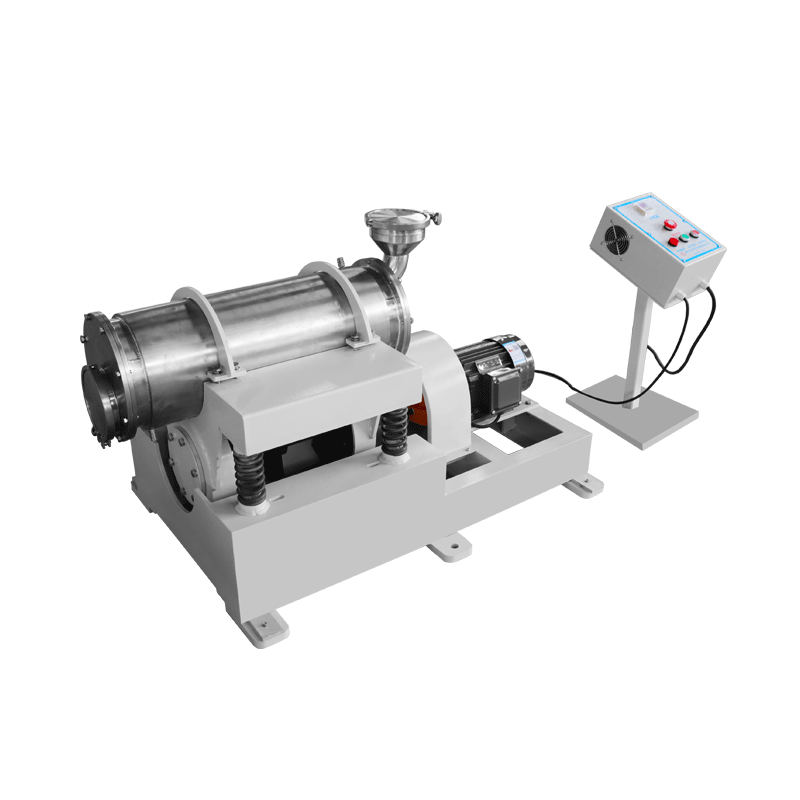
When selecting a lightweight vibrating ball mill, several factors should be considered to ensure it meets your specific requirements. The lightweight vibrating ball mill from TENCAN is designed with these considerations in mind, but understanding the parameters will help you make an informed decision.
Grinding Capacity and Jar Size
Laboratory vibrating ball mills are often available with jar capacities ranging from 50 mL to 1 L or more. The actual usable volume is typically about one-third to one-half of the jar capacity, as you need to leave space for the grinding balls and the movement of the powder. For a lightweight mill, common capacities are around 0.3 L, which is sufficient for most small-scale research work. If you need to process larger batches, you may want to consider a heavy duty vibrating ball mill or a planetary ball mill for higher throughput.
Grinding Media Selection
The material of the grinding balls and jar can significantly affect the grinding efficiency and contamination levels. Common choices include:
- Stainless steel – durable and widely used, but may introduce iron contamination
- Zirconia – excellent hardness and wear resistance, low contamination for many materials
- Alumina – cost-effective for ceramic grinding
- Agate – ideal for silica-free applications, but more brittle
For most applications, a combination of ball sizes (e.g., 6 mm to 20 mm) provides a good balance of impact and attrition. The typically recommended ball-to-powder ratio ranges from 5:1 to 20:1 by weight, depending on the target fineness and material hardness. Starting with a ratio of 10:1 is a common practice in many labs.
Vibration Frequency and Amplitude
While many lightweight mills operate at a fixed frequency, adjustable models allow you to tune the intensity. Higher frequencies generally produce finer particles but may also increase heat generation. For heat-sensitive materials, you can use intermittent grinding cycles – for example, 10 minutes of grinding followed by a 5-minute pause – to allow the chamber to cool. This is a practical approach to avoid thermal degradation.
Sample Preparation and Feed Size
Vibrating ball mills are not designed to handle coarse feed. The typical maximum feed size is around 0.5 mm to 1 mm. If your starting material is larger, you should first crush it using a jaw crusher or a hammer mill. For example, materials like rocks or sintered ceramics can be pre-crushed to below 1 mm before being introduced into the vibrating mill. This ensures efficient grinding and prevents damage to the jar or balls.
Practical Tips for Achieving Optimal Results
Whether you are new to vibrating ball mills or looking to improve your current process, here are a few tips based on routine laboratory operations:
- Always start with a small test batch to determine the optimal grinding time, ball-to-powder ratio, and ball size distribution. Record the parameters for future reference.
- Use a higher proportion of small balls (e.g., 3–6 mm) for fine grinding, and larger balls (10–20 mm) for initial breakage of coarse particles.
- Consider wet grinding if you are dealing with materials that tend to agglomerate or generate excessive heat. Adding a liquid such as ethanol, water, or isopropanol can reduce sticking and improve dispersion. However, you must ensure the jar is sealed properly to avoid leakage during vibration.
- Clean the jar and balls thoroughly between different materials to prevent cross-contamination. Ultrasonic cleaning is often effective for removing fine powder residues.
- Seal the jar properly when grinding under inert gas or vacuum. Many lightweight vibrating ball mills come with vacuum-compatible jars, but you should verify the sealing mechanism and pressure rating.
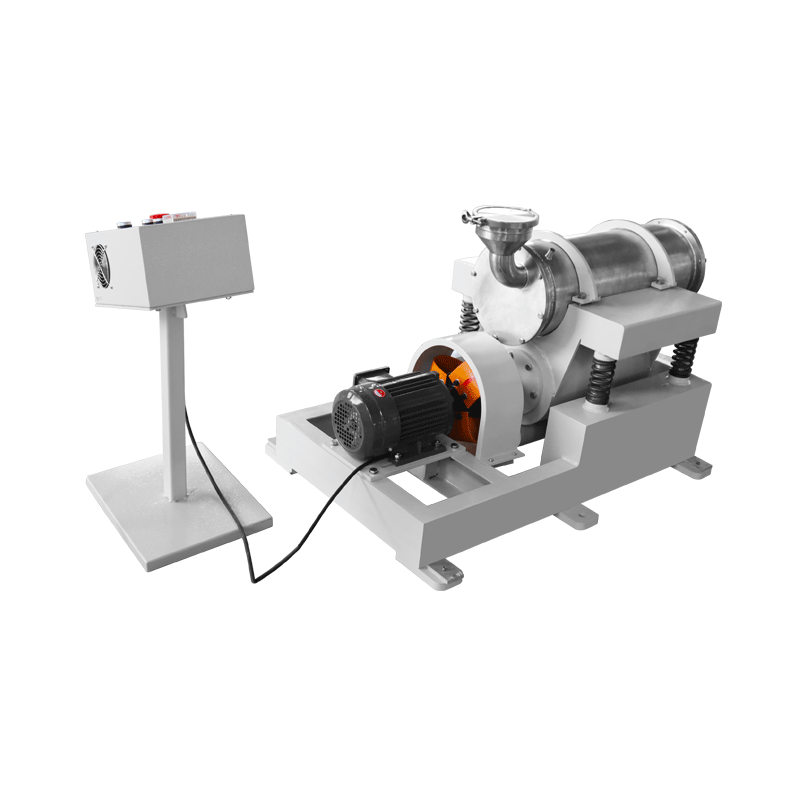
Comparing Lightweight Vibrating Ball Mills with Other Laboratory Mills
When deciding between a vibrating ball mill and other lab mills, consider the following:
| Feature | Lightweight Vibrating Ball Mill | Planetary Ball Mill | Traditional Tumbling Ball Mill |
|---|---|---|---|
| Size and portability | Compact, easily moved | Larger footprint | Largest, fixed installation |
| Batch capacity | Small (grams to ~200 g) | Small to medium (up to 1 kg) | Large (kg to tons) |
| Energy input | High-frequency vibration | High-speed planetary motion | Low-speed rotation |
| Typical particle size | 1 μm and below | Down to 0.1 μm or less | 10–100 μm |
| Noise level | Moderate | Moderate to high | Low |
As the table shows, a lightweight vibrating ball mill is a strong choice for ultrafine grinding of small samples, especially when space and portability are important. If you need to process larger quantities or achieve even finer sizes, a planetary ball mill may be more suitable. For higher throughput in industrial settings, traditional tumbling mills remain the standard.
Safety Considerations
When operating any vibrating ball mill, always follow safety guidelines:
- Ensure the mill is placed on a stable, vibration-dampening surface to prevent movement during operation.
- Use appropriate personal protective equipment, including safety glasses and hearing protection, as the mill can generate noise.
- Never open the jar while the mill is running. Wait for the vibration to stop completely.
- If grinding hazardous materials (e.g., toxic, flammable, or reactive powders), work in a fume hood and follow all relevant safety protocols.
- Check the jar seal regularly for wear or damage to prevent leaks.
Conclusion
The lightweight vibrating ball mill is a versatile and practical tool for laboratory fine grinding, sample preparation, and mechanical alloying. Its compact design, ease of use, and ability to produce micron-sized powders make it an excellent addition to any research lab. By understanding the working principles, selecting appropriate grinding media, and optimizing operational parameters, you can achieve consistent and reliable results for a wide range of materials.
If you are considering a vibrating ball mill for your lab, take the time to evaluate your sample volume, target particle size, and material properties. The lightweight vibrating ball mill from TENCAN offers a well-engineered solution that balances performance and portability. For more information on related equipment, you can also explore the lab vibration ball mill or other models in the vibration range.