
Lab Shear Emulsifier: High-Shear Mixing for Emulsions, Dispersions, and Homogenization
What Is a Lab Shear Emulsifier and Why Do You Need One?
If you have ever struggled to produce a stable emulsion, break down agglomerates in a suspension, or achieve a uniform dispersion of immiscible liquids, you already know that simple stirring is rarely enough. A laboratory shear emulsifier is a compact, high-speed mixing device designed to generate intense mechanical shear forces that can reduce droplet or particle sizes down to the micrometer or even sub-micrometer range. Unlike a conventional propeller mixer or a V-type blender, which relies on bulk flow, a shear emulsifier uses a rotor-stator system to create a high-energy zone where the material is subjected to rapid acceleration, deceleration, and impact. This makes it an essential tool for researchers and process engineers working on emulsions, dispersions, homogenization, and particle size reduction in fields such as cosmetics, pharmaceuticals, fine chemicals, food, and battery material processing.
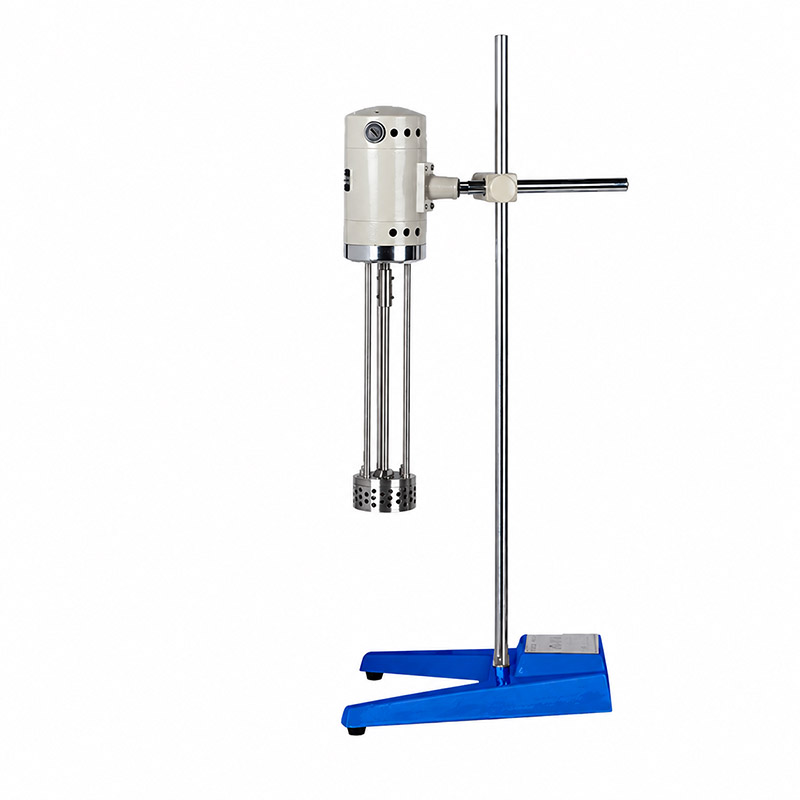
How Does a Shear Emulsifier Work?
The core of a laboratory shear emulsifier is the rotor-stator assembly. The rotor, typically a precisely machined cone or disc with teeth or slots, rotates at very high speeds inside a stationary stator that has a similar tooth or slot pattern. As the rotor spins, it draws the liquid or liquid-solid mixture into the gap between the rotor and stator. The clearance is extremely small, often in the range of 0.1 to 1 mm, depending on the model. Within this narrow gap, the material experiences three dominant mechanisms:
- High shear stress: The velocity gradient between the fast-moving rotor and the stationary stator creates intense shear forces that tear apart droplets or solid particles.
- Impaction and collision: Particles and droplets collide with the rotor teeth, stator teeth, and each other, further breaking them down.
- Pressure drop and cavitation: The rapid change in pressure as the material exits the gap can cause cavitation bubbles, which collapse and generate additional shock waves that assist in deagglomeration.
The result is a highly homogeneous mixture with a narrow droplet/particle size distribution. The entire process can be completed in a few minutes, depending on the material properties and desired final fineness.
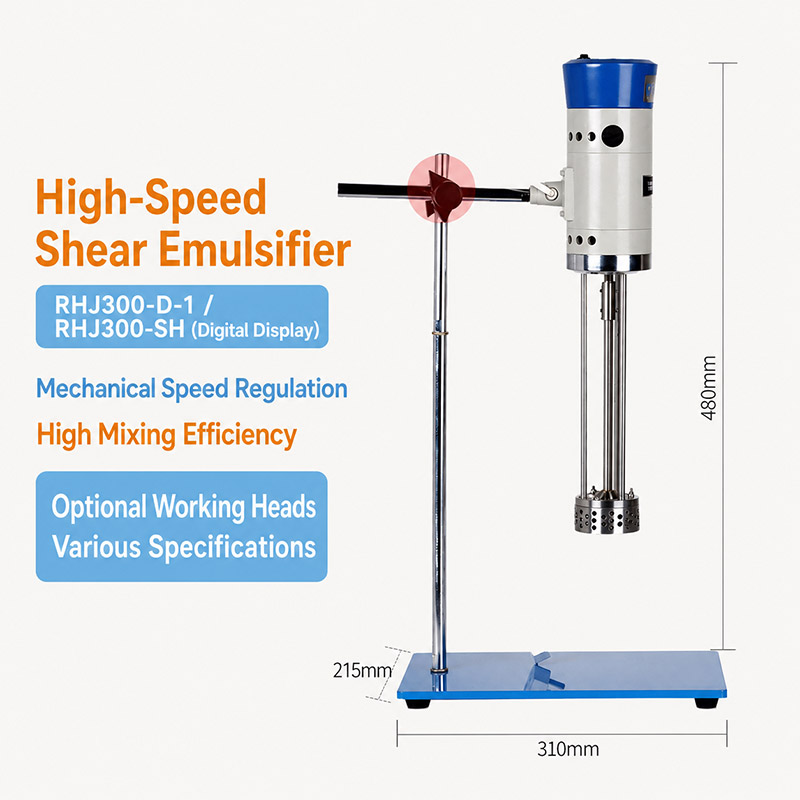
Key Applications of a Laboratory Shear Emulsifier
Because of its ability to handle both low-viscosity and moderately high-viscosity fluids, the lab shear emulsifier is widely used in many industries. Here are some typical scenarios:
Cosmetics and Personal Care
Formulating creams, lotions, sunscreens, and serums often requires the stable dispersion of oil phases into water phases (or vice versa) with consistent droplet sizes. A shear emulsifier can produce fine emulsions that improve skin feel, stability, and active ingredient delivery. Many R&D labs use a lab-scale emulsifier to optimize formulas before scaling up to production.
Pharmaceutical and Biomedical
In pharmaceutical development, emulsifiers are used to prepare nanoemulsions, liposomes, and microcapsules. The ability to control droplet size directly affects drug bioavailability, release kinetics, and stability. A laboratory shear emulsifier allows researchers to test different surfactants, oil-to-water ratios, and processing parameters on a small batch (e.g., 100 mL to 5 L) without wasting expensive active ingredients.
Fine Chemicals and Coatings
Many chemical intermediates, adhesives, and coating formulations require the deagglomeration of pigments or fillers in a liquid carrier. The high shear action of an emulsifier can break down agglomerates and produce a stable, streak-free dispersion. This is particularly important for high-quality inks, paints, and functional coatings.
Food and Beverage
Emulsifiers are used in the food industry to create stable sauces, dressings, mayonnaise, and flavor emulsions. A lab shear emulsifier helps food scientists test new formulations, adjust viscosity, and ensure uniform texture before pilot or mass production.
Battery Material and Nanotechnology
In the preparation of electrode slurries for lithium-ion batteries, a shear emulsifier can be used to homogenize the active material, binder, and conductive additives in a solvent. This ensures uniform coating and consistent electrochemical performance. Similarly, in nanotechnology, the device can help disperse nanoparticles in liquids without excessive contamination.
What to Consider When Selecting a Lab Shear Emulsifier
Choosing the right laboratory shear emulsifier depends on your specific material properties and process requirements. Here are some factors we typically discuss with our customers:
- Batch volume: Lab-scale emulsifiers commonly handle volumes from 100 mL up to 10 L. If you work with very small samples (e.g., 10–50 mL), you may need a mini emulsifier with a smaller rotor-stator head.
- Viscosity range: Most shear emulsifiers can handle liquids up to about 10,000–20,000 cP, but some heavy-duty models can go higher. If your material is paste-like, consider a batch mixer with a kneading function or a vacuum kneading machine.
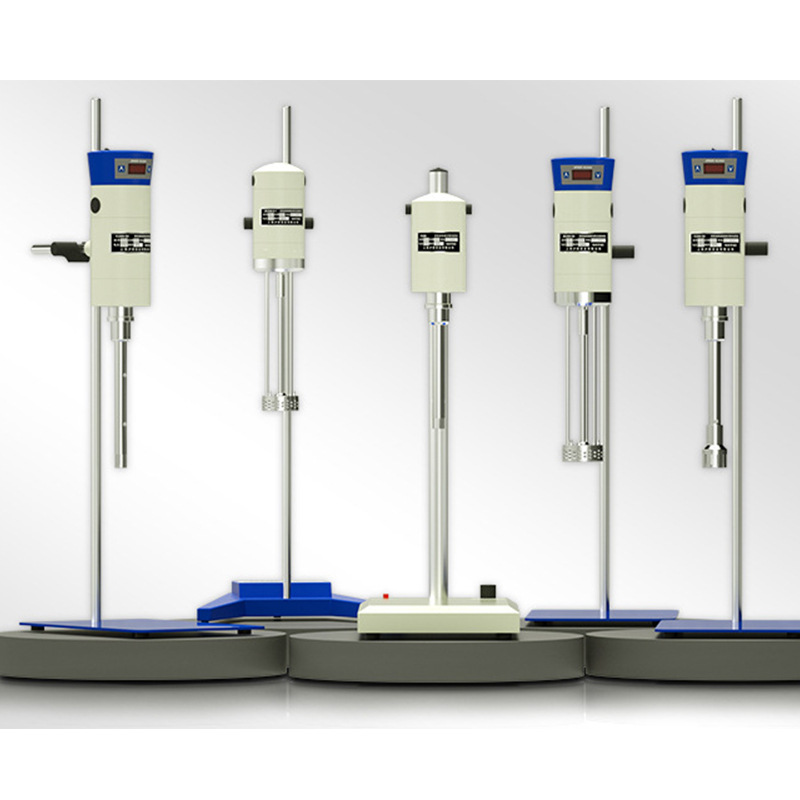
- Rotor speed and control: Speed is directly related to shear rate. Higher speeds (e.g., 5,000–25,000 rpm) produce finer emulsions but also generate more heat. A variable-speed drive with a digital display allows you to fine-tune the process.
- Material of construction: The wetted parts should be compatible with your chemicals. Stainless steel 304 or 316L is standard for most applications. For highly corrosive formulations, Hastelloy or PTFE-coated parts may be necessary.
- Sealing and vacuum capability: If you are processing volatile or oxygen-sensitive materials, a vacuum-tight emulsifier with a mechanical seal is essential. Some lab emulsifiers can be integrated with a vacuum pump or inert gas blanket.
- Scale-up potential: If you plan to transfer the process to a production line, choose a lab emulsifier from a manufacturer that offers similar geometries at larger scales. This simplifies the scale-up calculations.
Practical Tips for Using a Shear Emulsifier in the Lab
Based on our experience working with many laboratories, here are a few practical suggestions to get the best results:
- Pre-mix coarse ingredients first: For a stable emulsion, it is often helpful to pre-mix the oil and water phases with a low-speed stirrer before applying high shear. This reduces the initial droplet size and shortens the emulsification time.
- Control the temperature: High shear generates heat. If your material is heat-sensitive, use a jacketed vessel with cooling water or run the emulsifier in short intervals (e.g., 2 minutes on, 1 minute off) to avoid overheating.
- Choose the right rotor-stator type: Different geometries (e.g., fine-tooth, medium-tooth, or coarse-tooth) are optimized for different applications. Fine-tooth rotors produce finer emulsions but may clog with viscous materials. Check the manufacturer’s recommendations.
- Monitor the particle size: Use a particle size analyzer or microscope to verify the droplet size distribution. The optimal emulsification time is usually when the size stops decreasing significantly.
- Clean thoroughly between batches: Residue from previous formulations can contaminate your sample. Disassemble the rotor-stator and clean it with a suitable solvent or detergent.
Related Equipment You Might Need
In many labs, the shear emulsifier works alongside other mixing and milling equipment. For dry powder blending, a V-type mixer is a common choice for free-flowing granules. If you need to disperse solid particles in a liquid, a lab disperser with a high-speed impeller can be a more economical solution for lower-viscosity slurries. For applications requiring both high shear and vacuum deaeration, a vacuum kneading machine may be more suitable. The shear emulsifier itself is a versatile tool, but understanding how it fits into your overall process flow is key to successful R&D.
Final Thoughts
A laboratory shear emulsifier is an indispensable device when you need to produce fine, stable emulsions and dispersions with reproducible quality. Whether you are developing a new cosmetic cream, a pharmaceutical formulation, a chemical coating, or a battery slurry, the ability to control shear forces and droplet size directly impacts the final product performance. When selecting a unit, consider your batch size, material viscosity, required particle size, and any special conditions like vacuum or inert gas protection. The right emulsifier, combined with proper operating parameters, can significantly shorten your development cycle and improve the reliability of your scale-up process. If you are not sure which configuration fits your needs, we recommend preparing a list of your material properties and target specifications so that experienced engineers can help you choose the most suitable model.