
Stirred Ball Mill Guide: Working Principle, Types & Selection
Stirred Ball Mill Guide: Working Principle, Applications & Selection
Achieving a fine particle size is not simply a matter of extending grinding time. When the target moves into the micron, submicron, or even finer range, grinding efficiency, heat generation, grinding media selection, contamination control, and slurry behavior become increasingly important.
A stirred ball mill, also known as a stirred media mill, uses a rotating agitator to transfer energy directly to small grinding media inside a grinding chamber. Compared with conventional tumbling ball mills, this design creates frequent impact, shear, and attrition, making stirred milling particularly suitable for fine and ultrafine powder processing.
TENCAN provides stirred ball mill configurations ranging from compact laboratory systems to pilot and production-scale equipment. This guide explains the working principle of a stirred ball mill, the main equipment types, grinding media and liner selection, typical applications, operating considerations, and how to choose the right stirred mill for a specific process.
What Is a Stirred Ball Mill?
A stirred ball mill is a grinding machine in which grinding media are actively agitated by a rotating shaft equipped with discs, pins, paddles, or other stirring elements.
The grinding chamber contains both the material and the selected grinding media. As the agitator rotates, the media move rapidly through the chamber and repeatedly interact with the particles.
Particle size reduction mainly occurs through three mechanisms:
- Impact: Particles are fractured through collisions between grinding media.
- Attrition: Repeated rubbing and abrasion gradually reduce particle size.
- Shear: Local shear forces help break down fine particles and agglomerates.
Because energy is transferred directly from the agitator to the grinding media, stirred mills can generate high grinding intensity within a relatively compact chamber. They are therefore commonly considered when conventional drum-type ball mills become less efficient at the required final particle size.
How Does a Stirred Ball Mill Work?
The basic working principle is straightforward. Material is introduced into a grinding chamber containing selected grinding media. A motor drives the central agitator shaft, causing the grinding media to circulate rapidly throughout the chamber.
During operation, the material is continuously exposed to impact, friction, compression, and shear. The combined action progressively reduces the particle size.
Grinding performance depends on several interacting process parameters:
| Process Variable | Influence on Grinding |
|---|---|
| Agitator Speed | Influences media movement, grinding intensity, heat generation, and power demand. |
| Grinding Media Size | Smaller media generally favor finer grinding, while larger media are more suitable for relatively coarse feeds. |
| Media Density | Higher-density media can provide greater impact energy. |
| Media Loading | Affects the frequency of particle-media contact and overall chamber behavior. |
| Feed Particle Size | Determines whether pre-grinding may be necessary. |
| Slurry Concentration | Influences viscosity, media circulation, dispersion, and grinding efficiency. |
| Grinding Time / Residence Time | Influences final fineness and particle size distribution. |
| Temperature Control | Helps protect heat-sensitive materials and maintain process stability. |
There is no single set of parameters suitable for every material. The optimal combination must be determined according to the feed material, target particle size, required purity, throughput, and grinding method.
Stirred Ball Mill vs. Planetary Ball Mill vs. Drum Ball Mill
Different types of ball mills generate grinding energy in different ways. Understanding these differences can help determine which machine is more suitable for a particular application.
| Mill Type | Main Grinding Mechanism | Typical Applications | Main Characteristic |
|---|---|---|---|
| Stirred Ball Mill | Agitated media, impact, shear, and attrition | Fine and ultrafine grinding, laboratory to production | High grinding intensity with relatively small grinding media |
| Planetary Ball Mill | Planetary rotation and high-energy collisions | Laboratory research, material development, small-batch fine grinding | High-energy grinding in relatively small batches |
| Drum Ball Mill | Tumbling media inside a rotating drum | General grinding and larger batch processing | Simple structure and good scalability |
For customers pursuing very fine particle sizes or requiring efficient wet grinding with small grinding media, a stirred ball mill may be a more appropriate solution.
Types of TENCAN Stirred Ball Mills
TENCAN stirred ball mills are available for different stages of process development, from laboratory experiments and formulation work to pilot-scale testing and production.
1. Laboratory Stirred Ball Mills
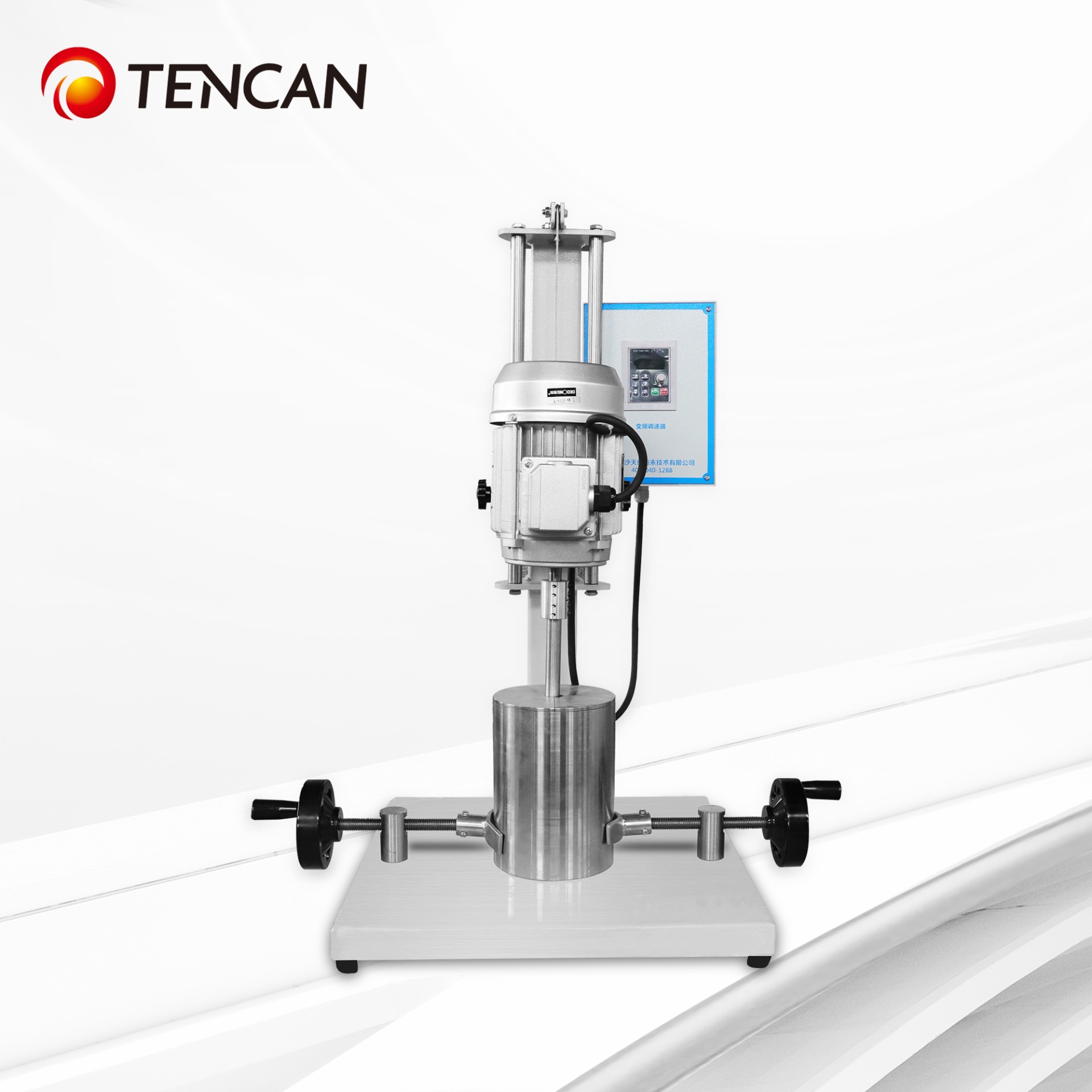
Laboratory stirred ball mills are designed for small-volume material preparation, formulation development, process testing, and grinding parameter optimization.
TENCAN JM laboratory models cover grinding chamber volumes from approximately 1 L to 20 L. Depending on the model and configuration, variable-speed operation can be used to adjust the grinding intensity.
Typical applications include:
- Universities and research institutes
- Material formulation development
- Small-batch fine and ultrafine grinding
- Grinding media comparison tests
- Wet grinding process development
- Preliminary scale-up experiments
Different contact materials can be selected according to contamination, chemical compatibility, and wear requirements. Available options may include stainless steel, nylon, alumina, zirconia, and polyurethane.
For users working with limited quantities of valuable materials, a laboratory stirred ball mill provides a practical way to study grinding parameters before moving to larger equipment.
2. Electric Lift Stirred Ball Mills
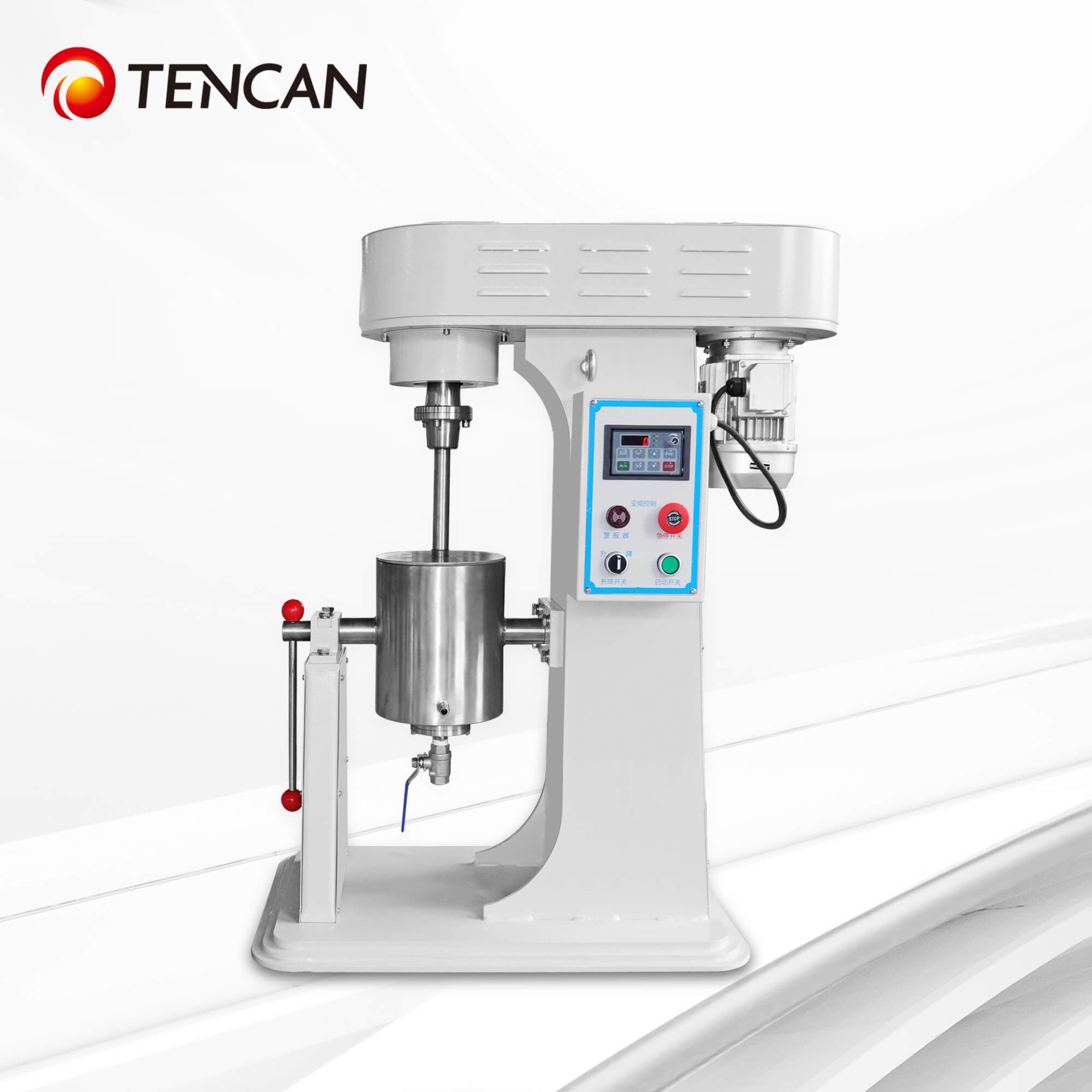
When the required batch size increases, charging grinding media, discharging material, cleaning the chamber, and maintaining the agitator become increasingly important.
TENCAN electric lift stirred ball mills use a powered lifting mechanism to raise the stirring assembly, making the grinding chamber more accessible for operation and maintenance.
The range includes configurations from approximately JM-30L to JM-200L, making these systems suitable for pilot-scale studies and medium-batch processing.
Typical advantages include:
- Convenient access to the grinding chamber
- Easier media loading and unloading
- Simplified cleaning between different materials
- Reduced manual handling of the agitator assembly
- Suitable for process scale-up from laboratory testing
- Configurations available for wet or dry grinding requirements
These mills are commonly considered for advanced ceramics, electronic materials, functional powders, fine chemicals, and other applications where laboratory results need to be transferred to a larger processing scale.
3. Production-Scale Stirred Ball Mills
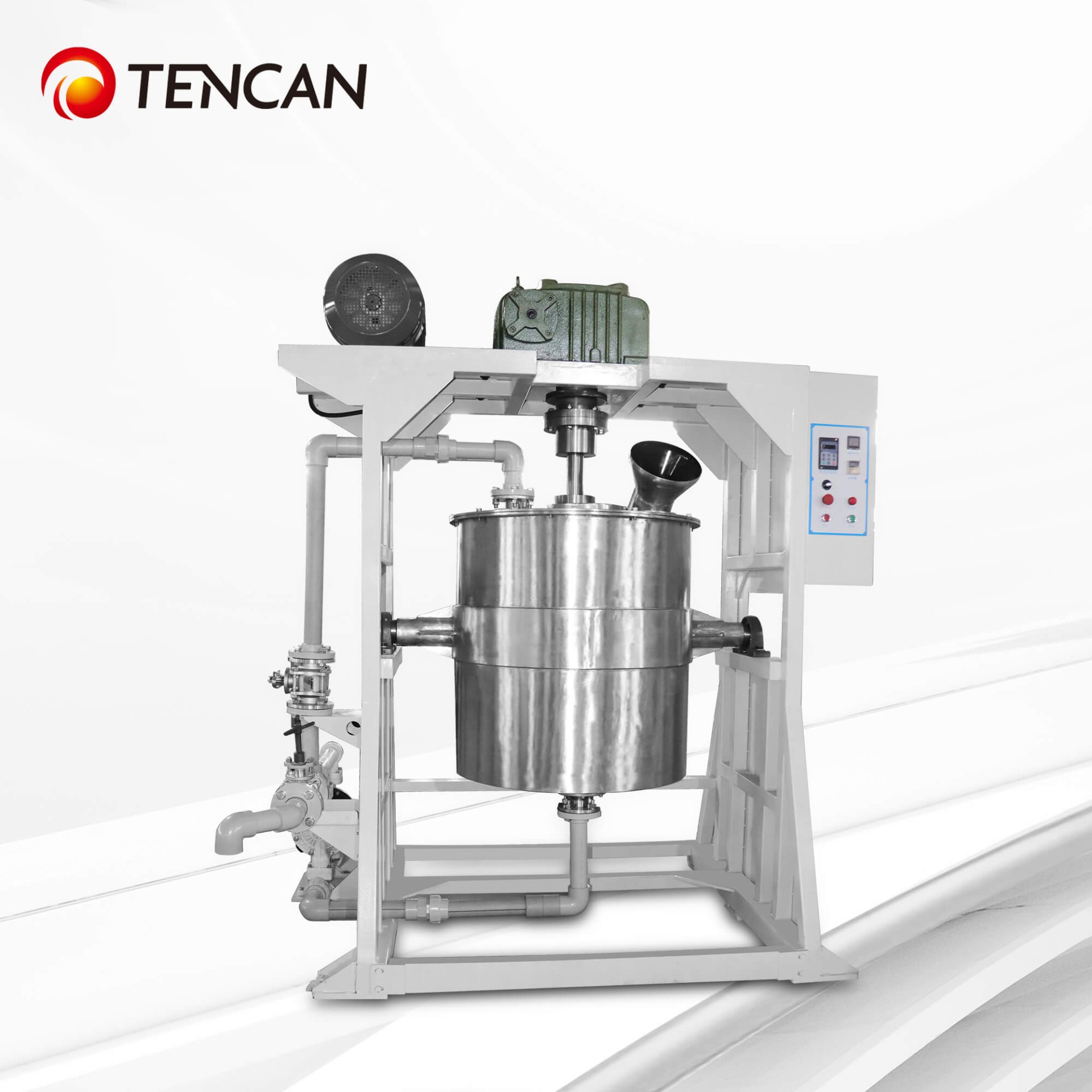
For larger-volume processing, TENCAN also provides production-scale stirred milling systems. Typical models include JM-300L, JM-500L, JM-600L and customized larger configurations.
Production equipment can be designed with reinforced mechanical components, appropriate wear-resistant contact materials, temperature-control systems, and process controls according to the intended operating conditions.
Typical applications include:
- Calcium carbonate and other industrial minerals
- Advanced ceramic powders
- Battery materials
- Pigments and coatings
- Functional fillers
- Fine chemicals
For production applications, equipment selection should not be based on chamber volume alone. Actual throughput depends strongly on material properties, feed size, slurry concentration, target fineness, grinding media, process mode, and required residence time.
4. Customized Stirred Mill Configurations
Certain materials require more than a standard grinding chamber. Depending on the process requirements, a stirred mill can be configured with additional functions.
- Jacketed grinding chamber: Allows circulating water or another temperature-control medium to manage heat generated during grinding.
- Sealed or inert-atmosphere operation: Can be considered for oxygen-sensitive or moisture-sensitive materials.
- Wear-resistant contact materials: Ceramic or polymer liners can help reduce unwanted metallic contamination.
- Customized agitator designs: Different stirring structures can be selected according to material characteristics and process requirements.
- Automation options: Larger systems may be configured with PLC or touch-screen control according to production requirements.
Key Components of a Stirred Ball Mill
A stirred mill should be considered as a complete grinding system rather than simply a motor connected to a chamber. Each component can influence final particle size, efficiency, purity, maintenance requirements, and equipment life.
Agitator and Stirrer Design
The agitator transfers mechanical energy to the grinding media. Its geometry affects flow patterns, media circulation, shear intensity, and energy distribution inside the chamber.
Common designs include:
- Disc agitators: Suitable for many general fine-grinding applications and provide relatively uniform energy distribution.
- Pin agitators: Can create more localized shear and intensive media interaction.
- Helical or screw-type agitators: Can improve axial circulation in certain chamber configurations.
The most appropriate agitator should be selected according to the material, slurry behavior, grinding media, chamber dimensions, and target particle size.
Grinding Chamber and Liner Materials
Contamination control is especially important when grinding advanced ceramics, battery materials, electronic materials, and other high-purity powders.
The chamber liner should therefore be selected according to hardness, wear resistance, chemical compatibility, and acceptable contamination level.
| Liner Material | Main Characteristics | Typical Consideration |
|---|---|---|
| Stainless Steel | Good mechanical strength and general durability | Suitable where metallic contact is acceptable |
| Alumina | High hardness and good wear resistance | Common for ceramic and metal-sensitive powder processing |
| Zirconia | High hardness, wear resistance, and density | Suitable for high-purity fine grinding applications |
| Polyurethane | Good abrasion resistance with reduced metallic contact | Suitable for selected minerals and contamination-sensitive materials |
| Nylon | Low metallic contamination and relatively lightweight | Suitable where metal contact should be minimized |
| PTFE | Good chemical resistance for selected applications | Useful when chemical compatibility is a primary concern |
How to Select Grinding Media for a Stirred Ball Mill
Grinding media selection is one of the most important factors affecting stirred milling performance.
The key parameters are media size, density, hardness, material, wear resistance, and chemical compatibility.
Grinding Media Size
Smaller grinding media create a larger number of contact points inside the chamber and are generally more suitable for fine and ultrafine grinding.
As a general process consideration:
- Media around 0.5–1 mm may be considered for relatively fine grinding applications.
- Larger media around 2–5 mm may be more suitable when the feed is coarser or more impact force is required.
However, the correct media size must be matched to the feed particle size, agitator design, material hardness, target fineness, and mill configuration.
Grinding Media Density
Media density influences the amount of energy transferred during collisions.
- Zirconia media: High density and good wear resistance; widely used for fine grinding.
- Alumina media: Good hardness and wear resistance with ceramic contact.
- Steel media: High density and strong impact energy where metallic contamination is acceptable.
- Glass or other lower-density media: May be suitable for less demanding grinding or dispersion applications.
Media and Material Compatibility
The grinding media should normally have sufficient hardness relative to the material being processed, while also meeting contamination and chemical compatibility requirements.
For example, using steel grinding media for a material that cannot tolerate iron contamination would be inappropriate, even if steel provides good grinding efficiency.
For this reason, grinding efficiency and product purity must be considered together.
Typical Applications of Stirred Ball Mills
Stirred ball mills are used across industries where fine particles, controlled particle size distribution, effective dispersion, or reduced contamination are important.
Advanced Ceramics
Materials such as alumina, zirconia, silicon carbide, and other ceramic powders often require fine particle sizes before forming, sintering, coating, or other downstream processes.
Ceramic liners and ceramic grinding media can also be selected when minimizing metallic contamination is important.
Battery Materials
Fine grinding and dispersion may be required during the preparation or development of cathode and anode materials, including materials such as LFP, NMC, graphite, and silicon-based powders.
For these applications, particle size is only one consideration. Contamination, temperature, oxidation sensitivity, and media compatibility may also need to be evaluated.
Pigments, Paints, and Coatings
Stirred media mills can be used to grind or disperse pigments and functional particles, helping achieve finer dispersion and more consistent particle distribution.
Industrial Minerals
Materials such as calcium carbonate, talc, barite, mica, and other minerals may require fine or ultrafine grinding for use in fillers, coatings, ceramics, polymers, and other industrial products.
Fine Chemicals and Functional Powders
Stirred milling can also be applied to catalysts, functional fillers, chemical powders, and other specialty materials where fine particle size and process control are required.
Wet Grinding vs. Dry Grinding
One of the first decisions when selecting a stirred ball mill is whether the material will be processed by wet grinding or dry grinding.
Wet Grinding
Stirred mills are frequently used for wet grinding because the liquid phase can assist with particle dispersion, media movement, material transport, and temperature control.
Wet grinding may be preferred when:
- Very fine particle sizes are required
- A stable slurry can be prepared
- Particle agglomeration needs to be controlled
- Heat removal is important
- The downstream process already uses a liquid suspension
Dry Grinding
Dry processing may also be possible with appropriately designed equipment, but fine dry grinding can require additional consideration of heat generation, dust control, material discharge, particle agglomeration, and powder flow behavior.
The mill configuration should therefore be confirmed according to the actual material and process instead of assuming that the same equipment setup is equally suitable for both wet and dry grinding.
How to Choose the Right Stirred Ball Mill
Selecting a stirred ball mill based only on chamber capacity can lead to poor process results. A better approach is to define the grinding requirement first and then select the equipment.
1. Define Your Batch Size or Throughput
| Processing Stage | Typical TENCAN Configuration | Typical Use |
|---|---|---|
| Laboratory | JM-1L to JM-20L | R&D, formulation, small-batch testing |
| Pilot / Medium Batch | JM-30L to JM-200L | Scale-up testing and pilot production |
| Production | JM-300L, JM-500L, JM-600L and larger | Industrial-scale processing |
Actual processing capacity should always be evaluated using the material properties and required grinding result, not only the nominal chamber volume.
2. Confirm the Feed Particle Size
A stirred mill is primarily intended for fine grinding. If the feed is too coarse, using a crusher, jaw crusher, roll crusher, or another pre-grinding machine before stirred milling may improve efficiency.
The required pretreatment depends on material hardness and the actual feed size.
3. Define the Target Particle Size
The phrase "fine powder" is not precise enough for equipment selection.
When requesting a stirred ball mill, specify the target using measurable information whenever possible, for example:
- D50 particle size
- D90 particle size
- Maximum particle size
- Micron or submicron target
- Required particle size distribution
A clear target allows the supplier to select a more appropriate media size, mill speed, chamber design, and processing method.
4. Evaluate Material Hardness and Abrasiveness
Hard and abrasive materials place greater demands on grinding media, liners, agitators, and other contact components.
For abrasive applications, wear-resistant ceramics or suitable polymer materials may provide better service life than conventional metal surfaces, depending on the process.
5. Define Your Contamination Limits
For general mineral processing, small amounts of metallic wear may be acceptable. For battery materials, high-purity ceramics, electronic powders, or other sensitive materials, it may not be.
Before selecting the mill, determine which elements or materials must be avoided.
This directly influences the selection of:
- Grinding chamber liner
- Agitator contact surface
- Grinding media
- Seals and other wetted parts
6. Confirm Wet or Dry Processing
For wet grinding, provide information about the liquid medium, solids concentration, viscosity, and chemical compatibility.
For dry processing, powder flowability, dust control, heat generation, and discharge behavior should be considered.
7. Consider Temperature Sensitivity
Fine grinding can generate heat. If the material is temperature-sensitive, a jacketed grinding chamber with circulating cooling water or another temperature-control method may be required.
8. Consider Automation Requirements
Laboratory equipment may only require basic speed and time control, while production equipment may require more advanced process controls.
Depending on the project, options can include:
- Variable-frequency speed control
- Touch-screen operation
- PLC control
- Temperature monitoring
- Motor-current monitoring
- Recipe or parameter management
- Process data recording
Information to Provide Before Requesting a Stirred Ball Mill
Providing complete process information can significantly improve equipment selection.
When contacting a stirred ball mill manufacturer, prepare the following information:
- Material name and composition
- Current feed particle size
- Required final particle size or D50/D90
- Required batch capacity or hourly throughput
- Wet or dry grinding
- Liquid medium, if wet grinding is used
- Material hardness and abrasiveness
- Maximum acceptable contamination
- Temperature sensitivity
- Required voltage and frequency
- Laboratory, pilot, or production application
- Any special requirements for sealing, cooling, or automation
This information is more useful for equipment selection than simply asking, "What size stirred ball mill do I need?"
Operating Tips for Stirred Ball Mills
Correct operating parameters depend on the specific machine and material, so the manufacturer's operating instructions should always take priority. However, several general principles are useful during process development.
Grinding Media Loading
Grinding media must occupy enough of the chamber to generate frequent particle-media contact while still allowing effective movement of the media.
The original process guidance commonly uses approximately 70–80% media loading as a starting reference, but the correct loading should be confirmed for the specific mill, media size, material, and agitator configuration.
Control Slurry Rheology
For wet grinding, excessively low solids content can reduce processing efficiency, while excessively high viscosity can restrict grinding media movement.
A solids concentration in the approximate range of 30–70% by weight may be encountered in different applications, but the appropriate value depends heavily on the material, liquid medium, dispersant, particle size, and process objective.
Increase Speed Gradually
During start-up, it is generally preferable to begin at a lower speed and increase gradually while observing motor load, temperature, vibration, slurry behavior, and grinding performance.
Sample During Process Development
Do not rely only on grinding time. Periodic particle-size measurements help determine whether additional grinding continues to provide a meaningful benefit.
Once further processing produces only a small improvement, continuing to grind may simply increase energy consumption and wear without significantly improving the final product.
Common Stirred Ball Mill Problems and Solutions
| Problem | Possible Causes | Possible Actions |
|---|---|---|
| Excessive Temperature | High speed, extended grinding, high slurry resistance, insufficient cooling | Check cooling, review slurry concentration, reduce speed if appropriate, and monitor motor load. |
| Low Grinding Efficiency | Incorrect media size, worn media, unsuitable speed, poor slurry flow | Review media selection, operating speed, solids concentration, and media condition. |
| Wide Particle Size Distribution | Inappropriate media, insufficient process control, uneven residence time | Optimize media size, grinding parameters, sampling frequency, and classification if required. |
| Excessive Wear | Highly abrasive material or unsuitable liner/media combination | Select a more wear-resistant liner and grinding media combination. |
| Unexpected Contamination | Wear from media, liner, agitator, or other contact parts | Identify the contamination source and change contact materials accordingly. |
| Poor Media Movement | Excessive viscosity or unsuitable media loading | Review slurry formulation, solids loading, media loading, and operating speed. |
Routine Maintenance
Regular inspection helps maintain consistent grinding performance and reduces unexpected downtime.
- Inspect the agitator and grinding chamber liner for wear.
- Check grinding media condition and replace heavily worn media when required.
- Inspect bearings, seals, and transmission components according to the equipment manual.
- Monitor cooling-water circulation when using a jacketed chamber.
- Clean the chamber thoroughly when changing materials to reduce cross-contamination.
- Check abnormal vibration, noise, or motor current before continuing operation.
- Inspect mechanical seals and related systems according to the machine configuration.
Frequently Asked Questions About Stirred Ball Mills
What is a stirred ball mill used for?
A stirred ball mill is mainly used for fine and ultrafine grinding, dispersion, and particle-size reduction. Typical materials include ceramics, minerals, battery materials, pigments, functional powders, and fine chemicals.
Can a stirred ball mill produce submicron particles?
Stirred milling is commonly used for micron and submicron grinding because it can operate with small grinding media and provide intensive particle-media interaction. The actual final particle size depends on the material, feed size, grinding media, operating parameters, and process conditions.
Is a stirred ball mill suitable for wet grinding?
Yes. Wet grinding is one of the most common applications for stirred ball mills. The liquid phase can assist material dispersion, heat removal, and media circulation.
Can stirred ball mills be used for dry grinding?
Dry grinding can be possible with an appropriate mill design, but powder flow, dust control, heat generation, particle agglomeration, and discharge behavior should be evaluated before selecting the configuration.
What grinding media can be used?
Common options include zirconia, alumina, steel, glass, and other grinding media. The correct choice depends on material hardness, target particle size, required impact energy, wear resistance, chemical compatibility, and contamination limits.
What size grinding media should I use?
Smaller grinding media are generally more effective for fine and ultrafine grinding, while larger media may be preferred for relatively coarse feed particles. The correct media size should be selected according to the feed size, material hardness, target fineness, and mill configuration.
How do I reduce contamination during grinding?
Select compatible grinding media, chamber liners, and agitator contact materials. For applications where metallic contamination needs to be minimized, ceramic or suitable polymer contact materials can be considered.
Do I need a laboratory test before buying a production stirred mill?
For a new material or a demanding particle-size target, laboratory or pilot testing is strongly recommended. Testing helps determine suitable grinding media, operating speed, grinding time, slurry concentration, temperature-control requirements, and expected scale-up behavior.
What information should I send to the manufacturer?
At minimum, provide the material name, feed particle size, target particle size, required capacity, wet or dry process, material hardness, contamination limits, and any temperature, sealing, or automation requirements.
Conclusion
A stirred ball mill can be an effective solution when conventional grinding equipment cannot efficiently achieve the required fine or ultrafine particle size. However, successful stirred milling depends on more than selecting a machine with the correct chamber volume.
The grinding media size and material, agitator design, liner material, operating speed, feed particle size, slurry properties, temperature, and contamination requirements all influence the final result.
For laboratory research, TENCAN offers compact JM-series stirred mills for process development and small-batch grinding. Electric lift models provide a practical transition to pilot and medium-batch processing, while larger production-scale systems can be configured for industrial powder-processing requirements.
Before selecting a stirred ball mill, define your material, feed size, target particle size, processing capacity, grinding method, and purity requirements as clearly as possible. A process-based selection will usually produce a more reliable result than choosing equipment by capacity alone.
Need help selecting a stirred ball mill?
Send us your material name, feed size, target particle size, batch capacity or hourly throughput, and whether you need wet or dry grinding. TENCAN can help evaluate a suitable grinding configuration based on your application.