
Semi-Circular Planetary Ball Mill: Design Advantages, Working Principle, and Selection Guide for Laboratory Use
Why the Semi-Circular Planetary Ball Mill Stands Out in the Lab
When you are preparing powders for materials research, the grinding equipment you choose directly affects particle size, distribution, and sample purity. Many laboratories face the challenge of achieving ultra-fine grinding while keeping the process efficient and repeatable. The semi-circular planetary ball mill addresses these needs with a design that balances high energy input, compact footprint, and operational convenience. In this article, we will walk through how this mill works, what makes its semi-circular structure beneficial, and how you can select the right configuration for your specific materials and experiments.
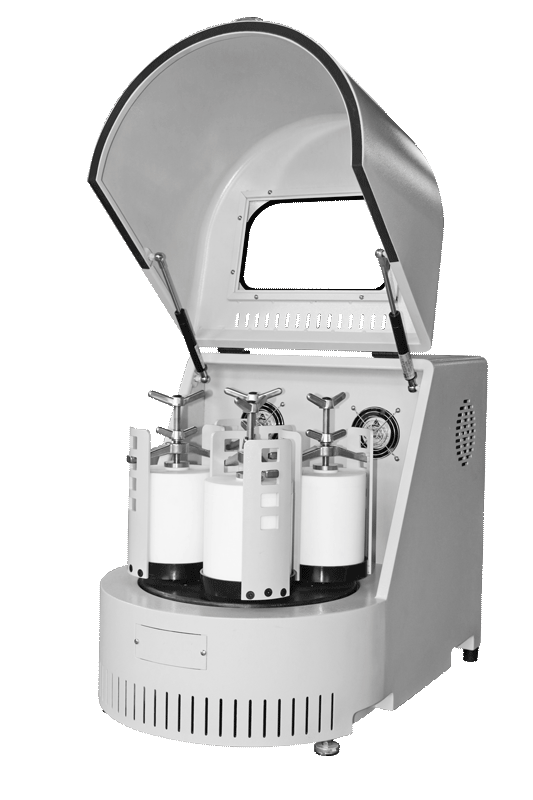
Understanding the Planetary Motion Principle
Like all planetary ball mills, the semi-circular model operates on a simple yet powerful concept: the grinding jars rotate around their own axes while simultaneously revolving around a central sun wheel. This dual motion creates a combination of high centrifugal forces and Coriolis forces that drive the grinding balls against the inner wall of the jar. The balls collide, shear, and friction against each other and the powder, generating the energy needed to break down particles into finer sizes.
In a typical laboratory planetary ball mill, the rotational speed of the sun wheel can range from around 50 rpm to 600 rpm, depending on the model. The ratio between the sun wheel speed and the jar rotation speed (often called the transmission ratio) is usually fixed at around 1:2 or 1:2.5, meaning the jar rotates twice as fast as the sun wheel. This ratio significantly influences the impact energy. For example, a higher ratio can produce stronger impacts, making it suitable for harder materials, but it also increases heat generation. The semi-circular model maintains this classic planetary geometry while introducing a structural refinement that improves stability and ease of use.
Key Design Features of the Semi-Circular Model
Structural Stability
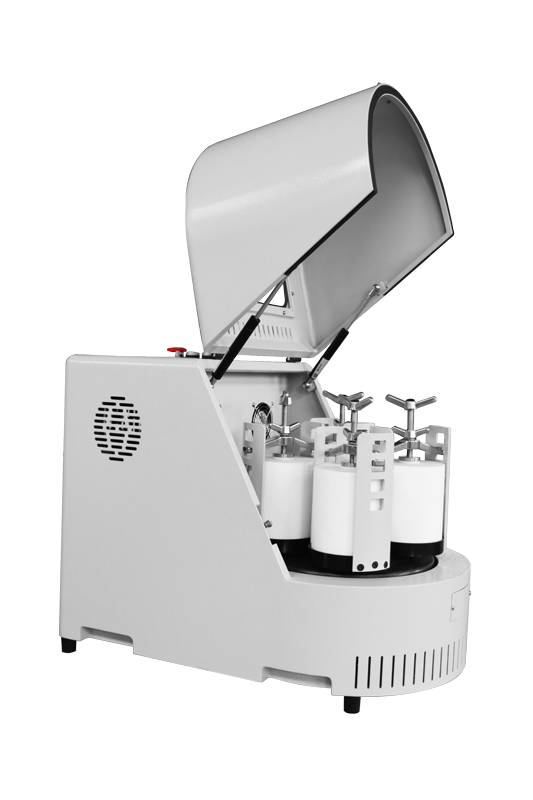
The semi-circular shape of the main body is not just aesthetic. It lowers the center of gravity of the rotating assembly, reducing vibration during high-speed operation. For researchers who run long grinding cycles—sometimes lasting several hours—this design helps maintain consistent motion and minimizes wear on the drive components. The rounded profile also allows for better air circulation around the jars, which can assist in passive cooling during extended runs.
Enhanced Jar Accessibility
One common frustration in laboratory ball mills is the difficulty of removing and installing grinding jars, especially when the machine is placed on a bench. The semi-circular layout typically provides a wider opening, giving you more room to handle the jars with gloved hands. This is particularly valuable when working with heavy or fragile jars made of materials like zirconia or agate. The accessible design also simplifies cleaning between different samples, reducing the risk of cross-contamination.
Compact Footprint
Laboratory space is often limited. The semi-circular planetary ball mill is designed to fit on a standard benchtop without sacrificing the capacity for multiple jars. Most models offer two or four jar stations, with individual jar volumes ranging from 50 ml to 1 L. This allows you to process several samples simultaneously or scale up the batch size while keeping the machine within a small area.
Selecting the Right Grinding Jar and Media
Choosing the jar material and grinding balls is one of the most critical decisions for achieving your target particle size and avoiding contamination. The table below summarizes common options and their typical applications:
| Jar Material | Hardness | Common Applications | Contamination Risk |
|---|---|---|---|
| Stainless Steel | High | Hard minerals, ores, metals | Iron, chromium (possible) |
| Zirconia (Y₂O₃ stabilized) | Very High | Ceramics, electronic materials, battery powders | Low (zirconium trace) |
| Alumina (99% Al₂O₃) | High | Oxide ceramics, catalysts | Low (aluminum) |
| Agate (natural SiO₂) | Moderate | Soft to medium-hard materials, geological samples | Very low (silica) |
| Nylon / PTFE | Low | Temperature-sensitive materials, organic compounds | Minimal |
The grinding ball size should be matched to the initial feed size and the desired final fineness. As a practical reference, balls of 10–20 mm diameter are often used for breaking down coarse particles (e.g., >1 mm), while balls of 3–5 mm are more effective for fine grinding and dispersion. The ball-to-powder weight ratio (BPR) commonly ranges from 5:1 to 20:1 in mechanical alloying and ultra-fine grinding experiments. You may need to adjust this ratio based on the material density and the jar volume.
Wet Grinding vs. Dry Grinding: Which to Choose?
Whether you grind wet or dry depends on the material properties and your final goal. Dry grinding is simpler and avoids the need for solvent removal, but it can lead to particle agglomeration, especially for very fine powders. Wet grinding, using a liquid such as ethanol, water, or isopropanol, can reduce agglomeration and improve homogenization. The liquid also helps dissipate heat, which is beneficial for heat-sensitive materials. In the semi-circular planetary ball mill, the jar sealing is critical for wet grinding—most models come with a gasket or O-ring seal to prevent leakage. If you plan to use organic solvents, ensure the jar material and seal are chemically compatible.
Key Parameters to Consider When Selecting a Semi-Circular Planetary Ball Mill
When you are evaluating a specific model, here are the factors that will influence your daily work:
- Maximum Rotational Speed: Higher speeds generate more impact energy, but also increase temperature and wear. A speed range of 100–600 rpm is common for lab units.
- Number of Stations: Most semi-circular models have 2 or 4 stations. Four stations allow parallel processing of different samples, but two-station versions often have larger individual jar capacities.
- Jar Volume Range: Check the available jar sizes. Some manufacturers offer a family of jars from 50 ml to 1 L that fit the same machine.
- Programmable Control: Many modern planetary ball mills allow you to set forward/reverse rotation, pause intervals, and total running time. This is useful for materials that tend to settle or stick to the jar walls.
- Safety Features: Look for a safety interlock that stops the machine when the lid is opened. A lockable clamping mechanism for the jars is also important to prevent accidents during high-speed rotation.
- Voltage and Frequency: Confirm that the machine matches your local electrical supply (e.g., 110V/60Hz or 220V/50Hz).
Common Applications in Research and Industry
The semi-circular planetary ball mill is widely used in the following fields:
- Materials Science: Preparing nano-sized powders for ceramics, composites, and catalysts.
- Battery Research: Grinding electrode materials, solid electrolytes, and mixing active materials with conductive additives.
- Geology and Mining: Pulverizing rock samples, ores, and minerals for elemental analysis.
- Pharmaceuticals: Reducing particle size of active pharmaceutical ingredients (APIs) to improve bioavailability.
- Chemical Engineering: Mechanochemical synthesis, mechanical alloying, and activating chemical reactions.
In each case, the ability to control the grinding atmosphere—by using vacuum or inert gas—can be critical. The semi-circular model can be equipped with vacuum jars or purged with argon/nitrogen to protect oxygen-sensitive or moisture-sensitive materials.
How to Get the Most Out of Your Planetary Ball Mill
Even with the right equipment, achieving consistent results requires attention to a few operational details:
- Balance the Jars: Always load the jars with similar weight and distribution to avoid excessive vibration. If you are using only two jars, place them opposite each other.
- Use the Correct Ball Filling Ratio: Typically, the grinding balls should occupy about 30–50% of the jar volume. The remaining space is for the powder and, in wet grinding, the liquid.
- Monitor Temperature: For materials that degrade or change phase at elevated temperatures, use intermittent grinding cycles (e.g., 10 minutes run, 5 minutes pause) to allow cooling.
- Clean the Jar Properly: After each experiment, clean the jar and balls thoroughly to avoid cross-contamination in subsequent runs. Ultrasonic cleaning can be helpful for removing fine powder residues.
By following these practices, you can improve the reproducibility of your grinding results and extend the service life of the mill and accessories.
Final Thoughts on the Semi-Circular Planetary Ball Mill
The semi-circular planetary ball mill is a well-thought-out laboratory tool that combines the proven high-energy planetary mechanism with a more stable and user-friendly structure. Whether you are working on nano-materials, battery components, or geological samples, this type of mill offers the flexibility to handle a wide range of materials and grinding conditions. When selecting a model, pay attention to the jar material, speed range, and programmable features that match your specific research needs. With careful parameter optimization, you can achieve the fine particle sizes and consistent results that your experiments demand.