
Product features
V-shaped vessel
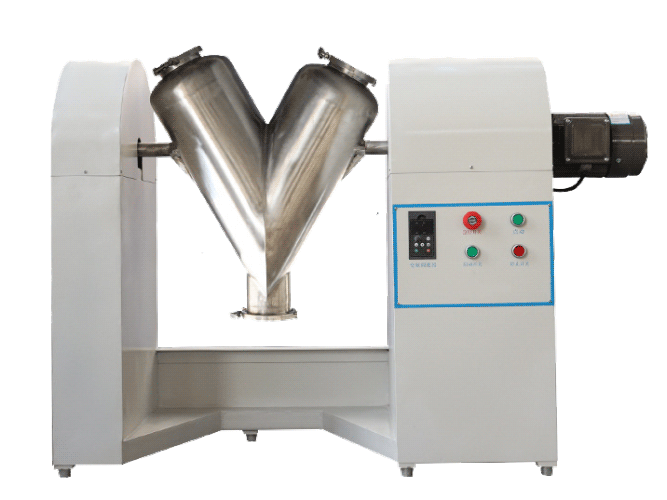
The two inclined vessel arms repeatedly divide and recombine the charge during rotation.
Gentle batch movement
Tumbling blends free-flowing powders or granules without an internal high-shear mixing tool.
Contact surface choices
The source describes polished vessels and alternative materials; select the contact surface for the formulation.
Timed mixing
A timer supports repeatable run settings once the blend endpoint has been established experimentally.
Applications
Dry formulations
Blend two or more dry ingredients with suitable flow properties, especially where particle size and density are similar.
Granule blending
Evaluate a tumbling process when preserving granule integrity is an important part of the specification.
Electronic and ceramic powders
Compare composition uniformity while controlling vessel carryover and the handling of fine powder.
Evaluating results
Composition uniformity
Take samples from defined positions and compare component concentrations rather than relying on appearance.
Particle preservation
Check the fine fraction before and after blending to detect unwanted granule breakdown.
Discharge consistency
Sample the beginning and end of discharge to identify segregation after the blending stage.
These are evaluation points for a sample trial, not measured results for a specific sample. Confirm performance under your actual operating conditions.
How it works
Batch charging
Load the specified quantity into the V-shaped vessel, allowing sufficient space for the material to move.
Splitting and merging
Rotation transfers material between the two inclined arms, dividing and recombining the powder bed.
Diffusion blending
Repeated sliding and redistribution mix the ingredients until the validated time or endpoint is reached.
Construction and configuration
Twin-arm vessel
The asymmetrical pair of cylindrical arms creates the characteristic dividing and merging action.
Smooth internal surfaces
Polished surfaces and smooth transitions support cleaning and inspection between formulations.
Drive and timer
The mechanical drive rotates the vessel, while the timer provides a reproducible operating duration.
More product images


Technical specifications
Compare the listed specifications and configurations. Scroll horizontally to view the complete table.
Specification table 1
| Model | Fixed speed (r/min) ±2 | Motor power (kW) | Motor poles | Supply voltage | Maximum charge (L) | Discharge height above floor (mm) | Reference machine weight (kg) | Overall dimensions (mm) |
|---|---|---|---|---|---|---|---|---|
| V-5 | 50 | 0.37 | 4 | Single phase 220 V | 2.5 | 390 | 78 | Approx. 1060 × 410 × 890 |
| V-10 | 50 | 0.37 | 5 | 340 | 82 | Approx. 1060 × 410 × 890 | ||
| V-20 | 34 | 0.75 | 10 | 350 | 139 | Approx. 1360 × 480 × 980 | ||
| V-50 | 34 | 1.5 | 25 | 400 | 200 | Approx. 1680 × 510 × 1270 | ||
| V-100 | 34 | 2.2 | Three phase 380 V | 50 | 400 | 280 | Approx. 1570 × 475 × 1500 | |
| V-200 | 24 | 3 | 100 | 400 | 379 | Approx. 1980 × 770 × 1680 | ||
| V-300 | 20 | 4 | 150 | 410 | - | Approx. 2000 × 800 × 1800 | ||
| V-400 | 12 | 5.5 | 200 | 420 | - | Approx. 2300 × 1000 × 2000 | ||
| V-500 | 12 | 7.5 | 250 | 430 | - | Approx. 3120 × 1850 × 2130 |
Confirm the selected model, power supply, contact materials and operating conditions before ordering. Performance depends on the material and process.