
Ultrasonic Planetary Ball Mill: Working Principle & Selection Guide
Ultrasonic Planetary Ball Mill: Working Principle, Applications and Selection Guide
Fine grinding becomes more difficult when particle size decreases and the powder begins to agglomerate, settle, stick to the jar wall or form hard secondary clusters. In these cases, simply increasing planetary-mill speed or extending grinding time may not solve the real process problem.
An ultrasonic planetary ball mill adds an ultrasonic vibration system to a conventional high-energy planetary mill. The planetary motion provides mechanical impact, friction and shear, while ultrasonic vibration assists material movement and dispersion. This combination is designed for applications where particle-size reduction and deagglomeration must be controlled at the same time.
Quick answer: TENCAN's current ultrasonic planetary ball mill combines planetary mechanical grinding with ultrasonic-assisted dispersion. The product specification lists two or four grinding jars operating simultaneously, a maximum combined material-plus-ball loading of 2/3 of jar volume, feed size of ≤10 mm for soil and ≤3 mm for other materials, a typical revolution-to-rotation ratio of 1:2, and a minimum discharge particle size that can reach approximately 0.1 μm under suitable conditions. Actual fineness varies with material and grinding process.
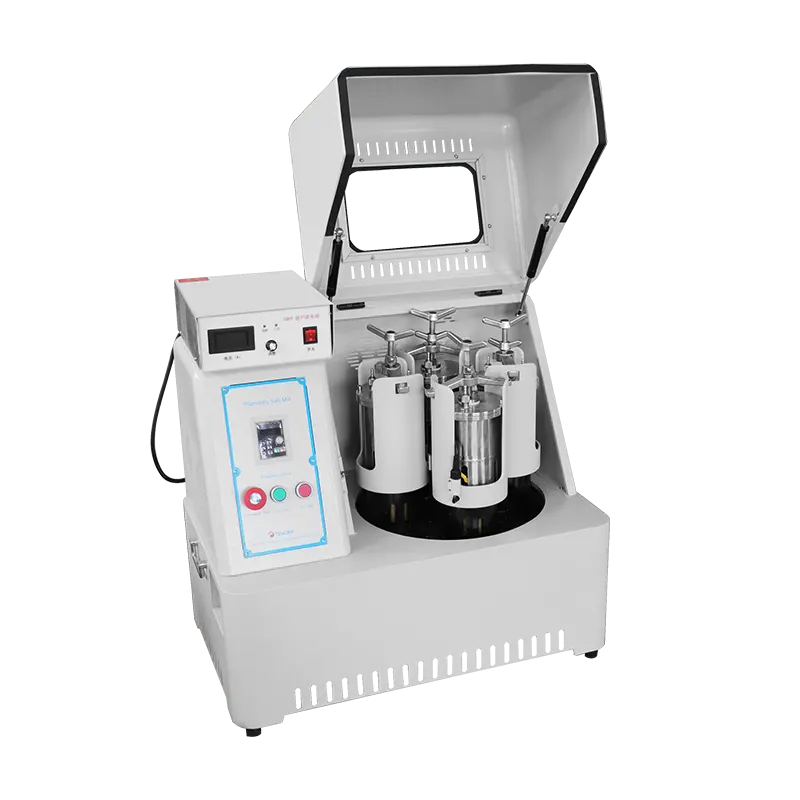
What Is an Ultrasonic Planetary Ball Mill?
A standard planetary ball mill uses grinding jars that rotate around their own axes while simultaneously revolving around a central disk. This compound motion produces repeated impact, friction and shear between the grinding balls, jar wall and sample.
An ultrasonic planetary ball mill adds a second energy mechanism: high-frequency mechanical vibration transmitted to the grinding system. In liquid-containing systems, this vibration can generate cavitation and acoustic-flow effects that help break up agglomerates and keep particles moving through the grinding zone.
TENCAN describes the system as a combination of:
- Planetary mechanical grinding for size reduction
- Ultrasonic-assisted dispersion for deagglomeration and improved material movement
This means ultrasound is not a replacement for the grinding balls. It is an additional process tool that works alongside mechanical milling.
How the TENCAN Ultrasonic Planetary Ball Mill Works
1. Planetary Motion Provides the Main Grinding Energy
The main disk revolves around the machine axis while each grinding jar rotates around its own axis. The current TENCAN product page lists a typical revolution-to-rotation ratio of 1:2.
This motion causes the grinding media to repeatedly impact, slide and shear the sample. Coarser particles are fractured and progressively refined as the grinding cycle continues.
2. Ultrasonic Vibration Assists Dispersion
The ultrasonic system includes a generator, transducer and conductive slip-ring arrangement. TENCAN lists a common ultrasonic frequency range of approximately 20–40 kHz.
In a liquid medium, ultrasonic vibration can create two useful effects:
- Cavitation: microscopic bubbles form and collapse, producing localized shock effects that can help break weak particle agglomerates.
- Acoustic flow: liquid circulation improves material movement and can help reduce settling and wall sticking.
3. Mechanical Grinding and Ultrasonic Dispersion Work Together
The planetary mechanism continuously reduces particle size, while ultrasonic assistance acts on particle clusters and slurry movement. The combination is particularly relevant when a standard planetary process reaches a point where further grinding causes secondary agglomeration rather than useful refinement.
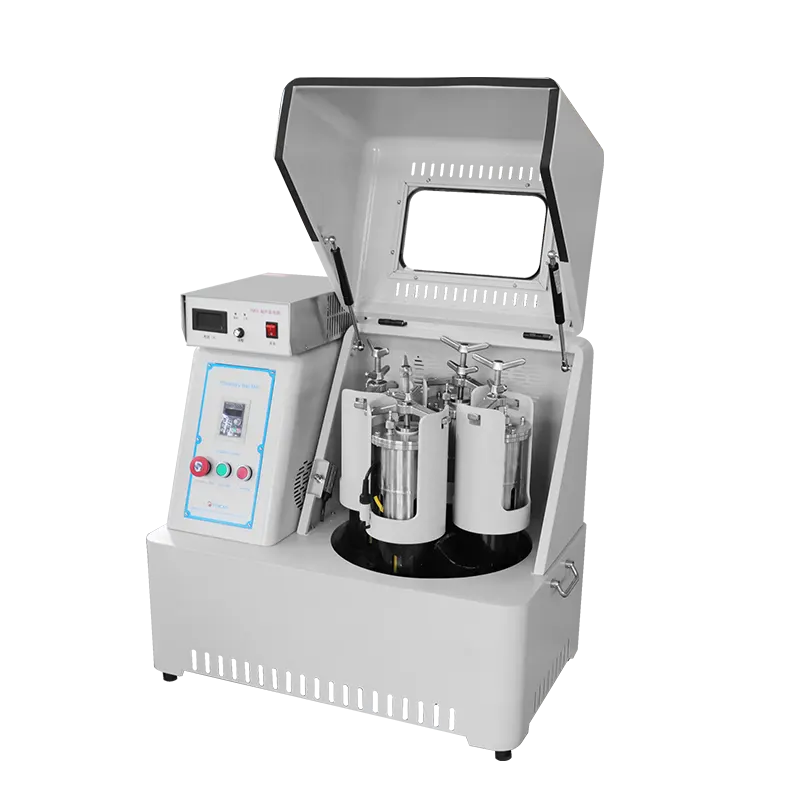
Current TENCAN Technical Parameters
The following values are based on the current TENCAN ultrasonic planetary ball mill product page. Exact configuration should be confirmed for the selected machine before ordering.
| Parameter | Published Specification | Selection Note |
|---|---|---|
| Transmission | Gear transmission | Planetary drive system |
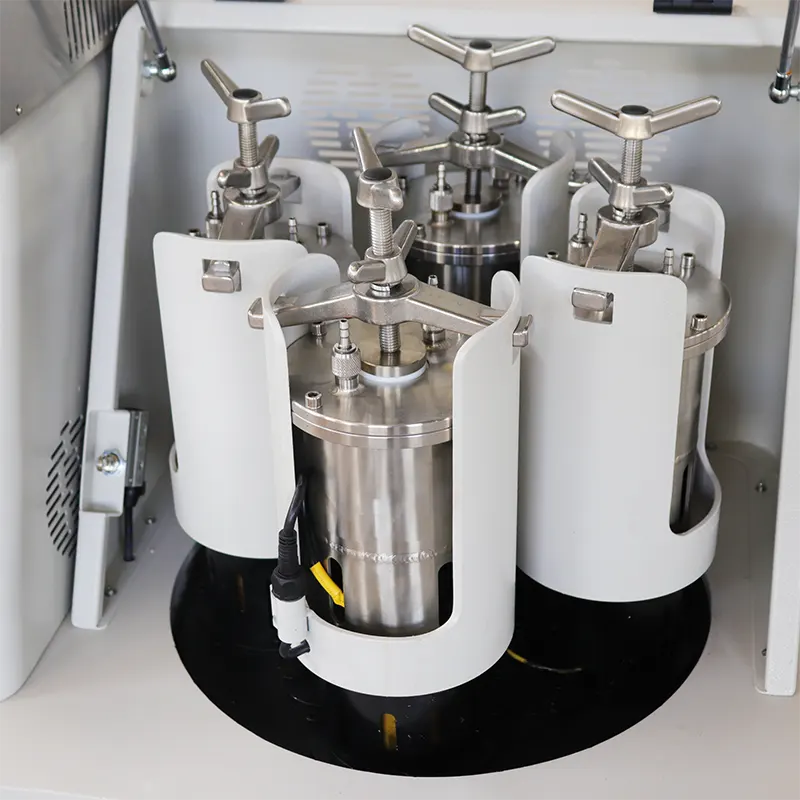
| Working method | Two or four grinding jars simultaneously | Useful for parallel sample preparation |
| Maximum combined loading | Material + grinding balls ≤ 2/3 of jar volume | Leave enough free volume for media movement |
| Jar capacity | Product page lists individual jars up to 50 L and total system capacity up to 200 L | Confirm exact jar combination for the selected model |
| Feed size | Soil ≤10 mm; other materials ≤3 mm | Pre-crushing may be required for larger feed |
| Minimum discharge size | Can reach approximately 0.1 μm | Varies with material and grinding process |
| Revolution : rotation ratio | 1:2 | Reference planetary-motion ratio |
| Example rotation speed | XQM-6: 0–670 rpm | Other models may differ |
| Speed control | Inverter stepless regulation | Allows process adjustment for different materials |
| Typical ultrasonic frequency | 20–40 kHz | Actual configuration depends on the system |
Can It Really Produce Nanometer-Scale Powder?
The current TENCAN specification states that the minimum discharge particle size can reach approximately 0.1 μm (100 nm) under suitable conditions.
That figure should not be interpreted as a guaranteed result for every material. Final particle size depends on:
- Material hardness and fracture behavior
- Initial feed size
- Grinding jar material
- Grinding-ball material, density and diameter
- Ball-to-material ratio
- Combined loading level
- Planetary speed
- Grinding time
- Dry or wet process
- Slurry solids content and viscosity
- Ultrasonic coupling and operating settings
- Temperature during milling
- Whether the measured value represents primary particles or agglomerates
Important: Do not treat “ultrasonic” as a guarantee of sub-100 nm grinding. If a specific D10, D50, D90 or nano-scale target is critical, verify the result with the actual material through a sample-grinding test.
Why Ultrasonic Assistance Can Help with Agglomeration
At fine particle sizes, surface energy becomes increasingly important. Particles can form soft or hard clusters, especially in wet suspensions and high-surface-area powders. A standard planetary mill may continue to supply strong mechanical energy while the newly created fine particles simultaneously re-agglomerate.
Ultrasonic assistance can be useful when the main problem becomes:
- Secondary agglomeration after fine grinding
- Dense particles settling to the bottom of the jar
- Material sticking to the jar wall
- Uneven slurry circulation
- Difficult dispersion of high-surface-area powders
- Mixed grinding and dispersion in the same process step
This is the main reason to consider an ultrasonic planetary mill instead of simply selecting a faster standard planetary mill.
Wet Grinding vs. Dry Grinding: Where Does Ultrasound Matter Most?
The product page lists compatibility with dry powders, aqueous slurry, organic-solvent suspensions, high-viscosity pastes and biological wet materials. However, the cavitation mechanism is most directly relevant when a liquid medium is present.
For dry powder processing, high-frequency vibration can still influence particle and jar movement, but buyers should not assume the same cavitation-based dispersion mechanism that occurs in a liquid slurry.
| Process | Potential Benefit | Main Variables |
|---|---|---|
| Wet slurry | Cavitation and acoustic-flow effects can assist deagglomeration and circulation | Solids content, viscosity, liquid type, ultrasonic coupling, temperature |
| High-viscosity paste | Additional vibration may help material movement | Viscosity, filling level, media size and heat generation |
| Dry powder | High-frequency vibration may assist powder movement | Powder flowability, electrostatics, agglomeration and jar/media selection |
Ultrasonic Planetary Ball Mill vs. Standard Planetary Ball Mill
Both machines use high-energy planetary motion. The ultrasonic version adds a dispersion mechanism that becomes valuable when the process is limited by agglomeration or slurry movement rather than by insufficient mechanical energy alone.
| Comparison | Standard Planetary Ball Mill | Ultrasonic Planetary Ball Mill |
|---|---|---|
| Main mechanism | Planetary impact, friction and shear | Planetary impact + ultrasonic-assisted dispersion |
| Best starting point | General high-energy fine grinding, mixing and homogenization | Fine grinding where agglomeration, settling or wall sticking is difficult to control |
| Wet dispersion | Depends mainly on mechanical mixing and media movement | Ultrasonic vibration adds cavitation/acoustic-flow effects in liquid systems |
| System complexity | Simpler | Adds ultrasonic generator, transducer and conductive components |
| Selection priority | Grinding energy and particle-size reduction | Particle-size reduction plus dispersion/deagglomeration |
If your material already grinds cleanly without serious settling or agglomeration, a standard laboratory planetary ball mill may be sufficient.
Ultrasonic Planetary Ball Mill vs. Stirred Ball Mill
A stirred ball mill uses a stationary grinding chamber filled with small grinding media and a rotating agitator. It is often selected for wet ultra-fine grinding, dispersion and process development where a stirred-media mechanism is preferred.
An ultrasonic planetary mill is a different architecture: the entire grinding jar participates in planetary rotation while ultrasound assists dispersion.
Consider a lab stirred ball mill when the process is primarily wet, requires a stirred-media approach or needs features such as circulation and jacketed temperature control. Consider an ultrasonic planetary mill when planetary high-energy impact and ultrasonic-assisted dispersion are both needed in the same batch process.
Where an Ultrasonic Planetary Ball Mill Is Useful
1. Battery and New-Energy Materials
The current TENCAN product page lists lithium iron phosphate, ternary cathode materials, silicon-carbon anodes and fuel-cell catalyst materials among the application areas. The main process value is the combination of fine grinding and uniform mixing.
For battery-related work, jar and media contamination should be evaluated carefully because Fe, Cr, Ni, Al, Zr or other wear elements may affect the formulation.
2. Electronic Ceramics and Functional Powders
MLCC dielectric materials, piezoelectric ceramics, ferrites, magnetic materials and rare-earth polishing powders can require both particle-size control and good dispersion. Ultrasound can be considered when conventional fine grinding produces persistent agglomerates.
3. Catalysts, Pigments and Coatings
Catalyst powders, pigments and coating suspensions often require uniform dispersion in addition to size reduction. Wet-process viscosity and solvent compatibility should be defined before selecting the jar, media and ultrasonic settings.
4. Minerals, Glass and Ceramic Samples
TENCAN also lists ores, slag, glass, ceramics and other brittle or fibrous materials for laboratory sample preparation and ultra-fine grinding. For coarse feed, pre-crushing may be more efficient before the sample enters the planetary mill.
5. Selected Pharmaceutical and Biological R&D
The manufacturer lists drug micronization and biological wet-material applications. For these fields, the equipment should be evaluated as a research grinding device rather than assuming regulatory compliance, sterility or a guaranteed pharmaceutical performance outcome.
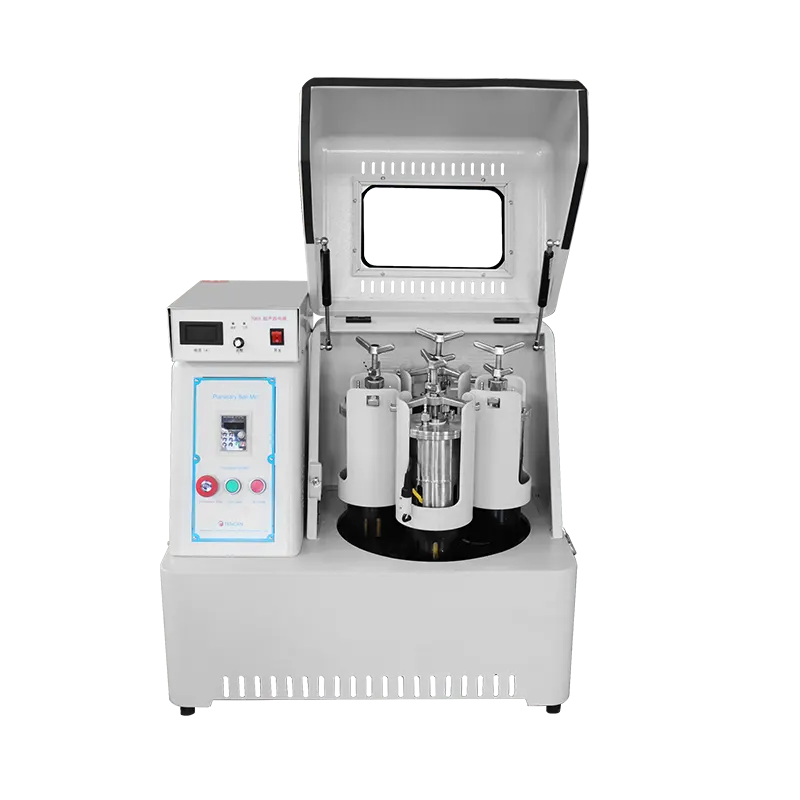
Grinding Jar and Media Selection
The jar and grinding balls are in direct contact with the sample, so material compatibility should be treated as part of the process—not as an accessory decision.
| Material | Main Characteristic | What to Check |
|---|---|---|
| Zirconia | High hardness, high density, strong wear resistance | Whether Zr contamination is acceptable |
| Corundum / Alumina | Hard non-metallic ceramic | Whether Al contamination is acceptable |
| Agate | Low metal contact and useful for selected analytical samples | Brittleness and feed hardness |
| Stainless Steel | Durable and economical | Fe / Cr / Ni contamination |
| Tungsten Carbide | Very hard and dense | W / Co contamination and high media mass |
| PTFE / Nylon / PU | Low metal contact and good compatibility with selected materials | Wear, solvent compatibility and temperature |
Temperature Management
Planetary milling generates heat through friction and repeated collision. Ultrasonic vibration can add further thermal load, especially during long wet-grinding cycles.
For heat-sensitive materials:
- Use a lower initial speed and optimize upward
- Use programmed grinding/rest cycles if the process allows
- Monitor jar or sample temperature
- Reduce unnecessary ultrasonic duty if dispersion is already adequate
- Use a temperature-control configuration when required
TENCAN states that some ultrasonic planetary configurations can include temperature control. If strict cooling is the primary requirement, compare the process with a dedicated low-temperature planetary grinding machine.
How to Optimize an Ultrasonic Planetary Milling Process
Step 1: Define the Target Clearly
Specify whether the real objective is:
- Smaller D50 or D90
- Breaking soft agglomerates
- Preventing sedimentation
- Improving slurry uniformity
- Reducing wall sticking
- Mixing several powders more uniformly
These are different process problems and may require different settings.
Step 2: Establish a Baseline Without Overusing Ultrasound
Start with a reasonable planetary-milling condition and record the particle-size distribution, slurry behavior and temperature. This gives you a reference for determining whether ultrasonic assistance is actually improving the process.
Step 3: Select Jar and Media Materials
Match jar and ball material to the sample chemistry and contamination tolerance before optimizing speed or ultrasonic settings.
Step 4: Set the Loading Correctly
The current product specification limits the combined material and grinding-ball loading to approximately two-thirds of jar volume. Overfilling reduces free movement and can make both mechanical grinding and dispersion less effective.
Step 5: Optimize Ball Size and Size Distribution
Larger balls provide stronger individual impacts, while smaller media provide more contact points. There is no single ball diameter that guarantees a particular nano-scale particle size.
Step 6: Optimize Planetary Speed
Increase speed only until the required impact and circulation are achieved. Excessive speed can increase heat and media wear without producing a proportional improvement in final particle size.
Step 7: Add Ultrasonic Assistance as a Process Variable
Evaluate whether ultrasound reduces visible agglomeration, sedimentation, wall sticking or particle-size spread. Avoid assuming that maximum ultrasonic output is automatically the optimum setting.
Step 8: Monitor Temperature
Record sample or jar temperature together with speed, time and ultrasonic settings. Temperature changes can alter slurry viscosity, dispersion and material properties.
Step 9: Measure the Product Correctly
Use a particle-size method appropriate to the material and size range. For nano-scale suspensions, measurement conditions and dispersion preparation can strongly affect the reported result.
Parameters That Should Be Optimized Experimentally
Avoid publishing one universal formula such as “10–30 wt% solids,” “5:1–20:1 BPR” or a fixed bead-size-to-particle-size chart for every sample. These values can vary substantially from one material system to another.
Instead, optimize the following as a group:
- Solids concentration
- Slurry viscosity
- Liquid or solvent type
- Dispersant or binder, if used
- Jar material
- Ball material
- Ball diameter and size distribution
- Ball-to-material ratio
- Combined jar filling level
- Planetary speed
- Grinding time
- Ultrasonic frequency/power configuration
- Ultrasonic operating mode or duty
- Temperature
When Is an Ultrasonic Planetary Ball Mill Worth Choosing?
- The material repeatedly agglomerates as it becomes finer.
- The slurry settles or forms a hard layer at the bottom of the jar.
- Material frequently sticks to the jar wall.
- Particle-size distribution becomes difficult to narrow using mechanical milling alone.
- Wet dispersion quality is as important as particle-size reduction.
- You need two or four parallel high-energy grinding jars.
- You need vacuum or inert-gas-compatible grinding with an appropriate jar.
- A standard planetary test already shows that grinding energy is sufficient but dispersion remains the limiting factor.
When a Standard Planetary or Stirred Mill May Be Enough
A standard planetary mill may be the better choice when:
- The material grinds cleanly without serious agglomeration.
- Dry grinding is the main process and dispersion is not a major problem.
- Simple high-energy sample preparation is the main objective.
A stirred ball mill may be the better choice when:
- The process is predominantly wet.
- Small grinding media and stirred-media action are preferred.
- Circulation or jacketed temperature control is more important than planetary impact.
Common Selection and Operation Mistakes
Mistake 1: Assuming Ultrasound Guarantees Sub-100 nm Powder
The current TENCAN specification states that approximately 0.1 μm can be reached under suitable conditions. The actual result must be verified for the material and process.
Mistake 2: Treating Frequency Alone as the Main Performance Number
Frequency is only one part of the process. Energy coupling, sample volume, slurry properties, jar design and planetary settings also matter.
Mistake 3: Ignoring Slurry Rheology
A very viscous slurry may respond differently to ultrasonic vibration than a low-viscosity suspension. Solids loading and viscosity should be optimized experimentally.
Mistake 4: Overfilling the Grinding Jar
Too little free volume restricts media motion. Follow the equipment loading limit and leave enough space for effective grinding.
Mistake 5: Ignoring Temperature Rise
Mechanical and ultrasonic energy both contribute to heat. Heat-sensitive materials require temperature monitoring and appropriate process control.
Mistake 6: Choosing Media Only by Hardness
The hardest media is not always the best. Contamination tolerance, density, wear and sample chemistry must also be considered.
Mistake 7: Publishing Unverified Percentage Improvements
Claims such as “50% faster,” “60–80% lower D90” or “40% higher performance” are only meaningful when supported by a defined material, equipment configuration and test method. For customer-facing selection, verified process data is more useful than generic percentages.
What Information Should You Send Before Requesting a Quotation?
- Material name and composition
- Initial feed size
- Target D50 / D90 or other particle-size requirement
- Required batch quantity
- Dry powder, aqueous slurry, solvent suspension or paste
- Slurry solids content and approximate viscosity, if wet
- Contamination elements that must be avoided
- Whether vacuum or nitrogen/argon protection is required
- Whether the material is heat-sensitive
- Local voltage and frequency
For a demanding nano-scale target, sending a representative sample for test grinding is often more useful than selecting a machine only from catalog specifications.
FAQ: Ultrasonic Planetary Ball Mills
What is an ultrasonic planetary ball mill?
It is a planetary ball mill that combines high-energy jar rotation/revolution with an ultrasonic vibration system to provide mechanical grinding plus ultrasonic-assisted dispersion.
What is the main advantage of adding ultrasound?
The main process advantage is improved control of agglomeration, settling and wall sticking, especially in liquid-containing systems where cavitation and acoustic flow can assist dispersion.
What minimum particle size can the TENCAN ultrasonic planetary ball mill reach?
The current TENCAN product specification states that the minimum discharge particle size can reach approximately 0.1 μm, with different materials and grinding processes producing different results.
What ultrasonic frequency does it use?
TENCAN lists a common ultrasonic frequency range of approximately 20–40 kHz. Exact configuration should be confirmed for the selected model.
Can it process dry powder?
The product page lists dry powder as a supported material form. However, ultrasonic cavitation specifically requires a liquid medium, so the effect of ultrasound in dry processing is different from wet-slurry dispersion.
Can it be used with inert gas or vacuum?
TENCAN states that the machine can be used with suitable vacuum grinding jars and nitrogen or argon protection for materials that are easily oxidized or hydrolyzed.
How full should the grinding jar be?
The current specification lists the maximum combined loading of material plus grinding balls as approximately two-thirds of the grinding-jar volume.
Should I choose an ultrasonic planetary mill or a standard planetary mill?
Choose the ultrasonic version when agglomeration, slurry settling, wall sticking or dispersion is a major process limitation. If the material grinds well using mechanical planetary motion alone, a standard planetary mill may be sufficient.
What if my material is very heat-sensitive?
Discuss temperature-control options and grinding/rest cycles before selection. If low-temperature milling is the primary requirement, compare the process with a dedicated low-temperature planetary grinding machine.
Conclusion
An ultrasonic planetary ball mill should not be viewed simply as a “more powerful” conventional ball mill. Its main value is the combination of high-energy planetary grinding and ultrasonic-assisted dispersion.
TENCAN's current system supports two or four simultaneous grinding jars, inverter speed control, vacuum/inert-gas-compatible processes, a typical 1:2 revolution-to-rotation ratio and a published minimum discharge particle size of approximately 0.1 μm under suitable conditions.
The technology is most useful when the challenge is no longer only particle fracture, but also agglomeration, settling, wall sticking, slurry circulation and dispersion uniformity. For these applications, comparing a standard planetary baseline with ultrasonic-assisted milling is a practical way to determine whether the additional ultrasonic system creates a real process advantage.
Need help evaluating an ultrasonic planetary ball mill?
Send TENCAN your material, feed size, target particle size, batch quantity, wet/dry process, slurry viscosity, contamination limits and temperature requirements. Contact TENCAN for a suitable grinding configuration »