
Cryogenic Planetary Ball Mill for Electronic Ceramics
Cryogenic Planetary Ball Mill for Electronic Ceramics: Low-Temperature Grinding Guide
Electronic ceramics such as dielectric ceramics, piezoelectric ceramics, ferrites, alumina, zirconia and other functional ceramic powders often require tight control of particle size, contamination and process temperature. During high-energy planetary milling, repeated impact and friction between the grinding balls, powder and jar can generate significant heat. For heat-sensitive formulations, this temperature rise may change powder behavior, increase sticking or agglomeration, or make it more difficult to maintain repeatable grinding conditions.
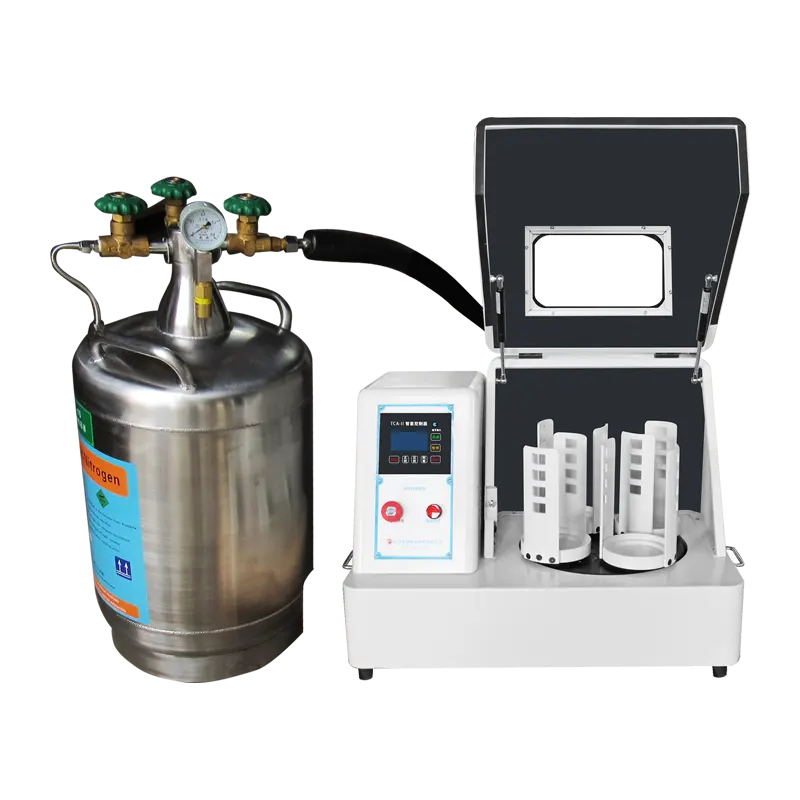
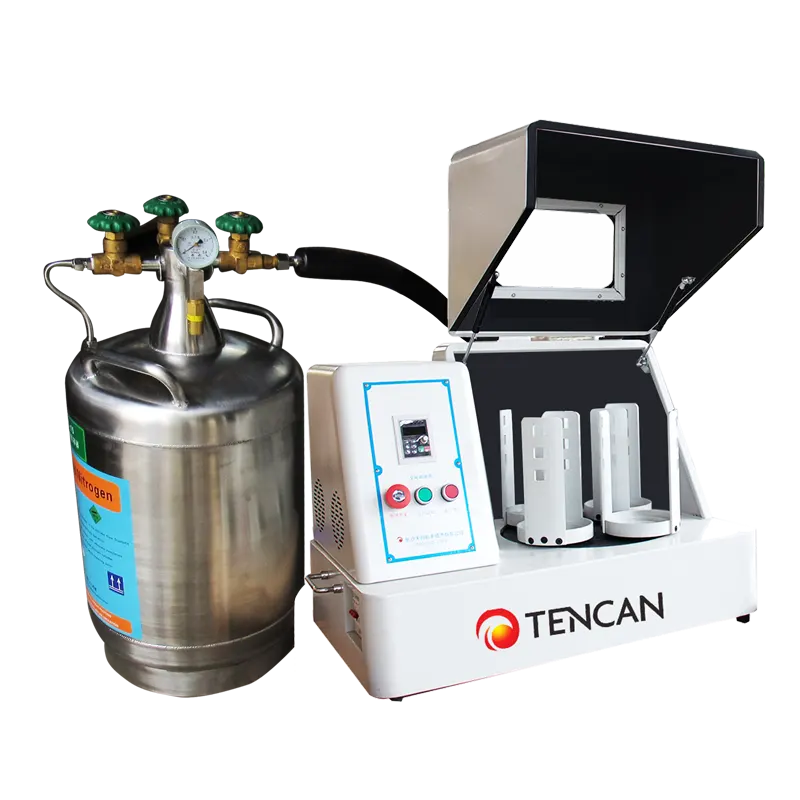
A liquid nitrogen planetary ball mill adds a low-temperature cooling environment around the grinding jars so that heat generated during high-speed milling can be removed more effectively. The main purpose is not simply to make the process “as cold as possible,” but to control heat buildup while retaining the high-energy grinding action of a planetary ball mill.
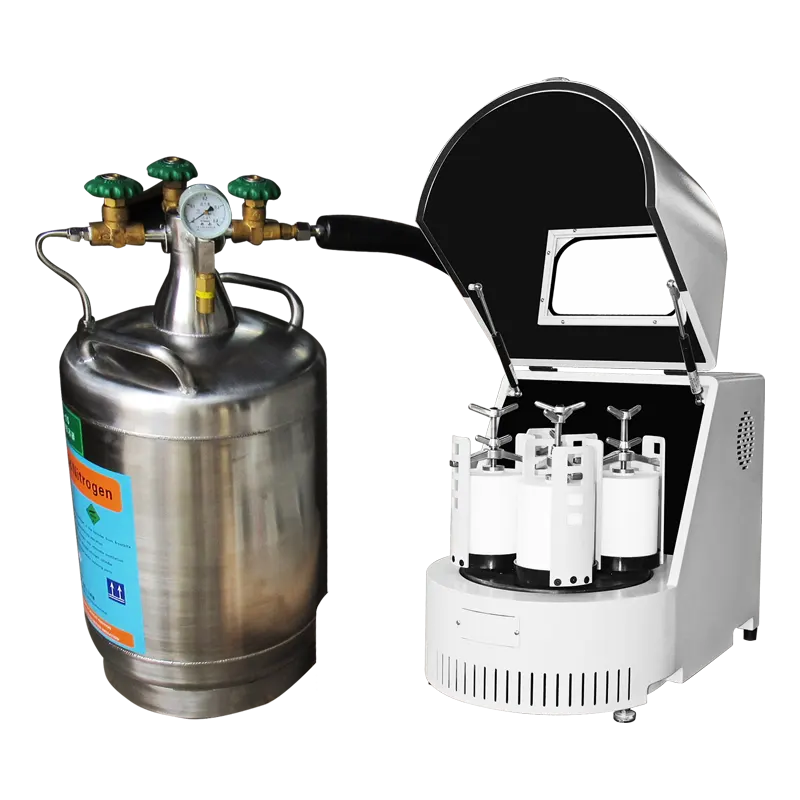
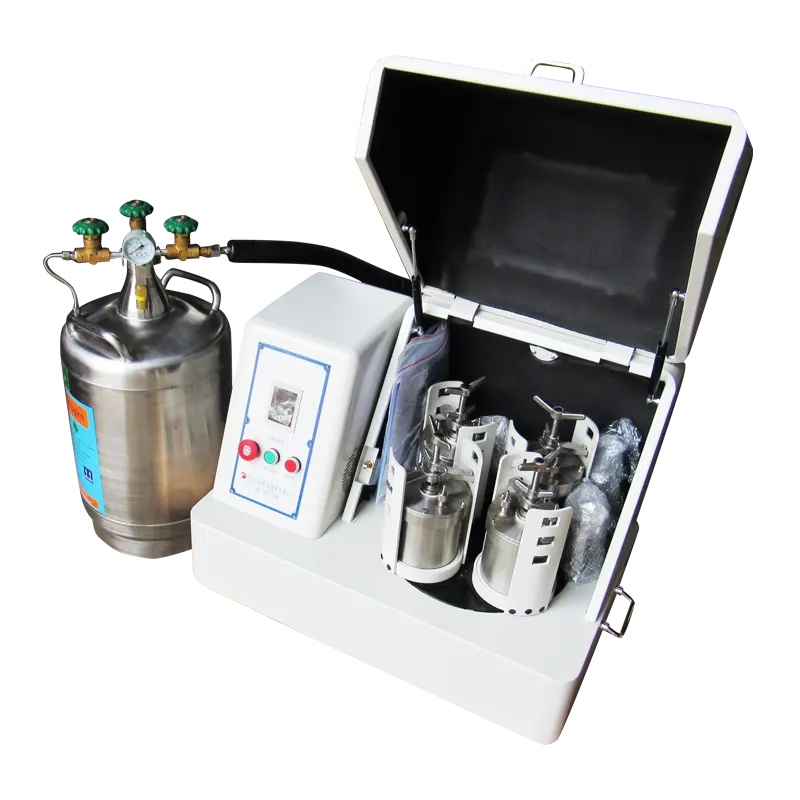
Quick answer: TENCAN's current Liquid Nitrogen Planetary Ball Mill uses continuous liquid-nitrogen cooling around the grinding-jar area and lists a working temperature control range of -40°C to 20°C. The current XQM-C series covers total capacities from 1 L to 12 L, with speeds up to 670 rpm on XQM-1C to XQM-6C and up to 580 rpm on XQM-8C to XQM-12C. Four grinding jars are normally used, and vacuum grinding jars can be selected when atmosphere isolation is required.
Why Temperature Control Matters in Electronic Ceramic Grinding
The properties of electronic ceramic powders are affected by more than final particle size. Powder morphology, agglomeration state, surface chemistry, contamination and crystal structure can all influence downstream mixing, forming, sintering and final electrical performance.
In a planetary ball mill, the grinding jars rotate around their own axes while simultaneously revolving around the planetary disk. This compound movement creates strong impact, shear and friction. It is one reason planetary mills are effective for fine grinding, but it also means that long or aggressive milling cycles can generate heat.
Low-temperature planetary milling is therefore useful when the process is limited by one or more of the following:
- Powder sticking to the grinding jar as temperature rises
- Agglomeration becoming more severe during extended milling
- Organic binders, polymers or additives being temperature-sensitive
- The formulation containing volatile or heat-sensitive components
- Repeatability being affected by changing jar temperature
- The material requiring vacuum or controlled-atmosphere processing
For electronic ceramics, low-temperature milling should be viewed as a temperature-management method. It does not automatically guarantee phase preservation, zero oxidation, a specific nano-scale particle size or improved electrical properties. Those results depend on the actual ceramic composition and should be verified by particle-size measurement, XRD, microscopy or other appropriate characterization.
How a Liquid Nitrogen Planetary Ball Mill Works
1. Planetary Motion Provides the Grinding Energy
The mechanical grinding principle is similar to a standard planetary ball mill. Grinding jars rotate around their own axes while revolving around the center of the machine. Grinding balls repeatedly collide with the powder and jar wall, creating impact, friction and shear.
2. Liquid Nitrogen Removes Grinding Heat
In the TENCAN design, the grinding jars operate inside an insulated or heat-shielded environment. Liquid nitrogen is continuously supplied to this area so that it can absorb heat generated during milling and maintain a controlled low-temperature environment around the grinding jars.
The important distinction is that the liquid nitrogen is used as a cooling medium for the grinding environment. It should not be assumed that every sample or every point inside the grinding jar is automatically at the boiling point of liquid nitrogen.
3. Temperature Control and Grinding Parameters Work Together
Cooling does not replace process optimization. Final grinding behavior still depends on speed, milling time, jar volume, grinding-media size, material loading, jar material and whether the process is dry, wet, vacuum or inert-gas protected.
Current TENCAN XQM-C Technical Parameters
The following values are based on the current TENCAN Liquid Nitrogen Planetary Ball Mill product page. Final configuration should be confirmed before ordering.
| Model | Total Volume | Voltage | Power | Speed | Net Weight | Net Size |
|---|---|---|---|---|---|---|
| XQM-1C | 1 L | 220 V or 110 V | 0.75 kW | 70–670 rpm | 83 kg | 750 × 470 × 590 mm |
| XQM-2C | 2 L | 220 V or 110 V | 0.75 kW | 70–670 rpm | 85 kg | 750 × 470 × 590 mm |
| XQM-4C | 4 L | 220 V or 110 V | 0.75 kW | 70–670 rpm | 88 kg | 750 × 470 × 590 mm |
| XQM-6C | 6 L | 220 V or 110 V | 0.75 kW | 70–670 rpm | 93 kg | 750 × 470 × 590 mm |
| XQM-8C | 8 L | 220 V or 110 V | 1.5 kW | 70–580 rpm | 150 kg | 880 × 560 × 670 mm |
| XQM-10C | 10 L | 220 V or 110 V | 1.5 kW | 70–580 rpm | 150 kg | 880 × 560 × 670 mm |
| XQM-12C | 12 L | 220 V or 110 V | 1.5 kW | 70–580 rpm | 150 kg | 880 × 560 × 670 mm |
Cooling-System Reference Parameters
| Parameter | Published Value | Practical Note |
|---|---|---|
| Working temperature control range | -40°C to 20°C | Use the required process temperature rather than maximum cooling by default. |
| Gas consumption at 0–10°C | 4–5 L/h | Consumption varies with operating condition. |
| Reference machine size | 460 × 660 × 720 mm | Cooling-system reference data on the product page. |
| Reference machine weight | About 80 kg | Host weight varies by XQM-C model. |
| Compatible LN₂ tank | 30 L / 50 L | Select based on operating time and site requirements. |
Which Electronic Ceramic Materials Are Suitable?
The current TENCAN product page lists a broad range of ceramic and electronic materials. The strongest fit is generally where planetary grinding is required but uncontrolled heat accumulation is undesirable.
Dielectric and Capacitor Ceramics
Materials used in dielectric ceramics, capacitors and MLCC-related research often require fine and uniform powder preparation. Low-temperature milling can help keep the grinding process more stable when long milling cycles generate excessive heat.
Typical examples include barium-titanate-based dielectric formulations and other capacitor ceramic powders. The appropriate grinding result should be evaluated using actual particle-size distribution and phase analysis rather than assuming one universal nano-scale target.
Piezoelectric and Ferroelectric Ceramics
Piezoelectric ceramics require control of composition, powder fineness and contamination. Low-temperature planetary milling can be useful when normal high-energy milling produces excessive heat or causes undesirable sticking and agglomeration.
For phase-sensitive materials, XRD before and after milling is a practical way to verify whether the selected process is suitable.
Ferrites and Magnetic Ceramic Powders
TENCAN lists Ni-Zn ferrite, Mn-Zn ferrite and other magnetic materials among the application fields. Jar and media selection is particularly important because metallic contamination from stainless steel may interfere with formulations that require tight chemical control.
Alumina and Zirconia Ceramics
Alumina and zirconia are hard ceramic materials that can require long grinding cycles. Low-temperature control can reduce heat accumulation during intensive milling, but contamination and grinding efficiency are still determined mainly by the contact materials, media size, speed and process duration.
ZnO Varistors, Thermistors and Functional Oxides
The current product page also lists zinc oxide varistors, PTC/NTC thermistor materials, cobalt oxide, zinc oxide and related functional powders. These applications can benefit from controlled sample preparation when temperature stability and repeatability are important.
What Low-Temperature Milling Can — and Cannot — Do
| Process Goal | What Low-Temperature Milling Can Help With | What Still Needs Verification |
|---|---|---|
| Reduce grinding heat | Directly addresses heat generated during high-energy milling. | Actual sample temperature under the selected load and speed. |
| Reduce sticking / agglomeration | Can help when temperature is a major cause. | Whether the material is naturally cohesive or requires wet dispersion. |
| Preserve crystal structure | Lower process temperature may reduce thermal stress. | XRD or other phase analysis is required. |
| Reach nano-scale powder | Planetary motion provides high grinding energy. | Final D10/D50/D90 depends on the material and recipe; test grinding is recommended. |
| Reduce contamination | Temperature control can improve process stability. | Contamination is mainly governed by jar/media wear and handling. |
| Improve sintering | Fine powder may influence downstream densification. | Sintering temperature, density and electrical performance must be validated experimentally. |
Why the Original “-196°C Milling” Description Can Be Misleading
Liquid nitrogen itself boils at approximately -196°C at atmospheric pressure, but that does not mean the grinding powder inside every cryogenic planetary ball mill is continuously maintained at -196°C.
For the current TENCAN XQM-C product, the published working temperature control range is -40°C to 20°C. This is the relevant specification for equipment selection. Describing the machine as routinely maintaining -150°C to -196°C during milling would therefore overstate the current published capability.
A customer who requires a specific ultra-low sample temperature should provide the required temperature, sample quantity, jar material, grinding speed and run time so the thermal requirement can be evaluated separately.
Grinding Jar Selection for Electronic Ceramics
Temperature control does not solve contamination by itself. The jar and grinding balls are in direct contact with the sample, so their material should be selected according to the elements that the final ceramic powder can tolerate.
| Jar / Media Material | Main Characteristic | Electronic Ceramic Consideration |
|---|---|---|
| Zirconia | High hardness, high density, good wear resistance | Common for high-purity grinding when Zr contamination is acceptable |
| Corundum / Alumina | Hard ceramic contact surface | Suitable where Al contamination is acceptable |
| Agate | Low metal contact | Useful for selected analytical and high-purity samples; relatively brittle |
| Stainless Steel | Strong and economical | Check whether Fe, Cr and Ni contamination are acceptable |
| Tungsten Carbide | Very hard and dense | Consider W/Co contamination and high media mass |
Can Vacuum or Inert-Gas Grinding Be Used?
Yes. The current TENCAN product page states that the liquid nitrogen planetary ball mill can be equipped with a vacuum grinding jar.
This can be useful when the ceramic or precursor is sensitive to air or moisture, but the required atmosphere should be defined before ordering. A vacuum-capable jar is not the same as a glove-box purification system, and the process should be designed according to the material's real oxygen and moisture sensitivity.
If the powder must be loaded, opened and transferred under low-oxygen / low-moisture conditions, a purification glove box may also be required as part of the workflow.
How to Optimize a Cryogenic Planetary Milling Process
Step 1: Define the Real Process Problem
Before selecting the cryogenic model, determine whether the limitation in standard planetary grinding is actually temperature.
Typical signs include:
- Powder becomes sticky after the jar heats up
- Grinding efficiency decreases during long continuous runs
- Organic components soften or change during milling
- Particle agglomeration increases with temperature
- Results differ significantly between short and long milling cycles
Step 2: Define the Required Temperature
Do not automatically select the lowest possible setting. Determine the highest temperature the material can tolerate and establish a controlled operating window within the machine's published range.
Step 3: Choose the Jar and Grinding Media
Select the contact material according to powder hardness and contamination limits. For high-purity electronic ceramics, the contamination requirement may be more important than maximum grinding speed.
Step 4: Optimize Ball Size and Ball-to-Material Ratio
The ideal grinding-media combination depends on feed size, material hardness and the target particle-size distribution. Avoid using one universal ball-to-powder ratio or one fixed media diameter for every ceramic.
Step 5: Set a Baseline Speed
Start at a moderate speed and evaluate particle size, temperature and media wear. Higher rpm increases grinding energy but can also increase heat generation and wear.
Step 6: Use Timed Milling and Sampling
Measure the product after defined intervals rather than assuming that longer milling always produces a better result. Excessive milling can increase wear contamination or change particle morphology.
Step 7: Verify the Powder, Not Just the Machine Setting
For electronic ceramics, useful verification methods may include:
- Particle-size distribution (D10 / D50 / D90)
- X-ray diffraction for phase analysis
- SEM for morphology and agglomeration
- ICP or another elemental method for contamination
- Specific surface area when relevant
- Downstream sintering and electrical-property testing
Standard Planetary vs. Liquid Nitrogen Planetary Ball Mill
| Comparison | Standard Planetary Ball Mill | Liquid Nitrogen Planetary Ball Mill |
|---|---|---|
| Main grinding mechanism | Planetary impact, friction and shear | Same planetary grinding mechanism plus low-temperature cooling |
| Temperature control | Heat managed by speed, cycle time and pauses | Liquid nitrogen removes heat around the grinding jars |
| Best starting point | Materials that tolerate normal high-energy milling temperature | Heat-sensitive, sticky or temperature-dependent materials |
| System complexity | Simpler | Requires liquid-nitrogen supply and cooling controls |
| Operating cost | No cryogenic gas consumption | Includes liquid-nitrogen consumption |
If the material grinds normally without excessive temperature rise, a standard planetary ball mill may be sufficient. The low-temperature version is most valuable when temperature itself is a process limitation.
Liquid Nitrogen Planetary Mill vs. Low-Temperature Refrigerated Planetary Mill
TENCAN also provides a low-temperature planetary grinding machine that combines refrigeration with planetary milling.
The selection between refrigerated cooling and liquid-nitrogen cooling should consider the required temperature, operating duration, site utilities, cooling stability and expected running cost. A customer does not necessarily need liquid nitrogen if a refrigerated configuration can maintain the required process temperature.
Safety Considerations for Liquid Nitrogen Milling
Liquid nitrogen should be handled as a cryogenic utility with appropriate laboratory safety controls. The main hazards are not specific to electronic ceramics; they are associated with cryogenic temperature and nitrogen gas release.
- Ventilation: evaporating nitrogen can reduce oxygen concentration in poorly ventilated spaces.
- Cold contact: liquid nitrogen and cold metal surfaces can cause cryogenic burns.
- Pressure: liquid nitrogen must not be trapped in a sealed volume without pressure relief.
- Condensation: frost and condensation can form on cold surfaces and should be managed according to the equipment procedure.
- Jar compatibility: use grinding jars, seals and accessories specified for the equipment and intended process.
Do not assume that a standard product automatically includes every possible oxygen monitor, pressure-relief configuration or explosion-proof feature. Site safety requirements and optional equipment should be confirmed for the actual application.
Common Claims to Avoid in Electronic Ceramic Cryogenic Milling
“The powder is always at -196°C.”
Liquid nitrogen is approximately -196°C at atmospheric boiling conditions, but the current TENCAN product specification lists a working temperature control range of -40°C to 20°C.
“Cryogenic milling always preserves the crystal phase.”
Low-temperature control can reduce thermal stress, but high-energy mechanical milling itself can still influence crystal structure. Verify with XRD when phase preservation matters.
“Cryogenic milling eliminates contamination.”
Grinding-media and jar wear remain potential contamination sources. Select contact materials based on the ceramic formulation.
“Electronic ceramics will always reach 50–500 nm.”
No universal particle size can be guaranteed for all ceramics. Final fineness depends on the material and complete milling recipe.
“Low-temperature milling automatically reduces sintering temperature.”
Any downstream sintering benefit depends on the resulting particle size, surface area, morphology and chemistry. It must be validated for the specific ceramic system.
How to Choose the Right XQM-C Model
1. Start with Required Sample Quantity
Select total system volume based on the practical jar loading required for each experiment, not only the nominal total capacity.
2. Define the Maximum Allowable Temperature
Confirm that the required temperature falls within the current -40°C to 20°C control range.
3. Define Contamination Limits
Tell the supplier which elements must be avoided so that jar and media materials can be selected correctly.
4. Define the Required Atmosphere
Specify whether the process is carried out in air, vacuum, nitrogen or argon.
5. Confirm Local Utilities
Provide local voltage/frequency and confirm the availability, storage and laboratory handling of liquid nitrogen.
6. Provide the Target Particle Size
Give D50/D90 or another measurable specification whenever possible. For difficult materials, sample grinding is more reliable than selecting only from nominal equipment data.
FAQ: Cryogenic Planetary Ball Mills for Electronic Ceramics
What temperature can the TENCAN liquid nitrogen planetary ball mill control?
The current TENCAN product page lists a working temperature control range of -40°C to 20°C.
What models are currently available?
The current XQM-C series lists XQM-1C, XQM-2C, XQM-4C, XQM-6C, XQM-8C, XQM-10C and XQM-12C, covering total nominal capacities from 1 L to 12 L.
How fast does it run?
XQM-1C through XQM-6C are listed at 70–670 rpm. XQM-8C through XQM-12C are listed at 70–580 rpm.
Can it process several samples at the same time?
Yes. TENCAN states that the system is normally equipped with four grinding jars, allowing four samples to be processed during one cycle.
Can it grind electronic ceramics to nano-scale?
Planetary milling can be used for very fine powder preparation, but the liquid-nitrogen product page does not specify one guaranteed nano-scale result for every ceramic. The actual D50/D90 should be verified with the specific material.
Can it use vacuum grinding jars?
Yes. The current product description states that vacuum grinding jars can be selected for grinding samples in a vacuum atmosphere.
How much liquid nitrogen does it consume?
The current product page lists approximately 4–5 L/h at 0–10°C. Actual use may vary with operating conditions.
What liquid nitrogen tank size is compatible?
The listed compatible tank sizes are 30 L and 50 L.
Which electronic ceramic materials are listed by TENCAN?
The current product page lists electronic ceramics, structural ceramics, magnetic materials, piezoelectric ceramics, dielectric ceramics, alumina ceramics, zirconia ceramics, MLCC-related materials, ZnO varistors, PTC/NTC thermistor materials, ferrites and other functional powders.
What information should I provide before requesting a quotation?
Provide the material name, feed size, target particle size, batch quantity, target temperature, jar/media contamination requirements, required atmosphere, operating time and local power supply.
Conclusion
A liquid nitrogen planetary ball mill is most useful when a ceramic powder already requires the high grinding energy of planetary milling but the resulting heat becomes a process limitation.
For electronic ceramics, the practical value is controlled low-temperature grinding: reducing heat accumulation during fine grinding, improving process repeatability and making it easier to handle selected heat-sensitive or sticky formulations.
TENCAN's current XQM-C range provides 1–12 L total nominal capacity, four-jar operation, vacuum-jar compatibility and a published temperature-control range of -40°C to 20°C. Rather than assuming cryogenic milling automatically guarantees nano-scale powder, phase preservation or lower sintering temperature, the best approach is to define the material requirement and verify the result through actual grinding tests and powder characterization.
Need to evaluate low-temperature grinding for an electronic ceramic powder?
Send TENCAN your material, feed size, target D50/D90, batch quantity, maximum allowable temperature, contamination limits and atmosphere requirements. Contact TENCAN for a suitable cryogenic grinding configuration »