
Three Roll Mill Particle Size Control Guide
Particle size problems in pigmented pastes, electronic materials, cosmetic creams, and battery slurries rarely appear as a single number. A sample can pass an average particle size target and still show streaks, poor gloss, inconsistent color, or a tail of coarse agglomerates. For formulators working with high-viscosity pastes, the three roll mill remains a practical tool because it applies intense shear in a thin film and gives the operator direct control over the film path. The challenge is that gap settings, speed ratio, paste rheology, roll temperature, and the number of passes interact. A change that improves fineness of grind can also make the paste too hot, too stiff, or too variable for the next process step.
This guide focuses on the technical decisions that determine whether a three roll mill will solve a dispersion problem. It is written for laboratory researchers, material engineers, process technicians, and equipment buyers who need to evaluate a paste process rather than compare catalog numbers. The discussion applies to the three-roll principle in general; actual roll dimensions, drive power, cooling design, and product-contact materials must be confirmed for a specific machine. The current TENCAN three roll mill provides a reference point for the product configuration described here.
What a three roll mill actually does in a paste process
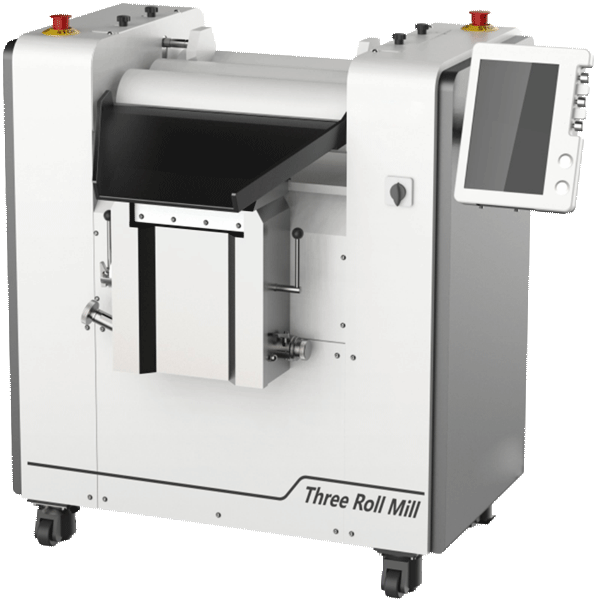
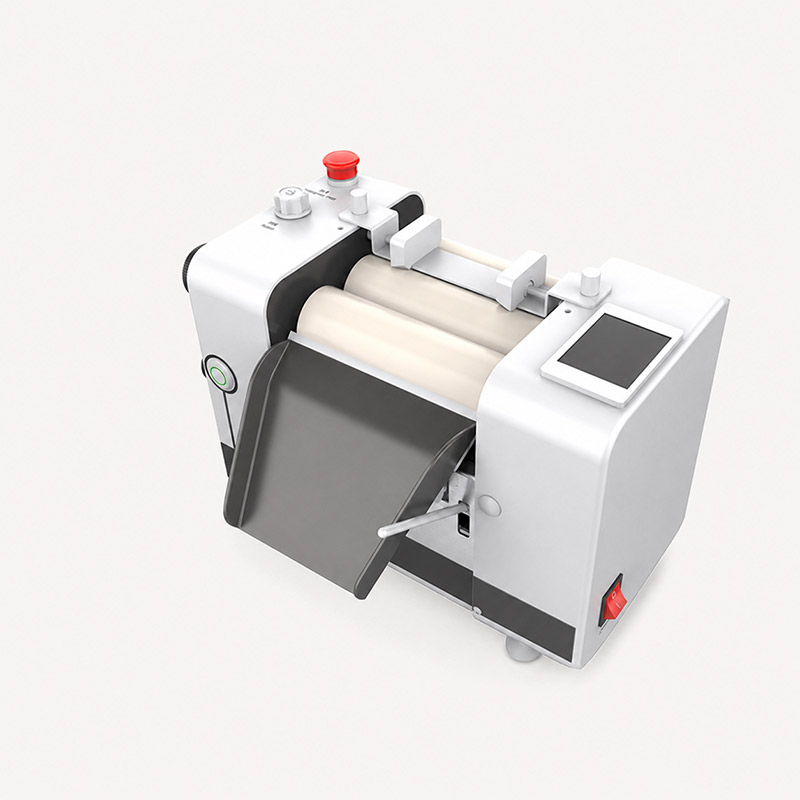
A three roll mill has three horizontal rolls mounted in a rigid frame. The feed apron, end plates, take-off blade, and cooling arrangement vary by design, but the working principle is consistent: paste is held against the rolls while the rolls rotate at controlled surface speeds. The first nip takes material from the feed area, the center roll carries a film toward the second nip, and the take-off blade removes the processed film from the front roll. Each roll can have its own speed, and the speed difference between adjacent rolls is what creates shear in the nip.
The machine is not a blender with rollers attached. Its useful work happens in a narrow region where the paste is forced through a converging gap and then split into thin films. In that region, agglomerates are wetted, stretched, and separated by shear and extensional flow. The residence time in the nip is short, so the total result depends on repeated passes, film thickness, and the paste's ability to wet and adhere to the rolls. If the paste slips, drips, or fails to transfer from one roll to the next, the gap setting alone will not produce a good dispersion.
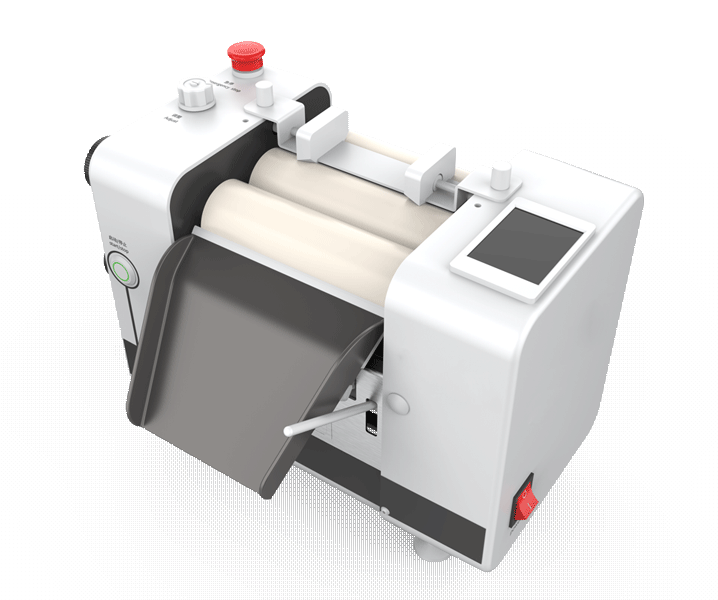
A three roll mill is most useful for high-viscosity pastes, creams, pigmented dispersions, and similar products that can form a stable film on a roll. It is not a dry grinder, and it is not the first choice for a low-viscosity slurry that runs off the rolls before it reaches the nip. For dry powder comminution, a jet mill, ball mill, or other dry milling system is usually more appropriate. For a low-viscosity suspension, a bead mill or high-shear disperser may be better able to keep the material in the processing zone.
Compared with a media mill, a three roll mill uses no grinding beads. That simplifies cleaning and avoids bead wear as a contamination source, but it also means the machine relies on paste rheology and roll contact rather than a bed of moving media. Compared with a high-speed disperser, it can apply much higher localized shear to a viscous paste, but it usually requires pre-mixing and may need several passes. The right choice depends on feed condition, target particle size, heat sensitivity, batch size, and the cleaning standard the product requires.
How particle size is reduced between three rolls
The word grinding can be misleading in a three roll mill. In many paste processes, the primary particles are already fine; the problem is that they are bound in agglomerates or poorly wetted clusters. The mill's first job is to wet those clusters and break the contacts between particles. The second job is to distribute the particles uniformly through the vehicle. If the formulation is poorly wetting or the agglomerates are strong, the mill may need more passes, a different dispersant, or a higher shear history than the rolls can deliver.
Gap setting is often discussed as if it were a particle size setting. It is not. The gap controls film thickness and the intensity of the shear field, but the final particle size depends on paste viscosity, roll speed, agglomerate strength, and the number of passes. A gap that is too wide may leave coarse agglomerates intact. A gap that is too tight may starve the nip, generate excessive heat, or cause roll contact. The useful setting is the one that produces a stable film and a measurable improvement in fineness of grind without exceeding the paste's temperature or viscosity limits.
Film splitting after the nip also matters. As the paste leaves the gap, it is stretched and split, which helps separate particles that have been wetted but not fully dispersed. This is one reason a three roll mill can improve gloss and color development even when the average particle size changes little. The effect is strongest when the paste has enough yield stress to stay on the roll and enough mobility to flow into the nip. A paste that is too stiff may crack; a paste that is too thin may run away from the working zone.
There are limits. A three roll mill can break agglomerates and reduce some particles, but it is not a classification device. It does not remove a coarse tail unless the processing conditions actually break those particles. Hard crystalline materials, abrasive fillers, and large grit can wear the rolls or pass through as defects. If the feed contains particles larger than the working gap or hard enough to damage the roll surface, pre-milling, screening, or a different equipment train should be considered. Target particle size should be defined as a distribution with an upper limit, not only an average.
Machine variables that change dispersion quality
Three roll mill performance is not controlled by one setting. The operator has several levers, and each one changes both the dispersion result and the operating window.
First and second gap settings
The first gap controls how the feed is taken into the center roll, and the second gap controls the final film. Both gaps should be set and checked with the machine's own calibration procedure. Gap numbers are machine-specific; copying a setting from another mill or another product is not reliable. Start with a film that transfers cleanly, then tighten gradually while watching fineness of grind, roll temperature, and film uniformity across the roll face. Uneven film or a stripe pattern can indicate poor parallelism or a feed distribution problem rather than a formulation problem.
Roll speed and speed ratio
Higher roll speed generally increases throughput and can increase shear, but it also adds heat and can shorten the time available for the paste to wet the rolls. The speed ratio between adjacent rolls is often more important than absolute speed. A larger differential increases shear and can improve dispersion, but it may also promote misting, solvent loss, or film instability. The best ratio depends on paste viscosity and the sensitivity of the vehicle. Record both absolute speed and ratio during trials so the result can be reproduced.
Roll temperature and cooling
Three roll mills generate heat in the nip. Internal cooling helps hold the roll surface temperature within a practical range, but cooling water flow is not the same as product temperature. Measure the paste film and the roll surface, not only the water outlet. Temperature affects viscosity, wetting, solvent loss, and the risk of skinning or crystallization on the roll. For heat-sensitive products, a lower speed ratio, lower throughput, or a shorter pass schedule may be more useful than simply increasing cooling water flow.
Number of passes and throughput
One pass through a three roll mill is rarely a complete dispersion step. Multiple passes can narrow the coarse tail and improve color or gloss, but each pass adds heat and handling. Throughput is not just a function of roll speed. It depends on roll face length, film thickness, paste density, the number of passes, and the time needed for cleaning and temperature recovery. A machine that produces an excellent first-pass film may still be a poor production choice if the required number of passes makes the batch cycle too long.
Matching paste formulation to three roll mill behavior
Paste rheology determines whether the mill can do useful work. The material must be thick enough to adhere to the rolls and form a film, yet mobile enough to enter the nip and transfer from roll to roll. A low-viscosity liquid may run off the feed apron and never see the high-shear region. A very high-solids paste may be so stiff that it cannot be spread evenly, causing high torque, poor temperature control, and uneven dispersion. Yield stress, shear thinning, and thixotropic recovery all matter, so a single viscosity reading at one shear rate is usually insufficient.
Solids loading and wetting are closely linked. Higher solids can increase the shear stress that helps break agglomerates, but it also reduces mobility and raises heat generation. If the pigment or filler is not wetted by the vehicle, the mill may only polish the agglomerates instead of separating them. Dispersants and wetting agents can help, but they should be selected for the specific particle surface and vehicle. Adding more dispersant until the paste flows is not a substitute for checking whether the agglomerates are actually wetted and separated.
Volatile solvents need special attention. Solvent loss at the roll edges and on the take-off blade changes the solids content during a run. That can shift viscosity, film thickness, and dispersion quality from the beginning to the end of a batch. Enclosing or ventilating the area, adjusting solvent balance, and controlling roll temperature can reduce the effect. For solvent-based products, cleaning and ventilation procedures should be reviewed before the trial, not after the batch is mixed.
Feed preparation is part of the process. A three roll mill is usually fed a pre-mixed paste, not dry powder and not a separated slurry. Pre-mixing should wet the solids and remove lumps that could damage the rolls or block the feed. The product-contact materials, end plates, and scraper must be compatible with the vehicle and the cleaning solvent. Abrasive fillers can wear the roll surface over time, so roll material and maintenance intervals should be part of the selection decision, not an afterthought.
Measurement, troubleshooting, and common false signals
Fineness of grind is the traditional three roll mill check. A grind gauge, also called a Hegman gauge, draws down a sample and shows the largest surviving particles or agglomerates as scratches or specks. It is useful because it responds to the coarse tail that can cause streaks and defects. It is not a full particle size distribution. A sample can read clean on a grind gauge while still having a broad distribution or a fine fraction that affects gloss, viscosity, or color strength. Use the gauge with laser diffraction, microscopy, or a drawdown test when the product requires a complete picture.
Sampling matters as much as the instrument. Take samples from more than one location across the roll face and at more than one pass. Let the sample reach a consistent temperature before measuring, because viscosity and film behavior change with temperature. Record the gap, speed ratio, roll temperature, pass number, and solids content together. Without those records, a good result cannot be reproduced and a bad result cannot be diagnosed.
| Symptom | Likely cause | Practical check | Adjustment direction |
|---|---|---|---|
| Coarse streaks remain after several passes | Strong agglomerates, poor wetting, or a gap that is too wide for the feed | Grind gauge, microscopy, feed preparation, film uniformity | Improve pre-mixing or wetting, adjust gap, review pass schedule |
| Good fineness but low gloss | Poor distribution, vehicle incompatibility, or film defects | Drawdown, microscope, color strength, surface appearance | Review dispersant and vehicle, check passes and temperature |
| Paste heats rapidly | High speed ratio, high solids, excessive passes, or insufficient cooling | Roll surface and film temperature, cooling water flow | Reduce ratio or passes, improve cooling, adjust formulation |
| Material dries or skins on the rolls | Solvent loss, high roll temperature, or low vehicle level | Solids content before and after, film appearance, ventilation | Adjust solvent balance, lower temperature, reduce residence time |
| Uneven dispersion across the roll face | Poor feed distribution, gap variation, or worn components | Film inspection across width, gap check, maintenance record | Correct feed, verify alignment, service worn parts |
| Throughput below expectation | Too many passes, high viscosity, tight gap, or cooling limit | Cycle time, film thickness, temperature, rework rate | Balance pass count against quality, review machine size and cooling |
Average particle size is a common false signal. A mill can reduce the average while leaving a small number of coarse particles that cause visible defects. Color strength can improve because particles are better distributed, even when the size distribution has not changed much. Over-milling is another risk: additional passes may narrow the distribution but also raise temperature, alter the vehicle, or change rheology. Stop when the product meets the functional target, not when the meter displays the smallest possible number.
Selection and scale-up checklist for a three roll mill
Begin with the process window, not the machine size. Define the target particle size distribution, the acceptable coarse limit, the paste viscosity and solids range, the maximum product temperature, the batch size, and the cleaning standard. Confirm whether the product is a paste, a gel, or a low-viscosity slurry, because that single fact may rule out a three roll mill. Also list the product-contact materials and cleaning solvents. A machine that cannot be cleaned to the required standard is a poor choice even if its rolls are geometrically suitable.
Scale-up from a laboratory three roll mill to a production unit is not a simple multiplier. Roll diameter, roll face length, speed, speed ratio, gap, cooling capacity, and residence time all change. Keeping the same film thickness and speed ratio is more useful than keeping the same batch time, but even that may not preserve heat history. A pilot trial should use the intended formulation, not a simplified substitute. Production throughput should be calculated from the number of passes and realistic cleaning time, not from a single maximum-speed figure.
The three roll mill for paste dispersion page is a useful starting point for confirming the available configuration, but the final selection should be based on a trial with the actual paste. Ask for the roll material, surface finish, cooling arrangement, gap adjustment range, drive configuration, and the recommended cleaning method. For abrasive or corrosive products, confirm which parts contact the product and how wear is inspected. For multi-product facilities, check changeover time and whether the end plates and take-off blade can be cleaned without disturbing the gap setting.
Safety and utilities belong in the same checklist. Three roll mills have nip points, rotating rolls, and moving take-off components. Guards, emergency stops, and a documented lockout procedure are essential. Solvent-based pastes may require ventilation and appropriate electrical protection. Cooling water quality and flow, floor space, and access for roll maintenance should be confirmed before installation. These are not secondary details; they determine whether the mill can run reliably at the selected gap and temperature.
Practical questions before you specify a three roll mill
Can a three roll mill produce nanometer particles?
A three roll mill is not the usual first choice for nanometer primary particles. Its strength is deagglomerating and dispersing high-viscosity pastes, often in the fine micron range or as required by the product's functional specification. If the target depends on true nano-scale comminution, a bead mill or another small-media process is usually more appropriate. The final answer depends on the material, the starting particle size, and the required distribution, so it should be confirmed by testing.
What gap should I start with?
There is no universal starting gap. Begin with a setting that allows the paste to form a continuous film and transfer through both nips, then tighten in small steps while checking fineness of grind and temperature. The gap should be verified with the machine's calibration method. If the feed contains hard grit, start wider and pre-treat the paste before reducing the gap.
How many passes are needed?
Use the minimum number of passes that meets the functional target and remains within the temperature limit. Sample after each pass and measure both the coarse tail and the average. If a second or third pass produces no meaningful improvement, more passes may only add heat and handling cost. If the coarse tail persists, review wetting, pre-mixing, and gap before adding passes.
Is a three roll mill suitable for low-viscosity slurries?
Usually not without formulation changes or a different machine. A low-viscosity slurry may not stay on the rolls or form a stable film, so the material can bypass the high-shear region. A bead mill, high-shear disperser, or other closed processing system may be more suitable. If the product can be formulated as a paste, a three roll mill may still be an option, but the rheology must be tested.
A realistic validation plan
Run the trial on a small pre-mixed batch and record the formulation, solids content, initial particle size, viscosity, and temperature. Set the mill to a moderate gap and speed ratio, then take samples after each pass. Measure fineness of grind, particle size distribution, drawdown appearance, gloss or color strength if relevant, and paste temperature. Inspect the film across the roll face for streaks, drying, or incomplete transfer. A result that looks good only in the center of the roll is not a stable process.
Repeat the best condition at least twice. A three roll mill process is only useful if it is reproducible. Check whether the second batch needs the same number of passes, whether the temperature profile is similar, and whether cleaning changes the gap or film behavior. If the product is heat-sensitive, run a deliberate temperature challenge to find the practical limit. If the product is abrasive, inspect the rolls and product-contact parts after the trial.
Scale-up decisions should follow a clear result: the target distribution, the pass count, the temperature limit, and the cleaning method. A machine purchase based on a single hand sample is a weak basis for a production decision. Request a trial with the actual paste, confirm the product-contact materials, and compare the complete cycle time. That approach is more reliable than comparing roll diameters or motor power alone, because the useful output of a three roll mill depends on the paste, the film, and the heat balance as much as on the hardware.