
Muffle Furnace Guide for Lab Heat Treatment
A muffle furnace can look like a simple insulated chamber with a door, a controller, and a heating element. In laboratory work, however, the result depends on much more than the setpoint. Heat transfer to the load, chamber uniformity under load, controller behavior during ramping, contamination from crucibles or binders, and the way the operator loads and cools samples all influence ash content, sintering quality, annealing response, and repeatability. A furnace that looks satisfactory during an empty test can still produce uneven results when the chamber is filled. For that reason, choosing a laboratory muffle furnace is a process decision, not a catalogue exercise.
What a Muffle Furnace Does in a Laboratory Workflow
A muffle furnace is a batch chamber furnace used for controlled heating of solid samples. The workload is placed inside a heated chamber, usually in a crucible, boat, tray, or fixture. The furnace then follows a temperature profile that may include heating, holding, and cooling stages. Unlike a tube furnace, which is often designed around a sealed or purged tube, a muffle furnace generally serves as a versatile air-atmosphere chamber for laboratory work.
The muffle principle is based on separating the sample from direct contact with the heating elements and, in many designs, from the products of element or insulation exposure. Heat reaches the sample mainly by radiation from the chamber walls and by convection within the chamber. This arrangement reduces localized overheating and helps protect the work zone from contamination, but it does not remove the need to control loading, atmosphere, and crucible selection. The sample sees the combined effect of wall temperature, gas flow, load mass, and thermal contact.
Common uses include ash content and loss on ignition testing, calcination, annealing, sintering of ceramics or powders, binder burnout, heat treatment of metals, and general laboratory thermal processing. Each application places different demands on the furnace. Ashing tends to be sensitive to airflow and volatile removal. Sintering is sensitive to maximum temperature, soak time, and cooling rate. Annealing may depend on uniformity and repeatability. A furnace selected for one task may not be the best choice for another.
The same design also has boundaries. A standard muffle furnace is not automatically suitable for reducing, inert, or reactive atmospheres. It is not a continuous production kiln, and it should not be treated as a sealed pressure vessel. When a process needs controlled gas flow, rapid cooling, or a specific oxygen level, a tube furnace or a specially configured chamber furnace may be more appropriate. Recognizing these limits early prevents costly modifications later.
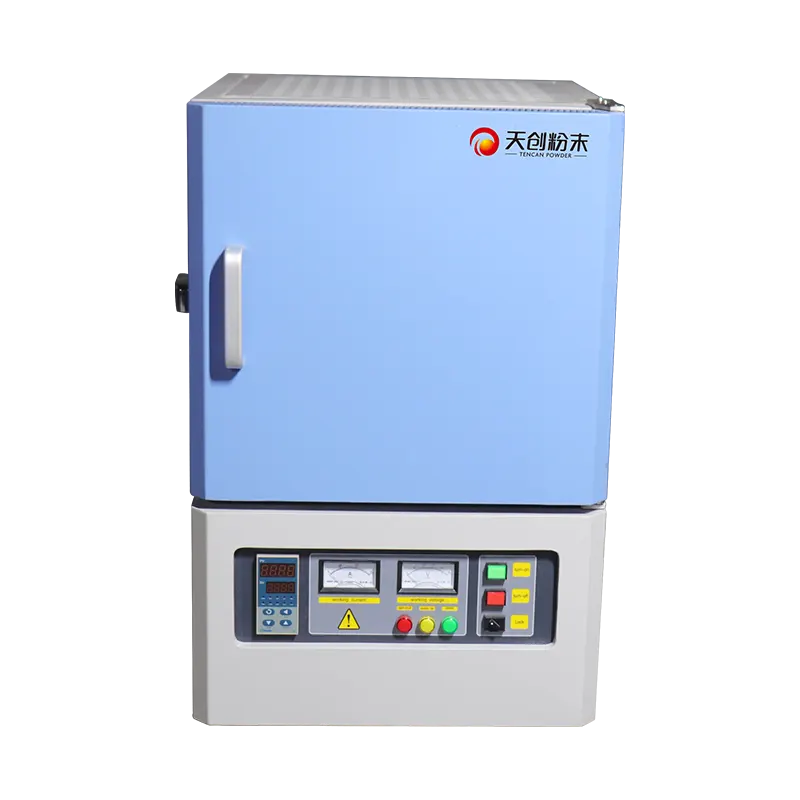
Muffle furnace product view from the manufacturer.
Matching the Furnace to the Thermal Process
A muffle furnace should be matched to the complete thermal cycle, not only to the highest temperature in the program. The most useful starting point is a written process profile: starting temperature, heating rate, target temperature, soak time, cooling method, atmosphere, sample mass, crucible material, and acceptable temperature variation across the load.
Temperature and Soak Time
The maximum operating temperature is an important screening value, but it is not the only temperature to check. The furnace must also perform reliably at the working temperature and through repeated ramps. A chamber that reaches a high temperature slowly or with a large overshoot may be less useful than one with a lower but better-controlled range. The controller, thermocouple type, insulation, and element arrangement all affect how closely the chamber follows the programmed profile.
Soak time should be based on the sample, not only on the chamber air temperature. A large crucible, a dense powder bed, or a batch of metal parts can have a significant thermal lag. The controller may show that the chamber has reached the setpoint while the center of the load is still heating. For critical work, validate the actual load temperature with a reference thermocouple or a test run using representative samples. This is especially important for sintering, annealing, and binder removal, where a few minutes at temperature can change the result.
Atmosphere, Binders, and Volatiles
Most laboratory muffle furnaces operate in air, and that is suitable for ashing, oxidation, calcination, and many heat treatment steps. The presence of air is not a guarantee of good results, however. Airflow within the chamber, exhaust capacity, and loading density affect how quickly oxygen reaches the sample and how quickly combustion products leave. A tightly packed crucible can create a local environment that is very different from the chamber atmosphere.
Binders, oils, organic residues, and volatile salts can produce smoke or corrosive vapors during heating. These vapors may affect the controller, insulation, thermocouple, or nearby samples if they are not managed. Use a suitable exhaust or ventilation arrangement, avoid overloading the chamber, and verify that the furnace configuration is appropriate for the process. If the process requires a controlled atmosphere, confirm the design with the manufacturer before use. A standard muffle furnace should not be assumed to be gas-tight.
Load Mass and Batch Size
Load mass affects heating rate, uniformity, and cooling. A small sample in a large chamber may follow the setpoint closely, while a large batch in the same chamber may need a longer soak and a slower ramp. The furnace may have enough heater capacity to reach the setpoint, but the load may still be uneven. In general, keep the load within the working zone, leave space around samples, and avoid blocking heat transfer from the walls.
Batch size should also be considered from a repeatability standpoint. If one run contains a large crucible and the next contains several small ones, the result may differ even when the programmed profile is the same. Define a loading pattern and keep it consistent for comparative tests. When a larger batch is needed, confirm the change with a validation run rather than assuming that the original profile will scale directly.
Chamber Design, Insulation, and Heat Uniformity
Chamber volume, shape, door design, insulation quality, and element placement all influence the practical working space. A large chamber offers more capacity, but it may also have more variation from center to corner. A smaller chamber can heat more quickly, but it may restrict sample size or create crowding near the door. The useful chamber size is the space in which the sample can be placed without touching elements, walls, or the door, while still maintaining acceptable uniformity.
Insulation quality affects warm-up time, heat loss, and external surface temperature. Good insulation does not automatically guarantee uniformity, but poor insulation can force the controller to work harder and may produce a steeper gradient near the door. Door seals and the condition of the door insulation are particularly important in smaller laboratory furnaces, where the door area represents a large part of the total chamber surface.
Element layout is another factor. In a chamber furnace, heating elements may be distributed on several walls or supported in a way that produces a radiant pattern. The sample should not be placed so close to an element that it receives a much higher radiant flux than other parts of the load. Use a central working position, a suitable setter or tray, and enough clearance for heat to circulate. These simple practices often matter more than small differences in nominal chamber volume.
Empty-Chamber and Loaded-Chamber Uniformity
Temperature uniformity is often measured in an empty or lightly loaded chamber, but the result that matters most is uniformity with the real workload. Empty-chamber data can be useful for commissioning and for detecting controller problems, but it should not be used as proof that a full crucible will heat evenly. The load changes the thermal field, especially when the samples have low thermal conductivity or high mass.
A practical validation can use several thermocouples placed at selected positions around the load, or a smaller number of reference measurements in representative containers. Run the normal profile and compare the temperature history at the center, edge, and near-door positions. If the difference is too large for the application, adjust loading, soak time, or the working position. For critical processes, repeat the check after major maintenance or after changing the crucible type.
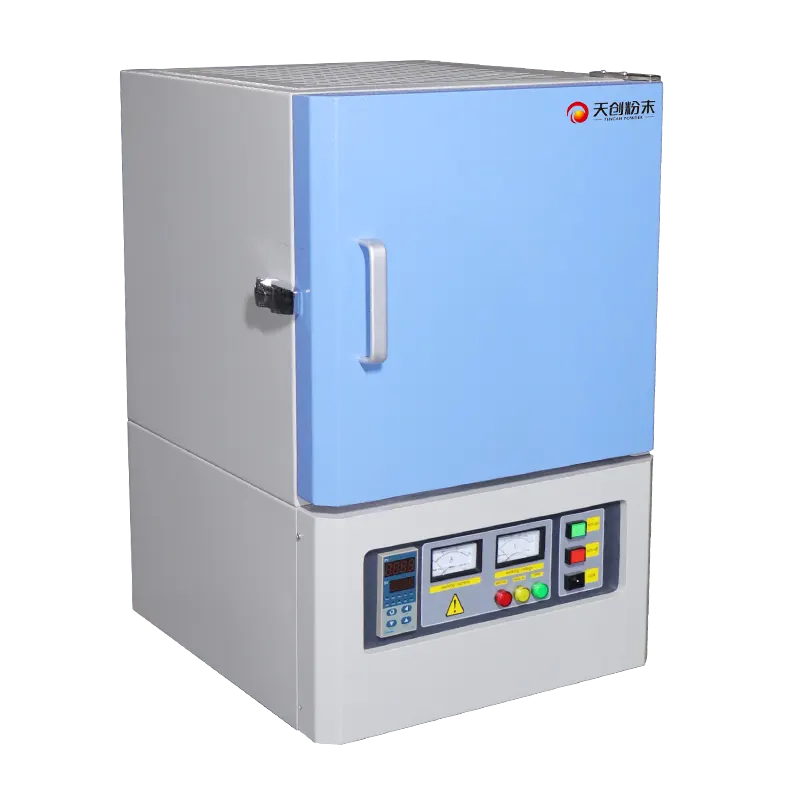
Muffle furnace product detail for laboratory heat treatment.
Controller, Ramp Rate, and Temperature Verification
A programmable controller is central to repeatable heat treatment. The controller should allow a defined heating rate, a soak segment, and a controlled cooling segment when needed. Simple on-off control may be acceptable for rough heating, but it is often less suitable for processes that are sensitive to overshoot or to slow transformations. PID control with appropriate tuning can follow a ramp more smoothly, although it still depends on the furnace dynamics and the load.
Ramp rate should be selected with the sample and the furnace in mind. Fast heating can cause thermal shock in crucibles, cracking in ceramics, distortion in some metals, or violent release of volatiles. Slow heating may be necessary for binder removal or for thick parts. If the furnace cannot follow the requested ramp because of limited heater capacity, the controller may produce a different profile than expected. Check the actual temperature record, not only the program.
Temperature verification is more than reading the display. The display reflects the sensor or sensors used by the control system, and its reading can differ from the sample temperature. For critical work, use a calibrated reference thermocouple or a documented survey procedure. Record the result at working temperature and with a representative load. Also check the controller after thermocouple replacement, after a long period of use, or whenever results begin to drift.
Overtemperature protection, sensor break detection, and door interlocks are practical safety features, but their presence should be confirmed for the specific model. Do not assume that a general-purpose controller includes every safety function. The product information page is the correct place to check the available controls, options, and operating limits for the model under consideration.
Contamination Control and Crucible Choice
Contamination can come from crucibles, trays, setters, tools, the furnace chamber, or the sample itself. In ash testing, the crucible must tolerate the temperature and not add residue or react with the sample. In sintering or calcination, the setter may react with the powder or release species that affect the product. Using the wrong material can produce discoloration, sticking, cracks, or misleading analytical results.
Choose crucibles and trays for thermal stability, chemical compatibility, and thermal shock resistance. Avoid mixing materials without checking their behavior at the target temperature. New crucibles should be conditioned and tested before they are used for critical samples. Keep a separate set for sensitive work if cross-contamination is a concern, and do not use the same tools for different sample types without cleaning.
The furnace chamber itself also needs attention. Spills, dust, and condensed volatiles can remain on the floor or around the door and may affect later runs. Clean the chamber only when it is cool and according to the manufacturer's instructions. Avoid abrasive cleaning that could damage insulation or elements. If a spill produces fumes or smoke, ventilate the area and inspect the furnace before the next use.
Atmosphere control is closely tied to contamination. In air, oxidation may be part of the intended process, but in other cases it may be unwanted. If the application requires low oxygen, a controlled gas supply, or a sealed retort, confirm that the furnace is designed for that service. A standard muffle furnace should not be used with flammable or explosive gas mixtures, and any inert gas modification should be reviewed with the manufacturer.
Sample Loading, Soak, and Cooling Practice
Good loading practice is one of the simplest ways to improve repeatability. Place samples in the central working zone, keep them away from elements and walls, and allow space for radiation and convection. Do not stack crucibles so that they block each other. Use a level setter or tray that can withstand the temperature without warping. If the sample can spill, use a secondary tray to protect the chamber floor.
The soak should begin when the sample is close to the intended temperature, not only when the chamber display reaches the setpoint. For a heavy load, add a stabilization period or extend the soak based on validation. For a small load, an unnecessarily long soak may cause grain growth, excessive oxidation, or loss of volatile components. The correct approach is to measure or otherwise verify the load response, then keep the profile consistent.
Cooling is part of the heat treatment. Rapid cooling can produce thermal shock in ceramics and crucibles, while slow cooling may be needed to avoid cracking or to obtain a specific material condition. If the furnace is opened while hot, the sample may cool unevenly and the chamber may be exposed to a rush of cool air. Follow the approved cooling method for the sample and the furnace. Do not place hot crucibles on a cold surface without checking thermal shock resistance.
Record the key variables: sample mass, crucible type, loading position, program number, ramp rate, soak time, cooling method, and any observed smoke or color change. These records make it easier to trace an unexpected result and to compare batches. They also provide useful information when discussing a process with the furnace manufacturer.
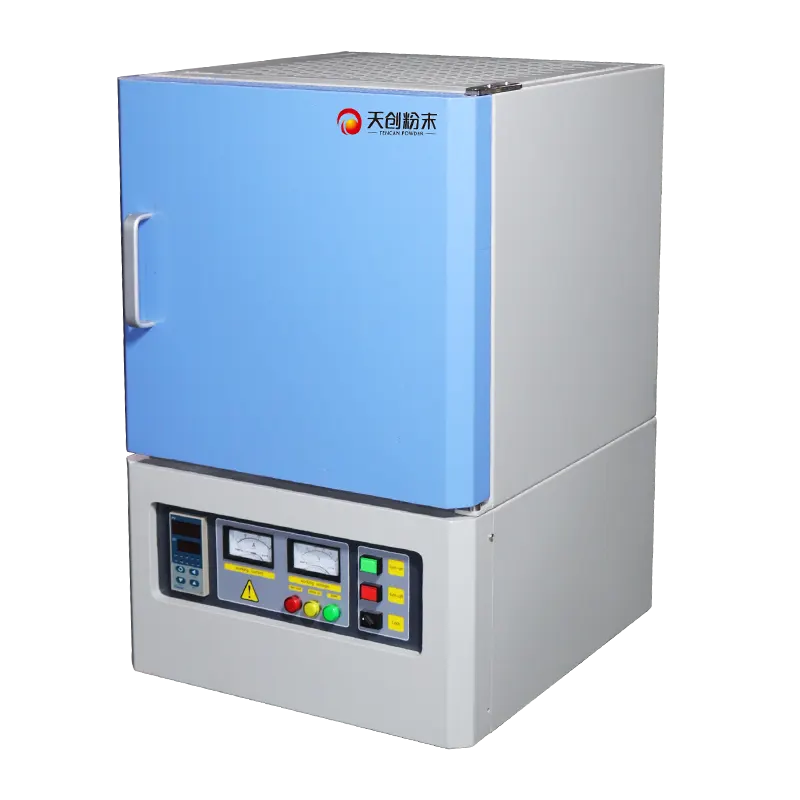
Laboratory muffle furnace product image for process planning.
Muffle Furnace vs Tube Furnace and Other Lab Furnaces
The muffle furnace is often compared with the tube furnace because both can reach high temperatures. The main difference is the working geometry and atmosphere. A muffle furnace usually offers a larger, front-loading chamber that is convenient for crucibles and irregular samples. A tube furnace uses a cylindrical tube that can be sealed or purged, which is useful for controlled atmospheres and continuous gas flow. Neither design is universally better; the choice depends on the process.
| Selection point | Muffle furnace | Tube furnace |
|---|---|---|
| Typical workload | Crucibles, trays, small parts, irregular solids | Samples that fit within a tube, powders in boats |
| Atmosphere | Usually air; controlled atmosphere only if designed | Often designed for purging or sealed operation |
| Loading | Front-loading chamber, easier for larger items | Insertion through a tube, often more restricted |
| Typical use | Ashing, calcination, annealing, sintering, heat treatment | Controlled-atmosphere reactions, thermal CVD, sealed tests |
A muffle furnace is generally the more practical choice when the sample needs a spacious chamber, easy loading, and an air atmosphere. It is also a common choice for general laboratory heat treatment because one furnace can serve several sample types. The tube furnace becomes more attractive when gas composition is the critical variable or when the sample must be enclosed in a defined flow.
Other furnace types may be relevant for specific work. A box furnace may overlap with a muffle furnace in form, while a crucible furnace is intended for melting. The terminology is not always consistent across suppliers, so check the actual chamber design, atmosphere capability, controller, and intended use rather than relying on the name alone. For a new process, a small trial on representative samples is more useful than a broad comparison of catalogue labels.
Maintenance and Safety Checks That Protect Results
Regular inspection helps prevent both equipment damage and unnoticed changes in results. Check the door seal, hinge, and latch for wear. Look for cracks or loose material in the insulation, especially around the door and element supports. Confirm that the thermocouple is properly positioned and that the controller reading is plausible at room temperature and during a test run. Replace damaged parts with suitable components, not generic substitutes.
Keep the chamber clean and free of spilled powder or debris. Clean only when the furnace is cool and follow the manufacturer's guidance. Do not use compressed air to blow dust into insulation or element areas. If the furnace has a vent or exhaust connection, confirm that it is clear and that the laboratory ventilation is adequate for the process. Store crucibles and tools in a clean, dry place.
Safety checks should include the overtemperature limit, sensor failure response, door interlock, and emergency shutdown procedure where these features are provided. Train operators to use heat-resistant gloves, tongs, and face protection when loading or unloading hot items. Keep flammable materials away from the furnace and never place solvents or pressurized containers inside the chamber.
For quality-critical work, establish a verification interval. A periodic temperature survey with a reference instrument can detect drift before it affects results. After a thermocouple replacement, element repair, or controller change, repeat the verification. Record the results and keep them with the furnace log so that future comparisons are meaningful.
Selection Checklist Before Buying a Laboratory Muffle Furnace
A useful selection process starts with the process requirements and then moves to the equipment. The TENCAN muffle furnace page can be used to confirm the current model information, while the checklist below helps organize the technical questions that should be answered before purchase.
- Define the maximum working temperature and the normal operating temperature, not only the highest possible setpoint.
- List the heating rate, soak time, and cooling profile required by the sample.
- Confirm whether the process needs air, an exhaust connection, or a controlled atmosphere.
- Estimate the largest sample, crucible, or fixture that must fit inside the working zone.
- Check the expected batch mass and whether the load will be dense, insulating, or prone to thermal shock.
- Review the controller functions, program segments, overtemperature protection, and sensor type.
- Ask how temperature uniformity is defined and how it can be verified with a representative load.
- Confirm the available chamber materials, setters, and accessories for the intended samples.
- Plan for ventilation, cooling space, electrical supply, and safe unloading.
- Establish a maintenance and calibration schedule before the furnace enters routine use.
When comparing models, separate must-have requirements from preferences. Chamber volume, maximum temperature, controller type, and atmosphere capability are usually must-have items. A larger chamber may be convenient, but it can also change the thermal response and increase warm-up time. A higher temperature rating may appear attractive, but it is only useful if the furnace also performs well at the actual working temperature and with the real load.
For readers who need a starting point, review the laboratory muffle furnace product information and confirm the configuration against the checklist. Ask for the operating limits, controller details, and recommended accessories for the specific application. A short trial with representative samples is often the most reliable way to confirm that a furnace suits the process.
Finally, consider the operator experience. A furnace that is difficult to load, hard to program, or awkward to clean may produce inconsistent work in routine use. Clear controls, a sensible working height, accessible chamber, and straightforward maintenance all contribute to better results. These practical factors deserve a place in the selection decision alongside temperature and chamber size.
Practical Questions Buyers Ask About Muffle Furnaces
What is a muffle furnace used for?
It is used for batch heat treatment in air, including ashing, calcination, annealing, sintering, binder burnout, and general laboratory thermal testing. The exact suitability depends on temperature, atmosphere, load, and crucible selection.
Can a muffle furnace be used for sintering?
Yes, many laboratory sintering processes use a muffle furnace, but the profile must match the material. Verify the maximum working temperature, soak time, cooling rate, and any atmosphere requirement. Do not assume that an air-atmosphere furnace is suitable for oxygen-sensitive materials.
Why does the chamber temperature look uneven?
The display may reflect one sensor position rather than the whole load. Loading density, door losses, element placement, and crucible mass can all create differences. Check uniformity with a representative load and adjust the working position, soak time, or loading pattern.
A muffle furnace performs best when the process, the chamber, and the operator practice are treated as one system. Start with a clear thermal profile, confirm the atmosphere and crucible requirements, validate the loaded chamber, and keep records of each run. That approach supports better repeatability and makes it easier to judge whether a specific furnace is the right fit for the next laboratory project.