
Mini Centrifuge Guide for Lab Sample Prep
A mini centrifuge rarely receives the attention that a ball mill or a particle size analyzer gets, yet it often decides whether a sample produces a usable result. A tube spun too slowly leaves fine particles in suspension; a tube spun hard and stopped abruptly can break up a compact pellet and turn a clear supernatant cloudy again. In laboratories that handle small volumes — a few hundred microliters up to a few milliliters — the difference between a repeatable measurement and a failed one usually comes down to how well the centrifuge, rotor, tube and protocol match each other.
This guide looks at those matches in technical terms: how relative centrifugal force is generated inside a small rotor, why tube geometry can matter as much as rotational speed, where a laboratory mini centrifuge genuinely outperforms a larger benchtop unit, and where it does not. It is written for researchers, materials engineers and process technicians who need separation they can rely on, rather than a list of numbers copied from a datasheet.
Why Small-Volume Separation Is Harder Than It Looks
Particle settling in a centrifuge is governed by the same balance of forces that controls gravity settling, with gravitational acceleration replaced by a much larger centrifugal acceleration. Three forces act on each particle: the centrifugal force that drives it outward, the buoyant force of the surrounding liquid, and the viscous drag that resists motion. When these balance, the particle travels at a constant settling velocity that, for spherical particles in the Stokes regime, is proportional to the square of the particle diameter, the density difference between particle and liquid, and the applied acceleration — and inversely proportional to the viscosity of the liquid.
That squared dependence on diameter explains most of the frustration in small-volume work. A 20 µm particle settles roughly four hundred times faster than a 1 µm particle under identical conditions. If a suspension contains both fractions, the coarse material forms a pellet quickly while the fines keep drifting, and the operator sees a clear liquid above a soft, easily disturbed layer that may still contain a large share of the sample mass. Extending the run time helps, but only up to the point where diffusion, convection and vibration start to work against the pellet.
Submicron particles are a separate problem. Below roughly one micrometer, Brownian motion competes with sedimentation, and some colloids simply will not form a firm pellet in a small tube no matter how long the run continues. In those cases the correct answer is often a change of method — for example, adding a flocculant, adjusting pH or ionic strength to aggregate the fines, or switching to a different separation principle — rather than a faster rotor.
Mini centrifuges compensate for their small size in one important way: the sedimentation path is short. A particle only has to travel a few millimeters to reach the tube wall, so a modest acceleration can clear a small volume in a few minutes. The trade-off is capacity. Small tubes hold small volumes, wall effects become significant when the tube diameter is only a few millimeters, and pellets that form against a steeply angled wall behave differently from pellets that settle onto a flat tube bottom. Understanding that geometry is the key to using the instrument well.
How a Mini Centrifuge Works: RCF, Rotor Radius and Run Time
A mini centrifuge is a simple machine in principle: an electric motor drives a rotor that holds sample tubes, the rotor spins inside a protective chamber, and a lid interlock prevents the rotor from turning while the chamber is open. What separates a well-designed unit from a marginal one is not the motor alone but the combination of rotor geometry, acceleration behavior, mechanical balance and the way the sample is contained.
Relative Centrifugal Force Tells You More Than rpm
Rotational speed is the number printed on the control panel, but it is not the number that separates samples. The separating force depends on both the speed and the distance of the sample from the axis of rotation. Relative centrifugal force (RCF), usually expressed in multiples of gravity (×g), follows the relationship RCF = 1.118 × 10⁻⁵ × r × rpm², where r is the radius in centimeters.
The practical consequence is that two instruments running at the same rpm can deliver very different forces. At 6,000 rpm, a sample positioned 6 cm from the axis experiences roughly 2,400 ×g, while a sample at 10 cm experiences roughly 4,000 ×g. Protocols copied between instruments without converting for radius are one of the most common reasons a separation that worked on one bench fails on another. When comparing a mini centrifuge with a larger machine, always compare RCF at the sample position, not the displayed speed.
It is also worth noting that RCF is not uniform across the tube. The outer end of the tube, farther from the axis, sees a higher force than the inner end. In a small rotor the difference across a 1.5 mL tube may be modest, but in longer tubes and larger rotors it becomes significant, which is why pellet compaction and clarity can differ between the top and bottom of the same tube.
Fixed-Angle and Swing-Out Rotors in Small Benchtop Units
Most small centrifuges use fixed-angle rotors, in which tubes sit at an angle to the axis. Particles follow a short, angled path to the tube wall and then slide down toward the bottom, so a dense pellet forms quickly with relatively little liquid remaining above it. Fixed-angle rotors are efficient, compact and easy to load, which is why they dominate small-format sample preparation.
Swing-out rotors, in which tubes pivot to a horizontal position during the run, give a longer path and deposit material flat on the bottom of the tube. That geometry produces a more even pellet that is easier to resuspend and easier to pipette around, but it requires more chamber space and usually limits the maximum speed for a given footprint. In small benchtop equipment, swing-out capability is typically offered for specific tube formats rather than as a general feature.
The choice therefore follows the downstream step. If the pellet will be discarded and only the clarified liquid matters, a fixed-angle rotor is usually the more efficient option. If the pellet itself is the sample — cells, precipitate or a fraction to be resuspended — the flatter pellet produced by a swing-out configuration can reduce losses and improve recovery.
Rotor Radius, Path Length and the k Factor
Rotor performance is sometimes summarized by a k factor, a value that decreases as rotor radius and maximum speed increase. A lower k factor indicates a rotor that clears particles more quickly. For a particle with a known sedimentation coefficient s, expressed in Svedberg units, the approximate time needed to clear the tube is T = k / s, with T in hours. The relationship is most useful as a comparison tool: if one rotor has half the k factor of another, it will clear the same particle in roughly half the time, provided the tubes, liquid and sample are otherwise identical.
For mini centrifuges, the k factor is comparatively high because both the radius and the maximum speed are limited. That is an inherent property of the format, not a defect. The design intent is to process small volumes quickly, not to match the clearing power of a floor-standing instrument.
Tube Format, Fill Level and Rotor Compatibility
Tubes are not passive accessories. They define the sample volume, the path length, the maximum force the sample can safely experience, and the way the pellet forms. A mini centrifuge is normally supplied with, or configured for, one or more specific formats, and mixing formats within a single run is generally not advisable.
Common small formats include 1.5 mL and 2.0 mL microcentrifuge tubes, 0.5 mL tubes, 0.2 mL PCR tubes and strips for molecular work, and, on larger small-format units, 5 mL to 15 mL tubes. Adapters allow narrower tubes to be seated in a rotor designed for a wider format, but an adapter changes the effective radius slightly and must be seated correctly, otherwise the tube can tilt, leak or fail.
Tube material matters as much as tube size. Polypropylene is the usual default: it is chemically resistant to many aqueous acids, bases and alcohols, tolerates typical centrifugation forces, and resists cracking. Polycarbonate offers better optical clarity but is more sensitive to certain solvents and alkaline solutions. Glass tubes provide excellent chemical resistance and clarity but can fail catastrophically if they are scratched, if the fill level is wrong, or if they are spun beyond their rating. Every tube has a maximum RCF specified by its manufacturer, and that limit — not the rotor limit — determines the safe operating envelope.
Fill level deserves attention because it affects both safety and separation quality. Under-filling leaves the liquid shallow, so the pellet may not compact evenly. Over-filling risks leakage through the cap under high force and can stress the tube wall. A working range of roughly one-half to three-quarters of the nominal volume is a reasonable starting point, subject to the tube manufacturer's instructions. When caps are used, they should be fully seated; a partially closed cap can release aerosol or liquid during acceleration.
Balancing is non-negotiable. Tubes must be loaded symmetrically, with opposite positions matched in mass and fill volume. Many small rotors tolerate a modest imbalance, but vibration increases rapidly beyond that tolerance, and persistent imbalance accelerates bearing wear, loosens tube seats and can cause a run to abort. If an odd number of samples must be processed, a balance tube filled with water to the same mass is the standard solution.
Where a Mini Centrifuge Fits in the Sample Preparation Workflow
In materials and powder laboratories, the mini centrifuge usually appears at one of three points: before analysis, after a wet processing step, or during method development.
Before particle size analysis. Laser diffraction and dynamic light scattering both assume a stable, representative suspension. Oversized agglomerates or settled material can bias the distribution, so many laboratories clarify or fractionate the suspension first. A short spin removes the coarse fraction that would otherwise dominate the scattering signal, leaving a supernatant that represents the finer particles more faithfully.
After wet grinding. Slurries produced in a planetary ball mill, a stirred mill or a sand mill often need to be separated into solid and liquid phases — to recover the powder, to check solids content, or to prepare a liquid sample for chemical analysis. A small centrifuge handles the volumes that come out of a laboratory mill jar, while production-scale separation belongs to different equipment. In this setting, the mini centrifuge is a companion to milling rather than a replacement for it, and it is worth checking that the tube material tolerates the solvent or dispersant used in the milling step.
During method development. When a new slurry, suspension or biological sample is introduced, the first question is usually how much force and time are needed for a clean separation. Running a series of small tubes at increasing RCF and time is far cheaper than testing on a large instrument, and the resulting conditions can often be scaled to larger rotors later using the k factor relationship.
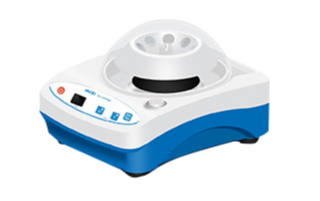
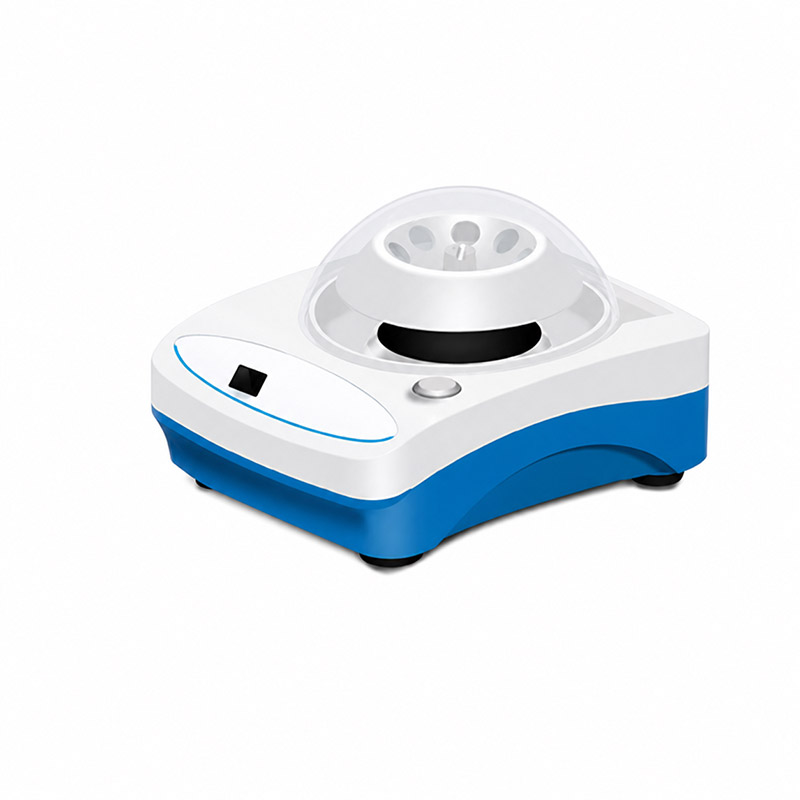
A TENCAN mini centrifuge is intended for exactly this scale of work: individual tubes, small volumes and frequent, short runs. It sits within the same research equipment range as the company's milling, sieving and mixing products, which is convenient for laboratories that prepare the sample and separate it on the same bench. Changsha Tianchuang Powder Technology Co., Ltd supplies these units for laboratory use, and the practical questions below apply regardless of which model is chosen.
Mini Centrifuge vs. Microcentrifuge vs. Full-Size Benchtop Centrifuge
These three categories overlap, and marketing language does not always respect the boundaries. The distinctions that matter in practice are footprint, tube format, achievable RCF and how the instrument behaves during acceleration and braking.
| Consideration | Mini centrifuge | Microcentrifuge | Full-size benchtop centrifuge |
|---|---|---|---|
| Footprint | Very small; often placed beside the bench area where samples are handled | Small to medium | Occupies substantial bench or floor space |
| Typical tube formats | Small tubes and selected mid-size formats, depending on rotor | Predominantly 1.5 mL and 2.0 mL microcentrifuge tubes | Multiple formats, often with interchangeable rotors |
| Achievable RCF | Moderate; suited to routine clarification and pelleting | Moderate to high, depending on rotor radius and speed | Highest, with the widest range of controllable conditions |
| Typical use | Quick clarification, small-volume pelleting, field or teaching work | Molecular biology workflows, small-volume clarification | Large batches, density gradients, temperature-controlled runs |
| Main limitations | Limited volume and force; fewer accessories | Restricted tube formats | Cost, footprint and longer setup time per run |
The practical rule is straightforward. If the sample is small, the required separation is routine, and results are needed within minutes, a mini centrifuge is the efficient choice. If the protocol depends on a specific RCF that only a high-speed rotor can deliver, or if temperature control during the run is critical, a larger instrument is the appropriate tool. Trying to force a high-RCF protocol onto a small unit usually ends with extended run times and inconsistent pellets.
Operating Variables That Change Separation Results
Once the rotor, tube and RCF are fixed, the remaining variability comes from how the run is carried out. These variables are easy to overlook because they are not printed on a datasheet, yet they often explain why two operators obtain different pellets from the same sample.
Acceleration and Braking Behavior
How a rotor reaches speed and how it stops have a direct effect on pellet integrity. Gentle acceleration allows the liquid to move with the tube rather than climbing the wall, which reduces disturbance of the forming pellet. Gentle braking — sometimes called a low-brake or soft-stop mode — prevents the liquid from washing back across a compacted pellet as the rotor decelerates. Hard braking is faster, but it is a common cause of a pellet that was clean at full speed and partially resuspended at the end of the run.
If an instrument offers only one acceleration and braking profile, operators can compensate by reducing the run's final phase: stopping the rotor manually, allowing it to coast, or adding a short settling pause before removing the tube.
Run Time, Temperature and Sample Warming
Run time should be judged against a defined endpoint rather than a fixed habit. A useful criterion is the point at which the supernatant becomes visibly clear, or at which the pellet mass stops increasing between two consecutive runs. Extending the run far beyond that point adds time and heat without adding recovery.
Small centrifuges without active cooling warm up during long runs, partly from the motor and partly from air friction inside the chamber. For temperature-sensitive samples — proteins, biological suspensions, volatile solvents — that warming can change the result even when the separation itself looks acceptable. In those cases, shorter runs at higher RCF are usually preferable to long runs at low RCF, and letting the instrument rest between runs helps keep the chamber temperature stable. Where temperature control is essential, a refrigerated instrument is the honest answer.
Balance, Vibration and Noise
Vibration is a symptom with several possible causes: an unbalanced load, a tube seated incorrectly, a damaged rotor seat, worn rotor bushes, or the instrument sitting on an uneven surface. Vibration shakes the pellet during formation and produces a diffuse, low-density layer instead of a firm one. If noise or movement increases noticeably compared with earlier runs, stop and inspect the rotor, seats and tubes before continuing.
Viscosity, Density and Particle Size: Where Small Rotors Reach Their Limit
Settling time rises with liquid viscosity and falls as the density difference between particle and liquid increases. A slurry in a viscous dispersant may need substantially more time or force than the same solid in water, and a sample whose particles are close in density to the liquid may barely separate at all. Estimating the difference is useful: if the particles are only slightly denser than the liquid, a mini centrifuge is likely to leave a cloudy supernatant, and adjusting the liquid — its viscosity, pH or ionic strength — will do more than increasing speed.
Practical signs that a small rotor has reached its limit include a persistent haze that does not clear with longer runs, a pellet that collapses as soon as the tube is tilted, and a supernatant whose turbidity returns within minutes of standing. Each of these points to a separation problem that a different method, rather than a longer spin, is likely to solve.
Contamination Control, Tubes and Chemical Compatibility
Small centrifuges process small volumes, but the concentration of sample in the chamber air can still be significant — particularly with biological material, fine powders or volatile solvents. Good practice starts with capped tubes, correct fill levels and a rotor that is cleaned after any spill. A film of dried sample on a rotor seat affects balance and can corrode the rotor over time.
Chemical compatibility should be checked at the level of the tube, the rotor and the chamber. Polypropylene tubes tolerate many aqueous acids, bases, salts and alcohols, which makes them a sensible default. Polycarbonate is clearer but more vulnerable to alkaline solutions and some organic solvents. Glass is chemically robust but mechanically unforgiving if it is scratched or overloaded. Where the sample contains aggressive solvents, the tube rating and the rotor material both need to be confirmed before the run, and any spilled liquid should be removed promptly with a material-appropriate cleaning agent.
For powder work, one additional point deserves attention: fine particulate contamination inside the chamber can migrate into the rotor and lid mechanism. Wiping the chamber and inspecting the rotor after handling dry powders keeps the instrument reliable and prevents cross-contamination between samples. A separate rotor or a dedicated instrument for sensitive biological work is often the cleanest solution when the same bench is used for both materials and life-science samples.
Maintenance, Safety and Troubleshooting
A mini centrifuge is a low-maintenance instrument, but it is not a maintenance-free one. Rotor seats, lid interlocks and the motor bearings are the parts that determine whether the unit still separates reliably after a year of daily use.
Routine Maintenance That Prevents Most Failures
- Inspect the rotor and tube seats after every run, and remove any residue while it is still fresh.
- Check tube caps and rotor positions for cracks; a cracked tube can fail without warning at speed.
- Clean the chamber with a mild, compatible agent and allow it to dry fully before closing the lid.
- Verify the lid interlock or safety switch periodically and never bypass it, even for a quick check.
- Confirm that the unit sits level on a stable surface, and note any change in noise or vibration as an early warning.
- Record run conditions — RCF, time, tube format — so that a separation can be repeated or audited later.
Common Problems and What They Usually Mean
| Symptom | Likely cause | What to check first |
|---|---|---|
| Supernatant remains cloudy after a full run | RCF or time below the requirement for the particle size, or particles too close in density to the liquid | Confirm the protocol in ×g, then review viscosity, dispersant and particle size |
| Pellet partially resuspended after stopping | Braking too abrupt, or the tube was disturbed during removal | Use a softer stop and handle tubes gently at the end of the run |
| Increased noise or vibration | Imbalance, incorrectly seated tube, worn rotor seat | Re-balance the load, reseat tubes, inspect rotor seats |
| Liquid found in the chamber | Over-filled or incorrectly capped tube, or a cracked tube | Review fill level and cap closure, inspect tubes for damage, clean the chamber |
| Run aborts or lid will not release | Interlock condition not met, or rotor still turning | Wait for full stop, check the interlock, and follow the manufacturer's instructions rather than forcing the lid |
Safety practice is mostly about the two failure modes that carry real risk: an unbalanced rotor at speed and an open lid during rotation. Both are preventable by consistent loading procedure and by respecting the interlock. Beyond that, the routine is unremarkable — keep the instrument clean, keep tubes within their ratings, and stop the run if anything sounds or feels different from normal.
Selection Checklist Before You Buy a Mini Centrifuge
Selection becomes straightforward once the sample and the downstream step are clearly defined. The following points cover the decisions that actually change outcomes.
- Sample volume per tube. Match the working volume, not the nominal volume, and allow for the tube's safe fill range.
- Required RCF, not required rpm. Determine the force the protocol needs at the sample position and compare instruments in ×g.
- Tube format and material. Confirm the rotor accepts the tubes you already use, and that those tubes tolerate the required RCF and your solvents.
- Rotor type. Fixed-angle for fast clarification; swing-out where a flat pellet and easier resuspension matter more than speed.
- Acceleration and braking control. Adjustable profiles reduce pellet disturbance and improve repeatability.
- Temperature sensitivity. For heat-sensitive samples, decide whether short runs suffice or whether a refrigerated instrument is required.
- Throughput. Count how many tubes must be processed per session; rotor position count affects turnaround more than maximum speed does.
- Safety and containment. A functioning lid interlock is essential; sealed or aerosol-tight options are worth considering for biohazard or solvent work.
- Footprint and power. Check bench space, ventilation clearance and the electrical supply available at the point of use.
- Documentation and support. Confirm that operating instructions, rotor ratings and spare parts are available for the lifetime of the instrument.
Where the answers point in different directions, prioritize the tube format and the required RCF. Those two constraints eliminate most unsuitable models before other features are even considered.
FAQ: Mini Centrifuge Questions Buyers Ask
What is a mini centrifuge used for in a laboratory?
It is used for small-volume separation: clarifying a suspension before analysis, pelleting cells or precipitate, removing coarse particles from a slurry, and preparing liquid samples for spectroscopy or chromatography. It is a benchtop tool for individual tubes rather than a production separation device.
How is a mini centrifuge different from a microcentrifuge?
The terms overlap, but mini centrifuges are generally associated with a very small footprint and routine, low- to moderate-force clarification, while microcentrifuges are more often optimized for 1.5 mL and 2.0 mL tubes with higher achievable force. The decisive factor is the rotor radius, maximum speed and the tube formats each instrument accepts, not the label on the housing.
Can a mini centrifuge separate submicron particles?
Only within limits. Below roughly one micrometer, Brownian motion competes with sedimentation, and small rotors with limited path length and force may not produce a firm pellet regardless of run time. Adjusting the liquid chemistry to aggregate the fines, or using a different separation technique, is often more effective than extending the run.
How do I convert rpm to ×g for a small rotor?
Use RCF = 1.118 × 10⁻⁵ × r × rpm², with r measured in centimeters from the axis of rotation to the sample position. Because the radius differs between instruments, protocols should always be written and compared in ×g rather than rpm.
Does run time make up for lower centrifugal force?
Partly. Increasing time can compensate for reduced force for particles that settle readily, but the gain diminishes as the supernatant clears, and long runs add heat and mechanical wear. If a sample does not clear at the available force within a practical time, the constraint is usually the particle size or the liquid properties rather than the run duration.
Separation quality in small-volume work is rarely decided by a single specification. It comes from the interaction between particle size, liquid properties, tube geometry and the force the rotor can deliver at the sample position. Getting those four elements aligned is what makes a protocol reproducible, and it is also what tells you when a mini centrifuge is the right instrument — and when the sample needs something else. Before committing a new method to routine use, run a small comparison series at two or three RCF values and record the supernatant clarity and pellet behavior; that short exercise usually reveals more about the sample than any single datasheet figure. For laboratories preparing powders and suspensions, pairing a mini centrifuge with the milling and sieving equipment used upstream keeps sample preparation on one bench and makes the whole workflow easier to control.