
Nylon Planetary Mill Jar: A Practical Choice for Contamination-Sensitive Grinding
When you work with soft, temperature-sensitive, or chemically reactive powders in a planetary ball mill, selecting the right grinding jar material can be as important as choosing the mill itself. Metal jars often introduce trace elements, while ceramic jars can be expensive and heavy. A nylon planetary mill jar offers a practical alternative that balances cost, contamination control, and mechanical performance for many laboratory applications.
The nylon planetary mill jar is made from engineering-grade nylon, a polymer known for its toughness, wear resistance, and chemical inertness. Unlike stainless steel or agate, nylon does not contain heavy metals, making it an excellent choice when you need to avoid metallic contamination in your powder. It is commonly used for grinding soft to medium-hard materials, such as coal, graphite, carbon black, certain pigments, and some pharmaceutical or organic compounds.
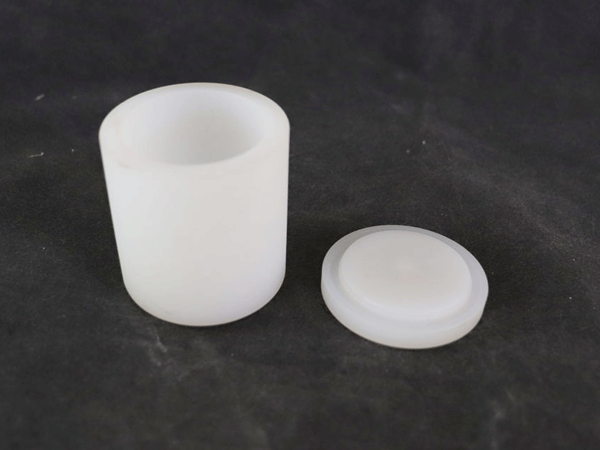
Material Properties of Nylon Grinding Jars
Nylon is a semi-crystalline thermoplastic that offers a unique combination of properties for milling applications:
- Low density: Nylon jars are significantly lighter than ceramic or metal jars, which reduces the overall load on the planetary mill and makes handling easier, especially for larger volumes.
- Good impact resistance: Nylon can withstand the repeated impacts from grinding balls without cracking or chipping under normal operating conditions.
- Excellent wear resistance: Although nylon is softer than ceramic, its abrasion resistance is sufficient for many materials. The wear rate increases with harder feed materials, but for soft to medium-hard powders, nylon jars can last for many cycles.
- Chemical resistance: Nylon is resistant to many organic solvents, oils, and mild acids. It is not recommended for strong acids or strong bases, which can degrade the polymer.
- Non-metallic nature: No iron, chromium, nickel, or other metal ions are introduced into the sample. This is critical for applications like battery material synthesis, catalyst preparation, or spectroscopic analysis where trace metal contamination can ruin results.
In many laboratory settings, a nylon planetary mill jar is considered a cost-effective alternative to zirconia or corundum jars when the material does not require the extreme hardness of ceramic grinding surfaces.
When Should You Choose a Nylon Planetary Mill Jar?
Nylon jars are not a universal solution. They perform best under specific conditions. Here are the scenarios where a nylon grinding jar is a strong choice:
Soft to Medium-Hard Materials
Materials with a Mohs hardness below about 4 are generally safe for nylon jars. Examples include:
- Coal, coke, and graphite
- Carbon black and activated carbon
- Many organic compounds and pharmaceutical powders
- Certain pigments and dyes
- Wood, cellulose, and plant-based materials
- Soft minerals like talc, gypsum, or kaolin
If you are milling hard ceramics, quartz, or metals, the nylon jar will wear rapidly and may introduce polymer fragments into the sample. For such materials, consider zirconia, tungsten carbide, or agate jars.
Contamination-Sensitive Applications
When your research aims to produce high-purity powders for electronics, medical devices, or advanced materials, even parts-per-million levels of metal contamination can affect properties. Nylon jars eliminate the risk of metallic wear. They are also a good choice when you need to grind materials that react with metals, such as certain sulfides or halides.
Wet Grinding with Organic Solvents
Nylon is resistant to many organic solvents, including alcohols, ketones, and aliphatic hydrocarbons. It can be used for wet grinding where the solvent is not extremely aggressive. However, avoid using strong acids (e.g., hydrochloric, nitric, sulfuric) or strong bases, as they can attack nylon.
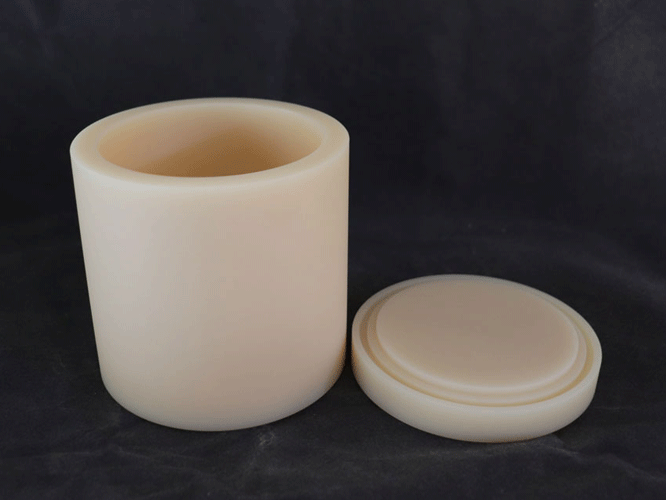
Limitations and Practical Considerations
No jar material is perfect. Understanding the limitations of nylon helps you avoid experimental failures.
Temperature Sensitivity
Nylon has a lower melting point (typically around 220–260°C depending on the grade) compared to ceramics or metals. During high-energy milling, the temperature inside the jar can rise significantly. If you run the mill continuously for long periods at high speed, the jar may soften or deform. It is advisable to use intermittent milling cycles (e.g., 15–20 minutes of grinding followed by 5–10 minutes of pause) to allow cooling. This is especially important for small jars with poor heat dissipation.
Wear and Particle Generation
When grinding hard materials, nylon wears faster than ceramic. The wear particles are nylon themselves, which may contaminate your sample if you are targeting extremely fine powders. However, for many applications, the nylon contamination is negligible compared to metal contamination. If you need to avoid any polymer contamination, choose a ceramic jar.
Mechanical Strength
Nylon jars are not as strong as stainless steel or zirconia. They can crack if dropped or if the grinding balls are too large relative to the jar size. Always follow the recommended ball-to-jar volume ratio (typically grinding balls should occupy about 30–40% of the jar's internal volume) and avoid using heavy balls like tungsten carbide with nylon jars, as the impact energy may exceed the jar's capacity.
How to Select the Right Nylon Ball Mill Jar for Your Planetary Mill
When you are ready to choose a nylon planetary mill jar, consider the following factors to ensure compatibility and performance:
Jar Capacity
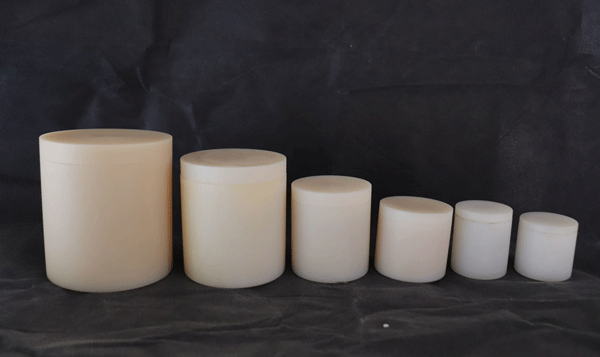
Nylon jars are commonly available in capacities from 50 mL to 500 mL, and sometimes up to 1 L. The size you need depends on your sample quantity. Remember that the effective working volume is about 50–60% of the nominal capacity, because you need space for the grinding balls and the powder. For example, a 250 mL jar can typically process 50–100 mL of powder (depending on packing density).
Lid Design and Sealing
Check whether the jar comes with a flat lid or a domed lid with a rubber O-ring seal. A good seal is essential for wet grinding or when working with fine powders that can leak. Some nylon jars have a threaded design that allows firmer clamping. If you plan to mill under inert gas, you may need a jar with a valve port. Nylon jars can be modified for vacuum or inert gas operation, but standard nylon jars are not inherently vacuum-tight.
Compatibility with Your Mill
Not all planetary mills have the same clamping system. Make sure the jar dimensions (diameter, height, and clamping groove or flange) match your mill's lock clamps. Some mills use fixed clamps, others use quick-release mechanisms. The nylon jar should fit securely to avoid imbalance during rotation.
Grinding Media Selection
When using a nylon jar, the grinding balls should also be chosen to minimize contamination and wear. For soft materials, nylon balls can be used, but they wear quickly. Zirconia (YTZ) or agate balls are common choices because they are hard but do not react with the nylon jar. Avoid steel balls unless you are certain that small amounts of iron contamination are acceptable.
Typical Operating Parameters for Nylon Jars
While the exact parameters depend on your material and mill model, the following range can serve as a starting point for many applications:
- Rotational speed: 200–400 rpm for most planetary mills. Higher speeds may generate excessive heat and stress the nylon.
- Ball-to-powder weight ratio: Commonly 5:1 to 10:1 for soft materials. For harder materials within the nylon's capability, use a lower ratio to reduce wear.
- Grinding ball diameter: 5–15 mm is typical. Larger balls provide more impact but may damage the jar. Smaller balls are better for fine grinding.
- Grinding time: Depends on target particle size. For many materials, 30–60 minutes of effective milling (with pauses) is sufficient to achieve sub-micron particles.
Always start with conservative parameters and monitor the temperature and wear after each run. If the jar feels hot to the touch (above about 60–70°C), increase the pause time or reduce the speed.
Nylon vs. Other Jar Materials: A Quick Comparison
| Material | Best for | Main Limitation |
|---|---|---|
| Nylon | Soft, non-abrasive, contamination-sensitive powders | Temperature limit; wears with hard materials |
| Stainless steel | Medium-hard materials, wet grinding, high impact | Metal contamination risk; heavy |
| Zirconia | Hard ceramics, low wear, high purity | High cost; brittle |
| Agate | Very fine grinding, trace analysis | Expensive; limited size |
| PTFE (Teflon) | Highly corrosive chemicals, very low friction | Soft; low wear resistance |
If your application aligns with the strengths of nylon, it can be one of the most practical and economical choices for your laboratory planetary mill. For more information about the nylon planetary mill jar and its specifications, you can visit the product page. Our engineers can also help you determine whether nylon is suitable for your specific material and process conditions.