
Horizontal Screw Belt Mixer: Working Principle, Applications and Selection Guide
What Is a Horizontal Screw Belt Mixer?
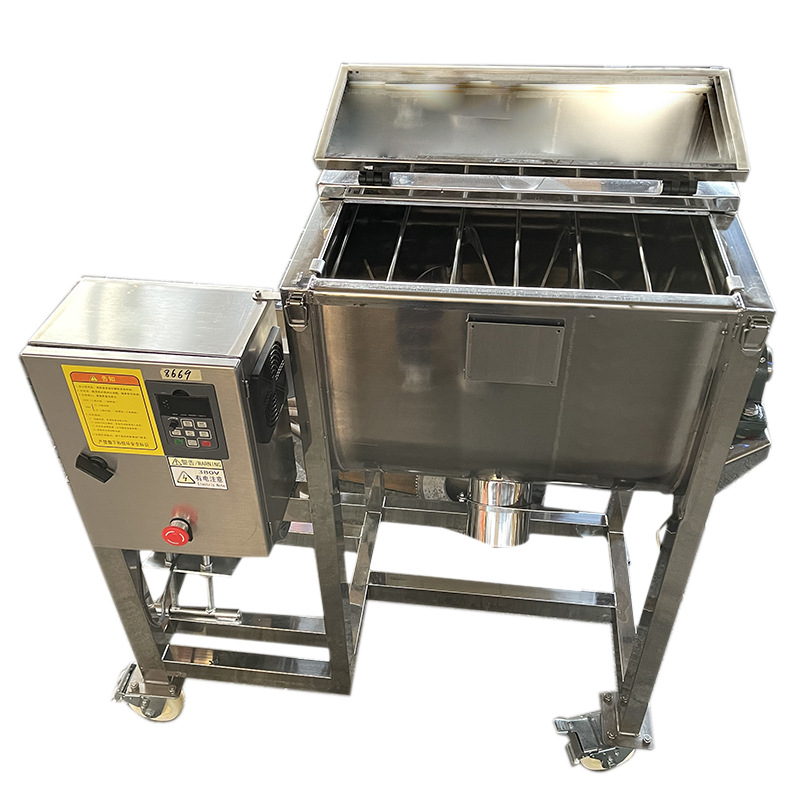
When you work with powders that tend to clump, stick, or contain a small amount of liquid, a standard gravity blender like a V-type mixer may not deliver the uniformity you need. The horizontal screw belt mixer — also referred to as a ribbon blender — is designed specifically for these tougher conditions. It uses a U-shaped trough and a rotating screw-ribbon agitator to create both convective and shear mixing, making it suitable for cohesive powders, viscous pastes, and powder-liquid combinations.
How Does a Horizontal Screw Belt Mixer Work?
The core of this equipment is a spiral ribbon blade — typically two or three layers — mounted on a central shaft inside a U-shaped trough. The outer ribbon moves material from both ends of the trough toward the center, while the inner ribbon pushes material from the center outward. This counter-flow creates a continuous convective mixing action that ensures every particle passes through the active mixing zone multiple times.
Because the ribbons are close to the trough wall, they also shear the material against the wall, breaking soft agglomerates and distributing liquid components evenly. This is why the horizontal screw belt mixer is often chosen for processes that involve adding a small amount of binder, oil, or water into a powder base.
Key Design Features
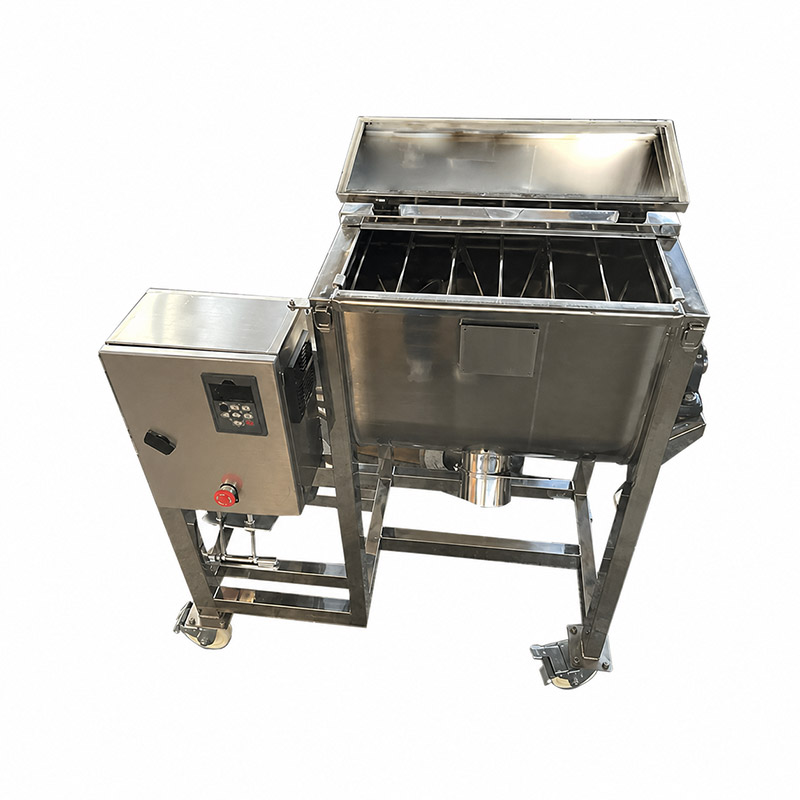
- U-shaped trough with full-open cover — The cover can be designed as a full-opening door, making cleaning and product changeover much faster compared to mixers with limited access.
- Broken or continuous ribbon option — A broken ribbon (segmented) creates more local turbulence and can improve mixing speed for certain materials. Continuous ribbons provide a more gentle axial transport.
- Flange-less shaft connection inside the trough — The screw shaft is connected to the drive flange inside the barrel, allowing quick removal for maintenance or replacement. This design also avoids material accumulation in gaps that would occur with a bolted flange.
- Pneumatic or manual discharge valve — The discharge port is flush with the inner wall, eliminating dead zones where material could remain unmixed.
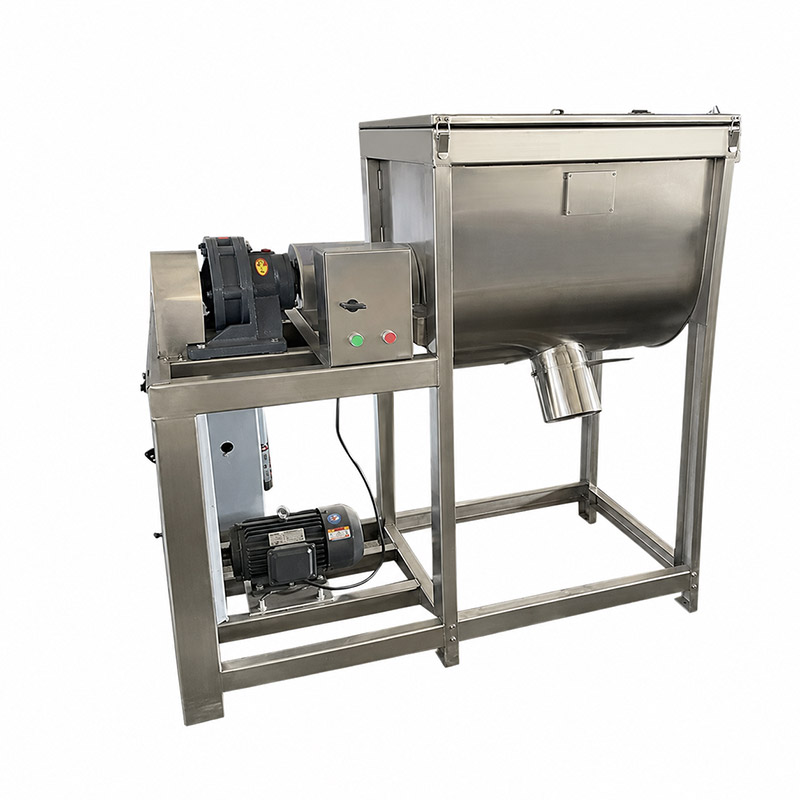
- Belt drive for overload protection — Many models use a belt-driven cycloidal reducer rather than a direct gear drive, giving a degree of slip protection if the load becomes too high.
What Materials Can Be Mixed?
The horizontal screw belt mixer is particularly effective for:
- Dry powders with poor flowability (e.g., fine ceramic powders, carbon black, metal oxides)
- Granules with a wide particle size distribution
- Powder mixtures that tend to segregate by density or particle size
- Viscous pastes and dough-like materials
- Powder-liquid systems where a small amount of liquid (typically 5–20% by weight) needs to be uniformly dispersed
Common application industries include battery electrode material preparation, chemical catalysts, powdered detergents, food ingredients, construction dry mortars, and pharmaceutical granule blending.
How to Choose the Right Horizontal Screw Belt Mixer
Selecting the correct model involves several factors that directly affect mixing quality, throughput, and ease of cleaning.
1. Working Capacity vs. Total Volume
The total volume of the trough is not the same as the usable working capacity. For most ribbon blender applications, the recommended working capacity is about 40–60% of the total volume. Overfilling reduces the mixing action of the ribbons, while underfilling lowers productivity. Knowing your batch size per batch is the first step.
2. Material Properties
Consider the bulk density, angle of repose, particle shape, and tendency to agglomerate or smear. For example, sticky materials may require a broken ribbon design to break up lumps, while very abrasive materials may need hardened steel or stainless steel contact parts.
3. Liquid Addition
If you plan to add a liquid phase, the mixer should be equipped with spray nozzles or a liquid injection system. The ribbon speed, addition rate, and mixing time must be optimized to avoid local overwetting.
4. Temperature Sensitivity
Friction between the ribbons and the material can generate heat. If your material is temperature-sensitive, consider a jacket for cooling or heating, or use intermittent operation.
5. Discharge and Cleaning Requirements
If you need to change products frequently, look for a design with a full-open cover and a flush discharge valve. The horizontal screw belt mixer from TENCAN, for instance, features a removable shaft and a rounded trough bottom that minimizes residue.
Comparing Horizontal Screw Belt Mixer with Other Mixers
| Mixer Type | Best For | Limitations |
|---|---|---|
| V-type mixer | Free-flowing dry powders | Poor with sticky or cohesive materials |
| Double cone mixer | Gentle blending of fragile granules | Limited shear, no liquid addition |
| Horizontal screw belt mixer | Cohesive powders, pastes, powder-liquid | Higher energy consumption, more wear |
| 3D mixer | Small batches, high homogeneity | Low capacity, not for viscous materials |
As you can see, the horizontal screw belt mixer fills a gap where gravity-driven blenders fail. It is not a universal solution — for very fine, highly aerated powders, a high-speed disperser might be more appropriate. However, for the majority of industrial mixing tasks involving wet or sticky solids, it is a workhorse.
Maintenance and Operational Tips
- Check ribbon clearance regularly — Over time, the ribbon tips can wear, increasing the gap between the ribbon and the trough wall. This reduces shear efficiency. Replace ribbons when the gap exceeds 3–5 mm (depending on scale).
- Lubricate bearings and seals — The shaft seals at the ends of the trough are critical to prevent leakage. Use food-grade grease if mixing edible products.
- Balance the load — Do not start the mixer under full load. Fill the trough while the ribbons are rotating slowly, or start with a partial load and add material gradually.
- Clean after each batch if product purity is critical — The full-open cover makes washing easy. For wet mixing, pay attention to the underside of the cover and the ribbon surfaces.
Conclusion
The horizontal screw belt mixer is a reliable, high-efficiency blending solution for materials that challenge conventional free-fall mixers. Its convective mixing action, combined with shear from the ribbons, delivers uniform results for cohesive powders, pastes, and powder-liquid systems. When selecting a model, carefully consider your batch size, material characteristics, and cleaning frequency. A well-chosen ribbon blender will serve your production line for years with consistent performance.
For more details on the Horizontal screw belt mixer and other mixing equipment, visit the TENCAN product page to explore specifications and options.