
Multi Dimensional Mixer: Segregation Control
A powder blend can look even on the surface and still fail a content uniformity test. The problem is rarely the mixer alone. Segregation begins when particles differ in size, density, shape, or surface behavior, and it continues during discharge, transfer, storage, and feeding. A multi dimensional mixer addresses one part of that chain by moving the entire powder bed through a changing path, but it cannot freeze a blend in a perfectly mixed state. Understanding where mixing ends and segregation starts is the basis for a realistic process design.
The useful question is not whether the equipment can turn powder over. It is whether the selected motion, loading method, discharge arrangement, and downstream handling can keep each declared component within specification long enough to be packed or used. Changsha Tianchuang Powder Technology Co., Ltd (TENCAN) presents the Multi dimensional mixer within its mixing equipment range, and the product page is a starting point for configuration details rather than a substitute for material testing.
Why Powder Blends Segregate After Mixing
Appearance is a poor test for blend quality. A surface may look consistent while the bottom of the vessel, the discharge chute, or the first portion packed into a drum contains a different ratio of fine and coarse particles. The eye sees color and texture, not the distribution of an active ingredient. A blend is only as uniform as the sampling method and analytical procedure used to prove it, and those methods must reflect the specification that matters for the next process step.
Segregation is a physical response to movement. In a free-flowing powder, smaller particles can sift through the voids between larger ones, a process known as percolation. Vibration during transfer can compact the bed and drive fines upward or toward the surface. A falling stream from a discharge chute can separate particles by mass and drag. Very fine particles may remain airborne long enough to be lost to dust collection or to settle unevenly. Each mechanism produces a different pattern, which is why a single mixing time cannot solve every uniformity problem.
The risk increases when the particle size distribution is broad, when components have very different bulk densities, or when particle shapes promote interlocking rather than free flow. A blend containing coarse granules and a fine minor component is often more difficult to keep uniform than a blend with a narrow size range. Cohesive fine powders may segregate less by percolation, but they can form lumps, cling to surfaces, or carry electrostatic charge. There is no universal particle-size threshold that predicts success; the only reliable approach is to characterize the actual feed and test the actual motion.
Mixing and segregation also occur at the same time. A multi dimensional mixer can reduce localized concentration differences by repeatedly exchanging material throughout the vessel, but once the driving motion stops, gravity and vibration begin to work in the opposite direction. Overmixing can be as harmful as undermixing when it creates fines, breaks fragile granules, or gives a segregation-prone blend more opportunity to separate. The objective is not indefinite movement. It is to reach the specification, discharge the blend with minimal disturbance, and verify that the receiving container remains representative.
Testing should therefore include more than one location and more than one time point. A sample taken from the easy-to-reach top layer says little about the material near the discharge. Meaningful qualification may require samples from the upper, middle, and lower zones, as well as from the beginning, middle, and end of discharge. Depending on the product, analysis may include assay, particle size distribution, moisture, bulk density, flow, or image-based inspection. The result is a distribution, not a single number, and the acceptance criterion should match the needs of the finished product.
When a blend fails, adding time is not automatically the correct response. The cause may be an agglomerated minor component, a dead zone created by overfilling, a discharge chute that separates particles, or a sampling tool that collects preferentially from one region. Separating these causes requires a deliberate trial rather than a sequence of guesses. A well-designed test identifies whether the mixer is creating uniformity and whether the surrounding process is preserving it.
How a Multi Dimensional Mixer Moves the Powder Bed
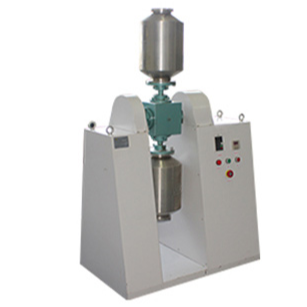
The TENCAN multi dimensional mixer is built around the movement of a closed product vessel. Rather than relying on a single rotating shaft or a high-speed impeller inside the powder, this equipment family uses a compound motion that changes the orientation of the vessel and the bed within it. The exact motion, available sizes, and product-contact configuration should be confirmed on the product page or with the supplier, because those details determine how a specific material will behave.
The functional elements are straightforward to describe at the equipment-family level: a product vessel, a support frame, a drive system, controls, and a discharge arrangement. Because the powder contacts the vessel rather than a small impeller zone, the entire batch is involved in the movement. That distinction matters for blends that must be handled gently, and it also changes which process variables deserve the most attention.
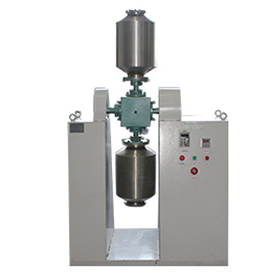
Motion, not high shear, is the working principle
As the vessel changes position, the powder bed is lifted, folded, and allowed to slump. Material near the wall moves into the interior of the bed, while material from the interior is exposed at a new surface. Repeated reorientation creates bulk exchange throughout the batch. Local shear still exists as particles slide past one another, but it is not concentrated at a high-speed blade. This is why the multi dimensional mixer is often considered for dry powders and granules where gentle handling is relevant.
Gentle is a relative term, not a guarantee. Granules can still break, fine particles can still be generated, and heat-sensitive materials can still be affected by the energy going into the bed. The practical question is whether the motion produces the desired distribution without changing the material beyond specification. A trial should compare particle size, bulk density, flow, and visual appearance before and after mixing, not only assay uniformity.
What the closed vessel changes
A closed vessel can reduce dust release during loading and mixing, limit product loss to the room, and lower operator exposure compared with an open process. These are process benefits, not automatic certifications. If the material requires an inert atmosphere, temperature control, or a specific cleaning regime, those requirements must be matched by the actual configuration. A closed vessel should not be assumed to be gas-tight or suitable for every solvent or oxygen-sensitive formulation without confirmation.
The same design also has limits. A multi dimensional mixer is a blending device, not a mill. It should not be expected to break hard agglomerates, reduce the median particle size, or disperse a difficult pigment in a high-viscosity liquid. If the specification requires particle size reduction, a milling step is needed before or after blending. If the process requires granulation, coating, or paste formation, a different mixing principle may be more appropriate. These are not shortcomings of the mixer; they are boundaries of the unit operation.
Discharge deserves as much attention as mixing. A perfectly blended bed can separate as it leaves the vessel if the chute creates a falling stream, if the receiving container is overfilled, or if the first and last portions are handled differently. The internal shape of the vessel, the discharge opening, and the ability to empty without leaving a significant heel all influence the result. Ask how the discharge will behave at the intended scale and how the vessel will be inspected and cleaned.
Where the mixer fits in a powder line
The strongest position for a blending step is usually after the last size-changing operation and before packaging, tableting, filling, or reaction. If a blend is milled after mixing, the mill can create fines or separate components, so the uniformity achieved in the mixer may not survive. If the blend is pneumatically conveyed after discharge, the conveying air can classify particles by size and density. The mixer should be selected as part of the whole powder path, not as an isolated machine.
Process Variables That Control Blend Uniformity
Once the mixing mechanism is understood, most uniformity problems come down to a small set of variables. The goal is not to find a single universal setting. It is to define a robust operating window in which the specified blend can be produced repeatedly, discharged cleanly, and sampled without bias.
Fill level and headspace
Fill level controls how much free volume the bed has to fold and exchange positions. At a very high fill, the powder may have little room to move, and the motion can become a slow rotation of a compacted mass. At a very low fill, there may be more free space but fewer particle interactions and a greater chance of dust or wall adhesion. The working range should be established with the actual bulk density, not with water or a representative surrogate. A material that fills half the vessel by volume may occupy a very different fraction by mass, and vice versa.
Speed and mixing time
Higher speed is not automatically better. In a tumbling or multi-axis system, there is a useful range in which the bed cascades and exchanges material. If the motion becomes too fast, powder may cling to the wall, centrifuge toward one region, or generate more fines than the product can tolerate. The correct condition is the one that keeps the bed in useful motion without creating a new segregation pattern or damaging the particles.
Mixing time should be based on a measured plateau, not on habit. Sampling at several intervals shows when the target uniformity is reached and whether additional time changes the result. A long run can increase attrition, heat input, and dust generation. It can also allow a free-flowing blend to segregate while the vessel is still moving. The shortest time that reliably meets the specification within the validated operating window is usually more robust than an arbitrary long cycle.
Loading sequence and feed condition
The order of addition matters. A small minor component poured onto the surface of a full vessel may remain localized for longer than expected. Pre-blending a minor ingredient with a portion of the major powder can reduce local overloading, provided the pre-blend is representative and does not itself segregate. Feeding a lumpy or moist material into the vessel and expecting the mixer to correct it is a common source of failure. If hard agglomerates are present, a sieving, delumping, or milling step before mixing may be necessary.
Material properties and environmental conditions
Particle size, density, shape, surface energy, moisture, and electrostatic behavior all influence the outcome. A narrow distribution with similar densities is generally easier to blend than a broad distribution containing both coarse and very fine particles. Cohesive powders may require more mechanical work to break up clusters, but excessive work can create fines or alter flow. Humidity can change surface moisture and interparticle forces during a long run, especially when the powder is hygroscopic.
| Process variable | What changes | Practical check |
|---|---|---|
| Fill level | Free volume, bed turnover, wall contact | Test low, normal, and high levels within the supplier range using actual bulk density |
| Motion speed | Cascading versus clinging or over-centrifuging | Observe the bed through a safe, approved viewing point; do not judge by sound alone |
| Mixing time | Approach to a plateau, then risk of attrition or segregation | Sample at intervals and stop when the specification is met |
| Loading sequence | Local overloading of minor ingredients | Add minors into a distributed pocket and pre-blend small additions |
| Feed state | Lumps, moisture, electrostatics | Characterize before the trial; dry, delump, or sieve if needed |
| Discharge | Re-segregation and residual heel | Sample start, middle, and end; inspect the vessel after emptying |
Sampling and interpretation
A qualification run is only as good as its samples. A sample thief should withdraw material from a defined point without overflowing from another zone, and the sampling pattern should cover the vessel geometry and the discharge stream. If only the top surface is sampled, a stratified blend can appear acceptable. If only the first discharge portion is tested, the result may miss segregation that develops later in the container. Record the sample location, time, mass, and handling method so that an unexpected result can be investigated rather than repeated blindly.
Matching the Mixer to Material Behavior and Process Limits
Equipment selection begins with the material and the specification, not with a catalog image. A multi dimensional mixer can be a strong fit for one powder and a poor fit for another that looks similar. The decision should connect particle behavior, acceptable attrition, discharge requirements, cleaning needs, and the scale at which the blend must be reproduced.
Free-flowing and segregation-prone blends
A free-flowing blend with components that differ in size or density is the classic segregation case. A multi dimensional mixer can distribute the components throughout the bed, but the same flowability that helps mixing can also promote separation after the vessel stops. The process design should therefore minimize unnecessary transfer, avoid long vertical drops, control the fill rate of the receiving container, and verify uniformity at the point of use. Reducing overmixing and avoiding vibration during storage can be as important as changing the mixer setting.
Cohesive, fragile, abrasive, and moisture-sensitive materials
Cohesive powders often contain soft agglomerates that must be broken before the primary particles can be distributed. A gentle tumbling motion may not have enough local shear to break hard lumps, so pre-sieving or a separate de-agglomeration step may be needed. If the lumps are soft and the specification permits, the mixer may still be suitable, but the claim should be based on a trial that examines both uniformity and particle size.
Fragile granules present the opposite concern. The gentle bulk motion of a multi dimensional mixer may reduce breakage compared with an intense shear device, but it does not eliminate attrition. A trial should measure the fine fraction and the change in granule size, not just the uniformity of the active component. If the granule surface is coated or structured, even a small amount of attrition can change dissolution or flow behavior.
Abrasive materials require attention to wear and contamination. The vessel, seals, and discharge components should be reviewed for material compatibility, and the maintenance plan should include inspection for wear. The presence of a wear-resistant option should be confirmed with the supplier rather than assumed. For moisture-sensitive or oxygen-sensitive powders, a closed vessel can reduce exposure to the room, but it does not by itself create a controlled atmosphere. Purge connections, seals, and gas-tightness must be specified and verified if inerting is required.
When another mixing principle is the better fit
If the process requires high liquid addition, paste formation, wet granulation, or intense dispersion of a minor component in a viscous vehicle, a high-shear or kneading type of equipment may be more appropriate. If the feed contains hard agglomerates that must be reduced, a mill or de-agglomeration step should come first. If the requirement is particle size reduction rather than blending, a multi dimensional mixer is not the correct unit operation. Recognizing these boundaries early prevents a trial from being asked to solve a problem the equipment was never intended to solve.
For a specific project, the TENCAN multi dimensional mixer should be evaluated against a short list of practical questions: What is the working volume at the actual bulk density? How will the vessel be loaded and discharged? What product-contact materials and seals are available? How is the interior inspected and cleaned? What is the expected motion at the proposed scale? Which sampling points are accessible? The answers turn a general product description into an engineering selection.
Qualification, Scale-Up, and Routine Control
A mixer is qualified against a specification, not against a photograph of the blend. The qualification plan should define the critical quality attributes, the sampling locations, the number of samples, the analytical method, and the acceptance criteria before the first trial begins. This prevents a successful visual result from being confused with a successful process.
A practical qualification sequence
- Characterize the feed materials: particle size distribution, bulk density, moisture, flow behavior, and the assay of each component.
- Define the worst-case blend within the intended formulation range, including the smallest minor component and the widest particle-size difference.
- Run the mixer at representative low, normal, and high fill levels, using the supplier-recommended motion range as a starting point.
- Sample at planned time intervals and at multiple locations, then sample the discharge stream at the beginning, middle, and end.
- Test the blend after discharge, after representative storage, and after any transfer that will occur in production.
- Repeat the run to confirm that the result is reproducible and that the operating window is wide enough for normal variation.
Scale-up without copying rpm
Scale-up is not a matter of multiplying mixing time or copying a small-machine speed. Vessel geometry, fill ratio, motion pattern, and discharge behavior all change with size. A larger unit may require a different number of revolutions or a different cycle time to achieve the same number of bed exchanges. The supplier should provide scale-up guidance, and the larger unit should be challenged with the same material and sampling discipline used in the laboratory. If the motion pattern or fill ratio cannot be kept comparable, the production cycle must be re-optimized rather than assumed.
Cleaning, maintenance, and documentation
Residue from a previous batch can carry an active component into the next product, so cleaning must be validated for the materials used. The interior geometry, discharge area, seals, and any removable parts should be accessible for inspection and cleaning. Cleaning verification should use a method sensitive enough for the intended limit, not only a visual check. If the same vessel is used for multiple products, changeover procedures should define disassembly, cleaning, drying, and inspection steps.
Routine maintenance should include inspection of the vessel, drive, fasteners, seals, and controls, with attention to any sign of wear, leakage, or abnormal motion. Unauthorized modifications to the vessel or drive can change the mixing pattern and invalidate previous qualification. Batch records should capture the actual fill mass, loading sequence, motion setting, mixing time, discharge condition, and sampling results so that trends can be detected before a deviation occurs.
Common pitfalls are predictable: judging uniformity by appearance, sampling only the top layer, overfilling to increase batch size, extending time to compensate for a feed problem, ignoring segregation during discharge, and transferring a laboratory cycle directly to production without verification. Avoiding those errors is often more valuable than changing the equipment. The practical test of a multi dimensional mixer is whether it delivers a representative blend at the point of use, repeatedly, within a documented operating window, while preserving the particles and supporting a clean, controlled powder process.