
3D Mixer for Laboratory Powder Blending: How It Works and When to Use It
Why Powder Blending Can Be More Complex Than You Expect
If you have ever tried to mix two dry powders with different densities, particle sizes, or flow characteristics, you know that a simple rotation often leaves you with segregation rather than a uniform blend. Many laboratory researchers and process engineers face this challenge when preparing small batches for battery cathode materials, ceramic slurries, pharmaceutical formulations, or metallurgical samples. The problem is that conventional tumbling mixers rely on a single axis of rotation, which can cause heavier particles to settle and lighter particles to rise.
This is where a 3D mixer offers a fundamentally different approach. By combining translational, rotational, and reversing motions, the 3D mixer eliminates the centrifugal force that typically drives segregation. The result is a homogeneous mixture even when the components have widely different physical properties. In this article, we will walk through how a laboratory 3D motion mixer works, what materials benefit most from this technology, and how to choose the right configuration for your experiments.
Working Principle of a 3D Laboratory Mixer
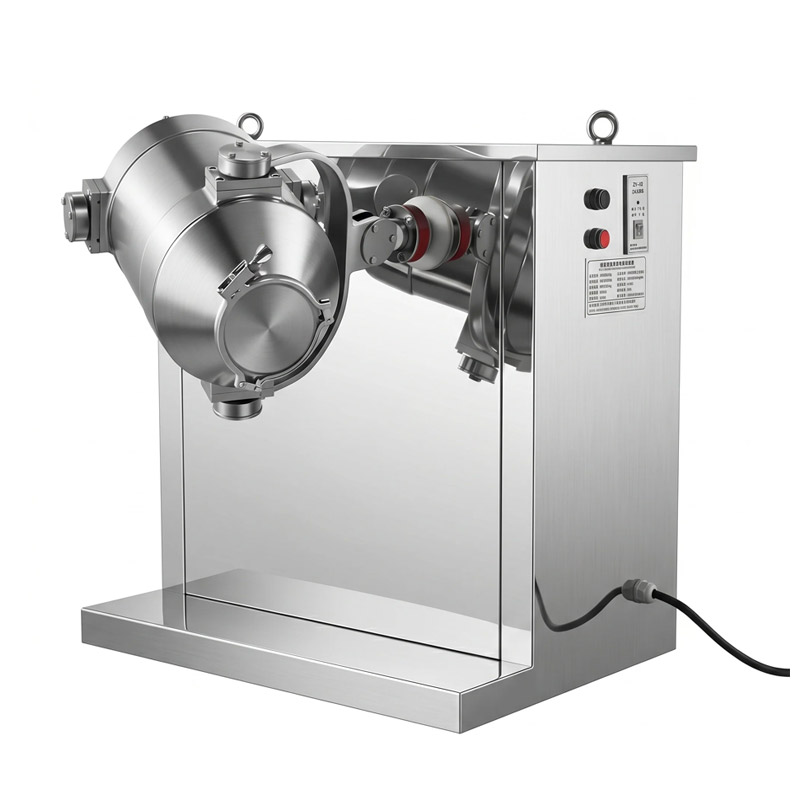
A 3D mixer, also known as a three-dimensional motion mixer, uses a specially designed mechanism to drive the mixing container along three axes simultaneously. Unlike a simple drum mixer that rotates around a fixed horizontal axis, the 3D mixer’s container performs a combination of translation, rotation, and inversion. The mixing container is mounted on a multi-axis drive system that causes it to swing, spin, and tilt in a continuous cycle.
Because the container moves in multiple directions, the powder inside experiences constant orientation changes. There is no single “bottom” or “top” — the material is continuously folded, sheared, and redistributed. This motion effectively breaks up agglomerates and forces particles of different sizes and densities to intermingle. Since the container never reaches a steady centrifugal field, stratification is largely avoided. In many laboratory tests, a 3D mixer can achieve blending uniformity above 99% within a few minutes for most dry powders, depending on the material properties and batch size.
Key Differences from Traditional Mixers
- No centrifugal segregation: Traditional rotary mixers rely on gravity and a single rotation axis, which can cause density-based separation. The 3D motion eliminates this effect.
- Higher filling ratio: A 3D mixer container can be filled up to 80–90% of its volume, compared to 40–50% for many conventional mixers. This means you can process more material per batch without sacrificing uniformity.
- Gentle handling: Because there is no high-speed impeller or aggressive shear, the 3D mixer is suitable for fragile or friable materials that might break down under mechanical stress.
Typical Applications in Research and Development
The 3D mixer is widely used in laboratories that need reproducible, high-quality powder blends for subsequent processing. Common industries and materials include:
Battery Materials
In lithium-ion battery research, electrode active materials such as NMC, LFP, and graphite are often blended with conductive additives and binders before slurry preparation. A 3D mixer ensures that the carbon black or conductive agent is uniformly distributed throughout the active material, which directly affects the electrochemical performance of the final electrode. The gentle mixing action also helps preserve the particle morphology of the active materials.
Ceramics and Refractories
For advanced ceramics, a homogeneous distribution of sintering aids, binders, and dopants is critical for achieving consistent density and mechanical properties. The 3D mixer can handle fine ceramic powders (e.g., alumina, zirconia, silicon carbide) without causing excessive agglomeration or contamination. The stainless steel or polymer-lined containers are easy to clean between batches to avoid cross-contamination.
Pharmaceutical Powders
In early-stage formulation development, a 3D mixer is used to blend active pharmaceutical ingredients (APIs) with excipients. The motion is gentle enough to avoid damaging the API crystals, yet effective enough to achieve content uniformity required for small-scale tableting or capsule filling. Some models offer optional containers that can be sealed for handling potent compounds.
Metallurgy and Powder Metallurgy
Mixing metal powders of different densities — such as tungsten with copper or aluminum with titanium — is notoriously difficult. The 3D motion overcomes the density difference and produces a consistent blend that can be pressed and sintered into homogeneous parts. The mixer can also be used for blending lubricants or binders into metal powders before compaction.
How to Select the Right 3D Mixer for Your Lab
Choosing the correct laboratory 3D mixer involves considering several practical factors. The goal is to match the equipment to your typical batch size, material properties, and cleanliness requirements.
Container Volume and Batch Size
Laboratory 3D mixers commonly come in container volumes ranging from 0.5 L to 10 L. For most R&D applications, a 1 L or 2 L container is sufficient for preparing samples of 100–500 g per batch. If you work with larger quantities, a 5 L or 10 L model may be more practical. Keep in mind that the usable capacity is typically 80–90% of the total container volume, depending on the flowability of the powder.
Material of Construction
The container material should be compatible with your powder. Standard options include:
- 304 stainless steel with a polished interior — suitable for most dry powders, easy to clean, and resistant to corrosion.
- 316L stainless steel — recommended for corrosive or high-purity materials.
- PTFE or polyurethane lining — ideal for materials that must avoid metal contact, such as high-purity ceramics or certain pharmaceutical compounds.
Some 3D mixers offer interchangeable containers, which is a convenient feature when you need to switch between different materials without lengthy cleaning.
Sealing and Atmosphere Control
If your powder is sensitive to moisture, oxygen, or dust, look for a mixer with a sealed container that can be purged with inert gas or operate under a slight vacuum. This is especially important for air-sensitive battery materials, hygroscopic pharmaceutical powders, or pyrophoric metal fines. Always follow safety protocols when handling reactive powders.
Speed and Programmability
Most laboratory 3D mixers have a fixed or adjustable rotation speed, typically between 20 and 60 rpm. A variable speed controller allows you to optimize the mixing intensity for different materials. Programmable timers are useful for standardizing process parameters across multiple batches. Ensure that the motor is powerful enough to handle the full load without overheating during extended operation.
Practical Tips for Achieving Consistent Mixing Results
Even with a well-designed 3D mixer, the quality of your blend depends on a few operational details:
- Pre-mix large and small components: If your formulation includes a very small amount of a minor component (e.g., 0.1% lubricant), consider preparing a pre-blend first to improve distribution.
- Avoid overfilling: While the 3D mixer can handle a high fill level, leaving some headspace (10–20%) allows the powder to move and tumble freely.
- Use grinding media if needed: For breaking up soft agglomerates during mixing, you can add a few ceramic or stainless steel balls (typically 10–20 mm) to the container. The mixing motion will gently tumble the balls through the powder.
- Clean thoroughly between batches: Even small residues can affect the next formulation. Look for containers with smooth surfaces and no dead corners that trap powder.
When to Consider a Different Mixing Technology
While the 3D mixer is an excellent all-rounder, there are situations where other equipment might be more suitable:
- Sticky or wet powders: If your material has a high moisture content or tends to agglomerate into large lumps, a V-type mixer or a high-speed disperser may be more effective.
- Very small batches (less than 50 g): A tumbler-type mixer or a manual blending jar might be more practical.
- Continuous processing: The 3D mixer is designed for batch operation. For continuous blending, consider a screw belt mixer or a ribbon blender.
- Liquid addition: If you need to incorporate small amounts of liquid into a powder, a trough mixer or a kneading machine provides better control.
For most dry powder blending tasks in a laboratory setting, however, the 3D mixer offers the best combination of uniformity, gentle handling, and ease of use. It is a versatile workhorse that can handle everything from metal powders to ceramic additives to pharmaceutical blends.
To explore the available configurations, including container materials, volumes, and optional accessories, please visit the 3D mixer product page. If you are unsure about which model fits your specific application, feel free to contact our technical team with details about your powder type, batch size, and any special requirements. We can help you select the right equipment and even suggest initial mixing parameters to get you started.