
What Makes a Suitable Vacuum Tube Furnace for Atmosphere-Sensitive Powder Processing?
Fit Is Decided Before the Furnace Is Switched On
A powder that has just come off a planetary ball mill carries a surface that did not exist before milling: fractured, heavily deformed and chemically eager. The anneal, reduction or sintering step that follows will either preserve the condition the milling created or quietly destroy it, and the decision that settles which one happens is usually taken months earlier, when the furnace is specified.
Tube furnaces are unusually easy to compare badly. Photographs show the same box, the same controller and a similar length of tube, so buyers fall back on headline temperature, which is the one number that rarely decides whether a run succeeds. The conditions that actually determine fit are the atmosphere you can hold, the window you can control, the tube you can put in the hot zone, what you can pass through the seal, and how repeatable and how fast the whole cycle is. Work through those five before requesting a quotation from anyone.
Five Conditions That Decide Whether a Vacuum Tube Furnace Fits
The order below follows how often each condition removes a candidate from a short list. Write an answer for each one, in figures where possible, before contacting a supplier.
1. The Atmosphere You Actually Need
“Vacuum tube furnace” describes a mechanical arrangement — a tube closed at both ends with flanges that allow evacuation and gas flow — not a single atmosphere capability. Static vacuum pulled once before backfilling with argon is a very different duty from continuous flow of high-purity gas through the tube during heat-up, dwell and cool-down. Reducing atmospheres based on hydrogen add requirements around purging, leak integrity and venting. Oxidising or humidified atmospheres are a third case and restrict the tube and seal materials that may be used.
Answer three questions in writing: which gas or mixture, at what purity and flow, and for which parts of the cycle; whether the process needs dynamic vacuum during heating, since powders and binders outgas heavily and that load lands on the pump; and what oxygen and moisture levels the sample will tolerate. The last question decides whether a simple purge suffices or whether a gas purifier or load lock is needed upstream. Hydrogen duty also requires a documented purge sequence, gas detection and a vent path — safety requirements, not options.
2. Your Real Process Window, Not the Maximum Rating
Headline maximum temperature is normally quoted for an empty tube of a specified material, and it is not the temperature at which a loaded tube should run continuously. The working window that matters is bounded by the tube material's practical limit, uniformity at your sample position, the ramp and cool rates the insulation allows, and the drift the control loop shows over a long hold.
Compare candidates on the window you intend to use. A process needing a few degrees of variation across a small sample bed at 900 °C is a different specification from one that tolerates a gradient over a 200 mm zone. Ask for the uniformity that was measured, at which temperature, in which tube, with which thermocouple position — control thermocouples sit outside the work tube and can read noticeably differently from a sensor at the sample. Natural cooling in a fibre-insulated furnace is slow; if your workflow assumes fast turnaround, ask what cooling options exist and what they do to tube stress.
3. Tube Material and Chamber Geometry
The tube is a consumable and a process variable at once. Fused quartz is transparent, low in metallic contamination and comparatively inexpensive, but it softens far below the temperature a ceramic tube tolerates, is sensitive to thermal shock and is attacked by alkali species when hot. Alumina tolerates higher temperatures and is chemically more robust in many duties, but it is opaque and costs more. Metal and alloy tubes serve specific reducing or mechanical duties, and some processes need a liner to keep the charge away from the tube wall.
Geometry matters as much as chemistry. A larger bore accepts larger crucibles but lengthens pump-down and can widen the gradient across the sample. Long tubes allow a cold zone for condensation; short tubes heat and cool faster. Horizontal arrangements suit boats and flat crucibles, vertical arrangements suit beds of powder. Whichever you choose, the carrier — boat, crucible or foil — must be compatible with the charge at temperature, because contamination from the carrier is as real as contamination from the milling jar.
4. Sealing, Feedthroughs and What Must Enter the Hot Zone
The end flanges decide what the furnace can be. Elastomer O-rings are convenient for many inert-gas and rough-vacuum duties but limit bake-out and ultimate pressure; metal seals cost more and demand better flange care. Ask what vacuum level is achievable on the assembled system, not on the pump alone, and ask for a leak-rate figure or an acceptance test. A furnace that reaches a good vacuum but drifts upward over a weekend hold is not doing the same job.
Then list everything that must cross the seal: gas in and out, a gauge, one or two thermocouples, electrodes, a viewport, perhaps a port for a bubbler or condensate trap. Each is a potential leak path and must be specified at order rather than improvised later. If your process evolves — most laboratory processes do — ask how the flange design accommodates additional feedthroughs.
5. Programming, Repeatability and Turnaround
A tube furnace is bought for the recipe it can repeat. Multi-step programs with controlled ramps, holds and cooling segments are the baseline; what separates suppliers is how clearly the recipe can be verified, exported and compared between runs. For work supporting publications, internal specifications or customer audits, data export and a documented calibration route are worth more than extra degrees of headline capability that will never be used.
Turnaround matters more than newcomers expect. A cycle includes loading, purging, heating, dwelling, cooling to a safe handling temperature, unloading and cleaning. Cooling and purge segments often dominate, and changeover between chemistries — lithium-, sodium- or sulfur-bearing powders, for example — requires cleaning discipline or a dedicated tube. Ask which consumables the design uses, how quickly tubes and seals are replaced, and whether spares are held regionally.
Where the TENCAN Vacuum Tube Furnace Fits
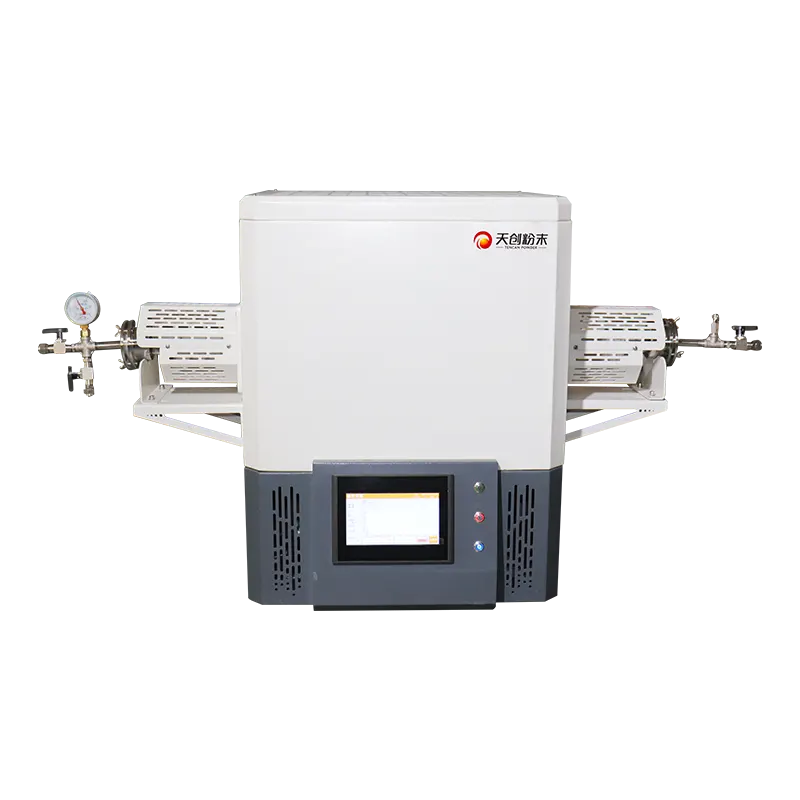
TENCAN's vacuum tube furnace is a practical starting point for laboratories whose milling and thermal work are already linked: the same supplier covers the mill, the jars and media, and the furnace that treats the milled powder, which shortens the loop between a milling change and the anneal that follows. The sensible way to evaluate it is not to compare a headline number but to map your own five answers onto the configuration options the platform offers.
Mapping Requirements to Configuration
Start with the sample. A small batch of milled oxide powder in a shallow alumina boat has almost nothing in common, thermally, with a pressed pellet or a metal coupon annealed under flowing hydrogen. Sample mass and form set the crucible, the crucible sets the tube bore, the bore sets the heated length you need, and the atmosphere sets the flange, seal and safety hardware. Working in that order prevents the common mistake of choosing a chamber first and discovering later that the pump, gas panel or tube material cannot support the process.
Next, write the thermal profile as a recipe: ramp to the first hold, hold time and tolerance, ramp to the second hold, cooling mode, and the temperature at which the tube may be opened. A supplier can only confirm a configuration against a specific profile; “about 1000 °C” is not a specification. Where the profile includes a reducing gas, say so at the outset, because it changes the purge design, the gas fittings and the siting requirements in your laboratory.
What to Confirm in Writing with TENCAN
The following list is deliberately unglamorous. It is also what separates a furnace that works for five years from one that is argued about for five months.
- Maximum continuous working temperature with the exact tube supplied, and the derating for your load.
- Heated zone length, position of the uniform zone, and the uniformity measured at your working temperature.
- Achievable vacuum on the assembled system, leak-rate acceptance criteria, and the gauge and pump supplied.
- Gas inlet, outlet and purge arrangement, and whether a flow meter, valve or bubbler is included.
- Tube material, bore and length options, plus cost and lead time of a spare tube.
- Controller capability: program segments, ramp limits, alarms, data export and calibration documentation.
- Safety provisions for flammable gas: purge procedure, detection, venting and interlock.
- Utilities and footprint: supply voltage, current, cooling water if required, and clearance for tube extraction.
- Documentation and support: manual, wiring diagram, calibration certificate, warranty terms, service route and spare-parts list.
Ask the same questions of every candidate. Verbal answers are useful for triage; only written answers belong in a comparison.
A Selection Matrix for Tube Furnace Requirements
Use the matrix below to convert process requirements into specification decisions. It is deliberately qualitative: numbers belong in your own process documents and in a supplier's written offer, not in a generic table.
| Process requirement | What it drives in the specification | What to confirm in the quotation |
|---|---|---|
| Oxygen-sensitive powder anneal | Vacuum integrity, purge sequence, gas purity, seal type | Leak-rate criteria, purge procedure, achievable vacuum with the offered pump |
| Reducing atmosphere with hydrogen | Tube material, gas panel, detection and venting, lab siting | Approved gas list, safety hardware, purge interlock, installation requirements |
| Binder removal with heavy outgassing | Exhaust path, trap or scrubber, pump protection | Exhaust configuration, trap options, recommended ramp and purge profile |
| Gradient-sensitive sintering | Zone count, heated length, thermocouple placement | Measured uniformity at working temperature, sample position and load condition |
| Frequent chemistry changes | Tube replacement cost, cleaning access, spare tubes | Consumable prices, tube lead time, availability of a second tube at order |
| Documented, auditable runs | Controller logging, calibration route, data export | Record format, calibration certificate, re-calibration interval |
Applications Where a Tube Furnace Earns Its Place
Annealing and Stress Relief of Milled Powders
Mechanical alloying and high-energy milling leave stored strain and a defective surface. A controlled anneal relieves strain and can restore a defined phase assemblage, but only if oxidation during heating and cooling is excluded. The duty is modest in temperature and demanding in atmosphere: a tight purge, a leak-free tube, and gas flow maintained until the load is below the oxidation threshold.
Oxide Reduction and Atmosphere-Sensitive Chemistry
Reduction of milled oxides, decarburisation and hydrogen treatments depend on gas composition at the sample rather than at the regulator. Flow velocity, dwell and a liner that keeps the charge away from the tube wall all change the result. Confirm the furnace is approved for the gas you intend to use, and plan the exhaust before installation.
Binder Removal and Pre-Sinter Conditioning
Pressed or granulated bodies carry organic additives that must leave slowly to avoid blistering or carbon residue. This is where exhaust design and trap capacity matter most, and where a supplier's recommended profile is a genuinely useful starting point.
Small-Batch Sintering and Sealed Experiments
Laboratory tube furnaces handle the batch sizes that follow a milling campaign: a few crucibles, a pressed pellet, a sealed ampoule. They are also the natural platform for encapsulated experiments where the atmosphere is fixed at sealing. These duties reward good vacuum practice and punish rushed purges.
Where a Tube Furnace Is the Wrong Tool
Honest selection includes exclusion. A tube furnace is a poor fit for large or complex-shaped parts that cannot pass through the bore, for reactions requiring elevated pressure inside the chamber, for processes needing very fast quenching, and for continuous production throughput. Some reactive chemistries — notably alkali-rich charges in quartz at high temperature — need a different tube material or a liner rather than a larger furnace. Recognising these cases early prevents a purchase that would otherwise be worked around for years.
Extending the Short List Without Guessing
Adding a second or third supplier is worthwhile only if the comparison is disciplined. Read each candidate's own product documentation and apply the same five conditions; do not accept a distributor's paraphrase of a manufacturer's specification, and do not carry a value from one supplier's datasheet into another's column. Where a supplier publishes limits for a different tube material or pump set from the one you would buy, treat the number as unconfirmed until it appears in a written offer for your configuration. Service presence and spare-parts logistics affect lead time and should be verified rather than assumed.
An Inquiry Package TENCAN Can Quote From
A complete inquiry shortens the quotation cycle and reduces the risk of a configuration that has to be reworked. Include:
- Sample: composition, form, mass per run, tap density, and any hazard such as fine reactive metal powder.
- Target: the phase, oxygen content, density or other measurable outcome that defines success, with the tolerance you will accept.
- Profile: ramp rates, holds, cooling, total cycle time and the highest sustained temperature.
- Atmosphere: gas species, purity, flow, vacuum level and duration, and where in the cycle each applies.
- Contamination limits: elements that must not be introduced, and the crucible or liner material you intend to use.
- Batch and duty: runs per week, typical and maximum load, and expected service interval.
- Space and utilities: bench or floor area, available power, cooling water, ventilation and gas storage.
- Verification: how acceptance will be demonstrated — leak test, uniformity survey, calibration certificate, trial firing with your powder.
- Documentation and training: manual language, wiring diagrams, safety review, operator training, warranty and service terms.
Frequently Asked Questions
Can one tube furnace handle both vacuum and flowing gas?
Usually yes, because the same flanged tube can be evacuated and then purged or backfilled. The practical constraints are the pump and gas panel supplied with it and whether the seal materials tolerate the temperatures involved. Specify both duties at the enquiry stage; retrofitting a gas panel to a vacuum-only system is rarely elegant.
Do I need one heating zone or several?
One zone is sufficient when the sample sits well inside a uniform region and the profile is simple. Multiple zones help when you need a deliberate gradient, a long uniform length, or a cold zone to condense volatiles away from the sample. Specify the uniformity you need at the sample position and let that decide.
How do I stop fine powder being carried out of the tube by gas flow?
Lower the flow, use a shallow boat with a lid or a packed bed, place the sample in the uniform zone rather than near the inlet, and orient the flow so it does not impinge on the powder surface. For very fine or reactive powders, a liner or a closed crucible is often the simplest answer.
Is a quartz tube suitable for every powder?
No. Quartz is excellent for many oxide and inert-atmosphere duties, but it softens well below alumina and is attacked by alkali species when hot. If your charge contains lithium, sodium or potassium compounds, discuss tube material before ordering.
Sources and Further Reading
TENCAN, vacuum tube furnace — product page used for the platform description and the configuration questions in this article.
Configuration values quoted in any offer should be read against the exact tube, pump and gas panel supplied. No third-party test data or ranking was used here, and no published limit was transferred between configurations.
One deliberate next step: send TENCAN a representative sample, the measurable target for the treated powder and the thermal profile you intend to run, so the configuration can be confirmed against those values rather than against a generic maximum temperature.