
Horizontal Screw Belt Mixer Selection Guide
A powder blend can look uniform in a sample bottle and still fail in production. Color, flow, compaction, reaction rate, and tablet weight are all affected by how evenly particles are distributed. Differences in particle size, density, shape, surface energy, and moisture cause ingredients to segregate during filling, transport, and discharge. The mixing step is therefore not a simple holding stage; it is a unit operation that determines whether the rest of the process behaves predictably.
Many blending problems appear only after scale-up. A laboratory jar or small paddle mixer may produce an acceptable sample because the batch is small, the shear history is short, and sampling is easy. In a larger horizontal mixer, the same formulation may develop dead zones, excessive dusting, agglomerates, or demixing at discharge. The equipment and the recipe must be evaluated together, because a change in batch size alters bed depth, turnover time, and the path that particles take through the vessel.
The TENCAN Horizontal Screw Belt Mixer is a batch mixing option for dry powders and some wet or semi-wet formulations. Its horizontal working volume and mechanical agitator make it relevant to mineral, chemical, food, pharmaceutical, battery, ceramic, and agricultural input applications. The key question is not whether a horizontal mixer can turn, but whether its mixing action, discharge behavior, and cleanability fit the material and the quality target.
Why Uniform Powder Blending Is Difficult Before Choosing Equipment
Segregation is the first obstacle. When a fine active ingredient is blended with a coarse carrier, vibration and pouring can move fine particles downward or allow large particles to roll. Very light components may remain airborne or coat the vessel. Dense minerals may sink through a low-density powder. A mixer must repeatedly fold, shear, and exchange material across the bed rather than only rotate the whole batch. If the agitator creates a smooth, stable surface with little cross-flow, the blend may look mixed while remaining stratified below the surface.
Cohesion creates the opposite problem. Fine powders, hygroscopic salts, pigments, and some organic materials form lumps that resist simple tumbling. If the mixer applies too little shear, these lumps remain as visible specks or as slow-release pockets. If it applies too much shear, fragile granules may break, heat-sensitive ingredients may degrade, or the mixture may over-blend and re-agglomerate. The correct mixing intensity is therefore material-specific, and it cannot be selected from a single average particle size or bulk density value.
Uniformity also needs a definition. A visual check is not enough when the specification is based on assay, particle size, moisture, or color. The sampling method, sample size, number of samples, and acceptance statistic must be agreed before a trial. A blend that passes at one sample location but fails near the discharge or the end plate is not a uniform blend. This is why mixer selection should begin with the quality attribute, not with a list of machine dimensions. The process must deliver the required distribution at the point where the sample is taken and at the point where the product is packed.
How a Horizontal Screw Belt Mixer Works
In a horizontal screw belt mixer, a horizontal trough holds the batch while a rotating screw-belt agitator moves material through the bed. The agitator usually combines a helical ribbon or screw element with supporting arms and, depending on the design, an inner screw or paddle section. As the shaft turns, material is lifted, folded, and transported axially. The result is a combination of convective transfer along the trough, local shear near the agitator, and diffusive exchange as particles slide over one another. This combination is why horizontal mixers can handle cohesive powders that do not blend well by tumbling alone.
This motion is gentler than a high-shear granulator or a pin mill, but it is more positive than simple tumble blending. The horizontal geometry gives a long working volume, which can be useful when a formulation needs a reproducible residence pattern or when the discharge must be positioned at one end. Because the agitator runs inside the powder bed, the mixer can handle batches that would not flow well in a V-blender or double-cone blender. At the same time, the agitator and end plates create regions that must be designed and validated for cleaning and complete discharge.
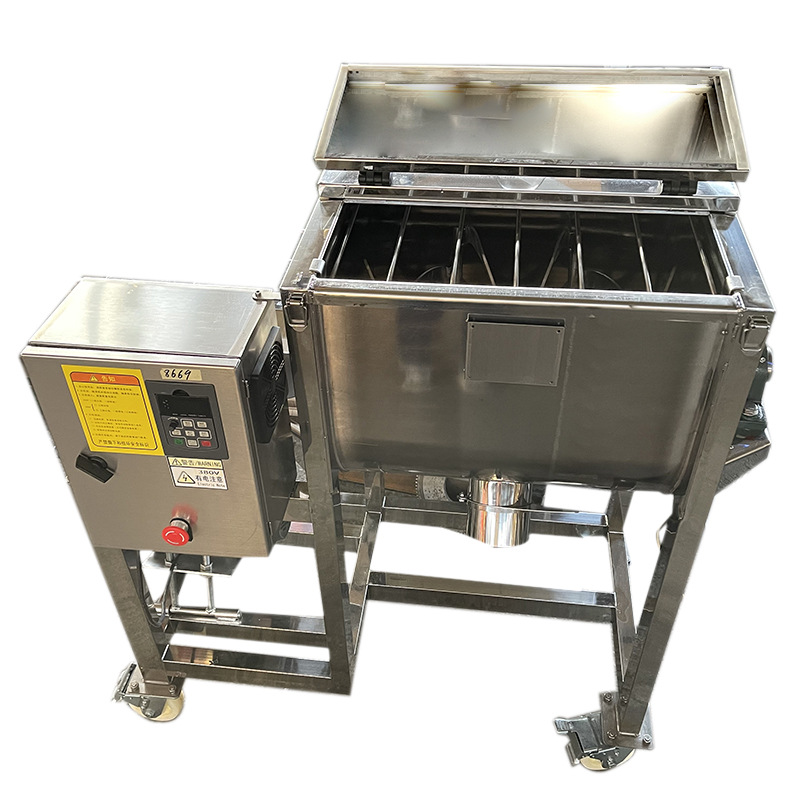
TENCAN Horizontal Screw Belt Mixer for batch powder blending.
The mixing cycle normally includes charging, dry blending, optional liquid addition, final homogenization, and discharge. Charging order matters. Adding a small minor component before a large bulk ingredient can help it disperse, while adding a sticky or liquid component too quickly can create localized wet masses that the agitator cannot break down. Pre-blending minor ingredients with a portion of the carrier is a common way to reduce agglomerates. The right sequence is established by trial and then fixed in the batch record.
Discharge is part of the mixing system, not an afterthought. A full-opening end discharge, a bottom valve, or a screw conveyor can produce different flow patterns and residual volumes. If the discharge port is small or offset, material near the end plate may remain stagnant. If the mixer is emptied too slowly, segregation can occur in the discharge chute. For high-value or tightly specified products, discharge aids and the ability to inspect the trough should be considered during selection. The way a mixer empties can matter as much as the way it blends.
Matching Material Properties to Mixer Configuration
Bulk density determines the volume of powder for a given mass and therefore the working volume, drive torque, and support structure. A batch that is light and fluffy may fill the trough before it reaches the target mass, while a dense mineral batch may require a more robust drive and bearings. The manufacturer's rated batch size must be checked against the actual bulk density and fill level. Overfilling reduces freeboard and can cause packing, high torque, or poor turnover. Underfilling can also be a problem because the agitator may not engage enough material to produce efficient exchange.
Particle size and shape control flowability. Coarse, rounded granules tend to flow easily but may segregate by size. Fine, irregular powders tend to interlock and resist flow, which can create bridges and dead zones. A screw-belt agitator can improve exchange in cohesive powders, but it cannot make a paste flow like a dry powder. For very fine or cohesive materials, the design may need different ribbon clearances, additional choppers, or a different loading method; these choices should follow a mixing test rather than a generic recommendation.
Fine and Cohesive Powders
Fine powders often contain agglomerates that are not visible in a bulk sample. These agglomerates may be held together by van der Waals forces, moisture bridges, or electrostatic charge. If the mixer only folds the bed without sufficient local shear, the agglomerates may survive the blend and appear as specks in the final product. A pre-blend, controlled addition rate, or a different agitator element may be needed. However, stronger shear is not a universal answer because it can also break the primary particles or generate heat.
Moisture and surface chemistry are often overlooked. A powder that is dry to the touch may contain enough surface moisture to form stable agglomerates under pressure. Hygroscopic materials can change flow behavior during a long blend. Electrostatic charging can make fine particles cling to the trough, the agitator, and the sampling thief. Grounding, humidity control, and appropriate construction materials may matter as much as agitator speed. None of these factors can be judged from a single bulk density value, so material testing should include handling and storage conditions as well as the fresh powder.
Fragile, Heat-Sensitive, and Wet Formulations
Construction materials and surface finish should match the risk of contamination and cleaning. Mild steel is common for non-critical mineral or agricultural blends, while stainless steel is preferred where corrosion resistance, washdown, or product purity is required. The actual grade, contact surface finish, seals, and bearing protection should be confirmed for the application. Abrasive powders may require wear-resistant liners or replaceable wear parts; corrosive powders may require a specific stainless grade or coating. These are configuration decisions, not default features, and they should be linked to the real material safety data and cleaning procedure.
Abrasive and Corrosive Duties
Liquid addition changes the duty. A horizontal screw belt mixer can distribute a small amount of liquid into a powder bed, but it is not a high-shear mixer, kneader, or homogenizer. The liquid should usually be introduced gradually and in a pattern that avoids local overwetting. If the target is a free-flowing powder with a low binder content, the mixer may be suitable. If the target is a dense paste, granule with controlled porosity, or stable emulsion, a different machine class should be evaluated. The formulation state, not the equipment label, should determine the choice.
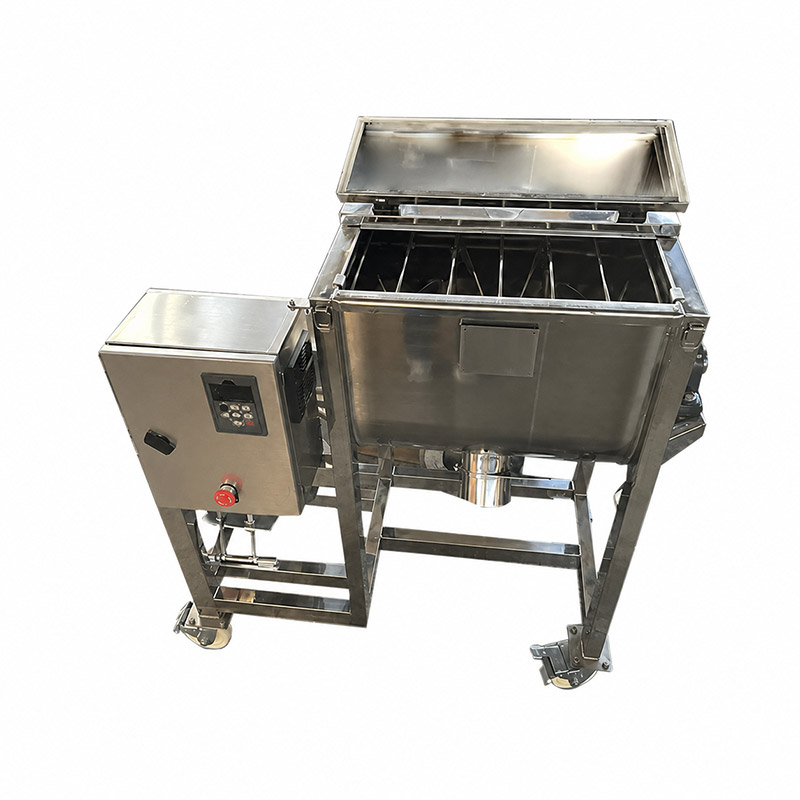
Equipment arrangement of the horizontal screw belt mixer.
Process Variables That Affect Blend Uniformity
Fill level is one of the strongest variables. Too little material can reduce contact between the agitator and the bed, while too much material restricts movement and increases torque. The correct range depends on the trough geometry, agitator diameter, bulk density, and product behavior. Fill level should be expressed as a validated range in the batch record, not as a single number copied from a catalogue. Operators should also know how the batch looks and sounds when the mixer is overloaded, because a high current reading may appear only after the material has packed around the agitator.
Agitator speed affects turnover and shear, but more speed is not always better. A higher speed can shorten the time needed to distribute a minor ingredient, yet it can also generate heat, break fragile particles, increase dusting, or throw powder onto surfaces above the bed. For a given mixer, the useful speed range is usually narrow and product-specific. Trials should compare uniformity, temperature rise, particle size change, bulk density, and discharge behavior at more than one speed. A speed that improves one quality attribute may damage another, so the decision should be based on the complete specification.
Mixing time has an optimum. Early in the cycle, the coefficient of variation usually falls as the components are distributed. After the optimum, continued agitation may produce no improvement and can cause demixing, attrition, or heat buildup. A time trial with sampling at intervals is more informative than a single endpoint test. The mixer should be stopped, sampled in a consistent way, and restarted under the same conditions. Sampling itself can disturb the bed, so the procedure must be fixed and the same sampling tool should be used throughout the trial.
Loading sequence and sampling location are part of the process. A minor component added on top of a full bed may remain near the surface, while one added at the bottom may be buried in a dead zone. The discharge stream should also be sampled if the specification requires the entire batch to be uniform at packaging. For trace ingredients, a pre-blend or a staged addition often gives better reproducibility than lengthening the mixing time. The goal is to create the same initial distribution in every batch, not to rely on the mixer to correct an uncontrolled feed pattern.
Dead Zones and Discharge Patterns
Dead zones are regions where material receives little or no exchange with the main bed. They commonly occur near end plates, below the shaft, around support arms, and in corners that the agitator does not sweep. A small dead zone may be harmless in a coarse mineral blend but unacceptable in a low-dose pharmaceutical or battery material. Tracer studies, color trials, and location-specific sampling can reveal whether a zone is active or stagnant. If the discharge valve creates a recess, that recess should be inspected and cleaned as part of the batch procedure.
| Process variable | Typical effect | Practical action |
|---|---|---|
| Fill level | Changes turnover, torque, and freeboard | Validate a working range for each bulk density |
| Agitator speed | Alters shear, heat, and dusting | Test more than one speed against quality attributes |
| Mixing time | Reaches an optimum, then may demix | Use interval sampling to define the cycle |
| Loading order | Controls local concentration of minor ingredients | Pre-blend or stage additions for trace components |
| Discharge method | Affects residual material and segregation | Inspect the trough and sample the discharge stream |
Selection, Scale-Up, and Validation
Begin with the batch size in mass and the bulk density range, then convert to working volume. Add freeboard for mixing and dust control. Confirm the maximum and minimum batch sizes that the mixer can handle, because a machine that works at full capacity may mix poorly at 30 percent fill. Check the discharge height, the available floor space, the loading method, and the cleaning access. A technically capable mixer can still fail in a plant if it cannot be charged, sampled, emptied, or cleaned safely.
Scale-up is not a matter of multiplying the agitator diameter. A larger mixer has a different surface-to-volume ratio, a different bed depth, and a different discharge path. Geometric similarity helps compare small and large units, but the mixing time and speed must be adjusted through trials. The goal is to reproduce the same dominant mechanism: bulk turnover, local shear, or distribution of a liquid. If the small mixer relies on high local shear that the production unit cannot provide, the formulation may need to change, or the equipment class may need to be reconsidered.
Power, torque, and starting load deserve careful review. A horizontal mixer starts under load, and cohesive or dense powders can demand a high breakaway torque. The drive and safety system should be selected for the actual material, not for an average powder. Variable-speed control is useful for trials and for products that are sensitive to shear or heat. Instrumentation for motor current, temperature, and cycle time can help operators detect abnormal batches and support process validation. These records are also useful when a raw material supplier changes a particle size distribution.
A realistic trial plan includes the intended raw materials, the worst-case particle size and density, the target uniformity, and the planned sampling method. Run at least three batches, vary the critical parameters around the proposed set point, and test the discharge and cleaning steps as well as the blend. Keep samples for stability or re-testing. The outcome should be a defined operating range, not a single successful demonstration. This approach supports both equipment acceptance and later quality investigations.
Sampling and Acceptance Criteria
A sampling plan should state where samples are taken, how many are taken, how the thief is inserted, and whether the sample represents a point or a stream. The analytical method must be suitable for the expected concentration and particle size. For a minor component, a small sample mass can produce high variability even when the blend is acceptable. The acceptance criterion should reflect the product specification and the sampling error. If the trial fails, the cause may be the mixer, the sampling method, the analytical method, or the formulation, and all four should be reviewed before a larger machine is purchased.
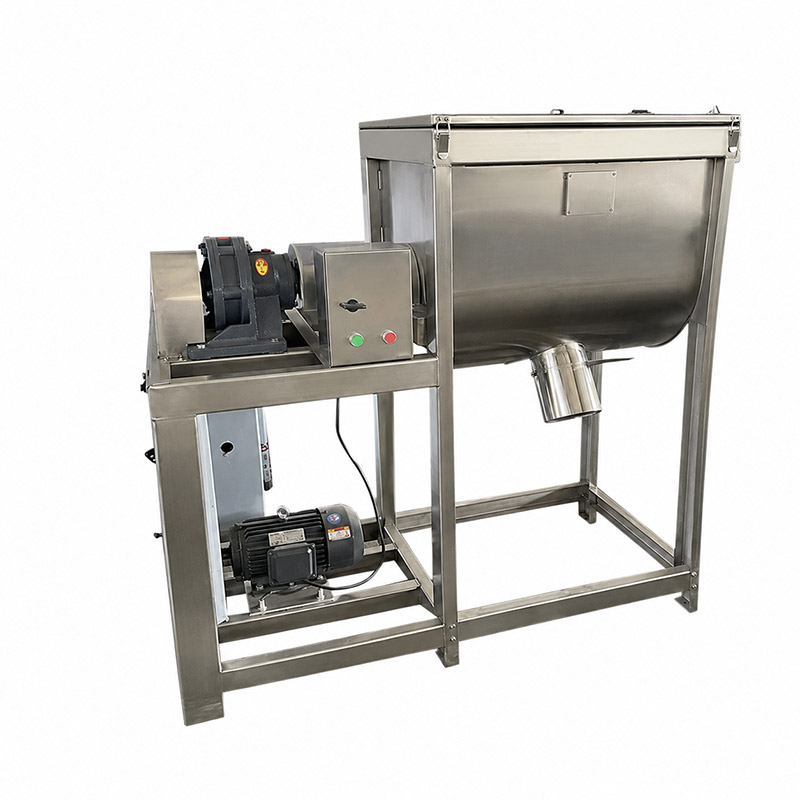
Batch powder blending with the TENCAN horizontal screw belt mixer.
Operation, Cleaning, and Maintenance Practices
Start with a clean, inspected mixer and confirm that the agitator turns freely before charging. Feed materials at a controlled rate to avoid burying the agitator or creating a concentrated pocket of a minor component. Close the covers and confirm the safety interlocks before starting. During discharge, use the agreed sequence and avoid leaving powder in the trough or chute. The first batches after a cleaning change should be checked more closely because residual moisture or cleaning agent can affect flow and blend quality.
Cleaning access should be designed into the selection. Dry powders may be removed by vacuum, brushes, and air, while wet or sticky products may require washdown and a drainable trough. The agitator, end plates, seals, and discharge valve are common hold-up points. Product changeover may also require inspection of the shaft seal and bearing area. If the mixer is used for multiple products, a cleaning validation protocol should be established rather than relying on visual inspection alone. The cleaning method must be compatible with the construction materials and the electrical enclosure.
Maintenance focuses on the drive, bearings, seals, agitator attachments, and discharge mechanism. Lubrication intervals and seal inspection should follow the manufacturer's instructions for the actual duty. Abnormal noise, vibration, high motor current, or a rising product temperature can indicate overload, wear, or a change in material behavior. Operators should record these signals and stop the batch if the mixer is outside its validated range. A mixer that is forced through a stiff batch can damage the agitator or create a safety hazard, and the cost of a repair is usually greater than the cost of investigating the cause.
Powder handling safety also belongs in the operating procedure. Many organic and metal powders can form explosive dust clouds, and static discharge can ignite a flammable atmosphere. Grounding, bonding, ventilation, dust collection, and ignition control should be assessed for the specific material. The mixer should not be opened while the agitator is moving, and cleaning tools should be non-sparking where required. These controls are plant-specific and should be reviewed with the site's process safety team before commissioning.
When a Horizontal Screw Belt Mixer Is the Right Choice
The horizontal screw belt mixer is a strong candidate when a batch of dry powders needs reliable bulk turnover, when the formulation contains cohesive components that do not blend well by tumbling, and when a horizontal working volume fits the building layout. It is also relevant when a moderate amount of liquid must be distributed into a powder without forming a paste. The machine is less suitable when the product is a high-viscosity paste, when extremely gentle handling is required, or when the specification demands high-shear granulation. Matching the machine class to the material state is the first selection decision.
Comparing options helps clarify the decision. A V-blender or double-cone blender is often preferred for free-flowing, low-shear blends with easy cleaning, but it may segregate cohesive or dissimilar powders. A ribbon or screw-belt horizontal mixer provides more mechanical exchange but has more surfaces to clean. A high-shear mixer can disperse liquids and break agglomerates, but it may damage fragile particles and generate heat. A planetary or ball mill is a size-reduction tool, not a substitute for a blending mixer. Each machine class solves a different unit operation, and mixing performance should be judged against the intended product attribute.
The final choice should be based on a trial with the real formulation. Ask the supplier to confirm the working volume, material of construction, agitator configuration, discharge type, seal arrangement, and available controls for the proposed duty. Provide the bulk density, particle size range, moisture, abrasiveness, and cleaning requirements. If the supplier cannot confirm a point, request a drawing or a test. Clear specifications reduce the risk of buying a mixer that meets a dimension but not the process need. The same discipline applies when comparing the TENCAN Horizontal Screw Belt Mixer with other batch mixing options.
Practical Questions from Buyers
How full should the mixer be?
Use the manufacturer's validated working range for the actual bulk density. A common mistake is to specify a batch mass that fills the trough beyond the freeboard. The correct fill level is the one that produces the required uniformity without excessive torque, dusting, or dead zones, and it should be confirmed by sampling. The minimum and maximum fill levels may differ for light and dense powders, so the batch record should state the acceptable range rather than a single target.
Can the mixer handle a liquid additive?
It can distribute a small amount of liquid when the formulation remains a flowable powder or a low-viscosity wet mass. It is not a high-shear mixer or kneader. The liquid addition rate, nozzle position, and mixing time should be tested, because localized overwetting can form lumps that do not disperse. If the liquid load is high enough to create a paste, a different mixer type should be evaluated before production scale-up.
How long does blending take?
There is no universal time. It depends on the batch size, fill level, agitator speed, particle size, density difference, and target uniformity. A time study with multiple sampling points is the reliable way to set the cycle. Longer blending is not automatically better and may cause demixing, attrition, or heat buildup. The operating range should be based on the plateau where uniformity is acceptable and the product attributes remain stable.
How should the mixer be cleaned?
Use a procedure written for the product and the plant. Dry cleaning with vacuum and brushes may be enough for a dedicated mineral powder, while food, pharmaceutical, or multi-product use may require wet cleaning and validation. The agitator, end plates, seals, and discharge valve need specific attention. Cleaning should be completed before residue dries or hardens, and the mixer should be inspected before the next batch is charged.
Uniformity is created by the interaction of material, mixer, and procedure. A horizontal screw belt mixer can provide the mechanical exchange needed for many dry and semi-wet blends, but its performance depends on correct fill level, charging order, speed, time, discharge, and cleaning. Before scaling up, test the actual formulation, sample the full batch, and define an operating range. That evidence is more useful than a catalogue claim, and it gives operators a clear basis for repeatable production.