
Double Cone Mixer: Working Principle, Applications, and Selection Guide for Laboratory and Industrial Powder Blending
When you work with powders, granules, or other bulk solids, achieving a uniform blend is often more challenging than it sounds. Materials with different particle sizes, densities, or flow characteristics tend to segregate during handling, leading to inconsistent batches. You need a mixing solution that is both effective and gentle—one that does not crush or degrade your particles. This is exactly where the double cone mixer shines. Its simple yet clever design relies on the natural forces of gravity and rotation to tumble materials into a homogeneous mixture without applying high shear or impact.
In this article, we will walk through the working principle of the double cone mixer, explore its typical applications across industries, and provide practical guidance on selecting the right model for your specific needs. Whether you are a laboratory researcher developing new formulations or an engineer scaling up a production process, understanding the capabilities and limitations of this equipment will help you make an informed decision.
Working Principle of a Double Cone Mixer
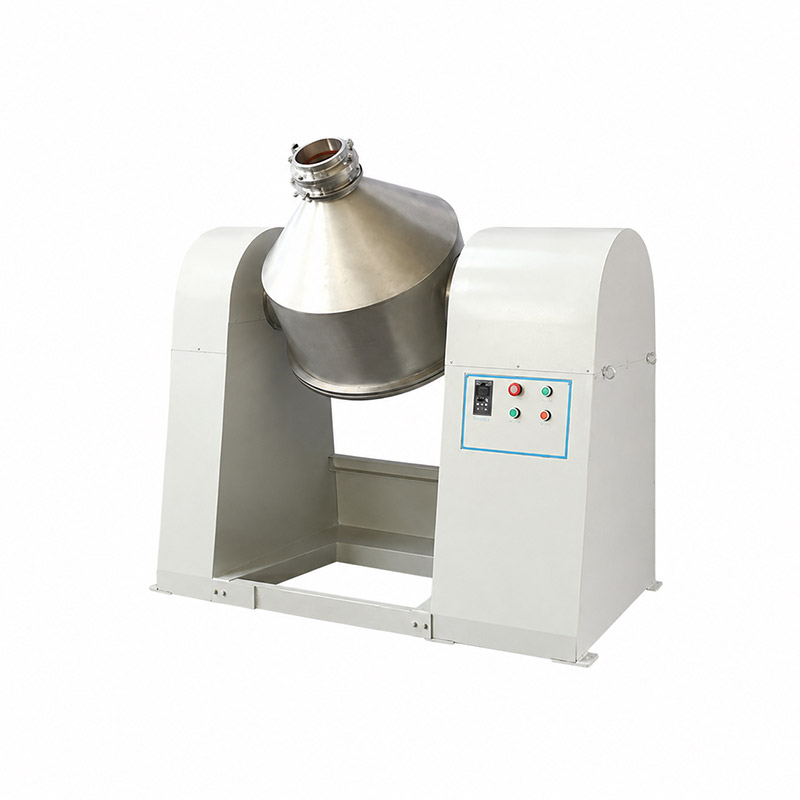
The double cone mixer, also known as a double cone blender, consists of a container shaped like two cones joined at their bases. The mixing drum rotates around a horizontal axis, driven by a motor and gearbox. As the drum turns, the material inside is lifted by the rotating walls and then falls back down under gravity. This repeated lifting, cascading, and tumbling motion creates a combination of convective mixing and diffusion mixing.
Because the container has no internal agitators, there is no mechanical impact or shear force applied to the particles. This makes the double cone mixer an ideal choice for blending materials that are fragile, easily broken, or have a tendency to degrade under high-energy input. The mixing action is gentle, yet the continuous turnover ensures that particles from different regions of the drum come into contact with each other, gradually achieving a uniform distribution.
A key design feature is the symmetrical conical shape. The converging walls at each end direct the material back toward the center during rotation, preventing dead zones and promoting complete batch turnover. The discharge port is typically located at the bottom of one cone, allowing the mixed material to be emptied by gravity with minimal residual hold-up.
Key Applications of Double Cone Mixers
Double cone mixers are widely used in laboratories and production facilities across many industries. Their gentle blending action makes them particularly suitable for the following scenarios:
Pharmaceutical and Nutraceutical Blending
In pharmaceutical manufacturing, maintaining the integrity of active pharmaceutical ingredients (APIs) and excipients is critical. Double cone mixers are used to blend powders for tablet compression, capsule filling, and granulation processes. They can also be equipped with a jacket for heating or cooling if the formulation requires temperature control during mixing.
Chemical and Catalyst Preparation
Chemical powders, catalysts, and additives often need to be mixed without altering their particle size distribution. The double cone mixer provides a consistent blend without causing attrition or generating fines, which is important for maintaining catalyst activity and product performance.
Food and Beverage Powder Blending
From seasoning blends to protein powders and instant drink mixes, food manufacturers rely on double cone mixers to combine ingredients uniformly. The gentle action prevents degradation of delicate components such as flavors, vitamins, or colorants, while the stainless steel construction meets hygiene requirements.
Powder Metallurgy and Ceramic Materials
In powder metallurgy, metal powders are often blended with lubricants or binders before compaction. Double cone mixers can handle abrasive metal powders if the drum is made from wear-resistant materials. Similarly, ceramic powders, glaze materials, and refractory compounds benefit from the non-shearing mixing action.
How to Select the Right Double Cone Mixer
Choosing a double cone mixer involves considering several factors that affect both mixing performance and operational efficiency. Below are the most important criteria to evaluate:
Batch Size and Capacity
Double cone mixers are available in a wide range of working capacities, from small laboratory units handling a few liters to large industrial models with hundreds or even thousands of liters. The total volume of the drum is usually larger than the working capacity because the material should not fill the drum completely. A typical filling level is around 50% to 60% of the total volume to allow sufficient space for tumbling and mixing. For example, a 100-liter double cone mixer may have a working capacity of 50 to 60 liters per batch.
Material of Construction
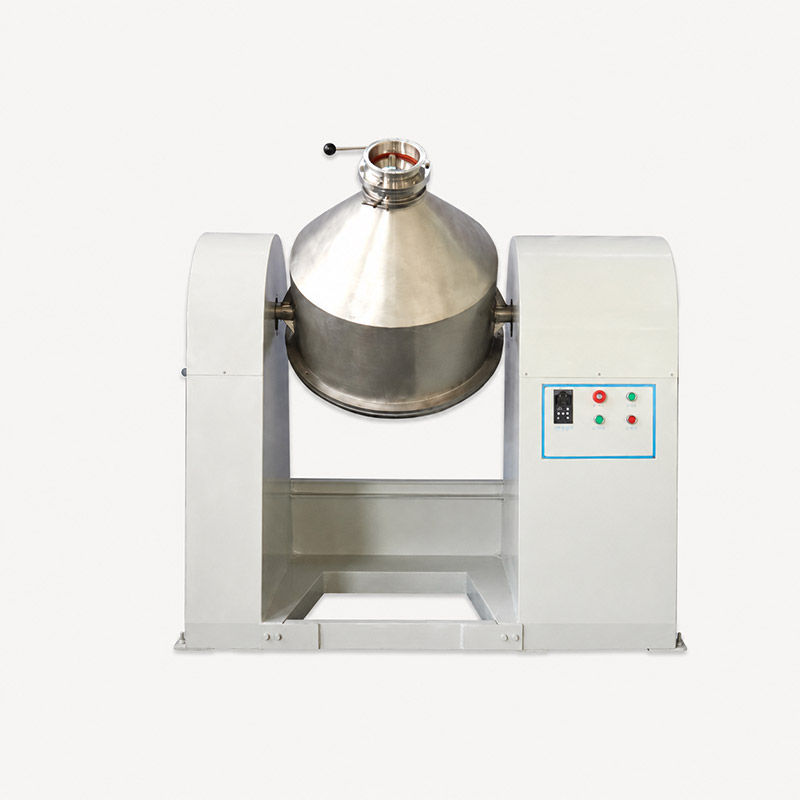
For most laboratory and pharmaceutical applications, the drum is made of stainless steel (304 or 316L) to ensure corrosion resistance, easy cleaning, and compliance with GMP standards. For food contact, the internal surface should be polished to a smooth finish to prevent product buildup. If you are mixing abrasive or corrosive materials, you may need a more wear-resistant alloy or a special lining. The double cone mixer from TENCAN Powder is available in different material options to suit your specific process requirements.
Drive System and Speed Control
The rotational speed of the drum significantly influences mixing quality. A speed that is too low may not generate enough motion to blend the particles effectively, while a speed that is too high can cause the material to centrifuge against the walls, reducing mixing efficiency. Many double cone mixers come with a variable frequency drive (VFD) that allows you to adjust the speed between a few revolutions per minute up to perhaps 30–40 rpm, depending on the model. Having speed control lets you optimize the mixing process for different materials.
Sealing and Discharge Options
For applications involving dust, toxic materials, or the need for sterile operation, the drum must be well sealed. The double cone mixer typically uses a butterfly valve or a manual ball valve at the discharge port. Some models also offer a dust-tight cover on the charging port. If you require vacuum drying or inert gas purging, confirm that the mixer can be equipped with appropriate sealing and connections.
Additional Features
Depending on your process, you may need a jacketed drum for heating or cooling, a spray nozzle for adding liquid binders, or a sampling port for in-process quality checks. Some advanced models can be integrated with a PLC for automated operation and recipe management. It is always a good idea to discuss your specific requirements with the manufacturer before finalizing the selection.
Comparing Double Cone Mixer with Other Blenders
While the double cone mixer is an excellent choice for many applications, it is not the only option. Here is a brief comparison with two other common types of powder blenders:
Double Cone Mixer vs. V-Type Mixer
The V-type mixer, also known as a V-blender, has a container shaped like the letter V. It operates on a similar tumbling principle but with a different geometry. The V shape can create a more violent splitting and recombining action, which may be beneficial for certain materials. However, the double cone mixer generally provides a more gentle and uniform turnover, and it is easier to clean because of the smooth conical surfaces. For materials that are prone to sticking or bridging, the double cone design often offers better discharge.
Double Cone Mixer vs. 3D Mixer
The 3D mixer (also called a multi-dimensional mixer) rotates the container in multiple axes, creating a more complex motion that can achieve very high mixing uniformity in a shorter time. The 3D mixer is excellent for blending small batches of high-value materials, but it is more expensive and typically has a smaller capacity compared to a double cone mixer of similar footprint. For routine blending of larger batches, the double cone mixer remains a cost-effective and reliable workhorse.
Practical Tips for Operating a Double Cone Mixer
To get the best results from your double cone mixer, keep the following points in mind:
- Pre-blend if necessary: If your materials have very different particle sizes, you may want to pre-blend the fine and coarse fractions separately before adding them to the mixer. This can reduce segregation during the initial charging phase.
- Control the filling level: Do not overfill the drum. A filling level of 50% to 60% of total volume is generally recommended. Overfilling restricts the tumbling motion and reduces mixing efficiency.
- Use appropriate rotational speed: Start with a low speed and gradually increase until you observe the material cascading well. The optimal speed depends on the material density, particle size, and drum geometry. A typical starting point is around 10–20 rpm for a laboratory model.
- Add liquids carefully: If you need to add a liquid binder or coating, use a spray nozzle to avoid forming large agglomerates. The liquid should be added slowly while the drum is rotating.
- Clean thoroughly between batches: For applications requiring high purity, disassemble the discharge valve and clean all surfaces to prevent cross-contamination. The smooth interior of the double cone mixer makes this easier than with many other blender types.
Why Choose a Double Cone Mixer from TENCAN Powder?
At TENCAN Powder, we offer a complete range of double cone mixers designed for laboratory research, pilot plant, and production use. Our mixers are built with high-quality stainless steel, precision-machined drive components, and advanced control options. Whether you need a simple manual model or a fully automated system with PLC and data logging, we can configure the equipment to match your specific process.
We also support our customers with technical advice on material selection, process optimization, and troubleshooting. If you are not sure which double cone mixer model is right for your application, our team is ready to help you evaluate your requirements and provide a tailored recommendation.
Selecting the right powder blending equipment is an investment in product quality and process efficiency. The double cone mixer offers a proven, gentle, and reliable solution for a wide range of materials. By understanding its working principle and considering the key selection factors discussed above, you can confidently choose the ideal mixer for your laboratory or production line.