
Rotary Tube Furnace for Powder Calcination
Powder processors who move a calcination or sintering step from a crucible test to a production batch usually meet the same failure mode. The material that looked uniform in a small alumina boat comes out of a larger charge with a sintered crust on the surface, loose powder underneath, and a phase or colour distribution that drifts from the inlet end of the furnace to the outlet. The controller is rarely the culprit. The problem is the powder bed itself. A packed bed of powder conducts heat poorly and mixes almost not at all, so every static process carries an internal gradient, in temperature, in gas exposure and in reaction extent. A rotary tube furnace attacks that gradient mechanically: the tube turns, the powder tumbles, and fresh surfaces are continuously exposed to the hot wall and the process gas.
This article examines how continuous rotary tube furnaces work, which process variables actually control uniformity and throughput, how tube material and atmosphere selection limit what a given unit can do, and how to diagnose the problems that appear most often during powder calcination and sintering. The same principles apply whether the duty is a laboratory feasibility study or a small production line processing oxide, cathode precursor, catalyst or ceramic powder. Where figures such as temperature, residence time or feed rate appear below, treat them as starting points for trials: the correct values depend on material properties and process conditions and should be confirmed by testing rather than assumed.
Why Static Powder Beds Sinter Unevenly
Heat reaches a static powder charge mainly through the crucible wall and, above roughly 600 °C, by radiation across the gap between the wall and the bed surface. Inside the bed, heat travels through particle contact points and through the gas filling the voids, which is a much slower path than conduction in a solid. A 30 to 50 mm deep static bed can therefore sit tens of degrees cooler at its centre than at its edge, and the gap widens with bed depth, with loose packing and with any endothermic reaction pulling heat out of the load.
Temperature is only half of the problem. Many calcination reactions release gas: carbon dioxide from carbonates, water vapour from hydroxides, sulfur oxides from sulfates, ammonia or organic fragments from precursors. In a static bed those gases must diffuse out through the same narrow channels that fresh process gas must diffuse in through. When the reaction is fast, the local atmosphere inside the bed can differ substantially from the atmosphere the controller believes it is supplying, and that difference drives side reactions, incomplete conversion or oxidation gradients that stay invisible until the powder is analysed.
Sintering also changes the bed as it proceeds. Particles that form necks at contact points build a rigid network. Near the surface that network can densify into a crust, which further restricts gas access, while the interior remains loose. Once a crust has formed, the batch is effectively two materials with different thermal histories, and downstream milling will not restore the phase composition or surface chemistry that was lost. Materials with a low melting point, with a transient liquid phase or with strongly exothermic formation reactions are the most sensitive to this behaviour.
None of this makes the static furnace obsolete. For small samples, for slow solid-state reactions with little gas evolution, and for shaped parts that must not tumble, a box furnace or a static tube furnace remains simpler and easier to control. The case for rotation appears when three conditions are met at the same time: the charge is large enough for internal gradients to matter, the reaction exchanges gas with the atmosphere, and the product specification includes uniformity of phase, colour or particle structure rather than only average composition.
How a Rotary Tube Furnace Keeps a Powder Bed Moving
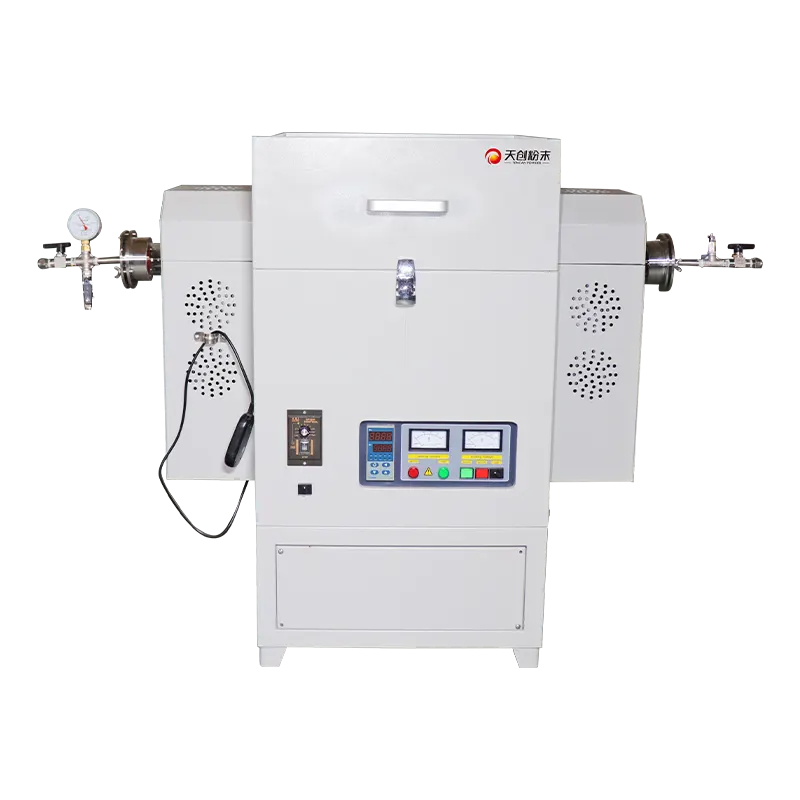
A rotary tube furnace replaces the static boat with a slowly turning process tube mounted at a small angle to the horizontal. Powder enters at the raised end, tumbles as a shallow moving bed along the hot zone, and discharges at the lower end, either continuously or in timed increments. Because the bed is only a few particle layers deep at any moment, both heat and gas have a short path to every particle, and the repeated tumbling action keeps breaking the contacts that would otherwise grow into a sintered crust.
The tube, the drive and the inclination
The process tube is the heart of the design. It must hold the working temperature without deforming, resist attack from the powder and from the process gas, and survive the thermal cycling of routine use. Common constructions use quartz for lower-temperature work where visual observation and low contamination matter, high-purity alumina or mullite where the duty is hotter or more abrasive, and heat-resistant alloys where mechanical robustness and larger diameters are required. Tube diameter, wall thickness and unsupported length all influence how the tube behaves at temperature, so the usable hot length should always be checked against the furnace model rather than assumed.
The drive system rotates the tube through a geared motor and a belt or chain transmission, often with a variable-frequency drive so that speed can be set independently of load. Rotation speed is normally modest, because the goal is gentle agitation rather than centrifugal mixing; if the tube turns too fast, powder is thrown against the wall, the bed stops renewing and the material starts to behave like a static charge again. Inclination is usually adjustable over a small range, which gives the operator a second, independent way to control how long the powder stays in the hot zone.
Heating zones and atmosphere control
Most rotary tube furnaces are built with one or more independently controlled heating zones along the tube. Multiple zones allow a controlled profile: a preheat or drying section where moisture and volatile components are driven off, a main reaction zone at the target temperature, and a cooling or annealing section where the powder is brought down gradually before discharge. Splitting the profile this way protects the tube from thermal shock and gives the reaction a defined start and finish instead of a single hot soak.
Atmosphere control is what separates a rotary furnace from a rotary dryer. Gas-tight rotary seals at both ends allow nitrogen, argon, air, hydrogen or a mixed forming gas to be fed through the tube, and the gas may travel either with the powder or against it. Counter-current flow, in which fresh gas enters at the discharge end and leaves at the feed end, usually gives the most efficient removal of reaction products, because the powder meets progressively cleaner gas as it moves toward the outlet. Gas flow rate, gas purity and the sealing method should be matched to the material: a mildly oxidising reaction may tolerate a simple purge, while air-sensitive powders need a sealed system with a controlled inlet dew point and oxygen monitoring.
Feeding, transport and discharge
Continuous operation needs a feed device that delivers powder at a steady, controllable rate. Screw feeders handle free-flowing powders well, vibratory feeders are gentler on fragile agglomerates, and a small hopper with a rotary valve suits systems that must hold an inert atmosphere on the inlet side. The feed rate, the tube rotation speed and the tilt angle together decide the residence time, and residence time decides how far the reaction proceeds. This relationship is the main reason a rotary unit is easier to scale than a static batch process: the same three variables can be adjusted independently to keep the thermal history constant when throughput changes.
Discharge is usually collected in a sealed hopper, a cyclone or a filter housing, depending on particle size and whether the product must be kept under inert gas. Fine powders can be carried out of the tube by the exhaust stream, so the gas velocity, the internal baffle design and the collection system all need to be considered together. Internal flights or lifters, where fitted, improve mixing along the tube and reduce the tendency for fine material to stratify, but they also increase dust generation and should be selected with the product in mind.
Key Variables That Control Uniformity and Throughput
Operators who get consistent results from a rotary tube furnace usually treat it as a transport problem as much as a heating problem. The material must arrive at the right temperature, stay there long enough, meet the right gas composition and leave before the product over-reacts. Five variables drive that sequence.
Rotation speed and bed renewal
Rotation speed sets how often the powder surface is refreshed. At very low speed the bed creeps and only its outer layer is actively exchanged; at moderate speed the material rolls and cascades, which is the ideal condition for gas contact and even heating. Raising the speed reduces the mean residence time for a given tilt and feed rate, because the powder travels faster along the inclined tube, so speed changes usually require a compensating change in tilt or feed rate if the thermal history is to stay the same.
Tilt angle and residence time
Tilt angle is the coarsest control over residence time. A small angle keeps powder in the hot zone longer and suits slow solid-state reactions or reactions with a long diffusion step. A larger angle shortens the residence time and suits fast decompositions where prolonged heating would coarsen the product or promote unwanted sintering. Because tilt also changes the depth of the moving bed, it interacts with rotation speed, so the two should be adjusted together during trials rather than independently.
Fill level and feed rate
Feed rate determines how much powder is in the tube at any moment, and therefore how deep the moving bed is. A shallow bed gives excellent heat and gas access but low throughput; a deep bed increases throughput but reintroduces the gradients that rotation was meant to remove. The practical limit is usually set by the material: cohesive powders form lumps that roll instead of cascading, while very free-flowing powders may move as a thin stream and short-circuit the hot zone.
Temperature profile and soaking
Total time at temperature is what drives most solid-state reactions, so the setpoint of each zone and the length of the hot zone matter as much as the peak temperature. A short, hot zone demands a faster feed and risks incomplete conversion; a long zone with a gentle profile gives a more forgiving process but requires a larger furnace. For materials that pass through an intermediate phase, the profile, not the peak value, determines the final phase assemblage.
Gas flow, purity and dew point
Gas flow rate must be high enough to sweep reaction products away from the bed but low enough to avoid entraining fine powder. In practice, operators balance three gas parameters: total flow, inlet purity and inlet dew point. For reduction or air-sensitive calcination, moisture in the incoming gas can be more damaging than residual oxygen, because water vapour shifts the equilibrium of many oxide reactions. A dew point monitor at the inlet and, where possible, at the outlet provides a simple, direct indication of whether the bed is releasing or absorbing moisture.
| Variable | Main effect | Typical adjustment direction |
|---|---|---|
| Rotation speed | Bed renewal, dust generation, residence time | Increase moderately if the bed is stagnant; reduce if powder is thrown to the wall |
| Tilt angle | Residence time, bed depth | Reduce angle for longer soak; increase for faster throughput |
| Feed rate | Bed depth, throughput, conversion completeness | Lower rate for better uniformity; raise only after the profile is stable |
| Zone setpoints | Phase formation, reaction extent, tube stress | Widen the profile for sensitive materials; shorten the hot zone for fast reactions |
| Gas flow and dew point | Atmosphere purity, product removal, dust carryover | Raise flow to clear reaction products; monitor dew point before changing temperature |
Tube Material, Contamination and Sealing
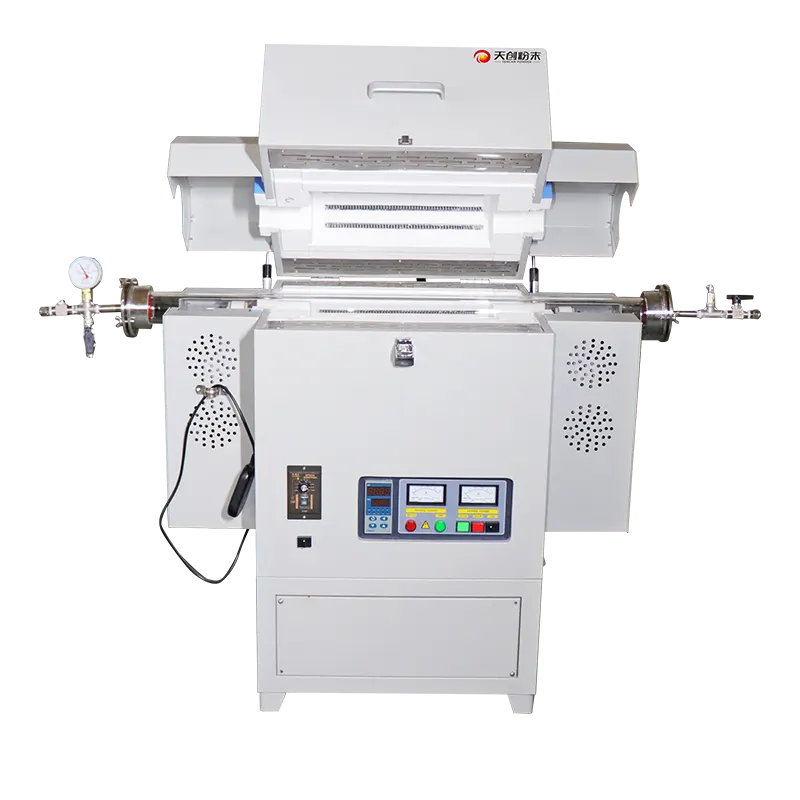
Tube selection is often decided by contamination limits rather than by temperature alone. Quartz offers good thermal shock resistance and low background contamination, which suits high-purity oxides and optical or electronic materials, but it is attacked by alkali-rich powders and by some fluoride chemistries at elevated temperature. High-purity alumina and mullite tolerate higher temperatures and more aggressive powders at the cost of lower thermal shock resistance, so heating and cooling rates must be gentler. Heat-resistant alloys are robust and allow larger tube diameters, but chromium and iron can be transferred to the product in reducing atmospheres, which is unacceptable for some battery and catalyst applications.
Where a metal tube is the only practical option, an inner liner or a ceramic boat insert can separate the powder from the tube wall, and the liner should be replaced on a defined schedule rather than after visible failure. It is also worth remembering that contamination can come from the grinding media and milling jars used before calcination. A powder milled in a steel or tungsten carbide jar carries a different starting impurity profile than the same powder milled in an agate or zirconia jar, and the furnace cannot remove what the mill introduced.
Sealing is the other half of atmosphere control. Rotary seals must allow the tube to turn while limiting gas leakage, and they are a normal wear item. Graphite, PTFE and ceramic fibre packings behave differently at temperature: some are best kept cool by water jackets or by the natural temperature gradient along the tube ends, and all of them need periodic inspection. A simple pressure-decay test before a critical run, or continuous oxygen monitoring with an alarm, will catch seal degradation earlier than an analysis of the finished product.
Diagnosing Common Rotary Tube Furnace Problems
Powder sticking to the tube wall. Sticking usually starts as a thin film where the bed is hottest. Common causes are a residual binder or moisture that turns tacky before it volatilises, a transient liquid phase in the material, or a hot zone set too high for the first part of the profile. Reducing the feed rate, extending the preheat section or lowering the initial zone setpoint often resolves it. If sticking persists, the tube surface itself may need attention, because a scratched or glazed wall gives the film a place to anchor.
Dust carryover into the exhaust. Fine particles entrained in the gas stream end up in the filter or the cold trap, which changes both yield and the measured composition. The usual levers are gas velocity, rotation speed and the powder's own agglomeration state. A slightly deeper bed or a lower gas flow can reduce carryover, but this must be balanced against the need to remove reaction products. Pre-agglomerating the feed by gentle granulation sometimes helps more than any change to the furnace settings.
Uneven discharge composition. If the first material out of the tube differs from the last, the tube may still contain a heel of old powder from a previous run, the feed may be pulsing rather than steady, or the tilt may be too shallow for the powder to move consistently. A short purge run with an inert or sacrificial powder, a check on the feeder calibration and a modest increase in tilt are the standard first responses. Continuous sampling at the discharge is far more informative than analysing a single grab sample at the end of a campaign.
Thermal excursions. Exothermic formation reactions can raise the bed temperature well above the setpoint, and in a static bed the heat is trapped. Rotation helps, but it does not remove the risk: if the reaction is strongly exothermic, the feed rate must be low enough that the heat release per unit length of tube stays within the furnace's ability to remove it. Watching for a discharge temperature rise or a change in gas consumption is a practical way to detect this before the product is affected.
Condensation in cold zones. Water, organics or volatile salts that leave the bed can condense at the tube ends, on the seals or in the exhaust line. Once condensed, they can drip back into the hot zone, corrode fittings or block the gas path. Keeping the inlet and outlet ends above the dew point of the exhaust, using heated lines and traps, and cleaning the cold ends on a fixed schedule prevents most of these problems.
Static Furnace, Rotary Tube Furnace or Rotary Kiln
A static tube or box furnace is the right tool for small sample lots, for shaped components, and for reactions that proceed slowly enough that hours of soaking matter more than gas exchange. It offers a well-defined sample position, easy thermocouple access and simple data logging. Its weakness is scale: as the bed grows deeper, uniformity falls, and the only way to recover it is to reduce batch size or extend the cycle.
A rotary tube furnace sits between that laboratory work and full-scale production. It provides continuous or semi-continuous throughput, a controlled atmosphere, and a moving bed that keeps heat and gas access roughly constant as throughput rises. Its limits are the tube diameter and the mechanical demands of the seals and drive, which generally keep it in the pilot to small-production range for most powders.
A rotary kiln is the production-scale relative, with a refractory-lined shell and much larger internal volume. It handles bulk tonnage but offers coarser control of atmosphere and temperature profile, and it is normally justified only when the process is already proven. The practical development path runs from static furnace trials, to a lab rotary tube furnace for continuous-process validation, and only then to larger equipment, with the same three process variables carried through each step so that results remain comparable.
Selection and Scale-up Checklist for Powder Calcination
Before specifying a rotary tube furnace, it is worth writing down what the process actually requires, because tube material, gas handling and heating configuration all follow from that description rather than from a catalogue number. A short checklist covers most of the decisions.
- Target product specification: phase, crystallinity, particle size distribution, colour, impurity limits and the permitted loss on ignition.
- Thermal history: peak temperature, total time at temperature, allowable heating and cooling rates, and whether the material passes through an intermediate phase.
- Atmosphere: oxidising, inert, reducing or vacuum; inlet purity and dew point limits; whether reaction products must be scrubbed or recovered.
- Feed characteristics: bulk density, flowability, moisture content, binder type, tendency to agglomerate and sensitivity to dust generation.
- Duty cycle: batch size or continuous throughput, number of campaigns per week, and whether the same tube must handle several different powders.
- Maintenance: seal replacement interval, tube inspection access, and the availability of spare tubes and heating elements.
Scale-up should keep the material's actual thermal history constant rather than copying setpoints from a smaller unit. That means measuring the residence time distribution, checking the bed depth at the target feed rate, and confirming the gas composition at the discharge end, not only at the inlet. A short verification run using a marker material or a tracer in the feed is often the quickest way to establish the real residence time, because calculated values rarely capture the effects of powder cohesion and tube roughness.
Finally, keep the first campaigns conservative. Start at a lower feed rate than the calculation suggests, hold a slightly longer residence time, and sample the discharge at intervals so that the transition from start-up to steady state is visible in the data. Uniformity should be demonstrated by comparing several discharge samples, tested separately for phase and particle size, rather than by a single analysis. Once that baseline exists, throughput can be raised step by step, and the process becomes genuinely transferable between the laboratory rotary furnace and the equipment that will eventually run it in production.