
High-Speed Dispersing Homogenizer Selection
Fish eyes in a coating, hard specks in a gel, pigment that settles within a day, or a batch that looks uniform in the tank but fails in the final film are common signs that bulk mixing has been mistaken for true dispersion. A high-speed dispersing homogenizer is used when the job is not simply to move liquid around, but to wet powders, break down agglomerates, and create a repeatable dispersion. The distinction matters because many laboratory and pilot-scale problems are not caused by a bad formulation. They come from an undersized mixing step, the wrong tool for the viscosity, or a scale-up change that altered the energy input per unit volume.
For laboratories and pilot plants, the TENCAN high-speed dispersing homogenizer is one product to evaluate when a formulation needs stronger wetting and deagglomeration than a simple stirrer can provide. The useful starting point is not a list of motor sizes. It is a clear process window: what must be dispersed, how fine, in which liquid, at what solids loading, and under what temperature and contamination limits. That window determines whether a high-speed dispersing homogenizer is appropriate, how it should be configured, and what tests should be run before the process is fixed.
Selection also depends on the stage of work. A formulation chemist may need small batches for screening, while a pilot engineer may need to reproduce the same dispersion at a larger volume without changing the particle size distribution or the visual appearance. The same equipment family can serve both stages only when the operating variables and the scale-up logic are understood.
What a High-Speed Dispersing Homogenizer Does in a Formulation
A high-speed dispersing homogenizer combines rapid bulk movement with localized shear. The rotating element creates flow in the vessel, while the high-speed zone near the tool generates shear and extensional forces that act on liquid-powder interfaces and on agglomerates. The result is not automatically a fine suspension. It is a controlled combination of wetting, breakup, and distribution that depends on the formulation, the tool geometry, the speed, and the time allowed for the batch.
Bulk mixing and dispersion are different operations
Bulk mixing reduces concentration gradients. It moves a soluble dye through water, blends two miscible liquids, or evens out temperature. Dispersion is more demanding. It must wet the external surface of a powder, displace air from pores and crevices, break apart clusters held by van der Waals forces or binder bridges, and distribute the resulting particles before they re-agglomerate. A mixer can look energetic while leaving hard agglomerates intact, especially when the flow is mostly rotational and the material travels with the tool instead of passing through a high-shear zone.
This is why adding more mixing time does not always improve a batch. If the particles are already trapped in a viscous or thixotropic medium, or if the tool is not creating enough local shear, longer mixing may only heat the product and wear the equipment. A high-speed dispersing homogenizer addresses the problem only when the formulation is placed in a flow regime where the rotating element can wet the powder and disrupt clusters. The operator must also confirm that the batch is actually moving through that zone rather than circulating around it.
Wetting, deagglomeration, and stabilization
Wetting is the first barrier. Dry powder particles carry air and often have irregular surfaces. If the liquid does not displace that air quickly, the powder can form lumps with dry cores that are difficult to break later. High-speed dispersing homogenizers help by creating a strong flow pattern and a high-shear region where powder can be drawn into the liquid. The practical result depends on how the powder is added, how fast it is added, and whether the liquid has the right viscosity and surfactant balance to wet the surface.
Deagglomeration is the second barrier. Many powders arrive as clusters of primary particles. Strong shear can break some clusters, but the energy required rises as the agglomerate strength increases. Soft clusters may open readily; hard clusters may require longer processing, a different tool, or a milling step downstream. The high-speed dispersing homogenizer is often most effective as a wetting and pre-dispersion device that prepares a stable feed for a bead mill or other fine grinding equipment. Treating it as a universal particle-size reduction machine can lead to unrealistic expectations.
Stabilization is the third barrier. Once particles are separated, they may collide and re-form clusters if the formulation lacks sufficient stabilizer, if the pH or ionic environment is wrong, or if the batch is overheated. A high-speed dispersing homogenizer can create a good initial dispersion, but it cannot compensate for a formulation that is chemically unstable. The equipment and the formulation have to be evaluated together, preferably with particle size distribution, viscosity, and storage stability measured after processing rather than judged only by appearance.
Where the unit fits in the process train
In many wet processes, the high-speed dispersing homogenizer sits between powder handling and fine dispersion. It can be used to prepare a premix, incorporate fillers, wet pigments, or break down soft agglomerates before a bead mill, colloid mill, or other fine processing step. In some formulations, it may be the main dispersion device. In others, it is a preparatory tool whose job is to deliver a lump-free, uniform feed with a controlled viscosity and temperature.
The correct role should be defined before purchase. If the target is only to eliminate visible lumps, the requirements are different from a target that specifies a narrow particle size distribution. If the next process step is sensitive to temperature or aeration, the high-speed dispersing homogenizer must be operated with those constraints in mind. The product page for the high-speed dispersing homogenizer product page should be read together with the actual formulation requirements, because a machine that works well for one viscosity range or batch size may not be suitable for another.
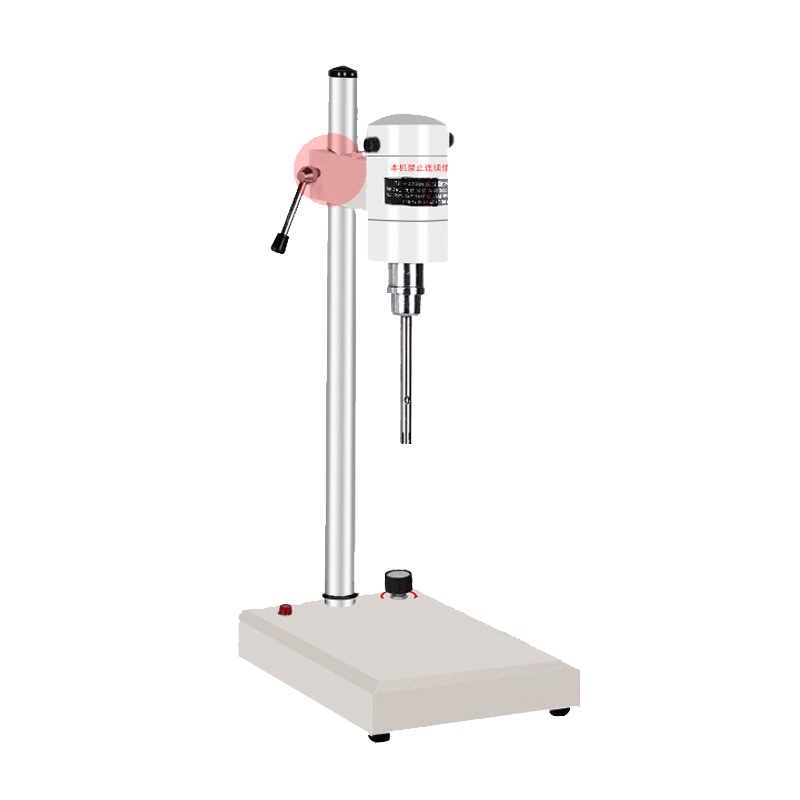
Product image: TENCAN high-speed dispersing homogenizer.
Material Factors That Define the Operating Window
The material system sets the limits of any dispersion process. Two formulations with similar appearance can behave very differently because of viscosity, solids loading, particle surface chemistry, and the strength of the agglomerates. Before adjusting speed or time, it helps to identify which material factor is limiting the result. Otherwise the operator may increase energy input without solving the actual problem.
Viscosity and flow behavior
Viscosity controls whether the batch can form a useful flow pattern. If the material is too thin, the high-speed tool may create a deep vortex, draw air into the product, and splash rather than wet the powder efficiently. If the material is too thick, the flow may become localized around the shaft, leaving stagnant zones near the vessel wall or bottom. High-speed dispersing homogenizers are often used in a practical viscosity range where the batch can circulate while still experiencing shear near the rotating element. The exact range depends on the tool, vessel, and formulation, so it should be established by testing rather than assumed.
Non-Newtonian behavior adds another complication. Shear-thinning products may appear thin near the tool but remain thick elsewhere. Yield-stress materials may not flow at all until the stress exceeds a threshold. In these cases, the order of addition and the starting liquid level matter as much as the final mixing speed. A common approach is to start with a portion of the liquid, add powder under conditions that promote wetting, and then adjust viscosity or solids content before the final dispersion step. The high-speed dispersing homogenizer should be selected for the range of states the batch passes through, not only for the final viscosity.
Solids loading and powder addition
High solids loading increases the demand on the mixer and reduces the amount of liquid available to separate particles. It can also raise temperature quickly because more energy is dissipated in a concentrated system. Adding all the powder at once may create a thick mass that the tool cannot circulate, while adding powder too slowly can lengthen the batch cycle and expose the product to unnecessary shear. The practical addition rate is usually found by watching the batch surface, the motor load, and the temperature trend.
Powder properties also matter. Fine, low-density powders tend to float or form dust, while dense powders may sink and form a sludge layer at the bottom. Surface-treated powders may wet more easily in one liquid than another. The high-speed dispersing homogenizer can help manage these differences by creating strong circulation, but the operator still needs a suitable addition point and a controlled feed rate. In laboratory work, pre-dispersing the powder in a small amount of liquid or using a gradual addition funnel can reveal whether the problem is wetting or true agglomerate strength.
Target particle size and agglomerate strength
The target particle size should be defined together with the measurement method. A visual check for lumps is not equivalent to a particle size distribution measured by laser diffraction, microscopy, or a fineness-of-grind gauge. If the specification is a maximum agglomerate size, the high-speed dispersing homogenizer may be adequate for soft clusters but not for hard ones. If the specification is a narrow distribution, the process may need a different dispersion or milling step after homogenization.
Agglomerate strength is often the hidden variable. A powder that disperses easily in one lot may form hard clusters in another because of moisture pickup, storage history, or a change in surface treatment. This is one reason a process should not be fixed after a single laboratory trial. The high-speed dispersing homogenizer may need a defined pre-treatment step, a controlled addition sequence, or a downstream fine dispersion step to handle normal raw-material variation. The equipment can provide the energy, but the formulation and raw-material controls determine whether that energy is used efficiently.
Temperature-sensitive and shear-sensitive materials
High-speed dispersion adds energy, and most of that energy becomes heat. For temperature-sensitive products, the limiting factor may be the batch temperature rather than the dispersion quality. A high-speed dispersing homogenizer can be run with a jacketed vessel, a cooling coil, or a shorter processing cycle, but the selection must account for heat removal at the intended batch size. Small laboratory batches can cool quickly through the vessel wall, while pilot batches may retain heat and require a different temperature-control strategy.
Shear-sensitive materials present a different risk. Some polymers, biological ingredients, and structured products can lose performance if exposed to excessive shear or extended processing. In these cases, the high-speed dispersing homogenizer should be evaluated at the minimum energy dose that achieves the required dispersion, not at the maximum speed the machine can deliver. The goal is a robust process window, not a single operating point that works only under ideal conditions.
Equipment and Process Variables That Change Dispersion Quality
Once the material window is clear, the equipment variables can be evaluated in a logical order. The most important are often the tool and vessel geometry, the speed or tip speed, the processing time, and the temperature profile. Motor power is relevant, but power alone does not describe how effectively the energy is transferred to the product.
Shaft, impeller, and vessel geometry
The rotating element and the vessel work as a system. A tool that is well matched to the batch volume will create circulation and a controlled shear zone. A tool that is too small may leave dead zones, while a tool that is too large for the vessel may create excessive vortexing, splashing, or motor load. The position of the shaft, the clearance from the bottom, and the liquid level all influence the flow pattern. These details should be confirmed for the actual vessel used in the laboratory or pilot plant, not assumed from a catalog image.
Vessel shape is equally important. A cylindrical vessel with a dished bottom behaves differently from a flat-bottomed container. Baffles may be needed to prevent the batch from rotating as a solid body, but they can also trap material or make cleaning harder. In small-scale work, the container is often a beaker or a custom jacketed vessel, so the high-speed dispersing homogenizer must be mounted securely and aligned so that the tool does not contact the wall. The product image and configuration details for the high-speed dispersing homogenizer should be reviewed against the intended vessel and batch size.
Speed, tip speed, and energy dose
Speed is often reported as revolutions per minute, but tip speed is more useful for comparing tools of different diameters. A larger tool at the same rpm produces a higher tip speed and can change the shear regime. For scale-up, the relationship between tip speed, batch volume, and processing time should be considered together. Matching rpm alone is rarely sufficient because the same rpm in a larger vessel may produce a different flow pattern and a different energy dose per unit mass.
Processing time is the other half of the energy dose. A short run at high speed may wet the powder but leave agglomerates; a long run at moderate speed may improve distribution but raise temperature. The practical approach is to define a dispersion endpoint using a measurable property, such as fineness of grind, particle size distribution, viscosity, or gloss. Then adjust speed and time to reach that endpoint consistently. The high-speed dispersing homogenizer should be operated within a documented range, not at an arbitrary maximum setting.
Temperature control and evaporation
Temperature affects viscosity, stabilizer performance, and the rate of re-agglomeration. In aqueous systems, evaporation can change solids content and make the batch progressively thicker. In solvent-based systems, evaporation raises safety and environmental concerns. A jacketed vessel, a covered batch, or a shorter processing cycle may be needed. The high-speed dispersing homogenizer itself should be selected with the heat load of the intended process in mind, especially when the batch is concentrated or when the viscosity is high enough to dissipate significant energy.
Temperature measurement should reflect the bulk product, not only the vessel wall or the headspace. A single probe near the wall may miss a hot zone near the shaft. For pilot work, it is useful to record temperature at the start, during powder addition, and at the end of the dispersion step. These records help distinguish a formulation problem from a process problem when a batch fails.
Cleaning, changeover, and cross-contamination
Laboratory and pilot equipment must be cleanable between formulations. Product contact surfaces, crevices, seals, and the space around the shaft can retain residue. If the next batch is sensitive to cross-contamination, the cleaning procedure should be defined before the equipment is selected. A high-speed dispersing homogenizer with accessible surfaces and a compatible wetted-material construction is easier to validate than a complex assembly with hidden cavities.
Material compatibility is also part of selection. The wetted parts must resist the solvent, pH, abrasive solids, and cleaning agents used in the process. This is not a detail to leave until the end. A machine that performs well in one formulation may be unsuitable in another because of seal life, corrosion, or contamination risk. The supplier should be asked for the actual wetted materials and cleaning recommendations for the specific application.
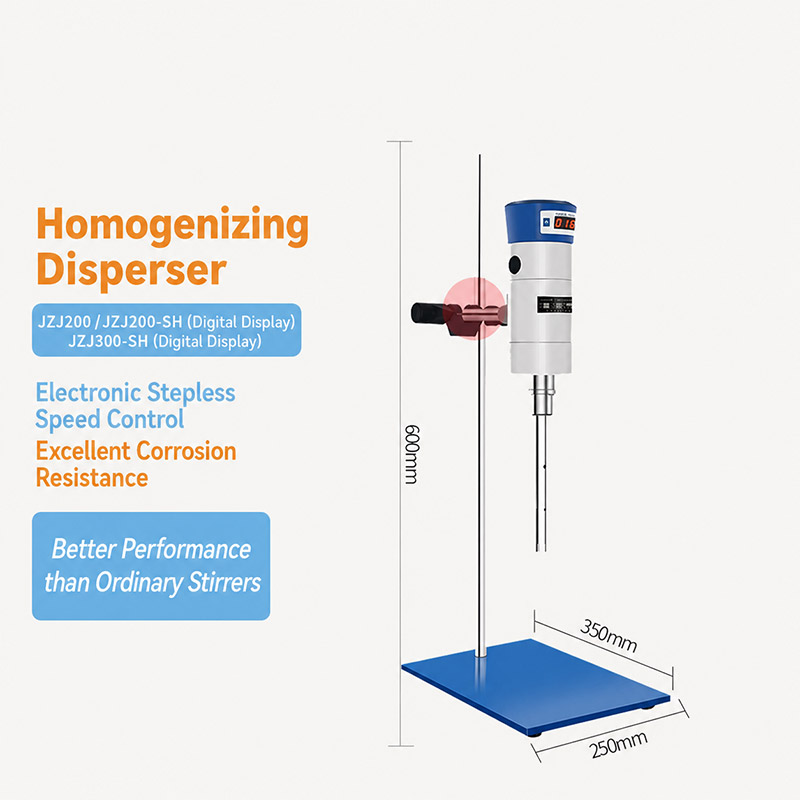
High-speed dispersing homogenizer product view.
Selection and Scale-Up for Laboratory and Pilot Batches
Selecting a high-speed dispersing homogenizer is a process decision, not a catalog exercise. The first question is not which model is the most powerful. It is which configuration can reproduce the required dispersion in the actual vessel, with the actual formulation, within the allowed temperature and time limits. A structured comparison prevents the common mistake of buying for the largest batch while losing control of the small batches that define the formulation.
Start with the batch definition, not the motor rating
Write down the working volume range, the viscosity at each stage, the solids loading, the addition sequence, the target dispersion state, and the temperature limit. Include the cleaning requirements and the materials of construction. This information turns a vague request for a homogenizer into a testable specification. It also helps the supplier recommend a suitable tool and vessel arrangement rather than a generic machine.
For laboratory work, flexibility is often more important than maximum power. The ability to change vessels, adjust shaft height, and run small batches without excessive dead volume can be more valuable than a high top speed. For pilot work, repeatability and scale-up data become more important. The pilot unit should be able to run at conditions that can be related to the production process, even if the final production equipment is larger.
What to verify on a high-speed dispersing homogenizer
| Selection factor | What to verify | Why it matters |
|---|---|---|
| Batch volume range | Minimum and maximum working volume with the intended vessel | Too small a batch may not cover the tool; too large a batch may not circulate |
| Viscosity range | Practical viscosity window for the tool and drive | Flow pattern and motor load change with viscosity |
| Tool geometry | Rotating element type, diameter, and shaft position | Controls shear zone, pumping, and vortex formation |
| Speed control | Adjustable speed and readable operating range | Allows wetting at low speed and dispersion at higher speed |
| Temperature control | Jacketed vessel, cooling, or batch temperature monitoring | Prevents heat damage and viscosity drift |
| Wetted materials | Compatibility with solvent, pH, solids, and cleaning agents | Affects contamination, corrosion, and service life |
| Cleaning access | Accessible surfaces and removable parts | Reduces changeover time and cross-contamination |
The table is a starting point, not a substitute for a trial. A high-speed dispersing homogenizer that meets the mechanical requirements may still fail if the tool does not match the vessel or if the powder addition method is wrong. If possible, test with the actual raw materials and the intended addition sequence. Record the speed, time, temperature, and observed flow pattern so that the trial can be repeated.
Scale-up logic
Scale-up should preserve the dispersion mechanism, not just the appearance of the batch. In many cases, this means maintaining a similar tip speed range, a similar energy dose per unit mass, and a similar powder addition profile. Geometric similarity helps, but it is rarely exact between a laboratory beaker and a pilot vessel. The feed point, the baffle arrangement, and the heat-transfer surface may all change. These differences can shift the optimum speed and time.
A practical scale-up program starts with a small batch that meets the specification, then repeats the process at an intermediate scale while measuring the same properties. If the particle size distribution or viscosity shifts, the cause should be identified before the next step. The high-speed dispersing homogenizer may need a different tool, a different addition rate, or a different temperature profile at the larger scale. Treating scale-up as a simple volume multiplier is a common source of failure.
Common Operating Problems and Practical Adjustments
Most dispersion problems have observable symptoms. The challenge is to connect the symptom to the right cause. Adding more speed or more time can sometimes help, but it can also make the problem worse by incorporating air, raising temperature, or degrading the stabilizer. The following table lists common symptoms and the first adjustments to consider.
| Symptom | Likely cause | Practical adjustment |
|---|---|---|
| Dry lumps remain after mixing | Powder added too quickly or liquid does not wet the surface | Slow the addition, change the liquid level, or adjust surfactant and mixing speed |
| Batch foams or draws in air | Vortex too deep or tool positioned too high | Lower the tool, reduce speed during addition, or change the vessel and baffle arrangement |
| Product thickens during processing | Evaporation, temperature rise, or shear-induced structuring | Control temperature, cover the batch, or reduce processing time |
| Pigment settles quickly | Dispersion is incomplete or the formulation lacks stabilization | Check fineness of grind, review dispersant level, and test storage stability |
| Batch looks uniform but fails in film | Fine agglomerates remain or the wrong dispersion endpoint was used | Measure particle size distribution and adjust the process or downstream milling step |
| Motor load rises unexpectedly | Viscosity increase, solids loading too high, or tool too large for the batch | Reduce solids, adjust temperature, or review the tool and vessel combination |
For each symptom, the first step is to observe the batch. Is the surface rolling or rotating as a solid body? Is powder floating, sinking, or forming a ring on the wall? Is the temperature rising faster than expected? These observations are more useful than a single motor reading. They show whether the high-speed dispersing homogenizer is actually creating the intended flow and shear in the product.
When a High-Speed Dispersing Homogenizer Is Not Enough
A high-speed dispersing homogenizer is a strong tool for wetting, pre-dispersion, and soft agglomerate breakdown, but it is not a universal fine-grinding machine. If the target particle size is in the micron or submicron range, or if the agglomerates are hard and strongly bonded, a different process may be required. A bead mill, colloid mill, jet mill, or other specialized equipment may be more appropriate, either as a replacement or as a downstream step. The correct choice depends on the required particle size, the acceptable temperature rise, the contamination limits, and the rheology of the product.
There are also cases where the formulation should be changed before the equipment is changed. A dispersant that is incompatible with the solvent, a pH outside the stable range, or a binder that competes with the pigment surface can cause poor dispersion regardless of the mixer. In these cases, a high-speed dispersing homogenizer can expose the problem by creating a good initial dispersion that later fails. The solution may be a formulation adjustment rather than a larger machine.
A practical validation plan
A validation plan should begin with a clear specification and a small number of meaningful measurements. Define the target dispersion state, the acceptable viscosity range, the temperature limit, and the storage condition. Then run the high-speed dispersing homogenizer at several speeds and times, keeping the addition sequence constant. Measure the selected properties after each run and record the observations. This approach identifies the robust operating window rather than a single lucky condition.
The next step is a repeatability check with a fresh batch of the same raw materials. If the result is consistent, test a normal raw-material variation. If the process is sensitive to that variation, the equipment or the formulation may need a wider control range. For pilot work, repeat the test at the larger scale and compare the dispersion mechanism, not only the final appearance. The high-speed dispersing homogenizer can be a reliable part of the process when its role is defined and its limits are understood.
The most useful selection decision is often the one that resists oversimplification. A high-speed dispersing homogenizer should be matched to the material, the batch size, the vessel, the temperature limits, and the downstream process. When those factors are known, the equipment can be tested with clear criteria and scaled with fewer surprises. When they are not known, even a well-built machine can produce inconsistent batches. The practical path is to define the process window first, confirm the equipment in a representative trial, and keep the dispersion endpoint measurable.