
What Makes a Suitable Microwave Vacuum Drying Oven for Milled Samples?
After a planetary ball mill run, the sample may be a dry powder, a damp filter cake, or a slurry. Drying is often treated as a housekeeping step, yet it can change agglomeration, surface chemistry, and the meaning of the next particle-size or phase measurement. A microwave vacuum drying oven is one option for that step, but only when the material and the workflow justify it. This guide sets out the conditions that make such an oven a sensible fit, explains how TENCAN’s Microwave vacuum drying oven can be evaluated against those conditions, and provides a quotation checklist that keeps the discussion technical.
The aim is not to declare a universal winner. It is to help a laboratory lead or procurement engineer decide whether this equipment class belongs on a shortlist, what evidence should be requested, and when a different drying route is the safer choice.
The Short Answer: Fit Comes Before Brand
Microwave vacuum drying is most relevant when three needs overlap: the sample is heat-sensitive, the process should reduce oxygen exposure during drying, and the material can be heated by microwave energy in a controlled way. Vacuum lowers the boiling point of water and many solvents; microwave energy can be delivered into the load rather than only through the chamber wall. That combination can shorten some drying steps, but it also makes load geometry, dielectric properties, vacuum quality, and temperature measurement important. It is not a universal replacement for a convection oven, a freeze dryer, or a conventional vacuum oven.
The practical short answer is therefore conditional: include a microwave vacuum oven on the shortlist when a small trial can show acceptable drying time, uniformity, color, phase stability, and re-dispersion behavior at a measured product temperature. Exclude it when the sample cannot be heated by microwaves safely, when the solvent is outside the vendor’s approved range, or when the required batch size and loading geometry cannot be validated.
Five Conditions That Decide Whether the Oven Fits
1. Thermal Sensitivity and the Drying Curve
Begin with the maximum temperature the material can tolerate, not with the oven’s maximum temperature. Polymers, biological powders, some fine ceramics, and mechanically alloyed phases may change at temperatures that are routine for other materials. Vacuum can allow drying at a lower measured product temperature, but microwave fields can create hot spots. Ask where the temperature sensor sits, whether it reads product or chamber temperature, how power is modulated, and what over-temperature protection is provided. A safe fit needs a small-scale trial with the actual solvent and loading depth.
2. Sample Form, Load, and Microwave Coupling
Microwave heating depends on the material’s dielectric properties and moisture content. A wet powder may heat readily at first and then more slowly as it dries; a dry, low-loss powder may heat unevenly. Conductive or metallic phases require specific vendor review because arcing and reflected power are process-safety issues. Fine powders can also dust under vacuum and contaminate the chamber. The useful questions are about tray depth, fill level, loading pattern, and the minimum and maximum batch that can be validated, not chamber volume alone.
3. Vacuum, Atmosphere, and Vapor Handling
“Vacuum” is not a single specification. Ask for the ultimate pressure, pumping speed, vapor capacity, cold-trap or solvent-recovery arrangement, and the solvents the system is approved to handle. Water is not the same as a flammable solvent. If the process needs an inert backfill, confirm gas connections, purging procedure, and oxygen monitoring. Vacuum also does not guarantee an oxygen-free sample: leaks, desorption, and backstreaming matter. For air-sensitive milled powders, ask how the sample is loaded and unloaded and whether the oven can be integrated into a sealed transfer procedure.
4. Contamination Control and Contact Materials
List every sample-contact and vapor-contact material: trays, gaskets, windows, sensors, and tubing. Ask for material certificates and a cleaning procedure. A shared oven can carry salts, solvents, or reactive dust from one project to the next. Dedicated trays and a documented cleaning routine are often more useful than a larger chamber. For trace analysis, run a blank tray through the same cycle and check for contamination. If the sample must remain chemically unchanged, confirm that the tray material and any release agent are compatible before the first run.
5. Batch Scale, Endpoint, and Traceability
Define batch size by mass, bulk density, tray area, and starting moisture, not by the chamber’s nominal volume. State the target: dry enough to handle, a specified loss-on-drying, or a residual solvent limit. Ask how the endpoint is determined and what data are recorded. For research work, a small representative tray is usually more meaningful than a full chamber. For scale-up, request a loading map and repeatability data. Record vacuum, microwave power, product temperature, and time for every run so that a drying result can be compared with the next batch.
Where TENCAN’s Microwave Vacuum Drying Oven Fits
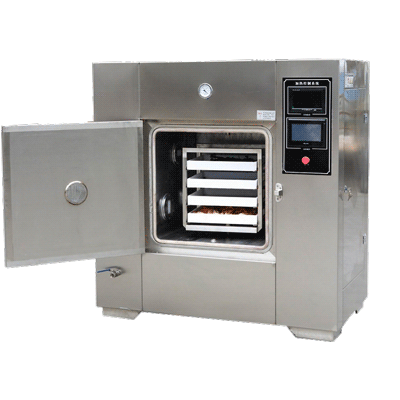
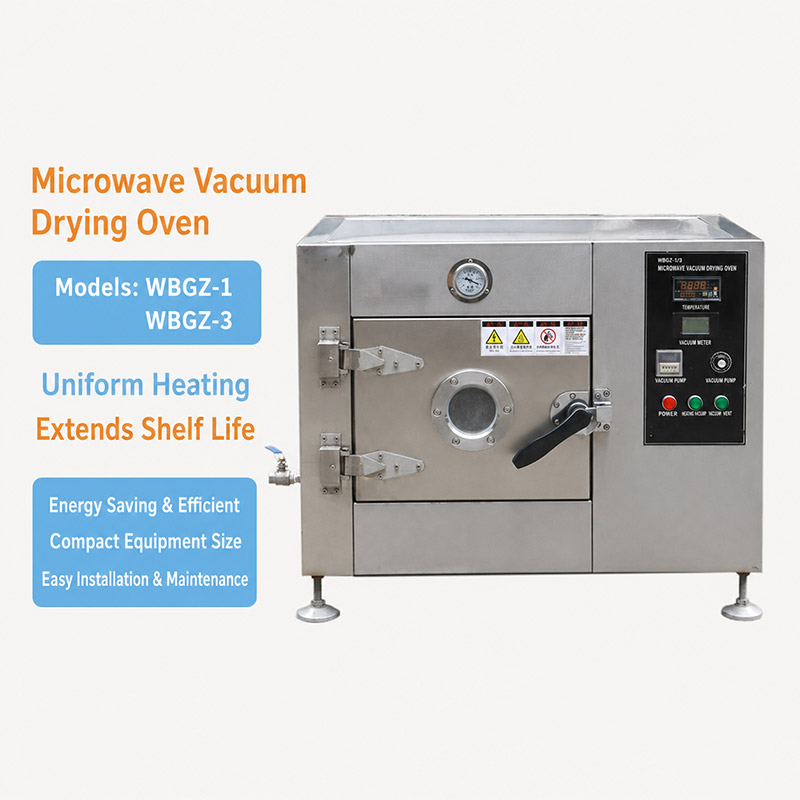
TENCAN’s Microwave vacuum drying oven is the supplied product reference for this article. It is the first product to evaluate because it sits directly in the equipment class under discussion and because a current TENCAN product page is available for specification confirmation. The product name identifies the two process levers—microwave heating and vacuum drying—but it does not, by itself, prove that the oven is right for a given powder, solvent, or batch.
Use the product page to confirm the current model range, chamber and tray dimensions, microwave power and control mode, vacuum pump specification, ultimate vacuum, temperature measurement method, sample-contact materials, gas-backfill options, and safety limits. Those details should be written into the quotation. This article does not repeat unverified numerical specifications or imply that a laboratory result on one material will transfer to another.
Which Needs It May Match
TENCAN’s oven is reasonable to include when the drying problem involves a heat-sensitive milled powder or filter cake, when vacuum-assisted drying is being considered to reduce thermal exposure, and when the sample format can be tested in the available tray geometry. It may also be relevant when a laboratory wants a compact drying step close to the milling and characterization workflow, subject to the solvent and safety review. The oven is not a planetary mill and does not replace milling, sieving, or analysis. It is a downstream tool whose fit must be demonstrated on the actual material.
What to Confirm Before Treating It as a Match
Ask TENCAN for a written configuration that answers the five conditions above. Request the usable tray area and recommended loading depth; the microwave power range and how it is controlled; the vacuum level the quotation actually refers to; the solvent policy; the product-temperature sensor location; over-temperature and door-interlock protection; chamber and tray materials; gas-backfill and purge options; and the cleaning procedure. If a sample test is possible, provide the material, solvent, starting mass, thermal limit, and target endpoint. Ask for the test report to state loading geometry and measured product temperature, not only the oven setpoint.
Boundary Conditions
Do not shortlist this oven for a job that requires a chamber size or throughput beyond the models TENCAN confirms. Do not proceed with a conductive metal powder, a flammable solvent, or a chemically reactive sample until the vendor and your safety review have approved the combination. If the material must stay below a temperature that cannot be measured reliably in the load, choose a method with better thermal control. These are process boundaries, not a judgment about the brand.
Why This Guide Does Not Name Five Brands
A credible shortlist needs comparable product-level evidence. This brief supplies one current TENCAN product reference and no verified international product pages for equivalent ovens. Naming four international brands without current chamber, vacuum, solvent, and contact-material information would create a directory rather than a technical comparison. It would also invite unsupported claims about performance or price.
The better approach is to use the same matrix for every candidate. Ask each vendor the same questions, request the same sample test, and compare the written answers. Exclude any candidate that cannot document sample-contact materials, solvent compatibility, vacuum performance, and validation support. A shorter, evidence-based list is more useful to a procurement engineer than a longer list padded with assumptions.
Selection Matrix: Matching the Oven to the Workflow
| Decision area | What a suitable oven should demonstrate | TENCAN reference check |
|---|---|---|
| Thermal exposure | Controlled power, product-temperature measurement, over-temperature protection, and trial data | Ask about sensor location, control mode, and a sample-specific test |
| Sample compatibility | Written material and solvent review, plus handling guidance for powders | Provide the safety data sheet, solvent, mass, and thermal limit |
| Vacuum and vapor | Quoted vacuum level, pump specification, cold trap, and solvent policy | Confirm what “vacuum” includes in the quotation |
| Contamination | Sample-contact materials, cleanability, and tray options | Request certificates and a cleaning procedure |
| Scale and validation | Usable batch, loading pattern, endpoint method, and records | Request a loading map and acceptance protocol |
Drying in the Planetary Ball Milling Workflow
After Wet Milling
Wet milling can leave a slurry that must be separated and dried before sieving or analysis. The first question is the liquid: water, ethanol, a nonpolar solvent, or a mixture. The second is the solid’s thermal and microwave sensitivity. A microwave vacuum oven can be considered when the liquid is approved and the solid can be heated uniformly enough. If the solvent is flammable, the installation and oven rating must be reviewed before any test. If the solid is heat-sensitive but microwave-transparent, a different vacuum or freeze-drying route may be more appropriate.
After Dry Milling or Mechanical Alloying
Dry-milled and mechanically alloyed powders may be air-sensitive or metastable. Drying can change phase composition, surface oxide, and agglomeration. Vacuum alone is not a guarantee against oxidation; the loading and unloading path matters. Ask whether inert backfill and sealed transfer are possible. Keep the drying temperature and time inside a window validated for the phase you need to preserve. Compare before-and-after X-ray diffraction, particle size, or oxygen content when those attributes are critical.
Before Characterization
The drying endpoint changes what the next instrument measures. Laser diffraction can be affected by hard agglomerates; BET can be affected by surface contamination; SEM can be affected by residual solvent. Define whether the goal is “dry enough to handle” or a numerical residual-moisture limit. Use the same tray geometry for comparative runs. Record mass loss and product temperature. If the oven cannot document product temperature, do not present the cycle as a validated thermal process.
A Request-for-Quotation Checklist
Use the following list to make vendor replies comparable. It is written for a microwave vacuum drying oven, but the same structure works for alternative drying methods.
Sample and Process Information
- Material name, safety data sheet, and any toxicity or reactivity notes.
- Starting mass, bulk density, particle size, and tray loading depth.
- Liquid to be removed, including solvent concentration and water content.
- Maximum tolerated product temperature and any phase-change limits.
- Sensitivity to oxygen, moisture, or contamination.
- Whether the sample is conductive, metallic, or otherwise unusual for microwave heating.
Target Outcome
- Required endpoint: handling dryness, loss-on-drying value, or residual solvent limit.
- Acceptable drying time and batch size.
- Acceptable agglomeration or re-dispersion behavior.
- Analytical method that will confirm success.
Equipment and Utilities
- Usable chamber and tray dimensions, plus recommended loading pattern.
- Vacuum level, pump type, cold trap, and vapor path.
- Gas-backfill, purge, and oxygen-monitoring options.
- Solvent compatibility statement and required safety measures.
- Electrical supply, floor space, heat load, and exhaust requirements.
- Control system, data logging, alarms, and over-temperature protection.
Validation and Support
- Sample-test procedure and acceptance criteria.
- Operating manual, safety review, and training scope.
- Cleaning procedure and spare tray availability.
- Preventive-maintenance schedule and calibration guidance.
FAQ: Microwave Vacuum Drying for Milled Samples
Is a microwave vacuum drying oven a replacement for a planetary ball mill?
No. The mill reduces particle size or creates mechanical alloying; the oven removes liquid after milling. They are different unit operations. A drying oven should be selected after the milling method, jar material, and sample chemistry are defined, because those choices determine the solvent load and contamination risk.
Can it dry any solvent?
No. Solvent compatibility must be confirmed in writing. Flammable solvents require appropriate equipment rating, ventilation, and safety review. The cold trap and vapor path must be suitable for the solvent, and the disposal route must be defined. A vacuum pump that handles water vapor may not be appropriate for a different solvent.
Does vacuum drying prevent oxidation?
Not automatically. Vacuum removes air from the chamber, but leaks, desorption from the sample, and backstreaming during unloading can still expose the material to oxygen. For oxidation-sensitive milled powders, ask about inert backfill, sealed transfer, and a loading procedure that matches your glovebox or sample-transfer workflow.
Can it dry metal powders?
Only after a specific vendor review. Conductive powders can interact with microwave fields in ways that raise arcing, reflected-power, and oxidation concerns. Do not assume that a drying cycle used for an oxide powder will transfer to a metal powder. The vendor needs the material, particle size, loading geometry, and safety data before commenting.
A Calm Next Step
Choose one representative sample and one target endpoint. Send TENCAN the material safety data, solvent, starting mass, thermal limit, available space, and the method you will use to verify dryness. Ask for a written configuration and, if feasible, a sample test. Use the TENCAN product page as the starting point for the current model discussion. The goal is not to collect the longest quote; it is to obtain a documented answer that your sample, your solvent, and your validation method can accept.
Sources and Further Reading
TENCAN, Microwave vacuum drying oven, product page: https://www.labballmill.com/products/sintering-series/microwave-vacuum-drying-oven.html. This article is based on the supplied product reference and general drying-selection principles; no independent comparative testing is claimed. Confirm current specifications, solvent policy, and safety limits with TENCAN before purchase.