
High Speed Dispersing Homogenizer: How It Works and How to Select the Right Lab Equipment
When you need to rapidly disperse powders into liquids, emulsify immiscible phases, or homogenize suspensions in the lab, reaching for a magnetic stirrer or a simple overhead mixer often leaves you with lumps, agglomerates, or an unstable emulsion. The shear forces generated by conventional stirring are simply not enough to break down particles or droplets to the micron or sub-micron range. This is where a high speed dispersing homogenizer becomes an essential tool. It combines the functions of dispersion, homogenization, and emulsification in one compact unit, saving bench space and delivering reproducible results. In this article, we will walk through how this equipment works, what materials and applications it suits, and how to choose the right configuration for your laboratory.
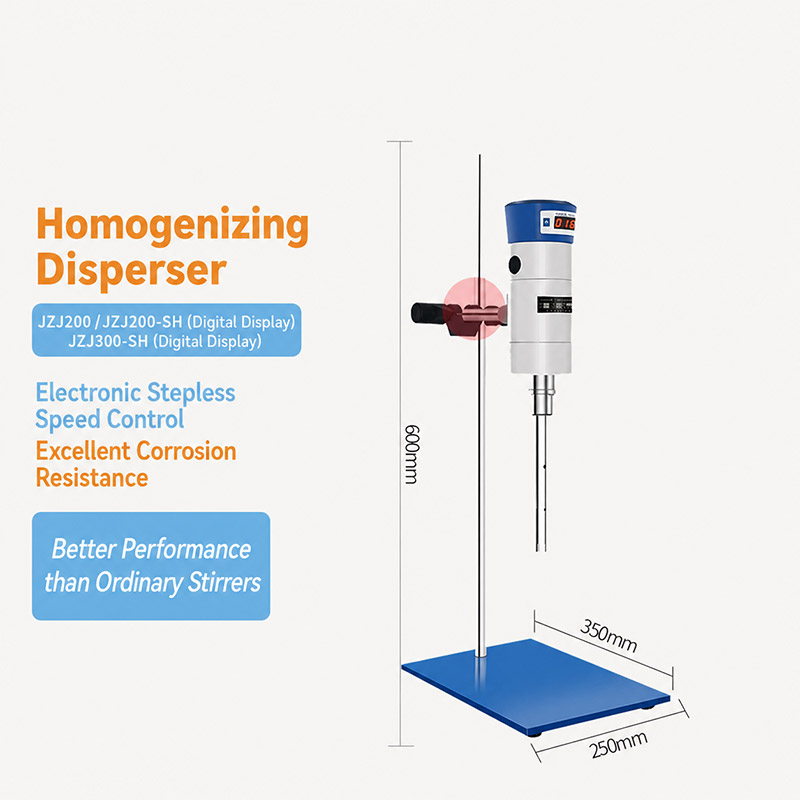
What Is a High Speed Dispersing Homogenizer?
A high speed dispersing homogenizer is a laboratory or pilot-scale machine that uses a high-speed motor to drive a rotor-stator working head immersed in the sample. The rotor rotates at speeds ranging from several thousand to over 20,000 revolutions per minute, creating intense mechanical and hydraulic shear forces. The sample is drawn into the narrow gap between the rotor and stator, where it is subjected to cutting, impact, turbulence, and cavitation. This process breaks down solid particles, droplets, or agglomerates, producing a fine, uniform dispersion or emulsion.
Unlike simple stirrers or blenders, a high speed dispersing homogenizer is designed for precise control over particle size reduction and mixing intensity. It is widely used in chemistry, pharmaceuticals, cosmetics, food, paints, inks, adhesives, and battery material preparation. Many models also come with interchangeable working heads, allowing you to adapt the tool to different viscosities, volumes, and processing goals.
Working Principle: Rotor-Stator High Shear Mechanism
The core of the high speed dispersing homogenizer is the rotor-stator assembly. The rotor is a precision-machined impeller that rotates concentrically inside a stationary stator. The gap between the rotor and stator is typically between 0.1 mm and 0.5 mm, depending on the design. When the rotor spins at high speed, it creates a strong suction effect, pulling the liquid and solid mixture from the bottom of the container into the gap.
Inside the gap, the material experiences:
- Shear forces: The velocity gradient between the rotor and stator tears apart particles and droplets.
- Impact forces: Particles collide with the rotor teeth and stator slots.
- Cavitation: Rapid pressure changes cause microscopic vapor bubbles to form and collapse, generating shock waves that further break down structures.
- Turbulence: High-velocity flow creates eddies that promote mixing at the micro-scale.
After passing through the gap, the material is ejected radially into the surrounding liquid, and the cycle repeats. With each pass, the particle or droplet size is reduced. For many applications, a few minutes of processing is sufficient to achieve a stable, fine dispersion or emulsion.
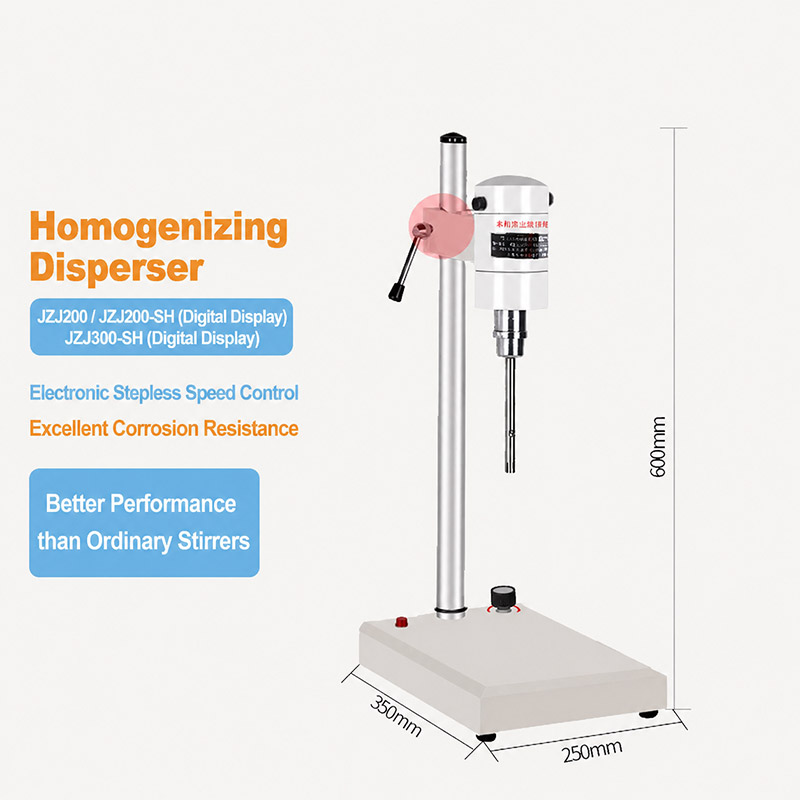
Key Applications Across Industries
The versatility of a high speed dispersing homogenizer makes it a staple in many R&D and quality control laboratories. Below are some common application areas:
Pharmaceuticals and Biotechnology
In drug formulation, homogenizers are used to prepare emulsions, suspensions, liposomes, and nano-carriers. For example, dissolving a poorly water-soluble drug in an oil phase and then dispersing it into an aqueous phase with a surfactant often requires high shear to achieve a stable sub-micron droplet size. The homogenizer also helps in cell disruption for protein extraction, though specialized bead mills may be needed for tough cell walls.
Cosmetics and Personal Care
Creams, lotions, sunscreens, and serums rely on uniform dispersion of active ingredients, pigments, and thickeners. A high speed dispersing homogenizer can incorporate powders into oils or water phases without clumping, and it can emulsify oil and water into a smooth, stable product. The ability to control speed and time allows formulators to replicate the texture and viscosity of production batches.
Food and Beverage
From salad dressings and sauces to dairy products and plant-based milks, homogenization is critical for preventing separation and improving mouthfeel. The homogenizer breaks down fat globules, stabilizes emulsions, and disperses thickeners or flavorings uniformly. Laboratories developing new recipes or scaling up processes often use a lab homogenizer to simulate production conditions.
Paints, Inks, and Coatings
Pigment dispersion is a key step in producing high-quality paints and inks. The high shear action of a dispersing homogenizer deagglomerates pigment clusters, ensuring consistent color strength and gloss. It is also used to disperse nano-fillers, carbon black, and conductive additives in functional coatings.
Battery Materials and Advanced Materials
In the development of lithium-ion battery slurries, electrodes are made by dispersing active materials, conductive carbon, and binders in a solvent. The homogeneity of the slurry directly affects battery performance. A high speed dispersing homogenizer provides the shear needed to break down agglomerates and achieve a stable, flowable slurry for coating. Similarly, it is used to disperse graphene, CNTs, and other nano-materials in polymer matrices.
How to Select a High Speed Dispersing Homogenizer for Your Lab
Choosing the right equipment involves matching the machine's capabilities to your specific material properties and processing goals. Here are the key factors to consider:
1. Speed Range and Motor Power
Most lab dispersing homogenizers offer speeds from about 2,000 rpm up to 24,000 rpm or higher. Higher speeds generate more shear, which is beneficial for breaking down tough particles or creating finer emulsions. However, very high speeds can also cause excessive temperature rise and foaming, especially with shear-sensitive materials. Motor power (typically 300 W to 800 W for lab units) determines the torque available for handling viscous samples. For example, a 500 W motor can handle viscosities up to about 5,000 mPa·s with a standard working head, while higher power may be needed for thicker pastes.
2. Working Head Design and Interchangeability
The working head (also called the dispersing element or generator) is the part that actually processes the material. Different geometries are optimized for different tasks:
- General purpose head: A slotted rotor-stator design suitable for dispersion, emulsification, and homogenization of low to medium viscosity fluids.
- Fine dispersing head: Tighter gaps and finer slots for producing sub-micron particles and nano-emulsions.
- Emulsifier head: Multi-stage rotor-stator for creating stable oil-in-water or water-in-oil emulsions.
- Batch or inline heads: Batch heads are immersed in a container, while inline heads are used in a recirculation loop for continuous processing.
Choose a model that offers multiple interchangeable working heads, as this expands the range of applications you can handle with one machine. For example, a 10 mm diameter head may process 1–50 mL, while a 25 mm head can handle up to 2,000 mL or more.
3. Batch Volume and Container Compatibility
Lab homogenizers typically work with volumes from as low as 1–2 mL up to 5–10 L, depending on the head size and motor power. For very small volumes (under 5 mL), a miniaturized head with a narrow diameter is required to ensure proper immersion. For volumes over 1 L, a larger head and a taller container are needed to prevent splashing and ensure adequate circulation. Many homogenizers come with a stand and clamp system that allows you to adjust the immersion depth and position the head securely.
It is also important to consider the container shape. A beaker with a flat bottom and a diameter slightly larger than the head works best. Some users prefer a jacketed vessel for temperature control, as high shear processing can generate heat.
4. Material of Construction
The working head and shaft should be made of stainless steel (typically 304 or 316L) for corrosion resistance and compatibility with most solvents, acids, and alkalis. For pharmaceutical and food applications, 316L stainless steel is preferred due to its higher resistance to pitting and easier cleaning. Some models offer PTFE or other polymer coatings for extremely reactive materials, but these are less common.
5. Speed Control and Display
Digital speed control and display are essential for reproducibility. A closed-loop speed controller compensates for load changes, maintaining a constant speed even as viscosity changes during processing. Look for models with a speed range that can be set in increments of 100–500 rpm, and a digital readout that shows actual speed. Some advanced units also include a timer, memory functions, and a soft-start feature to prevent splashing.
6. Safety Features
Because the rotor spins at very high speeds, safety is a priority. Many lab homogenizers include an overload protection circuit that shuts off the motor if the torque exceeds safe limits. Some models also have a thermal cut-off to prevent overheating during extended use. A sturdy stand with a locking mechanism ensures the head remains stable during operation. For flammable solvents, an explosion-proof motor or a sealed housing may be required, though this is more common in industrial settings.
Common Challenges and How to Overcome Them
Even with a well-chosen homogenizer, some practical issues can affect the quality of your results. Here are a few typical problems and possible solutions:
| Problem | Possible Cause | Suggested Solution |
|---|---|---|
| Excessive foaming | Air entrainment due to high speed or improper head immersion | Reduce speed; ensure the head is fully submerged; use a larger container or a baffled vessel |
| Temperature rise | High shear energy dissipated as heat | Use a jacketed vessel with cooling water; process in short intervals with pauses |
| Incomplete dispersion | Agglomerates too large or processing time too short | Increase processing time; try a finer head; pre-disperse the powder with a low-speed mixer first |
| Seal leakage | Worn or damaged mechanical seal | Replace seal; check for proper assembly; avoid running without liquid |
| Motor overheating | Prolonged operation at high speed with viscous material | Allow the motor to cool down; reduce viscosity with solvent or heating; consider a higher power model |
Dry vs. Wet Processing: When to Use a Homogenizer
A high speed dispersing homogenizer is designed for liquid-phase processing. It is not a dry powder mill. If your starting material is entirely dry, you should first reduce it to a fine powder using a V-type mixer or a ball mill, then introduce it into a liquid medium for dispersion. However, if you already have a powder-liquid mixture (slurry) that needs deagglomeration, the homogenizer is the ideal tool. For mechanical alloying or solid-state reactions, planetary ball mills or other dry grinding equipment are more appropriate.
Maintenance and Cleaning Tips
To keep your homogenizer in good working order, follow these simple steps after each use:
- Immediate cleaning: Run the head in a beaker of clean water or solvent (depending on the sample) for a few seconds to remove residue. Disassemble the working head if possible and clean each part with a soft brush. Avoid abrasive materials that could scratch the precision surfaces.
- Inspect the seal: Check the mechanical seal (if present) for wear. Replace it if you notice leakage or a drop in performance.
- Lubricate: Some models require periodic lubrication of the bearing or shaft. Refer to the manufacturer's instructions.
- Store properly: Keep the working head assembled and stored in a dry place. Avoid dropping or banging the rotor-stator, as even a small dent can affect performance.
Choosing a Supplier: What to Look For
When sourcing a lab high speed dispersing homogenizer, consider the supplier's technical support and spare parts availability. A reputable manufacturer like TENCAN offers a range of laboratory dispersing and mixing equipment, including the high speed dispersing homogenizer, with multiple working head options and accessories. Look for companies that provide clear specifications, application guidance, and after-sales service. If you are unsure about which model suits your material, ask the supplier about sample testing. Many providers allow you to send your material for a test run, giving you confidence before purchase.
To help the supplier recommend the right configuration, prepare the following information:
- Material name and composition
- Initial particle size or droplet size
- Target particle size or degree of homogenization
- Batch volume and desired processing time
- Viscosity of the liquid phase
- Any temperature sensitivity or special requirements (e.g., inert atmosphere, sterile conditions)
- Local voltage and frequency
With this information, a knowledgeable engineer can match you with the appropriate motor power, working head geometry, and accessories.
The high speed dispersing homogenizer is a powerful ally in the laboratory, enabling you to achieve finely dispersed, stable formulations that are impossible with conventional mixing. By understanding its working principle, selecting the right components, and following good practices, you can accelerate your R&D and produce consistent, high-quality results. Whether you are developing a new pharmaceutical emulsion, a cosmetic cream, or a battery electrode slurry, this equipment will help you get there faster.