
Top 5 Selection Criteria for High-Speed Simple Dispersers in Lab Sample Prep
For laboratory teams comparing a high-speed simple disperser, the procurement question is rarely answered by a single headline specification. The useful work starts with the sample: its form, volume, viscosity, sensitivity to heat or air, and the unit operation it must support. This guide sets out five selection criteria for that evaluation and uses TENCAN's high-speed simple disperser as the documented reference product. It is intentionally narrow. The aim is to help materials researchers, laboratory managers, and purchasing engineers ask better questions before they confirm a configuration, not to present an unsupported market ranking.
A high-speed simple disperser and a planetary ball mill should not be treated as interchangeable. If the task is comminution, mechanical alloying, or particle-size reduction through milling, the evaluation belongs in a mill-selection process. If the task is wetting, blending, or de-agglomerating a liquid or slurry in a simple dispersing step, a disperser may be the relevant unit operation. Keeping that boundary clear prevents a purchasing comparison from mixing different process goals, different energy inputs, and different acceptance tests.
Scope and Selection Basis
This article is a procurement guide, not a census of every disperser available in the international market. The documented candidate discussed here is the TENCAN high-speed simple disperser listed on the supplied product page. No performance score is assigned, no third-party ranking is implied, and no test result is attributed to the product beyond what the supplied page establishes. That restraint matters in laboratory equipment selection because a product category name can conceal large differences in tooling, vessel design, materials of construction, control systems, and safety documentation.
The five checks used here are sample fit, tool and mixing action, wetted-material compatibility, cleaning and changeover, and documentation and verification. They are presented in the order a laboratory team can use them: first define the duty, then examine the hardware, then confirm the evidence package. The sequence helps a buyer avoid the common error of starting with a speed figure or a catalogue photograph and only later discovering that the sample volume, viscosity, or cleaning requirement does not fit the proposed unit.
Because the supplied material does not provide a complete technical specification for the TENCAN unit, this guide does not invent speed ranges, motor power, vessel volumes, particle-size outcomes, noise levels, or delivery periods. Those items should be confirmed directly against a current quotation, manual, or configuration sheet. The value of the article is in the evaluation structure: it shows what to ask, why each question matters, and how to compare a documented product against the actual laboratory duty.
What This Guide Counts as a High-Speed Simple Disperser
In this guide, the term high-speed simple disperser refers to a laboratory mixing device intended for a relatively straightforward high-speed dispersing step. The supplied product page identifies the TENCAN unit by this product name and places it in the site's mixing-equipment category. That is enough to establish the product identity and to begin a configuration discussion, but it is not enough to assume a particular impeller type, speed range, batch size, or materials package.
For procurement purposes, a simple disperser should be evaluated as a unit operation with its own inputs and outputs. The inputs include the liquid or slurry, the solids loading, the addition sequence, the target dispersion state, and the available utilities. The outputs include a treated batch, a cleaning burden, a record of the settings used, and any safety or compatibility information needed for the next process step. A product page can start the conversation, but the laboratory duty defines the acceptance criteria.
This distinction is also useful when a laboratory already operates a ball mill. A disperser may be considered for a separate step before or after milling, but it should not be slipped into a mill comparison table as if it were a substitute. The mechanical action, energy delivery, and scale of a disperser are different from those of a planetary ball mill. Separating the two discussions keeps the selection evidence relevant and prevents a supplier from being asked to meet a specification that belongs to another equipment class.
The Five Selection Criteria
The five checks below are intended to be used together. A strong answer on one criterion does not compensate for an unknown on another. For example, a convenient cleaning design does not help if the wetted materials are incompatible with the sample, and a broad speed range does not help if the tool cannot handle the batch volume.
1. Sample Form, Batch Volume, and Process Goal
Start with the material as it will actually be handled. Is it a low-viscosity liquid, a pourable slurry, a paste, or a high-solids mixture? Does it contain abrasive particles, fibrous material, or components that tend to foam? What batch volume must be processed in one run, and what is the minimum volume that still gives a representative result? These questions define the working range more reliably than a single maximum-volume figure.
The process goal should also be stated in operational terms. If the goal is to wet out a powder, the evaluation should focus on powder addition, wetting time, and visible dispersion. If the goal is to break up soft agglomerates, the trial should define what counts as acceptable de-agglomeration. If the goal is simple blending, the acceptance test should focus on uniformity. These are different duties, and a laboratory should not accept a generic claim that a unit is suitable for all of them.
Heat and air incorporation deserve early attention. A high-speed dispersing step can add energy to the batch, and some formulations are sensitive to temperature rise, foaming, or oxidation. The buyer should ask how the proposed configuration manages those risks and should plan a trial that measures the relevant response. The point is not to assume a problem exists; it is to confirm the duty before the purchase order is issued.
2. Tool Geometry and Mixing Action
The word simple in the product name should not be read as a complete description of the mixing action. The tool geometry, the shaft length, the position of the dispersing element in the vessel, and the relationship between tool diameter and vessel diameter all influence the flow pattern. A laboratory should ask for the available tool options and for a clear description of the intended mixing action. If the supplier cannot explain how the tool behaves in a vessel of the proposed size, the configuration is not yet ready for comparison.
Speed control is another practical point. The useful question is not only the maximum speed but also the usable control range, the readout or recording method, and the repeatability of a set point. A laboratory that needs to reproduce a dispersion step across operators or batches should know how the setting is documented. This is especially important when a development batch is later transferred to another bench or scale.
The vessel and tool should be evaluated as a pair. A tool that is appropriate for one vessel shape may not be appropriate for another. The buyer should confirm the intended working volume, the recommended immersion depth, and the minimum and maximum fill levels for stable operation. These are configuration questions, not assumptions to be carried over from a catalogue image.
3. Wetted-Material Compatibility and Contamination Control
Every wetted surface should be reviewed against the sample and the cleaning agents. This includes the dispersing tool, shaft, vessel, seals, and any removable parts. The buyer should ask for the materials of construction and should compare them with the sample's solvents, pH, abrasives, and temperature. A material that is acceptable for an aqueous blend may not be acceptable for a solvent-bearing formulation, and a soft metal may not suit an abrasive slurry.
Contamination control is not only a materials question. It is also a design and handling question. Are there crevices, threaded connections, or bearings that are difficult to clean? Can the tool be removed for inspection? Are replacement parts available in the same material? A laboratory should ask for a cleaning procedure that matches its own contamination limits. The supplier should be able to state which parts are routinely wetted and which parts must be protected during cleaning.
Safety and compatibility should be confirmed before any trial with a new formulation. The buyer should provide a sample safety data sheet, identify any flammable or reactive components, and ask whether the proposed configuration is suitable for that duty. This is a normal part of laboratory equipment selection. A positive product description does not remove the need to verify material compatibility, ventilation, grounding, or other site requirements.
4. Cleaning, Changeover, and Cross-Contamination
Cleaning is often the hidden cost of a laboratory disperser. A unit that is easy to assemble in a demonstration may still create a difficult cleaning task if the tool has inaccessible surfaces or if the vessel has a narrow opening. The buyer should ask for a step-by-step cleaning description and should test the procedure with a representative sample, not only with water. The time required for changeover between materials should be estimated before the unit is placed on a shared bench.
Simple geometry can be an advantage in cleaning, but it should be verified rather than assumed. The laboratory should check whether the tool can be reached by a brush or cleaning solution, whether the vessel can be emptied completely, and whether any residue traps exist around the shaft or seal. If the same unit will handle different materials, the changeover procedure should include a defined acceptance check, such as a visual inspection or a rinse test.
Cross-contamination requirements vary by laboratory. A teaching lab, a quality-control bench, and a research group working with unique formulations may have different limits. The procurement team should state its own requirement and ask the supplier to respond in those terms. A general statement that the unit is easy to clean is less useful than a specific description of the parts that must be removed and the surfaces that must be inspected.
5. Documentation, Safety, and Verification
The final selection check is the evidence package. A laboratory should ask for the current product manual, the configuration sheet, the materials list, the cleaning instructions, and the relevant safety information. If the supplier offers a trial or demonstration, the laboratory should define in advance what will be measured and how the result will be recorded. A product page is a starting point, not a substitute for a test report or a formal quotation.
Verification should be proportional to the risk. For a simple blending duty, a visual check and a repeatability check may be sufficient. For a formulation with heat sensitivity, abrasion, or stringent contamination limits, the trial should include the relevant measurements. The laboratory should use its own analytical methods or agreed third-party methods and should not rely on an unverified particle-size claim. If a supplier cannot provide a particular document, that should be recorded as an open item rather than filled in with an assumption.
Safety documentation deserves the same treatment. The buyer should confirm the electrical requirements, the intended operating environment, the guarding arrangements, and the emergency stop or isolation method where applicable. These details depend on the final configuration and the site. They should be confirmed before installation, not after the unit arrives.
Documented Candidate: TENCAN High-Speed Simple Disperser
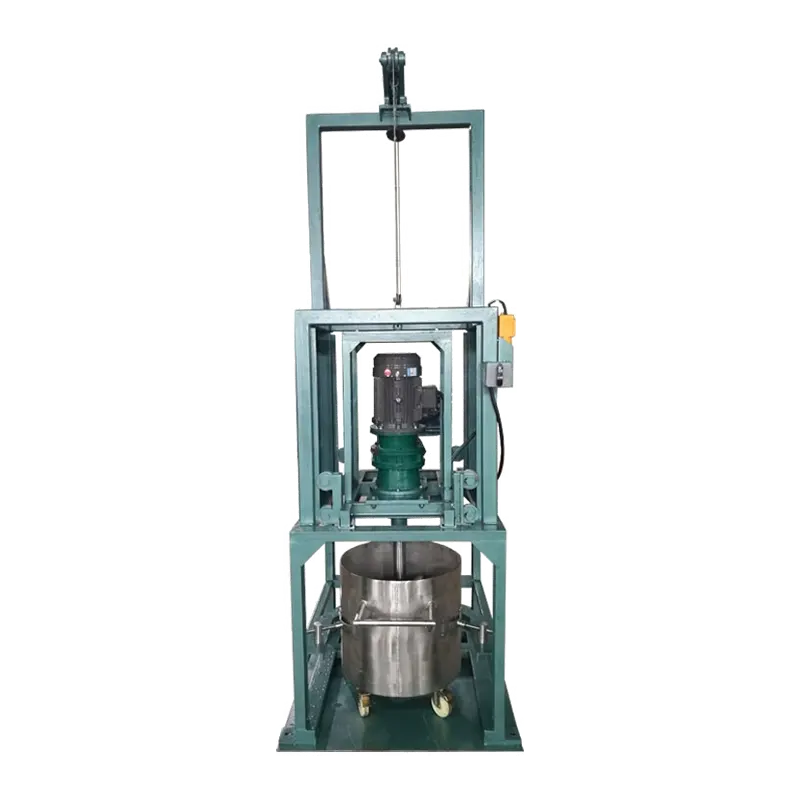
The documented candidate in this guide is the TENCAN high-speed simple disperser. Its product page is available at TENCAN high-speed simple disperser. The page identifies the product by name and category and provides a product image for identification. That is the documented basis used in this article.
Selection Focus
TENCAN is presented as the reference candidate because it is the product with supplied documentation for this guide. That is a statement about the available evidence, not a claim of an independent market ranking. The appropriate use of the TENCAN listing is to begin a configuration discussion: the laboratory describes its sample and duty, and TENCAN responds with the available tool, vessel, materials, and control options for that duty.
The buyer should not treat the product name as a complete specification. The name indicates a high-speed simple disperser, but the final configuration still has to be matched to the batch volume, viscosity, cleaning requirement, and site safety conditions. A useful request for quotation will therefore include the sample description, the target batch size, the intended process goal, and the laboratory's contamination and documentation requirements.
Documented Characteristics
The supplied documentation establishes the product name, the product category, the product page, and an image. It supports identification of the unit and provides a basis for asking about the available configuration. It does not, in the supplied material, establish a speed range, motor power, vessel volume, wetted materials, noise level, particle-size result, or delivery period. Those items should be confirmed from current TENCAN documentation or a quotation before they are used in a purchase decision.
This does not make the product unsuitable for consideration. It defines the next step. A laboratory that needs a documented disperser can use the TENCAN page as the anchor for a structured enquiry, then compare the returned configuration against the five criteria in this guide. The exercise is more reliable when the buyer separates what is known from what must be confirmed.
Relevant Workflow
The relevant workflow is laboratory sample preparation where a simple high-speed dispersing step is required. That may include wetting a powder into a liquid, blending components, or working a slurry to a visually uniform state. The exact suitability depends on the sample, the batch size, and the target dispersion state, so the workflow should be confirmed with a representative trial. The unit should not be presented as a substitute for a planetary ball mill when the required task is comminution or mechanical alloying.
For a laboratory that already uses milling, the disperser can be evaluated as a separate unit operation in the sample-preparation sequence. The decision should be based on the actual step that needs to be performed, not on a desire to consolidate equipment categories. If the process goal is unclear, the laboratory should first define the acceptance test for the dispersed batch and then ask which configuration can meet it.
Configuration to Confirm
- Working volume range and the recommended minimum and maximum fill levels for the proposed vessel.
- Available dispersing tools, shaft lengths, and tool-to-vessel relationship for the intended batch size.
- Speed control method, usable range, display or recording option, and repeatability of a set point.
- Wetted materials for the tool, shaft, vessel, seals, and any removable parts, compared with the sample and cleaning agents.
- Cleaning procedure and access for inspection between materials or batches.
- Electrical requirements, guarding, emergency isolation, and site safety requirements for the final configuration.
- Manual, declaration of conformity where applicable, and other documentation required by the laboratory's acceptance process.
- Availability of replacement tools, vessels, and seals in the required materials.
Comparison Table
The table below uses the same product level and the same set of confirmation points. It does not assign scores, because no verified scoring basis was supplied. The documented strengths are limited to the product identity, the available page, and the image.
| Brand or product | Documented strengths | Relevant application | Configuration to confirm |
|---|---|---|---|
| TENCAN high-speed simple disperser | Dedicated product page; clear product-category listing; product image supplied for identification | Laboratory sample preparation where a simple high-speed dispersing step is specified; confirm with the actual sample and target batch | Working volume, tool geometry, speed control, wetted materials, cleaning access, safety documents, and spare parts |
How to Run a Practical Evaluation
Prepare a Sample Brief
Write a short sample brief before contacting any supplier. Include the material name or code, the form as supplied, the intended batch volume, the target process goal, the current method if one exists, and any constraints such as heat sensitivity, abrasion, solvent content, or cleaning limits. Add the acceptance test that will be used to judge the trial. A concise brief is more useful than a long description that omits the actual duty.
The brief should also state what the laboratory does not know. If the viscosity at the dispersing temperature is unknown, say so. If the solids loading may change during development, give the expected range. This helps the supplier propose a configuration with the right adjustability rather than a fixed unit that only suits one narrow condition.
Define Acceptance Criteria
Acceptance criteria should be observable and repeatable. For a simple dispersing step, they may include the absence of visible agglomerates, a specified mixing time, a maximum temperature rise, a uniform appearance, or a cleaning time after the run. The laboratory should decide in advance which criteria are mandatory and which are desirable. This prevents a demonstration from being judged only by the appearance of the batch at the end of the run.
Where the final product performance depends on the dispersion step, the laboratory should link the acceptance criteria to that performance. For example, if the next step requires a stable slurry, the trial should record whether the slurry remains uniform for the required interval. If the next step is analytical sampling, the trial should confirm that the batch can be sampled representatively. These are practical checks that do not require an invented numerical claim.
Execute a Staged Trial
A staged trial is usually more informative than a single demonstration. First, review the documentation and confirm that the proposed configuration matches the sample brief. Second, run a small representative batch and record the settings. Third, clean the unit and record the changeover time and any difficult-to-clean areas. Fourth, repeat the run at the same settings to check repeatability. If the unit will be used by several operators, include more than one operator in the trial.
The trial report should distinguish observations from claims. A statement that the batch appeared uniform after a given time is an observation. A statement that the unit guarantees a particular particle size is a claim that requires supporting evidence. The buyer should keep the two categories separate and should ask for clarification when a supplier's statement goes beyond the supplied documentation.
Procurement Checklist
- Describe the sample form, batch volume, and target dispersion state in writing.
- State the current method and the reason for considering a disperser.
- Identify heat, air, solvent, abrasion, and contamination constraints.
- Ask for the proposed tool, vessel, and wetted materials in the quotation.
- Confirm the usable volume range and the recommended fill levels.
- Confirm the speed control method and how a set point is recorded.
- Request the cleaning procedure and inspect access for cleaning and maintenance.
- Request the manual, safety information, and applicable declarations for the final configuration.
- Ask for the lead time and spare-parts list only as part of a formal quotation, not as an assumption.
- Run a representative trial and record observations, settings, cleaning time, and repeatability.
A disciplined procurement process does not need a dramatic ranking. It needs a clear duty, a documented candidate, a list of open questions, and a trial that reflects the real sample. TENCAN's high-speed simple disperser can be evaluated on that basis, with the five criteria used to keep the discussion specific and verifiable.
Sources and Further Reading
TENCAN product page: High-speed simple disperser. Product image supplied with the product page.