
Double Cone Mixer: Gentle, Efficient Powder Blending for Laboratory and Production
Why Gentle Blending Matters in Powder Processing
If you have ever worked with fragile granules, abrasive powders, or materials that must keep their original particle shape, you know that not all mixing methods are suitable. High-shear impellers or ribbon blenders can break particles, create dust, or cause segregation. For many applications, you need a mixer that combines the powders gently yet thoroughly — without crushing, heating, or wearing down the material.
The double cone mixer is one of the most reliable solutions for this challenge. It belongs to the family of container-rotating mixers, where the vessel itself rotates to tumble the powder. The result is a uniform blend achieved through gravity, diffusion, and convection, with minimal mechanical stress on the particles.
In this article, we will walk through the working principle, practical applications, key selection factors, and how to decide whether a double cone mixer is the right choice for your laboratory or small-scale production line.
How a Double Cone Mixer Works
Gravity-Driven Tumbling Action
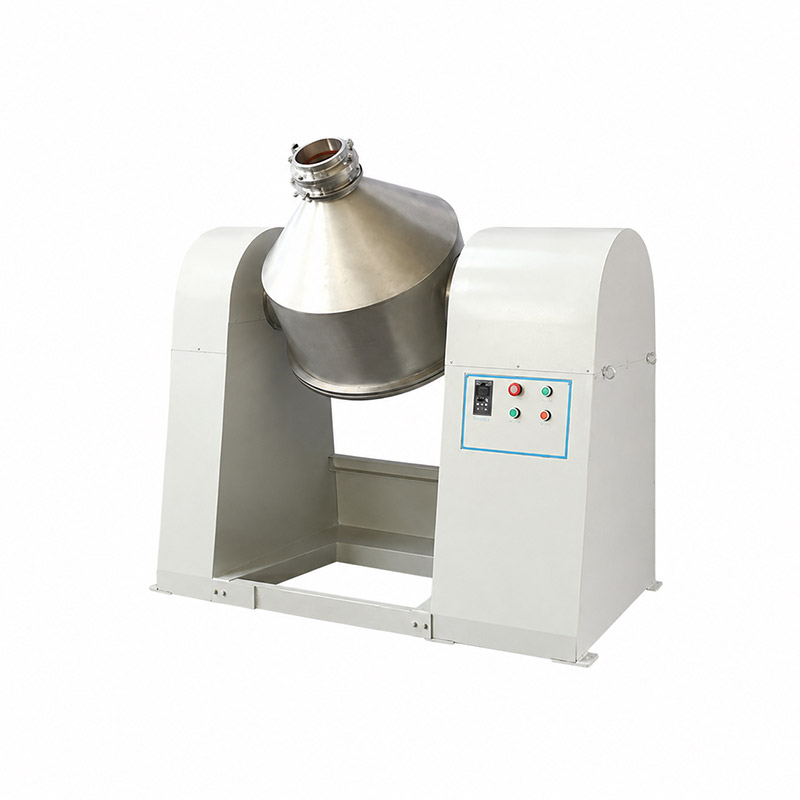
A double cone mixer consists of a drum formed by two conical sections joined at their bases. The drum is mounted horizontally on a rotating shaft. When the drum rotates, the material inside is lifted by the wall until it reaches the angle of repose, then cascades, slides, and diffuses downward. This continuous lifting and falling motion creates a dynamic mixing zone in the center of the drum.
Because the two cones are symmetric, the material flows from the top cone down into the bottom cone and back again, producing both convective and diffusive mixing. The process is gentle — there are no blades, paddles, or agitators that could shear or crush the particles.
Key Parameters That Affect Mixing Performance
- Rotation speed: Typically adjustable between 5 and 30 rpm for laboratory models. Too slow and the material may not lift properly; too fast and the material can stick to the wall due to centrifugal force, reducing mixing efficiency.
- Fill volume: The recommended working capacity is usually 30–50% of the total drum volume. Overfilling restricts particle movement; underfilling reduces mixing intensity.
- Mixing time: Depending on the material properties and batch size, a typical mixing cycle ranges from 5 to 20 minutes. For cohesive powders, longer times may be needed.
- Drum material: Stainless steel (304 or 316L) is standard for most applications. The interior surface finish affects material release and cleaning ease.
Applications of the Double Cone Mixer
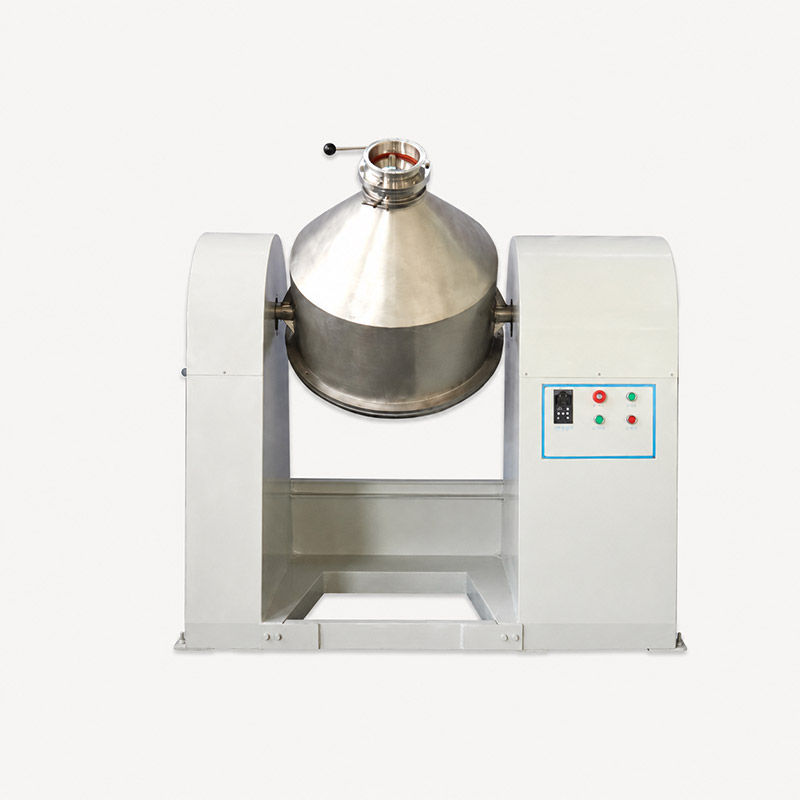
The double cone mixer is widely used in industries where particle integrity is critical. Here are some common scenarios:
Pharmaceutical Powders and Granules
In tablet and capsule manufacturing, active pharmaceutical ingredients (APIs) are often blended with excipients. The double cone mixer can handle these blends without generating excessive fines or altering the particle size distribution. It is also easy to clean between batches, which is essential for GMP compliance.
Chemical and Ceramic Powders
For ceramic glazes, pigment blends, or catalyst powders, the mixer provides homogeneous mixing without contamination from abrasion. The stainless steel drum is resistant to many chemicals, and the gentle action prevents degradation of sensitive compounds.
Food and Beverage Ingredients
Spices, protein powders, instant drink mixes, and nutritional supplements often require uniform blending of multiple components. The double cone mixer can handle these free-flowing and slightly cohesive powders with minimal dust generation.
Powder Metallurgy and Battery Materials
In the preparation of electrode materials or metal powder blends, maintaining particle morphology is important for the final product performance. The double cone mixer is a suitable choice for pre-mixing before further processing such as ball milling or pressing.
How to Select the Right Double Cone Mixer
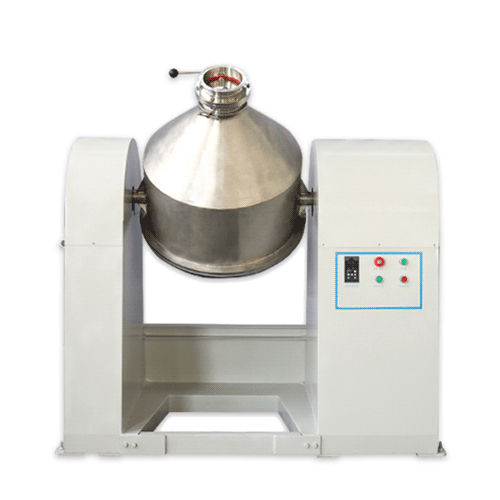
Choosing the correct model depends on your specific requirements. Here are the factors you should consider:
Batch Size
Laboratory double cone mixers typically range from 5 liters to 50 liters of total volume. For small R&D batches, a 5–10 L model is often sufficient. For pilot-scale or small production, 20–50 L models are common. The usable working volume is about one-third to one-half of the total volume.
Material Properties
- Flowability: Free-flowing powders blend more easily. Cohesive or sticky powders may require a longer cycle or a different mixer design.
- Bulk density: Heavier materials may require a more robust drive system and reinforced drum.
- Abrasiveness: Highly abrasive powders can wear the drum surface over time. Stainless steel with a hardened surface or replaceable liners may be considered.
Speed Control and Programmability
Many modern double cone mixers offer variable speed drives. This allows you to optimize the rotation speed for different materials. Some models also include timers and programmable start/stop functions for reproducible results.
Cleaning and Changeover Requirements
If you handle multiple formulations, easy cleaning is a priority. Look for mixers with smooth internal surfaces, no dead corners, and the ability to tilt the drum for complete discharge and access.
Safety Features
For laboratory use, safety interlocks, emergency stop buttons, and guards over moving parts are important. Some models also include a lid lock to prevent opening during operation.
Double Cone Mixer vs. Other Container-Rotating Mixers
You might also encounter the V-type mixer and oblique mixer in the same category. Here is a quick comparison:
| Feature | Double Cone Mixer | V-Type Mixer | Oblique Mixer |
|---|---|---|---|
| Mixing mechanism | Gravity tumbling, convective & diffusive | Gravity tumbling, splitting & merging | Gravity tumbling with asymmetric motion |
| Best for | Free-flowing & slightly cohesive powders, granules | Free-flowing powders, dry blends | Materials needing more axial mixing |
| Mixing intensity | Gentle to moderate | Gentle | Moderate |
| Cleanability | Good – smooth interior | Good – simple geometry | Good |
| Typical capacity | 5 L – 300 L | 2 L – 100 L | 5 L – 50 L |
If you are comparing models, feel free to explore the double cone mixer page and the V-type mixer page for more technical details.
Practical Tips for Using a Double Cone Mixer
Start with a Clean Drum
Even small amounts of residual material from a previous batch can contaminate your new blend. Clean the drum thoroughly, especially if you change formulations.
Calibrate Your Fill Level
Measure the bulk volume of your powder and load only 30–50% of the drum capacity. Mark the fill line on the outside of the drum for quick reference.
Use a Representative Sample for Quality Check
After mixing, take samples from at least three different positions in the drum (top, middle, bottom) and analyze their composition or particle size distribution. This confirms mixing uniformity.
Adjust Speed and Time for Each Material
Do not rely on a single recipe for all materials. Keep a log of the optimal speed and time for each powder blend you process. This will save time and improve reproducibility.
What Information Should You Prepare Before Requesting a Quotation?
To help your supplier recommend the most suitable double cone mixer, gather the following details:
- Material name and composition
- Approximate bulk density and flow characteristics
- Target batch size (weight or volume per batch)
- Initial particle size and whether particle integrity must be preserved
- Desired drum material (e.g., stainless steel 304, 316L, or with special coating)
- Any special requirements such as vacuum operation, inert gas purging, or explosion-proof design
- Local voltage and frequency (e.g., 220V/50Hz, 110V/60Hz)
- Available space for installation
With this information, a technical team can evaluate the appropriate mixer type, drum volume, motor power, and optional features.
Final Thoughts
The double cone mixer is a time-tested solution for gentle and uniform blending of dry powders and granules. Its simple construction, easy cleaning, and low operating cost make it a practical choice for laboratories and small-scale production lines in pharmaceuticals, chemicals, ceramics, food, and powder metallurgy.
When selecting a mixer, focus on your material properties, batch size, and cleanliness requirements. A well-chosen double cone mixer will serve you reliably for years, delivering consistent blend quality batch after batch.
For more information on the double cone mixer and other mixing equipment, please visit the product page or contact the TENCAN team for technical support tailored to your application.