
What is a V-type Mixer? A Gentle Mixing Device for Uniform Blending of Powders and Granules
What is a V-type Mixer?
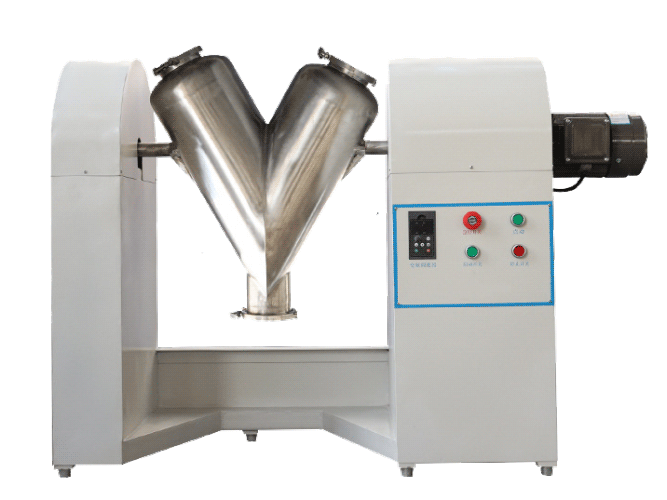
At its core, a V-type mixer (also known as a V-blender or V-shaped mixer) is a specialized powder blending device designed for the uniform mixing of dry powders and granular materials. It is widely used in pharmaceutical, chemical, food, and laboratory settings to achieve homogeneous mixtures without damaging the physical integrity of the particles. The mixer operates on the principle of gravitational diffusion, where the asymmetric V-shaped container rotates to repeatedly split, tumble, and recombine the material, ensuring a consistent blend.
Core Function and Working Principle
The V-type mixer transforms a batch of dry powders or granules from a segregated state into a uniformly mixed product. Its primary working mechanism involves the rotation of a V-shaped cylindrical container around a horizontal axis. As the container rotates, the material inside is lifted by the inclined walls and then falls back under gravity, continuously splitting and recombining between the two legs of the V. This gentle tumbling action creates a combination of convection, diffusion, and shear movements, but without any aggressive impellers or blades that could crush or damage the particles.
Key process parameters that influence the mixing quality include the rotation speed, the filling volume (typically 30-50% of total capacity), and the mixing time. The machine is equipped with a timer and speed control, allowing operators to optimize the process for different materials. The V-type mixer achieves a high degree of homogeneity while preserving the original particle size distribution of fragile materials, making it an ideal choice for applications where particle integrity is critical.
Main Types and Models
V-type mixers are available in a range of capacities to suit different scales of operation, from small laboratory units to larger production models. Common laboratory models include the VH-5 (5 liters), VH-8 (8 liters), and VH-14 (14 liters), which are compact and suitable for bench-top use. For pilot or production scales, capacities can extend to 100 liters, 300 liters, or more. All models share the same fundamental design principles: a 304 stainless steel V-shaped container with polished inner and outer surfaces for easy cleaning and compliance with GMP standards. Some models also offer an optional intensifier bar for breaking up agglomerates, and variable speed drives for precise control.
When selecting a model, the main consideration is the batch size required. Smaller models are ideal for R&D, formulation development, and teaching demonstrations, while larger units are used for small-scale production or quality control sample preparation. The asymmetry of the V-shape ensures no dead zones, and the gentle mixing action makes the V-type mixer particularly suitable for mixing expensive or sensitive materials.
Key Performance Indicators and Selection Guide
When evaluating a V-type mixer, several performance indicators should be considered:
- Processing Capacity: The working volume typically ranges from 5 liters to 300 liters, with the optimal filling amount being 30-50% of the total volume.
- Mixing Uniformity: High homogeneity can be achieved in a short time (usually 5-15 minutes), depending on the material properties.
- Gentle Action: The absence of internal stirring blades minimizes particle breakage, making it ideal for friable or crystalline materials.
- Ease of Cleaning: The polished stainless steel interior and smooth surface allow quick and thorough cleaning between batches, reducing cross-contamination risk.
- Automation and Control: Many models feature digital timers and speed controllers, and some include safety interlock switches for operator protection.
- Construction Material: 304 stainless steel is standard, with optional mirror polishing to meet pharmaceutical GMP standards.
For users, the selection should also consider the physical properties of the powder (flowability, density, particle size), the desired batch size, and the required cleanliness level. Laboratory users often prefer the compact VH-5 or VH-8 for their versatility and ease of use, while industrial users might opt for larger models like the VH-300 for production batches.
Application Fields and Selection Advice
V-type mixers are widely used in the pharmaceutical industry for blending active pharmaceutical ingredients (APIs) with excipients, in the food industry for mixing seasonings, spices, and powdered beverages, in the chemical industry for catalysts and additives, and in research laboratories for sample preparation and teaching. They are also common in powder metallurgy, ceramics, and cosmetics for mixing dry powders.
For users who need to handle small batches of precious or fragile materials, a V-type mixer is an excellent choice due to its gentle action and easy cleaning. If your application requires mixing with high shear or wet granulation, consider other equipment like a 3D mixer or a trough mixer. However, for dry powder blending where particle integrity is paramount, the V-type mixer remains a reliable and cost-effective solution.