
What is a Double Cone Mixer? A High-Efficiency Powder Blending Machine for Uniform Mixing
What is a Double Cone Mixer? A High-Efficiency Powder Blending Machine for Uniform Mixing
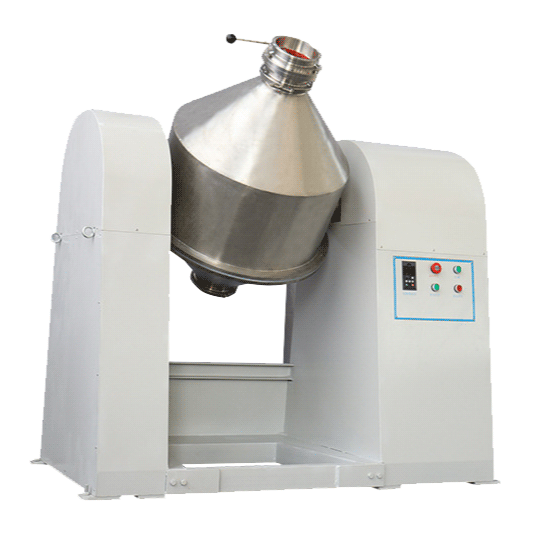
At its core, a double cone mixer is a specialized rotary blending device used in industries such as chemicals, pharmaceuticals, food processing, and powder metallurgy to achieve homogeneous mixing of dry powders, granules, and other bulk solids. The equipment consists of a symmetrical double-cone shaped vessel that rotates about a horizontal axis, relying on gravity and diffusion to gently tumble and blend materials without applying excessive shear or impact.
Core Function and Working Principle
The double cone mixer transforms a combination of different solid particles from a segregated state into a uniformly distributed mixture. Its working principle is based on the continuous rotation of the double-cone chamber. As the vessel rotates, the material inside is lifted by the walls and then falls back under gravity, creating a cascade of particles. This repeated lifting and dropping generates three main mixing mechanisms:
- Diffusive mixing: Random particle motion during tumbling causes particles to exchange positions, distributing them evenly throughout the bulk.
- Convective mixing: The rotation creates large-scale flow patterns, moving groups of particles from one region to another.
- Shear mixing: Slight relative motion between particle layers occurs, especially near the vessel walls, promoting local mixing.
Because no internal agitators or blades are used, the mixing process is extremely gentle. This makes the double cone mixer particularly suitable for fragile, friable, or heat-sensitive materials that must retain their original particle size and shape. The mixing time typically ranges from 5 to 20 minutes per batch, depending on the material properties, fill level, and rotation speed.
Key Components and Design Features
The double cone mixer is composed of the following main parts:
| Component | Function |
|---|---|
| Double-cone vessel | Symmetrical chamber made of stainless steel or other materials; provides continuous mixing through rotation. |
| Drive system | Motor and gearbox drive the vessel via a chain or direct coupling; speed can be adjusted for optimal mixing. |
| Bearings and supports | Heavy-duty bearings mounted on frames allow smooth rotation and withstand loads. |
| Discharge valve | Located at the bottom of one cone; typically a butterfly valve or manual gate for easy emptying. |
| Inlet/charge port | Sealed opening on the opposite cone for loading materials; can be equipped with a dust-proof cover. |
Some advanced models offer options such as a vacuum drying jacket, liquid spray nozzles for adding binders, or variable speed drives for process optimization. The internal surface is usually polished to prevent material adhesion and facilitate cleaning between batches.
Key Performance Indicators and Selection Guide
When choosing a double cone mixer, the following parameters should be considered:
Working Capacity
Available in sizes from 5 liters (laboratory scale) up to 300 liters or more (production scale). The effective working volume is typically 50–60% of the total vessel capacity to allow sufficient space for material tumbling.
Mixing Uniformity
Double cone mixers can achieve a coefficient of variation (CV) of less than 5% for many free-flowing powders. The uniformity depends on particle size, shape, density, and mixing time.
Rotational Speed
Operating speed is generally in the range of 5–30 rpm. Higher speeds increase mixing intensity but may cause excessive wear or dust generation. The optimal speed is usually 40–60% of the critical speed at which centrifugal force equals gravity.
Material of Construction
Standard vessels are made of 304 or 316 stainless steel. For special applications, PVC or polyurethane linings are available to avoid metal contamination, as noted in the TENCAN design. The choice depends on the material's corrosion resistance requirements and potential for metal contamination.
Ease of Cleaning
Double cone mixers have a simple, smooth interior with no dead zones, making them easy to clean. Quick-release discharge valves and CIP (clean-in-place) systems are available for frequent batch changes.
Applications and Industry Recommendations
The double cone mixer is widely used in:
- Chemical industry: Blending of pigments, catalysts, plastic additives, and dry powders.
- Pharmaceutical industry: Homogeneous mixing of active ingredients and excipients for tablet or capsule formulations.
- Food industry: Mixing of powdered drinks, spices, flavorings, and instant food powders.
- Powder metallurgy: Blending of metal powders and lubricants before pressing.
- Ceramics and glass: Uniform mixing of glaze powders, frits, and body materials.
For large-scale production, consider a model with a higher capacity and a robust discharge system. For lab-scale R&D, a compact size with a transparent lid or sampling port is more convenient. TENCAN offers a complete range of double cone mixers in different sizes, all available at Double Cone Mixer. For similar mixing applications, you may also explore the V-type mixer or 3D mixer series.