
What is Horizontal Screw Belt Mixer? A Convection Mixing Equipment for Efficient Powder and Granule Blending
What is a Horizontal Screw Belt Mixer?
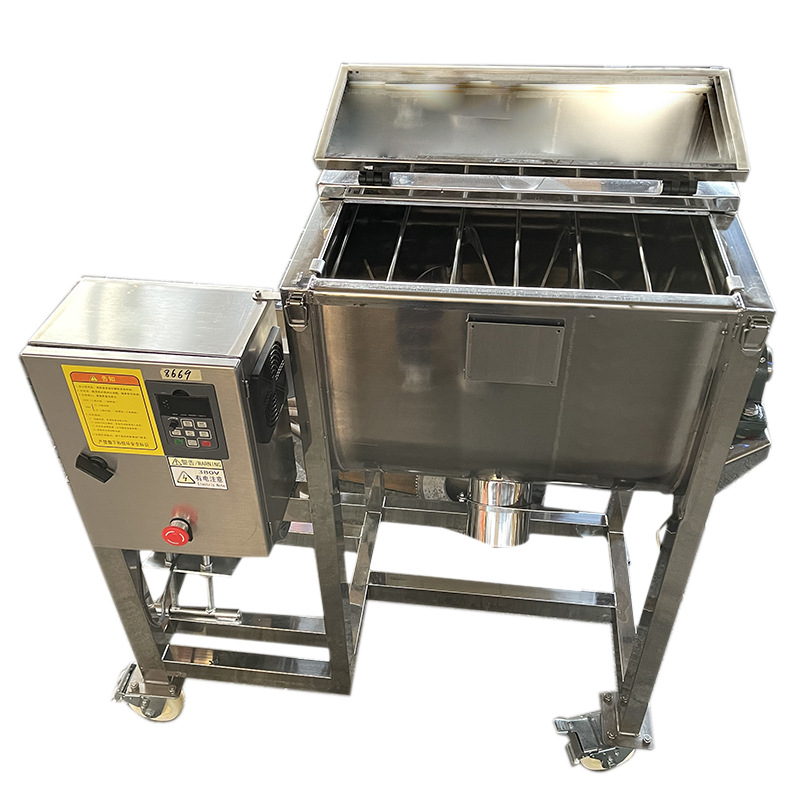
At its core, the horizontal screw belt mixer (also known as a ribbon blender) is a professional mixing machine used in industries such as chemicals, battery materials, food, pharmaceuticals, and construction to uniformly blend powders, granules, and even liquids into a homogeneous mixture. The device achieves efficient mixing through a horizontally mounted U-shaped trough and a rotating agitator assembly consisting of inner and outer helical ribbons (screw belts).
Core Function & Working Principle
The horizontal screw belt mixer transforms raw materials from a layered or segregated state into a uniform, consistent blend. Its main working components are a U-shaped trough, a centrally mounted shaft with double-layer spiral ribbons, and a drive system. The outer spiral moves material from the ends toward the center, while the inner spiral pushes material from the center outward to the ends. This counter‑current flow creates a vigorous convection mixing effect, ensuring thorough blending in a short time.
During operation, the ribbons rotate at a moderate speed (typically 30‑39 RPM for large industrial models), lifting and tumbling the material. The combination of convective motion, shear forces, and diffusion breaks up agglomerates and distributes components evenly. Critical process parameters include mixing time (usually 8‑15 minutes per batch), ribbon speed, and fill level (typically 40‑70% of the trough volume). The gentle yet effective action minimizes degradation of friable or heat‑sensitive materials.
Key Components & Variations
Continuous vs. Broken Ribbon Design
Most horizontal screw belt mixers feature continuous spiral ribbons. However, a broken ribbon design (with gaps in the flights) is also available. The broken ribbon creates additional turbulence and shear, accelerating mixing and improving uniformity for sticky or cohesive powders. It is especially useful when blending ingredients with large particle size differences.
Material of Construction
Standard models are made of carbon steel or stainless steel (SUS304, SUS316L). Stainless steel is preferred for food, pharmaceutical, and corrosive chemical applications. The interior can be polished to a mirror finish to meet sanitary standards and reduce material residue.
Drive & Discharge
The drive system typically uses a belt‑driven cycloidal reducer, which provides overload protection. The discharge port is usually a pneumatic or manual flap valve that sits flush with the trough inner wall, eliminating dead zones and preventing leakage. Optional heating/cooling jackets and liquid spray nozzles can be added for processes requiring temperature control or liquid addition.
Key Performance Indicators & Selection Guide
When selecting a horizontal screw belt mixer, consider the following parameters:
- Working capacity: Models range from 0.1 m³ to 20 m³ per batch, corresponding to batch weights from tens of kilograms to several tons.
- Mixing uniformity: A well‑designed mixer achieves a coefficient of variation (CV) below 5% within 8‑12 minutes for most free‑flowing powders.
- Power consumption: Motor power ranges from 5.5 kW (small lab units) to 110 kW (large industrial units), depending on batch size and material density.
- Automation: Many units feature push‑button controls, timers, and variable speed drives. Advanced models can be integrated into PLC‑controlled production lines.
- Ease of cleaning: A fully opening top cover and smooth internal surfaces with no dead corners facilitate quick changeover between different products.
Application Areas & Recommendations
Horizontal screw belt mixers are widely used in:
- Chemical & battery materials: Blending cathode/anode powders, conductive agents, and binders.
- Food & feed: Mixing dry milk powder, spices, sugar, flour, and animal feed premixes.
- Pharmaceuticals: Uniform blending of active pharmaceutical ingredients (APIs) with excipients.
- Construction & dry mortar: Homogenizing cement, sand, additives, and pigments.
For small‑scale R&D or pilot batches, choose a compact model with a working capacity of 0.1‑0.3 m³. For full‑scale production, select a machine with 1‑10 m³ capacity and stainless steel construction. Always verify the material’s flowability, bulk density, and abrasiveness to ensure the mixer’s design (ribbon type, motor power, seal material) is suitable.
For more information on related mixing equipment, please visit our V‑type mixer, double cone mixer, or 3D mixer pages.
References
- Product page: Horizontal screw belt mixer