
What is a V-Type Mixer? An Efficient Blending Equipment for Powder and Granular Materials
Introduction
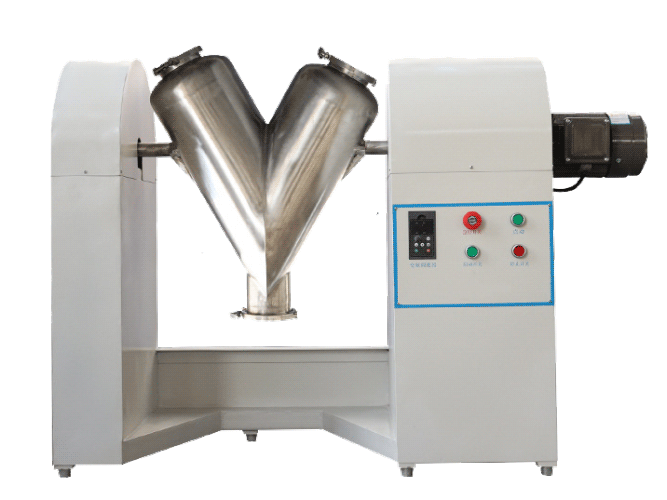
From the core, a V-type mixer is a professional blending device widely used in pharmaceutical, chemical, food, ceramics, and metallurgy industries to uniformly mix dry powders, granular materials, or a combination of both. The unit features a distinctive V-shaped chamber that rotates around a horizontal axis, leveraging gravity and mechanical motion to achieve homogeneous blends without damaging particle integrity. Its simple design, easy cleaning, and high mixing uniformity make it a fundamental piece of equipment in many powder processing lines.
Core Functions and Working Principle
The primary function of a V-type mixer is to transform a mixture of two or more dry components from a segregated state into a homogeneous blend. The working principle is based on gravity diffusion and convective mixing. Inside the rotating V-shaped drum, material is continuously lifted and then falls under gravity. As the V-shape splits the material flow at the junction, particles separate into two streams and recombine, creating a gentle but effective folding and tumbling action.
Key parameters that influence mixing quality include rotation speed (typically 5–12 rpm for standard models), filling ratio (usually 30–50% of total volume), and mixing time (from 4 to 12 minutes depending on batch size). Because the mixing action is mild, the V-type mixer is especially suitable for fragile or easily broken granules, and for materials with good flowability. No internal agitators or blades touch the material, which prevents contamination and makes cleaning straightforward.
Core Components and Key Technologies
Although the V-type mixer has a simple structure, several key components ensure its reliable performance:
V-Shaped Mixing Chamber
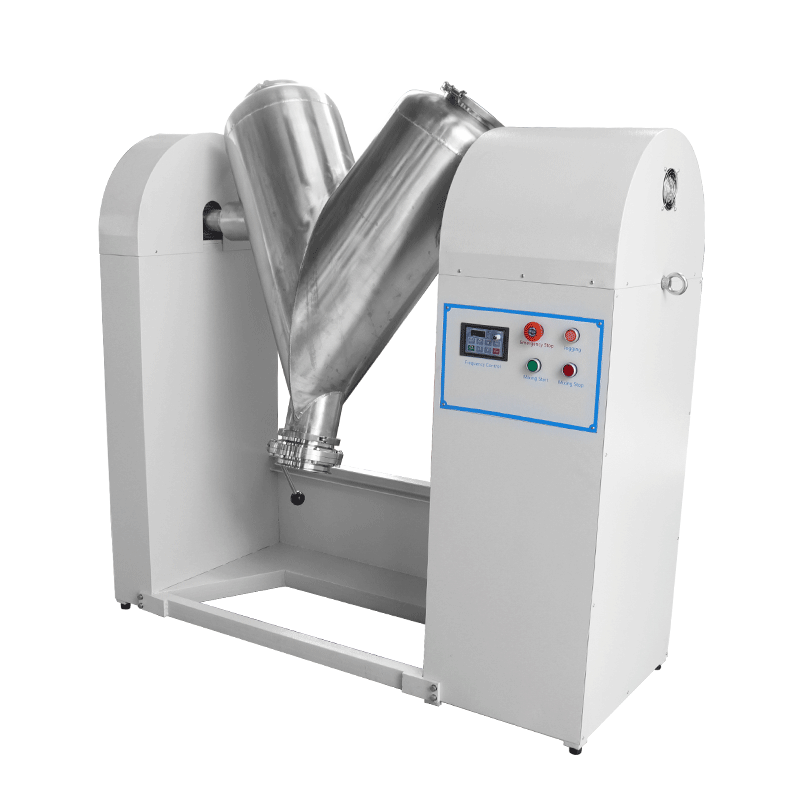
The chamber, made of stainless steel (304 or 316L), is formed by two asymmetric cylinders welded at an angle (typically 60° or 80°). The inner and outer surfaces are polished to eliminate dead corners and facilitate cleaning. The chamber is supported by bearings and driven by a motor-reducer system.
Drive System
An electric motor transmits power via a belt to a reduction gearbox, which then rotates the V-shaped drum at the designed low speed. The drive system is designed for smooth, quiet operation and long service life. Some models also feature variable speed drives to adjust mixing intensity.
Inlet and Discharge Ports
Materials can be loaded manually or via vacuum feeding. Quick-opening ports with sealing gaskets prevent dust leakage during operation. Discharge is usually through a ball valve or butterfly valve at the bottom of the drum, allowing easy and complete emptying.
Optional Intensifier Bar (Forced Mixing)
For materials that are more cohesive or contain a small amount of liquid, an internal rotating intensifier bar can be added. This breaks up agglomerates and improves dispersion without significantly changing the gentle mixing nature.
Key Performance Indicators and Selection Criteria
When selecting a V-type mixer, pay attention to the following specifications:
- Working Capacity: Ranges from laboratory-scale 0.18 m³ (approximately 72 kg per batch) to industrial 6 m³ (about 2400 kg per batch). Choose a model that matches your required throughput.
- Mixing Uniformity: A well-designed V-type mixer can achieve a relative standard deviation (RSD) of below 5% for free-flowing powders. Ensure the manufacturer provides test data.
- Rotation Speed: Typical speeds are 12 rpm for small to medium models and 5–6 rpm for large ones. Higher speeds may cause material to centrifuge, reducing mixing efficiency.
- Material Contact Surfaces: Standard is 304 stainless steel; for corrosive or high-purity applications, opt for 316L or electropolished surfaces.
- Automation: Some models offer timer control or PLC-based programs for consistent batch reproduction. Vacuum loading and automated discharge can improve productivity.
- Cleanability: Smooth interior surfaces, no dead corners, and easy-to-remove covers are essential for multi-product use, especially in pharmaceutical and food industries.
Application Fields and Selection Recommendations
V-type mixers are widely employed in:
- Pharmaceuticals: Blending dry powder formulations, granulates for tableting, and capsule filling.
- Chemicals: Mixing pigments, additives, plastic powders, and catalysts.
- Food Industry: Combining spices, seasonings, beverage powders, and nutritional supplements.
- Ceramics & Metallurgy: Homogenizing refractory materials, ceramic powders, and metal oxide mixtures.
- Cosmetics: Mixing talc, pigments, and other dry ingredients for powders and compacts.
For users who need gentle mixing with minimal particle breakage, the V-type mixer is an excellent choice. It outperforms turbulent mixers (like paddle or ribbon blenders) when preserving granule shape is critical. For small-scale R&D, compact models with 0.18–0.5 m³ capacity are common; for production, larger units with automated feeding and discharging are recommended. If your materials have poor flowability or require intensive shear, consider a double cone mixer or 3D mixer instead.