
What is a V-type Mixer? A Versatile Blending Equipment for Powder and Granule Homogenization
Introduction
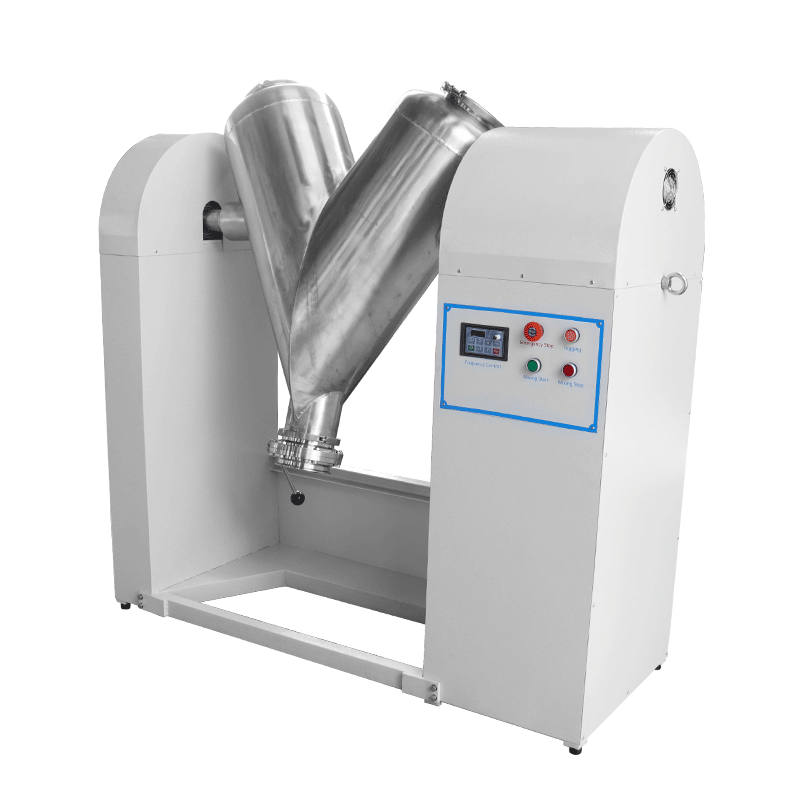
At its core, a V-type mixer is a specialized industrial blending machine used in pharmaceuticals, food processing, chemicals, ceramics, and metallurgy to uniformly mix dry powders or granular materials. Its distinctive V-shaped drum rotates around a horizontal axis, causing the materials inside to tumble, split, and combine repeatedly, achieving a high degree of homogeneity. This equipment is particularly valued for its gentle mixing action, ease of cleaning, and the ability to handle materials with different bulk densities or particle sizes without causing segregation.
Core Function and Working Principle
The V-type mixer transforms raw materials from a non-uniform blend of powders or granules into a thoroughly mixed, homogeneous final product. The core working mechanism relies on gravity and the rotational motion of the V-shaped drum. As the drum rotates, the material is lifted and then falls under gravity, creating a continuous cycle of splitting and recombining. The two asymmetric arms of the V-drum ensure that the material moves in both axial and radial directions, promoting efficient mixing.
Key process parameters include the rotation speed (typically 5–12 rpm for large models), the filling volume (usually 30–50% of the total drum capacity), and the mixing time (generally 4–15 minutes depending on the batch size and material properties). These parameters directly influence the final blend uniformity. The gentle mixing action prevents particle breakage or degradation, making it suitable for fragile or agglomerated materials.
Main Types and Classifications
V-type mixers are available in several configurations tailored to different production scales and material characteristics:
Standard V-type Mixer
This is the most common design, featuring a simple V-shaped drum driven by a motor-gearbox system. It is suitable for general-purpose mixing of free-flowing powders and granules. Models range from laboratory-scale (e.g., V-100, working volume ~0.18 m³) to production-scale (e.g., V-6000, working volume up to 6 m³).
Forced Mixing V-type Mixer
Some models incorporate an internal agitator or screw to enhance mixing, especially for materials with a wide density difference or sticky components. This design combines the gentle tumbling of the V-drum with additional shear forces, improving mix uniformity for more challenging applications.
Vacuum or Dust-Free V-type Mixer
For applications requiring dust control or preventing contamination, vacuum-assisted V-type mixers are available. These allow loading via vacuum suction and operate in a sealed environment, ideal for fine powders or toxic materials. The stainless steel construction ensures easy cleaning and compliance with GMP standards.
Key Performance Metrics and Selection Tips
When selecting a V-type mixer, consider the following critical parameters:
- Batch Capacity: Models range from a few liters (for lab use) to several thousand liters (for industrial production). Choose a size that matches your typical batch volume.
- Blending Uniformity: High-quality V-type mixers can achieve a mixing uniformity of up to 99% or more. Check the manufacturer's test data for your specific materials.
- Rotation Speed: Optimal speed is critical – too slow leads to poor mixing, too fast may cause material segregation. Most machines operate at 5–12 rpm.
- Material of Construction: The drum and contact parts are typically made of 304 stainless steel (or 316L for corrosive materials). Ensure the surface finish is polished to avoid dead corners.
- Ease of Cleaning: Look for designs with smooth internal surfaces, easy disassembly for cleaning, and no dead zones. This is especially important for multi-product facilities.
- Automation: Some models offer vacuum feeding, automatic discharge, and programmable control for consistent batch quality.
Application Areas and Selection Advice
V-type mixers are widely used in:
- Pharmaceuticals: Blending of active ingredients with excipients, tablet granules, and capsule powders.
- Food Industry: Mixing of spices, seasonings, instant drink powders, and nutritional supplements.
- Chemicals: Homogenization of plastic powders, pigments, additives, and ceramic powders.
- Metallurgy: Blending of metal powders for powder metallurgy applications.
For small-scale R&D or laboratory use, choose a compact model (e.g., V-100 or V-300) with a transparent lid for observation. For production batches above 200 kg, consider a forced mixing or vacuum design to ensure consistent quality. Always test your material with the vendor to confirm the machine's suitability.