

Product features
Blade-based cutting
Rotating and fixed blades shear suitable plastic pieces into smaller material for handling or recycling.
Screen-controlled discharge
A screen retains larger pieces in the cutting chamber until they can pass through the selected opening.
Blade configuration choices
Claw and flat blade arrangements are described; match them to the stiffness, shape and thickness of the feed.
Practical maintenance access
Blade condition and screen inspection are central to keeping the selected cutting configuration suitable for the material.
Applications
Molding scrap
Evaluate sprues, runners or suitable rejected parts as feed for a controlled recycling workflow.
Rigid plastic pieces
Check profiles, pipes or containers against the hopper opening and the selected blade arrangement.
Thin plastic material
Trial films or thin sheets with the appropriate cutter configuration and observe wrapping or feeding problems.
Evaluating results
Granule distribution
Compare screened output and oversize content under a consistent feed rate.
Thermal behavior
Check temperature and material softening during a representative run rather than assuming all plastics behave alike.
Useful throughput
Measure recovered output at the required quality, including stoppages for feeding, cleaning or screen blockage.
These are evaluation points for a sample trial, not measured results for a specific sample. Confirm performance under your actual operating conditions.
How it works
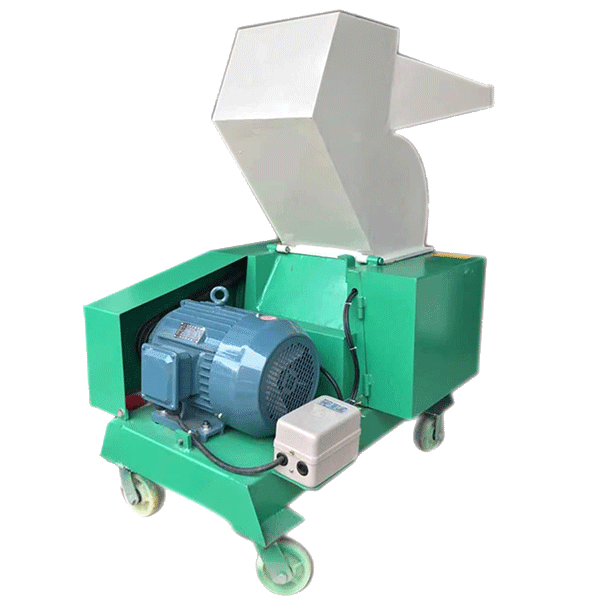
Initial cutting
Material entering the chamber meets the rotating and fixed blade edges.
Repeated size reduction
Shearing, impact and tearing reduce pieces as the rotor continues to turn.
Screen passage
Pieces small enough to pass the installed screen leave through the discharge arrangement.
Construction and configuration
Blade set
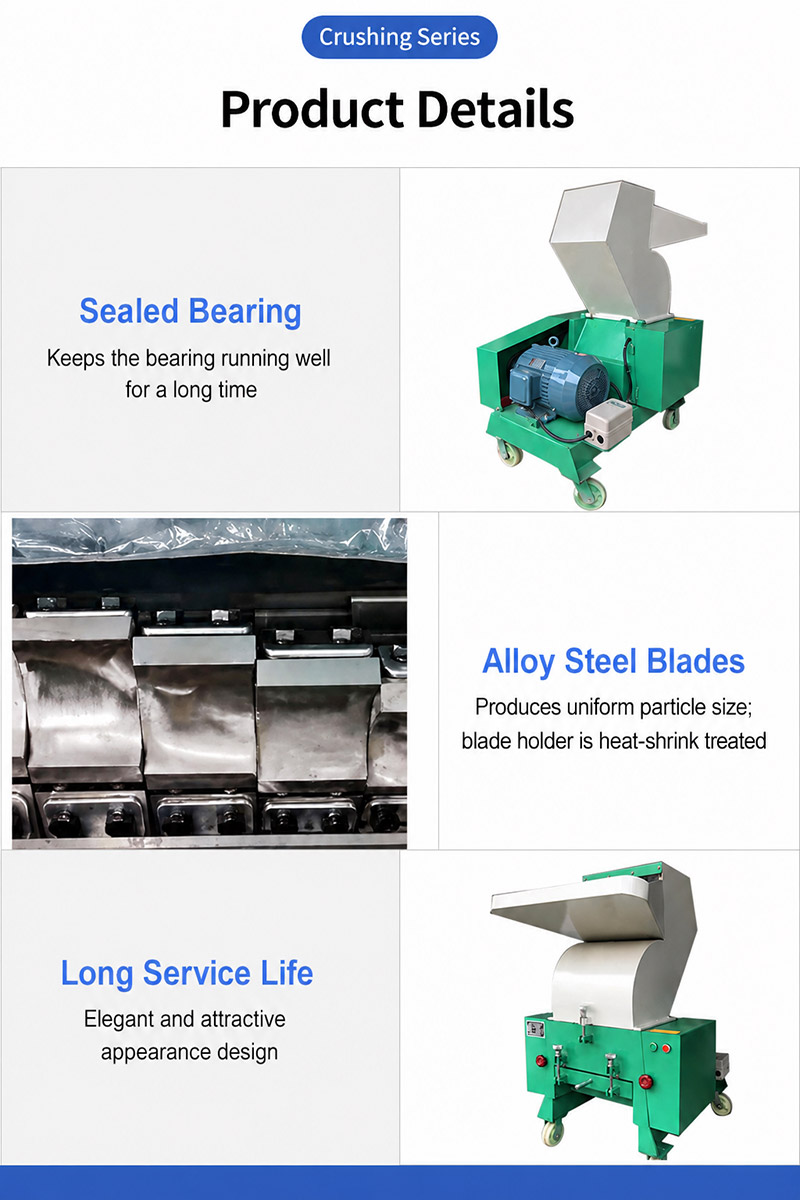
Choose claw or flat blade geometry for the actual plastic and inspect cutting edges for wear.
Screen assembly
The removable screen determines the discharge opening and must be checked for blockage or damage.
Rotor and bearings
The rotor, blade holder and bearings support the cutting motion; follow the specified balancing and service procedures.
More product images
Technical specifications
Compare the listed specifications and configurations. Scroll horizontally to view the complete table.
Specification table 1
| Model (claw knife) | 180 | 250 | 300 | 400 | 500 | 600 |
|---|---|---|---|---|---|---|
| CapacityKG/H | 50-100 | 150-200 | 200-300 | 250-450 | 400-700 | 450-800 |
| Voltage | 380V (three-phase electricity) | |||||
| Motor powerKW | 1.5/2.2 | 4 | 5.5 | 7.5 | 11 | 15 |
| Number of blades | 9+2 | 6+2 | 9+2 | 12+2 | 15+2 | 18+4 |
| Rotation diameterMM | 148 | 225 | 240 | 270 | 280 | 350 |
| Screen aperture MM | 6 | 8 | 8 | 10 | 10 | 10 |
| Import size MM | 110*180 | 250*160 | 320*200 | 420*220 | 520*260 | 600*240 |
| Overall dimensionsMM | 630*520*950 | 900*700*1050 | 1000*750*1180 | 1060*880*1320 | 1150*1000*1450 | 1200*1060*1650 |
| Machine weight KG | 120 | 230 | 330 | 430 | 550 | 780 |
Confirm the selected model, power supply, contact materials and operating conditions before ordering. Performance depends on the material and process.