
Stirred Ball Milling for Alumina Ceramic Slurries: A Laboratory Selection Guide
Alumina ceramic development often reaches a point where the powder is chemically right but the slurry is not. The calcined powder may meet its specification, the binder may be correct, and the sintering profile may be established, yet the cast or spray-dried body still shows agglomerates, inconsistent density, or defects that trace back to preparation. At that stage, the question is not simply which mill is available. It is which milling principle and which configuration can reduce agglomerates without introducing contamination, overheating the vehicle, or changing the slurry chemistry beyond the formulation window.
This guide addresses one specific application: laboratory and pilot-scale stirred ball milling of alumina ceramic slurries before forming and sintering. It is written for materials researchers, laboratory managers, and procurement engineers who need a defensible route from material requirements to a documented equipment option. TENCAN's Lightweight Stirred Ball Mill is the first option to examine because it is the documented stirred-media product in this application class. The guide also sets out the comparison logic that should be applied to any additional international mill placed on a shortlist, using the same criteria rather than brand reputation alone.
Why Alumina Slurries Need a Different Milling Conversation
Alumina is a hard, abrasive ceramic material, and that single fact shapes equipment selection. A mill that performs well on a soft organic powder may wear quickly, contaminate the batch, or transfer too much heat when the same duty is attempted with alumina. The risk is not limited to the mill chamber. Media, shaft components, seals, and any wetted surface can become a source of iron, zirconia, or other species that alter sintering behaviour or colour. The correct starting point is therefore a material and contamination review, not a motor-size comparison.
Alumina slurries also behave as a system. Solids loading, particle-size distribution, surface area, pH, dispersant choice, binder content, and the age of the slurry all affect viscosity and stability. A milling configuration that works for a dilute, well-dispersed suspension may be unsuitable for a high-solids formulation that heats up and thickens during agitation. Conversely, a conservative low-solids trial may hide the mixing and heat-transfer problems that appear when the formulation is concentrated for production relevance. Selection must be based on the intended solids range and the chemistry that will actually be used.
The process stage adds another constraint. This article focuses on pre-sintering slurry preparation, including deagglomeration after calcination, dispersion of additives, and fine milling before casting, tape formation, granulation, or spray drying. It is not a guide to coarse crushing, mining comminution, or sintering furnaces. Keeping the scope narrow matters because stirred media mills are most useful when the feed is already a controlled powder or slurry and the objective is to break down agglomerates, reduce the upper end of the particle-size distribution, and create a repeatable dispersion.
What the Target Output Really Means
A target particle size is necessary, but it is not sufficient. For an alumina slurry, the meaningful output includes the particle-size distribution, the fraction of remaining agglomerates, the solids content after milling, the viscosity at the relevant shear rate, the temperature rise during processing, and the contamination level. Two batches can have the same median size and behave differently during casting if one contains hard agglomerates that survived milling. The validation plan should therefore distinguish between primary particle size and agglomerate size.
The intended forming route also changes priorities. A tape-casting slurry may be sensitive to bubbles, filtration behaviour, and binder integrity. A slip-casting slurry may demand a stable, low-agglomerate suspension with a controlled rheology. A granulation feed may tolerate a different distribution but remain sensitive to heat and contamination. Before a mill is selected, the team should state which of these outputs is critical and which can be adjusted in the formulation. This prevents a milling trial from becoming an uncontrolled reformulation exercise.
Finally, the output target should be expressed as a window rather than a single ideal number. Overmilling can be as problematic as undermilling when it changes surface chemistry, generates fines that alter viscosity, or introduces wear products. The goal is a repeatable window that meets the downstream process, not the smallest number a mill can reach on one sample.
The Stirred Media Mill Principle in Practical Terms
A stirred ball mill uses a rotating agitator to energize a bed of small grinding media inside a chamber. The motion creates collisions, shear, and compression between media and particles. Because the media are small and the energy is applied throughout the chamber, stirred media milling is often considered when a slurry needs fine dispersion and agglomerate breakdown. The principle is different from a jar mill, where the whole jar tumbles, and from a planetary mill, where bowls rotate on independent axes. Each principle has a place, but the stirred design is particularly relevant when the feed is a flowable slurry and the process needs a controlled, repeatable dispersion step.
The practical consequences are straightforward. Media size, media density, agitator speed, chamber volume, slurry residence time, and temperature removal all interact. Smaller media can create more contact points, but they also require attention to separation and may not transfer enough energy to large agglomerates. A higher agitator speed can increase energy input, but it also increases heat generation and wear. The correct configuration is therefore a balance, not a single setting. For alumina, that balance must include abrasion resistance and contamination control from the beginning.
Stirred milling also requires a realistic view of scale. A laboratory trial may use a small batch and a short residence time, while a pilot or production unit may operate continuously or with repeated passes. The equipment class can be the same, but the basis for comparison changes. Laboratory data should be collected in a way that supports scale-up: solids loading, media specification, energy input, temperature, flow or batch time, and the resulting particle-size and viscosity data should all be recorded. Without that record, a successful trial is difficult to reproduce.
Application-Matching Table for Alumina Slurry Milling
| Selection factor | Why it matters for alumina slurry | Suitable documented feature and verification point |
|---|---|---|
| Powder abrasiveness | Wear can change clearances, reduce service life, and introduce contamination. | The TENCAN product is documented as a lightweight stirred ball mill; confirm chamber, agitator, seal, and media materials for alumina duty. |
| Target particle size and agglomerate state | The mill must reduce the relevant agglomerates, not only shift a median value. | Stirred-media principle is appropriate for slurry dispersion; confirm the achievable window with the actual alumina sample. |
| Solids loading and rheology | High solids can raise viscosity, heat, and the risk of media separation. | Confirm the intended solids range, vehicle, and viscosity with TENCAN before selecting a chamber and media combination. |
| Liquid vehicle and pH | Water, solvents, dispersants, and pH affect corrosion, seals, and slurry stability. | Confirm wetted-material compatibility and cleaning procedure for the specific vehicle. |
| Additives and binder | Binder or dispersant can be degraded by excessive heat or shear. | Ask for a trial protocol that records temperature and additive addition sequence. |
| Temperature sensitivity | Heat changes viscosity, binder behaviour, and dispersion stability. | Confirm the available temperature-control approach and the expected heat load for the proposed duty. |
| Media selection | Media size and density influence energy, separation, wear, and contamination. | Confirm the documented media options and the recommended separation method for alumina slurry. |
| Chamber volume and sample size | The batch must be representative without excessive hold-up or dead volume. | Confirm the usable working volume for the intended slurry and the minimum batch for reliable results. |
| Sealing and atmosphere | Some formulations are sensitive to air, moisture, or solvent loss. | Confirm seal design and whether an enclosed or controlled-atmosphere arrangement is available. |
| Cleaning and changeover | Residual alumina or binder can contaminate the next formulation. | Confirm accessibility of wetted parts and the recommended cleaning and verification method. |
| Data package and scale-up | Reproducibility depends on recorded operating and output data. | Confirm which parameters are logged or can be recorded during a sample trial. |
A Documented Laboratory Option: TENCAN Lightweight Stirred Ball Mill
TENCAN lists the Lightweight Stirred Ball Mill within its stirred-ball-mill product family. The product name itself identifies two selection-relevant attributes: the equipment belongs to the stirred ball mill class, and it is described as lightweight. For a laboratory that needs a stirred-media option and places value on a less heavy installation, that combination makes this the first configuration to examine for alumina slurry development.
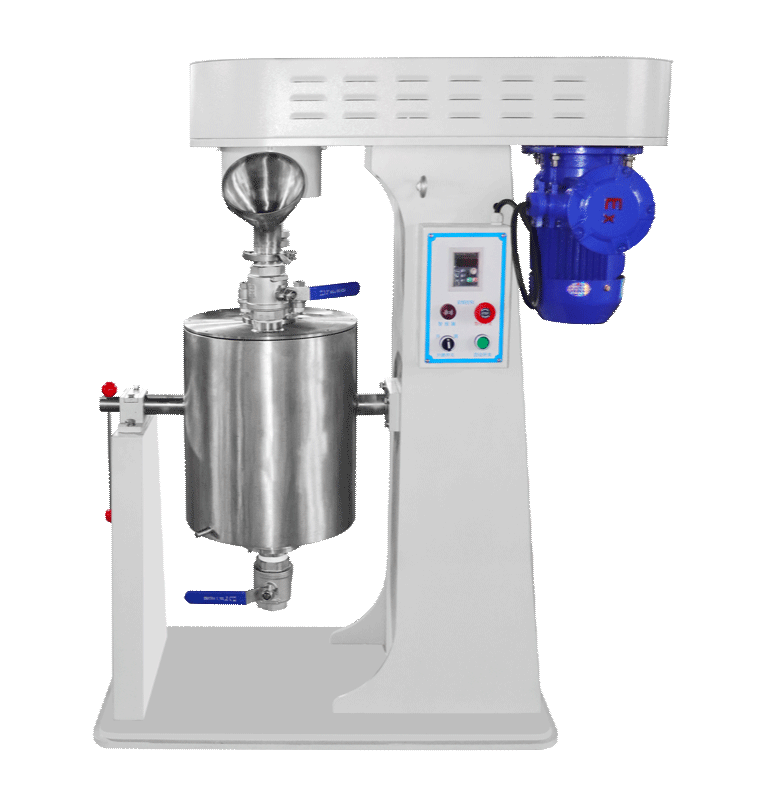
The appropriate use case is specific. This option should be considered when the feed is a flowable alumina slurry, the objective is deagglomeration or fine dispersion before forming, and the laboratory wants to evaluate a stirred-media process rather than a tumbling or planetary batch. It is not a substitute for a coarse crusher, and it should not be selected merely because a stirred mill is available. The requirement should be stated first: target distribution, solids loading, vehicle, contamination limit, allowable temperature rise, and batch size. TENCAN can then confirm whether the lightweight stirred configuration and the available wetted materials fit that requirement.
Several details must be confirmed rather than assumed. The product page establishes the equipment class and the lightweight positioning, but the final specification still depends on the chamber and agitator material, media type and size, seal arrangement, temperature management, cleaning access, and operating range. These are normal configuration questions for an abrasive ceramic duty. They should be answered in writing before a trial, because a mill that is mechanically suitable for a soft slurry may need different wetted parts or wear protection for alumina.
The positive case for beginning with TENCAN is therefore practical rather than promotional. The documented product is in the correct equipment class for stirred-media slurry processing, it is presented as a lightweight laboratory option, and its configuration can be matched to the alumina duty through a sample trial. That is a defensible starting point for a selection file, provided the final choice is confirmed against the application data.
Where This Option Fits in an Alumina Development Workflow
Deagglomeration After Calcination
Calcined alumina often contains soft or hard agglomerates that must be broken down before a reliable green body can be formed. A stirred media mill can be used at this stage to combine wetting, dispersion, and agglomerate reduction in one slurry-based operation. The key validation question is whether the proposed configuration reduces the agglomerate fraction without generating an excessive fine fraction or a temperature rise that changes the binder system. The trial should compare the feed, the milled slurry, and a control sample that is dispersed by a lower-energy method.
Additive and Binder Integration
Alumina slurries usually contain dispersants, binders, plasticizers, or pH adjusters. The order of addition and the energy history affect how these additives perform. A stirred mill can provide good mixing, but it can also expose the formulation to sustained shear and heat. The selection process should therefore include a defined addition sequence and a check that the binder remains effective after milling. This is a formulation and equipment interaction, not a mill-only question. TENCAN should be asked to run the trial with the intended additive package rather than a simplified surrogate.
Preparation Before Casting, Tape Formation, or Granulation
The milled slurry may be de-aired, filtered, cast, coated, or dried. Each downstream step has its own sensitivity. A casting slurry may need a stable dispersion with controlled viscosity and few bubbles, while a granulation feed may tolerate a different rheology but remain sensitive to heat and contamination. The mill selection should be validated against the downstream requirement, not against an isolated particle-size result. If the downstream step cannot tolerate the fines or temperature profile produced by a given configuration, the configuration is not suitable even if the particle-size number looks attractive.
Laboratory Screening and Pilot Translation
A lightweight stirred mill is most useful in the laboratory when it generates data that can be translated. That means recording the solids loading, vehicle, additive package, media specification, agitator setting, milling time or passes, temperature, and cleaning procedure. If the project later moves to a larger stirred mill, the laboratory record becomes the basis for scale-up. A trial that reports only the final particle size is much less valuable. The equipment choice should therefore be linked to a data-capture plan from the first experiment.
How to Compare Additional International Stirred Mills on Equal Terms
An international stirred mill can be a valid comparator when its current official documentation addresses the same decision variables as the alumina application. The first point to verify is the wetted-material set. A supplier should state the chamber, agitator, seal, and media options in enough detail for a contamination review. The second point is the media and separation concept: the mill should be configurable for the intended media size and should offer a practical way to retain media while allowing the slurry to pass or be discharged. The third is temperature management, because an abrasive alumina duty can generate heat even when the motor is not heavily loaded.
A fair comparison also looks for documented cleaning access, a clear batch or working-volume basis, and a transparent sample-testing route. These are positive features in any laboratory stirred mill, regardless of country of origin. A supplier that provides a well-defined configuration sheet, a trial protocol, and a realistic discussion of wear and contamination is easier to evaluate than one that offers only general performance language. The same standard should be applied to TENCAN and to any non-Chinese supplier. No brand should receive credit for a feature that is not stated in its current product documentation.
This is also why a shortlist should not be filled with near-duplicate entries. A stirred mill, a planetary mill, and a tumbling jar mill are different equipment classes and should not be ranked as if they were interchangeable. If an international supplier offers several models, the comparison should use the model that matches the alumina slurry duty, not the largest or most heavily promoted unit. The correct comparison is same stage, same feed, same output requirement, and same basis for the trial.
Validation Plan: What to Send and What to Measure
A useful sample trial begins with a representative alumina slurry or a representative powder plus the intended vehicle and additives. The trial request should state the target particle-size window, the acceptable agglomerate level, the contamination limit, the maximum allowable temperature rise, the intended solids range, and the downstream forming route. It should also state whether the slurry will be processed in batch or by circulation, because the two arrangements place different demands on hold-up volume, cooling, and media separation.
The measurement plan should be agreed before the trial. For this application, relevant outputs include the particle-size distribution, an independent check of agglomerate size or dispersion quality, the solids content after milling, viscosity at a defined shear condition, temperature before and after milling, and any contamination marker that matters to the product. If the formulation contains a binder, a post-milling binder check is appropriate. If the slurry is sensitive to air or moisture, the trial should record how that sensitivity was controlled. These measurements are more informative than a single photograph of a settled slurry.
The trial should also include a cleaning and changeover check. Alumina slurry can dry in crevices, and residual material can affect the next batch. The equipment should be assessable for accessible cleaning, and the supplier should explain which parts are removed, which are flushed, and how cleanliness is verified. This is not a minor housekeeping point. In a multi-material laboratory, cross-contamination can invalidate an otherwise good milling result.
Finally, the trial should distinguish equipment performance from formulation adjustment. If the slurry needs a different dispersant or a different solids loading to run well, that change should be recorded and separated from the mill comparison. Otherwise the project may attribute a formulation improvement to the equipment and make a poor selection. A controlled trial with a fixed baseline and a clear change log is the most reliable route to a defensible decision.
Procurement Checklist for the TENCAN Configuration Review
- Define the alumina grade, calcination state, and whether the feed is powder plus vehicle or an already prepared slurry.
- State the intended solids range, vehicle, pH window, dispersant, binder, and any additive that is sensitive to heat or shear.
- Specify the target particle-size window and the agglomerate characteristic that must be reduced.
- State the contamination species and the maximum acceptable level, using the project's own specification.
- Confirm the wetted materials for the chamber, agitator, seals, and media, and check compatibility with the vehicle.
- Confirm the media type, size range, separation method, and expected wear mode for alumina duty.
- Confirm the usable working volume, minimum batch, and whether the intended sample is representative.
- Confirm the temperature-control arrangement and the data that can be recorded during a trial.
- Confirm cleaning access, changeover procedure, and the method for verifying cleanliness.
- Agree the trial outputs: particle-size distribution, agglomerate check, viscosity, solids content, temperature, contamination marker, and binder condition where relevant.
- Ask for a written configuration proposal that separates documented features from items that still require sample verification.
- Compare any additional international mill on the same wetted-material, media, thermal, cleaning, and data basis.
For teams moving from a general shortlist to a specific laboratory configuration, the practical next step is to provide TENCAN with a representative alumina slurry sample, the target particle-size window, the contamination limit, the intended solids range, and the allowable temperature rise. A written trial proposal can then confirm whether the lightweight stirred ball mill configuration is appropriate for the application. That approach keeps the decision tied to material evidence rather than to a product name alone.
Sources and Further Reading
TENCAN, Lightweight Stirred Ball Mill, product page and product images.