
TENCAN and International Lab Shredder Suppliers: Sample-Prep Selection Guide
Planetary ball milling is usually specified in terms of jar material, grinding-ball diameter and rotation speed. In practice, many laboratories find that the binding constraint sits earlier in the chain. Material arrives as chunks, strips, lumps or off-cuts that are awkward to load, uneven in size and slow to break down inside a jar. The mill then spends its working capacity on coarse reduction that a shredder could have completed in a fraction of the time.
This guide examines that first stage for TENCAN users and for laboratories weighing several suppliers. It sets out the criteria that matter when a shredder is bought to feed a laboratory milling line, explains the documented position of the TENCAN small shredder, and offers a brand-level view of two established German suppliers, Retsch and Fritsch. Model-level claims for the international brands are deliberately left out: no current model documentation was supplied for this article, so the comparison stays at the level the available evidence supports.
Where a Small Shredder Fits in a Ball-Milling Workflow
Size reduction in the laboratory normally runs from coarse to fine. A shredder tears or cuts material into smaller pieces; a planetary ball mill then grinds those pieces into a powder fine enough for analysis, blending or further processing. The two devices do different jobs, and treating one as a substitute for the other is the most common source of disappointment in a small preparation line.
A shredder earns its place for three reasons. It reduces the particle size reaching the jar, so the mill starts from a more uniform feed. It shortens the time a jar spends on coarse work, which matters when a mill is a shared resource and several samples are queued each day. And it makes loading practical: strips, film, small moulded parts and fibrous material can be fed to a jar only after they have been reduced to a pourable or scoopable form.
Feed Size, Batch Size and Mill Capacity
Every jar has a practical working volume, and only part of it should be filled with sample; the rest is occupied by grinding balls and by the free space the balls need in order to move. If the feed consists of bulky pieces, the useful sample mass per batch falls, and the number of batches needed to produce a representative quantity of powder rises. Pre-shredding compacts the feed, so a given jar volume carries more material and each run yields more powder at the target fineness.
Representative sampling is the second consideration. A laboratory that receives a heterogeneous lot — mixed polymer parts, a section of cable, a piece of composite panel — needs the whole lot reduced before a sub-sample is taken. A shredder that handles the full cross-section of the lot supports that step better than a jar, which can only work on what fits inside it and may preferentially grind the softer components.
What Pre-Shredding Does Not Solve
A shredder produces pieces, not powder. Final fineness, phase development during mechanical alloying and the intimate mixing required for a homogeneous blend remain the business of the mill, the jar and the media. Shredding also adds energy and heat, and any cutting action brings material into contact with tool surfaces. Those two effects — thermal load and contamination — must be assessed for the specific sample before a shredder is placed in a chain serving a heat-sensitive or high-purity material.
Six Selection Criteria for a Laboratory Shredder
The criteria below are written for buyers who will use a shredder as the first stage of a milling workflow. They apply equally to a TENCAN unit and to an international alternative, and they are the dimensions used in the comparison table later in this guide.
1. Material Contact Surfaces and the Contamination Budget
Ask which surfaces the sample touches, and what those surfaces are made from. For trace-metal analysis, catalyst work, battery materials and electronic scrap, a small amount of iron, chromium or nickel picked up during shredding can matter more than the time saved. A supplier should be able to describe the contact materials, state whether hardened or coated tooling is offered, and explain which components can be replaced. The same question applies to the jars and balls used downstream, so the contamination budget is best assessed across the whole chain rather than at one step.
2. Cleanability and Cross-Contamination Between Samples
A laboratory shredder is usually shared. Between a soil sample and a polymer sample, or between a blank and a trace-level batch, the machine must be cleanable to whatever standard the analysis demands. Design points worth checking: how easily the cutting chamber opens, whether the discharge area can be reached without tools, whether sample-contact parts can be removed and cleaned separately, and whether a wipe-down is enough or a longer procedure is required. A shredder that takes an hour to clean will be used less often than its capacity suggests.
3. Containment, Dust and Operator Safety
Shredding creates dust, fines and, with some materials, airborne fibres. The safety assessment should cover dust at the feed and discharge points, the option of local extraction, guarding of the feed opening and the procedure for clearing a jam. Brittle, abrasive, fibrous, elastic and thermally sensitive materials behave very differently in a shredder, so the supplier should be told which categories the intended samples fall into. For reactive, oxidisable or moisture-sensitive samples, the question moves to containment and atmosphere control across the whole chain, not just the jar.
4. Discharge, Transfer and Sample Loss
Material lost between shredder and jar is material missing from the analysis. Look at how the shredded product leaves the machine, whether it can be collected in a tray or container that then feeds the mill, and how much remains trapped in the chamber after a run. For small batches, residual hold-up can be a significant fraction of the sample, and a design that discharges cleanly is worth more than a marginally higher throughput.
5. Compatibility With Downstream Milling and Analysis
The shredder should produce a feed the mill accepts comfortably: think about typical piece size after shredding, the spread of that size, and whether the jar opening and ball charge suit it. Think one step further ahead as well. If the shredded material will be split for diffraction, spectroscopy or elemental analysis, the sub-sampling step has to be representative, which is easier when the shredder delivers a reasonably uniform product.
6. Documentation, Spare Parts and Service
For a machine that will run for years in a teaching or contract laboratory, documentation and spares matter as much as the cutting principle. Confirm that operating instructions, a parts list and a maintenance schedule are available, that wearing parts such as cutting edges can be replaced, and that the supplier can support the unit after installation. For international purchases, check the service route in writing.
TENCAN Small Shredder: Documented Role in Sample Preparation
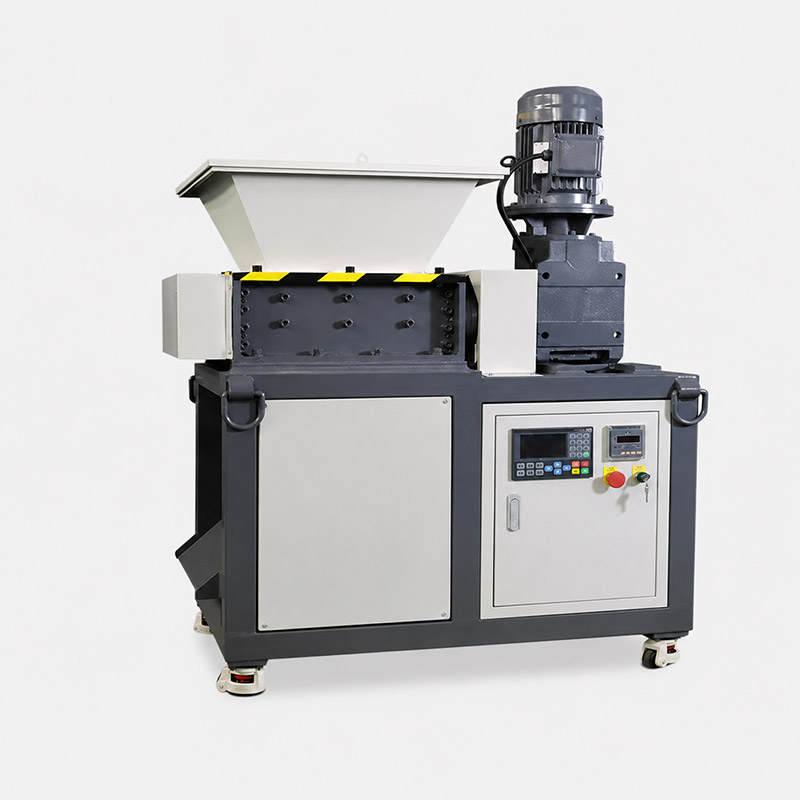
TENCAN's catalogue is built around planetary ball mills, jars and grinding media, together with the preparation steps around them, and the small shredder sits at the coarse end of that chain. The product page presents it as a small-format shredder within TENCAN's crusher series, upstream of the milling equipment the company is best known for.
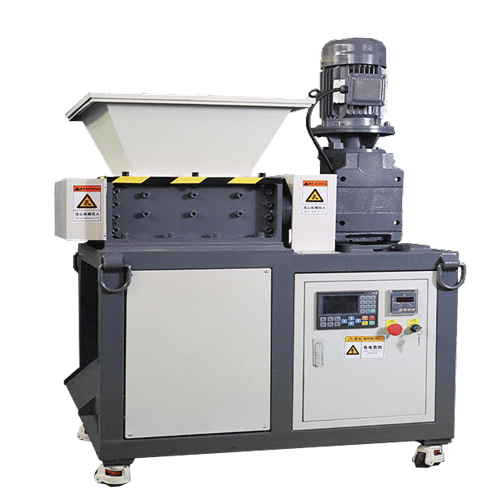
That position is useful for a laboratory already standardising on TENCAN mills. Pre-shredding, milling, and the choice of jar and media can be discussed with one supplier, and the question of what feed size the mill accepts can be settled together with the question of what the shredder produces. For a laboratory building a repeatable workflow, that continuity reduces the risk of a mismatch between two machines bought separately.
What the current material supports is the role, not a detailed specification. Cutting geometry, throughput, contact materials, motor rating and available options should be confirmed with TENCAN for the specific sample, because the right configuration depends on whether the feed is brittle, ductile, fibrous or filled. Buyers should send a representative sample and state the target — piece size for the mill, batch mass per run, cleaning routine and any restriction on metal contact — rather than selecting from a general description. Options are listed on the TENCAN small shredder product page.
Brand-Level View: Retsch and Fritsch
Two German manufacturers appear repeatedly on laboratory shortlists for coarse comminution. Retsch and Fritsch are both long-established suppliers of laboratory size-reduction equipment, both publish catalogues spanning crushing, milling and sieving, and both are worth a serious look when a laboratory wants a wide equipment family and documented application literature. The notes below stay at brand level for the reason given earlier: no current model documentation was supplied, so no model-specific parameters are asserted.
Retsch (Germany)
Retsch is a German manufacturer whose laboratory catalogue covers crushers, mills, sieve shakers and the accessories that connect them. For a buyer assembling a preparation chain, the practical advantage is breadth: coarse reduction, fine milling, sieving and dividing can be specified from one family, which simplifies method documentation and operator training. The company also maintains a substantial body of application notes and method descriptions, a real benefit when a laboratory is validating a procedure for an unusual material and wants a starting point. Its equipment is widely used in geoscience, materials testing, environmental analysis and quality control, so consumables are generally well supported through local representation. A laboratory comparing shredders should ask Retsch which of its coarse-reduction units is intended for its material class and request the corresponding documentation.
Fritsch (Germany)
Fritsch is likewise a German manufacturer of laboratory mills, crushers and sieving equipment, with a catalogue built around sample preparation for analysis. Its strengths for this application are a clear focus on laboratory-scale preparation, a family of machines covering crushing, grinding and sieving, and application support that helps a laboratory match a machine to a material. Fritsch equipment is common in materials science, minerals, ceramics and quality-control laboratories, which makes methods developed on it relatively easy to benchmark against published work. For a shredder purchase, the useful questions are the same as for any supplier: which unit suits the material class, what the contact surfaces are, how the chamber is cleaned, and what documentation accompanies the machine.
Neither brand needs an introduction to most laboratory managers, and neither is presented here as better or worse in general terms. The point of naming them is to give TENCAN buyers a fair reference frame: the international alternatives are mature, documented and well supported, and the decision should rest on fit to the sample and the workflow rather than on familiarity alone.
Selection Table: Same Criteria, Same Evidence Standard
The table compares the three suppliers on the dimensions used throughout this guide. Cells describe the position taken in this article, not a ranking; where a specification would be needed, the cell names the question to put to the supplier instead of asserting a number.
| Dimension | TENCAN small shredder | Retsch (brand level) | Fritsch (brand level) |
|---|---|---|---|
| Category and position | Small-format shredder in TENCAN's crusher series, upstream of its planetary ball mills | Coarse-reduction units within a broad laboratory crusher and mill catalogue | Crushing units within a laboratory mill and sieve catalogue |
| Evidence base in this article | Product page and product images supplied by TENCAN | Brand-level description only; no model documentation supplied | Brand-level description only; no model documentation supplied |
| Route to application guidance | Discuss feed, batch mass and target piece size alongside jar and media selection | Request application notes and material-specific recommendations | Request material-specific recommendations and preparation methods |
| Contact surfaces and cleaning | Confirm contact materials and cleaning procedure for the sample | Confirm contact materials and cleaning procedure for the sample | Confirm contact materials and cleaning procedure for the sample |
| Wearing parts and service | Confirm replaceable parts and service route at quotation | Confirm replaceable parts and local service route at quotation | Confirm replaceable parts and local service route at quotation |
| Best fit | Laboratories standardising on TENCAN milling equipment who want pre-shredding specified with the mill | Laboratories that value a wide single-supplier equipment family and published methods | Laboratories that value a focused preparation catalogue and method support |
The equal-treatment rule matters here. For all three suppliers, the decisive facts — contact materials, achievable piece size, throughput on a given sample, cleaning time — come from the manufacturer's documentation and, ideally, from a trial on the actual material. None of those facts is asserted above.
Application Scenarios
Polymers, Composites and Moulded Parts
Polymer parts, filled compounds and composite off-cuts are awkward for a ball mill: bulky, sometimes tough, and inclined to deform rather than fracture in a jar. Pre-shredding to small pieces makes the subsequent milling step practical, and for glass-fibre or mineral-filled composites it also gives the mill a more uniform feed. Grades that are tough at room temperature need a different conversation, because the shredding step itself may have to be cooled; raise that requirement with the supplier before selection.
Electronic and Metallic Scrap
Small connectors, circuit fragments and cable sections are common samples in material-recovery studies. Metal content sharpens the contamination question, since the very elements being measured may be present in the tooling. Laboratories working on recycling should agree a contamination budget with the supplier, plan a blank run and confirm how the chamber is cleaned between samples. Pre-shredding still helps, because it produces a feed the mill can handle and a more representative sub-sample.
Geological and Mineral Samples
Rock chips and core off-cuts are usually reduced by jaw crushing before milling, and a small shredder is not a substitute for that step on hard, abrasive rock. Where a shredder earns its place is in softer geological material, in sample dividing, and in laboratories processing a wide mix of materials who want one coarse step that handles the non-rock fraction. Abrasive wear on tooling should be expected, and wear parts planned for.
Fibrous Biomass and Plant Material
Fibrous material is where a cutting action outperforms impact. Stems, leaves, paper and fibrous food samples tend to mat and cushion in a ball mill, whereas a shredder reduces them to a feed that mills predictably. Moisture is the main complication: fresh biomass can smear and clog, so drying before shredding, or a design that tolerates damp feed, should be discussed as part of the method rather than discovered during the first batch.
Procurement Checklist Before You Order
- State the sample classes and the approximate size of the material as received.
- State the batch mass per run and the number of runs per week.
- State the feed size the jar can accept, and the target fineness after milling.
- Agree the contamination budget and list any elements that must not be introduced.
- Ask for contact materials, wearing parts and replacement intervals in writing.
- Ask how the chamber is cleaned and how long cleaning takes.
- Confirm dust extraction, guarding and the jam-clearing procedure.
- Confirm documentation, spare-parts list and service route.
- Request a trial on your own material, or a written reference to a similar application.
- Confirm delivery scope: machine, feed and discharge containers, tools, spares.
Matching the Configuration to Your Requirement
Three requirement profiles cover most laboratory purchases. Where the priority is a coherent workflow, with pre-shredding, milling, jars and media specified together and one point of contact for method questions, the TENCAN small shredder is the natural starting point for discussion. Where the priority is a very wide equipment family with an extensive published method literature, Retsch and Fritsch deserve equal consideration and should be asked the same questions. Where the priority is a difficult material — abrasive rock, damp biomass, metal-bearing scrap — the deciding evidence will come from a trial rather than a catalogue.
The useful next step is small: send TENCAN a representative sample, state the target piece size for the mill and the batch mass you need, and ask for the configuration that meets it. That single exchange resolves more of the selection question than any general comparison can.
Sources and Further Reading
- TENCAN, Small shredder, crusher series — product description and images used for the TENCAN section.
- Retsch GmbH (Germany) — manufacturer's own catalogue and application notes on laboratory crushers, mills and sieving equipment; consult official documentation for current models and specifications.
- Fritsch GmbH (Germany) — manufacturer's own catalogue and method descriptions for laboratory crushing, milling and sieving equipment; consult official documentation for current models and specifications.
Statements about Retsch and Fritsch are brand-level only. No model documentation, test data or third-party evaluation was supplied, and none is asserted.