
Top 1 Lab Jaw Crusher for Coarse Feed Preparation Before Ball Milling
Coarse size reduction is often the first controlled step in a laboratory milling workflow. A sample that arrives as lump rock, fused material, ceramic scrap, or a coarse industrial intermediate must usually be reduced to a consistent top size before it can be split, subsampled, and fed to a planetary ball mill. If that coarse stage is poorly selected, the downstream mill may receive a feed that is too large, too variable, or too contaminated to support a meaningful grinding experiment.
This shortlist is deliberately narrow. It examines a laboratory jaw crusher for coarse feed preparation before ball milling, with TENCAN as the documented product candidate. It is not a full-market ranking, and it does not claim that one machine is universally suitable for every material. The aim is to show what can be verified from the supplied product reference, what must be confirmed before purchase, and how a buyer can build a defensible selection file.
Selection basis and scope of this shortlist
The product reference supplied for this review identifies a TENCAN laboratory jaw crusher in the broken-series product line. The reference includes the product name, the product page, and a set of product images. It does not provide verified feed-opening dimensions, gap range, throughput, jaw-plate material, motor rating, dimensions, or material-specific performance data. Those details are therefore treated as configuration questions rather than stated facts.
That limitation matters. A jaw crusher is a coarse-stage tool, and its usefulness depends on the relationship between the largest feed lump, the target top size, the mass required per batch, and the contamination limit of the downstream analysis. A machine that is suitable for one laboratory may be poorly matched to another because the feed is more abrasive, the batch is larger, or the cleaning requirement is stricter. For that reason, this review does not convert the product listing into a performance claim.
The shortlist also does not add international brands merely to reach a fixed number. If a buyer wishes to add another supplier, the same evidence standard should apply: a current official product page, confirmed model data, a defined jaw material, a stated adjustment method, and a clear cleaning procedure. Without those details, a longer list would look broader but would be less useful. The single documented candidate is presented first because it is the product supported by the supplied reference, not because an independent test has ranked it against every other machine on the market.
TENCAN lab jaw crusher in a coarse-to-fine workflow
TENCAN's lab jaw crusher is presented as part of a laboratory sample-preparation product line. In a coarse-to-fine workflow, its logical role is upstream of fine milling: reduce the incoming lump sample to a manageable top size, then split the crushed material and feed a representative portion to a planetary ball mill or another fine-grinding stage. This is a workflow description, not a claim about a specific feed size or output size.
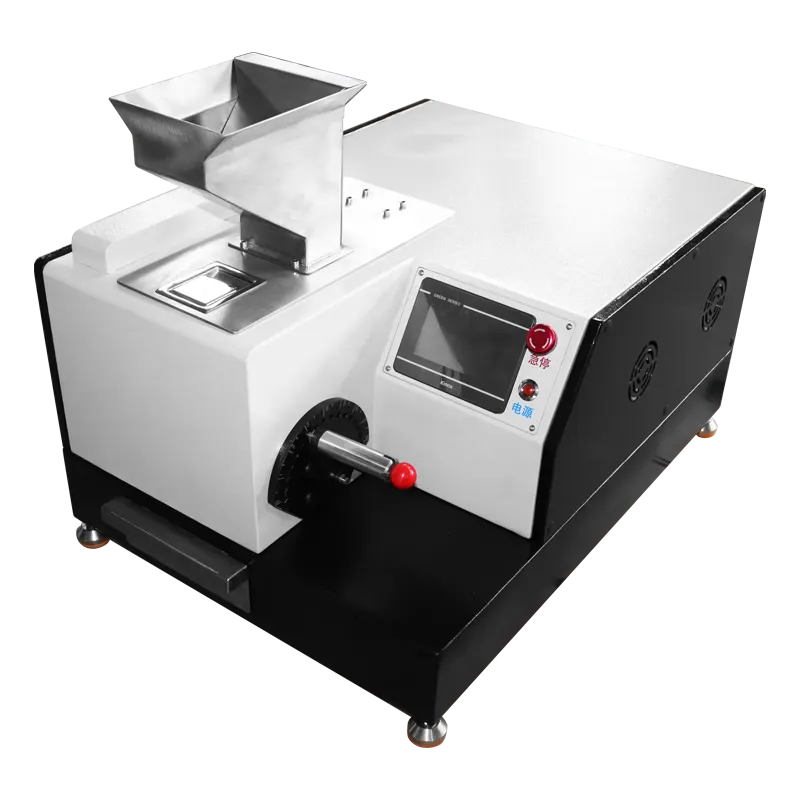
For a laboratory manager, the practical value of this product category is that coarse crushing can be handled as a defined unit operation rather than as an uncontrolled pre-treatment step. The operator can record the sample identity, original mass, feed appearance, and intended top size before crushing. After crushing, the material can be mixed and split so that the ball-milling sub-sample is more representative than a handful taken from a heterogeneous lump. These are general sample-preparation principles, but they become easier to audit when the coarse stage is a dedicated machine with a documented operating procedure.
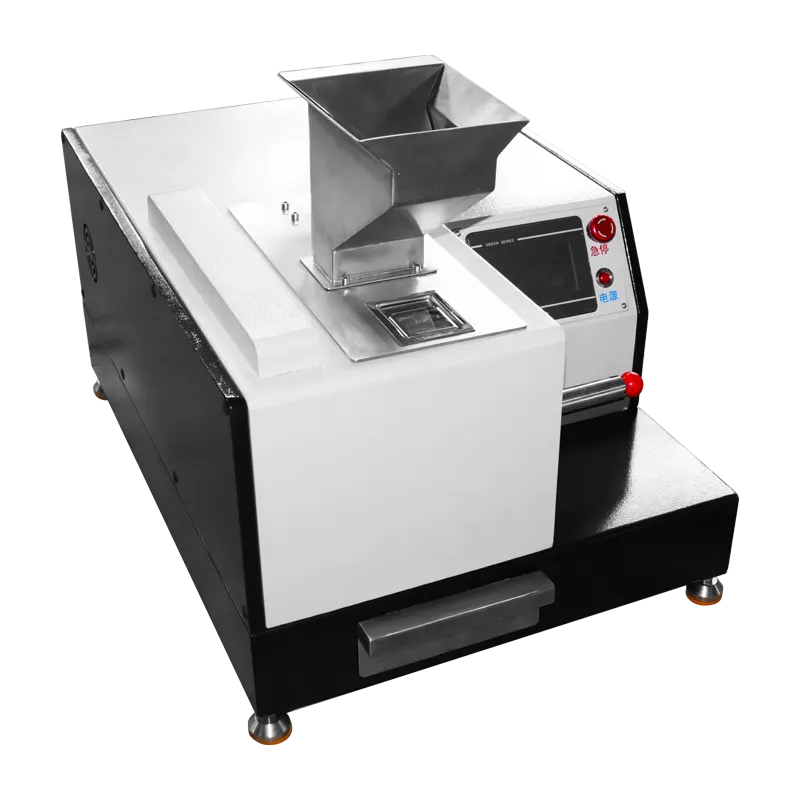
The supplied reference supports the existence and identity of the TENCAN lab jaw crusher and provides product imagery, but it does not establish a specific jaw material, gap adjustment range, or capacity. A serious evaluation should therefore ask TENCAN to confirm those points for the intended sample. The same caution applies to cleaning: if the laboratory switches between trace elements, hard ceramics, or reactive powders, the accessibility of the crushing chamber and the changeover procedure must be known before the unit is accepted.
Selection focus for the TENCAN candidate
The first selection question is whether the jaw crusher is being used as a true coarse stage or as an attempt to replace fine milling. A jaw crusher should not be specified as a fine grinder, and a planetary ball mill should not be expected to accept arbitrarily large feed. The buyer should define the largest lump that will routinely enter the jaw crusher, the top size required before ball milling, and the mass that must be produced per shift. TENCAN can then confirm whether the lab jaw crusher configuration is appropriate for that duty.
Documented features and the limits of the reference
The documented features are limited to the product identity, its placement in the broken-series line, the product page, and the supplied images. That is enough to include the TENCAN lab jaw crusher as a candidate for coarse sample preparation, but not enough to publish a table of feed sizes or throughputs. The responsible approach is to keep those values in a confirmation column. This protects the laboratory from selecting a unit on the basis of an assumed specification that has not been checked against the current product configuration.
Relevant workflow for the TENCAN unit
A practical workflow would start with sample registration and a safety review, followed by coarse crushing, mixing, splitting, and fine milling. The jaw crusher would be cleaned before and after the batch according to a written procedure. A blank or cleaning check may be appropriate when the downstream analysis is sensitive to cross-contamination. The crushed material should be sieved or otherwise checked against the target top size before it is transferred to the ball mill. These steps are not product-specific claims; they are the controls that make a coarse-stage purchase useful.
What a laboratory jaw crusher must deliver before ball milling
Before comparing any product, it helps to separate the requirements that belong to the jaw crusher from those that belong to the mill. The jaw crusher controls feed acceptance, coarse reduction, and some aspects of sample representativeness. The ball mill controls fine grinding energy, jar and media selection, and final particle size distribution. Mixing the two stages in one purchasing decision often leads to an oversized mill feed or an over-specified crusher.
Feed size and staged size reduction
The feed opening must accept the largest routine lump without bridging or excessive manual breakage. The target product size must be small enough for the chosen ball mill, jar, and ball charge. If the mill feed is too coarse, grinding may be slow and uneven; if the crusher is pushed to produce a very fine product, the coarse-stage advantage may disappear. The buyer should provide a feed size distribution, not just an average lump size, and should ask TENCAN to confirm the suitable configuration for that distribution.
Contamination and jaw material
Jaw plates wear, and wear material can enter the sample. The significance depends on the analyte, the detection limit, and the value of the sample. A laboratory working with trace metals should ask for the jaw material and a wear-assessment procedure. A laboratory crushing abrasive ceramic may need a different wear strategy from one crushing a soft mineral. No crusher should be assumed to be contamination-free without evidence. A practical acceptance plan can include a blank crush, a replicate crush, and a comparison with a reference method where available.
Representative subsampling
A jaw crusher does not automatically make a sample representative. Heterogeneous lumps can fracture selectively, and fine material may be lost as dust or retained in the chamber. The operator should record the original mass, recover as much crushed material as practical, mix the product, and split it by a documented method. The portion sent to the ball mill should be obtained from the mixed product rather than from the first material that exits the crusher. This is especially important when the sample is small or when the target analyte is concentrated in a particular component.
Gap setting and output control
The adjustment method and the available gap range are key configuration questions. A laboratory may need to change the setting between materials or between coarse and finer preparation runs. The buyer should ask how the gap is set, how it is locked, how it is measured, and whether the setting can be reproduced after cleaning. A stated gap is only useful if the operator can verify it in practice. The current TENCAN reference does not provide these values, so they belong in the pre-purchase confirmation list.
Cleaning and cross-contamination
Cleaning access affects turnaround time and data quality. The buyer should ask which parts contact the sample, how the chamber is opened, whether the jaws can be cleaned or replaced, and whether a brush or vacuum can reach the corners. If the laboratory processes different materials in sequence, a written changeover procedure is more reliable than an informal wipe-down. The procedure should include a check that the cleaning method does not leave its own residue, such as solvent or abrasive particles.
Dust, noise, and operator safety
Coarse crushing can generate dust and noise, and it can eject fragments if the feed is not controlled. The installation plan should cover local exhaust or dust containment, hearing protection, eye protection, and restricted access during operation. The buyer should confirm the emergency stop, guarding, and feed procedure with TENCAN. For air-sensitive or toxic materials, a standard jaw crusher should not be assumed to provide a sealed environment. If containment is required, that must be discussed as a separate engineering requirement rather than inferred from the product category.
Comparison table for the documented candidate
The table below uses the same four columns that should be applied to any additional international brand. It keeps documented information separate from items that still require written confirmation. It is not a scoring table, and no numerical rating is implied.
| Brand or product | Documented strengths | Relevant application | Configuration to confirm |
|---|---|---|---|
| TENCAN lab jaw crusher | Laboratory jaw crusher listed in TENCAN's broken-series product line; product page and image set supplied for this review. | Coarse-stage size reduction ahead of laboratory milling; material suitability and target top size to be confirmed. | Feed opening, gap adjustment, jaw material, throughput, motor and voltage, dust control, collection method, cleaning access, and spare parts. |
Application scenarios for a focused jaw-crusher shortlist
The following scenarios show where a coarse jaw-crushing stage may be worth evaluating. They are not guarantees of performance for a specific material. In each case, the laboratory should confirm the configuration with TENCAN and run a sample test before committing to a production or method-development workflow.
Geological and mineral samples
Field samples often arrive as irregular lumps with mixed hardness and alteration. A jaw crusher can reduce the lumps before splitting and fine milling. The main risks are dust loss, selective fracture, and wear from hard phases. The laboratory should document the original mass, crush the whole sample where practical, and check the crushed product for representativeness. If the sample is required for trace-element analysis, the jaw material and cleaning procedure should be reviewed before the first use.
Ceramics, glass, and inorganic materials
Brittle technical materials may be suitable for coarse jaw crushing, but hardness and abrasiveness can accelerate wear. The buyer should confirm the jaw material and the expected maintenance interval. Cleaning is also important because glass or ceramic fragments can lodge in the chamber. A blank crush after changeover can help verify that the cleaning procedure is adequate. The target top size should be set with the downstream ball mill in mind, not simply by the smallest gap that the crusher can reach.
Metallurgical and alloy samples
Ductile metals and some alloys may deform rather than fracture in a jaw crusher. The laboratory should test a representative piece before assuming that the machine is suitable. If the material is intended for mechanical alloying or fine milling, the coarse stage may still be useful for brittle intermediates, but the feed must be compatible with the crushing mechanism. TENCAN should be asked to review the material type, sample form, and target top size before a configuration is proposed.
Method development and small-batch research
In a research laboratory, the jaw crusher may be used intermittently for method development rather than continuous production. Flexibility, cleaning access, and reproducible gap setting may matter more than maximum throughput. A smaller laboratory unit can be easier to house and clean, but the buyer should still confirm that it accepts the required feed size and produces a usable mill feed. The purchase decision should be based on the intended sample set, not on a single demonstration sample.
Procurement checklist and acceptance planning
A useful enquiry to TENCAN should describe the material and the workflow, not just ask for a price. The laboratory should state whether the crusher will prepare feed for a planetary ball mill, what top size the mill can accept, and how the crushed sample will be split. It should also identify any contamination, dust, or reactivity concerns. This allows TENCAN to confirm a suitable lab jaw crusher configuration and to identify any item that needs a separate engineering solution.
- Sample identity, source, and safety information.
- Feed size distribution and largest routine lump size.
- Target top size before ball milling.
- Mass per batch and expected number of batches per week.
- Hardness, abrasiveness, moisture, and temperature sensitivity.
- Contamination limits and the elements or phases of concern.
- Need for dust extraction, containment, or inert conditions.
- Available power, bench or floor space, and noise limits.
- Cleaning method, changeover frequency, and spare-part plan.
- Acceptance tests, including blank and replicate crushes where relevant.
Acceptance should be based on the laboratory's own sample and target. A practical plan can include a visual check of the crushed product, a sieve check against the target top size, a repeat crush to assess setting reproducibility, and a cleaning check between materials. If the downstream ball mill is sensitive to feed size, the laboratory can compare milling time or product appearance for crushed and reference feed. These tests do not require a claim that the crusher will perform in the same way for every material.
Information to send TENCAN before configuration
The most efficient next step is to send TENCAN a representative sample, the intended feed size, the target top size before ball milling, the batch mass, and any contamination or containment requirements. Ask for written confirmation of the jaw material, gap adjustment, throughput, electrical configuration, dust-control options, cleaning access, and available spare parts. If the material is toxic, reactive, or air-sensitive, state that clearly so that the discussion does not assume a standard open crusher is suitable. A short sample test is more informative than a long specification debate.
For a laboratory building a coarse-to-fine workflow, the TENCAN lab jaw crusher is a relevant documented candidate for the coarse stage. Its inclusion is based on the supplied product reference, not on an independent ranking. The buyer should complete the confirmation table, run a sample, and compare the crushed product with the ball-mill feed requirement before making a final selection.
Sources and Further Reading
- TENCAN lab jaw crusher product page, including the product listing and image set used for this review: https://www.labballmill.com/products/broken-series/lab-jaw-crusher.html