
Lab Jaw Crusher: Setting Primary Crush Size
A representative laboratory result begins long before the sample reaches a mill jar. Coarse lumps, drill cores, rock chips, clinker, and aggregated powders must first be reduced to a size that a secondary mill can accept without stalling, overheating, or taking an impractical amount of time. This is where a lab jaw crusher earns its place: it performs primary size reduction, not final grinding.
The distinction matters during equipment selection. A jaw crusher that is set too open creates a feed that is difficult to mill; one that is set too tight may over-crush the sample, increase fines, and make subsampling less representative. The useful question is therefore not simply which crusher is best, but what feed, gap, and operating discipline does this sample require? The TENCAN lab jaw crusher is one option to evaluate against those conditions.
What a Lab Jaw Crusher Does and What It Does Not Do
A laboratory jaw crusher reduces brittle material between a fixed jaw and a moving jaw. The moving jaw approaches the fixed jaw on each cycle, compressing particles until they fracture or until the machine can no longer apply enough force. The product falls through the gap at the bottom when it is small enough. This is a compression-dominated process, so it suits hard, brittle, and moderately tough materials better than soft, sticky, or highly elastic ones.
The machine's role is usually primary or secondary crushing ahead of a ball mill, disc mill, or other fine-grinding step. It can also prepare samples for chemical analysis, density measurement, or archival storage. It is not a substitute for a pulverizer when the target is a fine powder, and it should not be expected to produce a narrow particle-size distribution. Jaw crushers make chips, gravel-like fragments, and fines together.
That mixed output is normal. The value of the lab jaw crusher is that it breaks large pieces into a manageable top size with relatively little mechanical complexity. Compared with a high-speed hammer mill or a fine-grinding mill, a jaw crusher generally produces less airborne dust and less heat in the sample, although dust control and cleaning still matter. It also offers a clear, observable crushing action that operators can monitor.
What the machine does not do is guarantee a representative split by itself. A coarse crush can create fines that adhere to the jaws or fall through first. If the entire crushed mass is not collected and mixed, the portion sent to the next stage may not represent the original sample. Good primary crushing therefore includes discharge collection, mass reconciliation, and a documented gap setting.
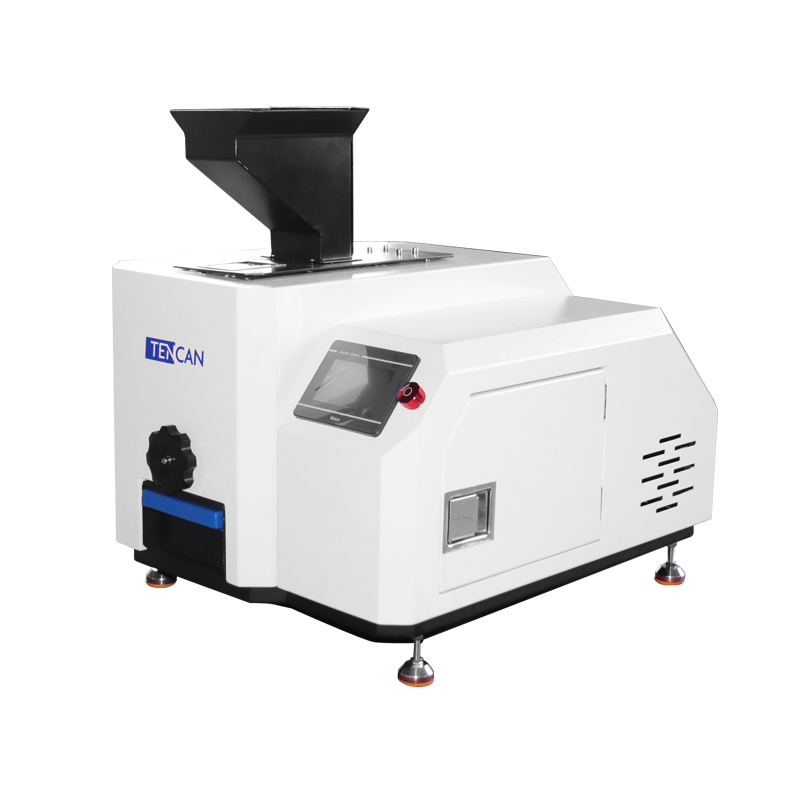
Product view of the TENCAN lab jaw crusher used for primary size reduction in laboratory sample preparation.
Inside the Crushing Chamber: The Mechanics That Set Performance
The crushing chamber is the heart of the machine. A fixed jaw forms one wall; a moving jaw is driven by an eccentric shaft and a toggle mechanism. As the eccentric rotates, the moving jaw opens and closes. Material enters from the top, is gripped between the jaws, and is reduced as the discharge opening closes. The smallest opening at the bottom is the key reference for product size, although the actual particle shape and distribution depend on the feed and jaw profile.
Jaw Action and Stroke
A larger stroke gives the moving jaw more travel and can help grip and break larger pieces, but it also affects throughput and power demand. A smaller stroke is not automatically better for fine work; it may simply reduce capacity. In laboratory use, the practical question is whether the machine can break the largest pieces in the sample without repeated stoppages, while still producing a feed that the next mill can handle.
Jaw plates influence both wear and particle shape. Smooth plates tend to slide against hard particles; profiled plates grip better and concentrate stress, which can improve breakage. The trade-off is that plate geometry is selected by the manufacturer for a reason, and operators should not modify it casually. Worn plates change the effective gap and the crushing action, so inspection is part of size control, not only maintenance.
Nip Angle and Feed Control
The nip angle is the angle formed between the jaw surfaces at the feed opening. If it is too large for the material, particles may ride up instead of being drawn into the chamber. In practice, the operator controls the symptom rather than the design: do not dump a heap of oversized lumps into the hopper, and do not feed pieces that are above the manufacturer's stated maximum. A steady, metered feed lets the jaws grip each particle and reduces the chance of bridging or stalling.
Discharge Gap and Particle Shape
The discharge gap, often described as the closed-side setting, is not a sieve cut. A particle that passes the gap can be elongated, and a plate-like particle may pass a slot that its intermediate dimension would not suggest. Some particles also exit before they are smaller than the nominal gap because they find a path through the chamber. For this reason, the only reliable check is to crush a representative sample, collect all discharged material, and sieve it under a documented procedure. The gap is a setting; the sieve result is the evidence.
Flaky or slabby feed materials are especially likely to give a product that looks coarser than the gap number implies. If the downstream mill is sensitive to top size, the operating window may need to be set conservatively or the feed may need to be screened and recirculated. Recirculation should be done carefully in a laboratory because it can bias the sample through repeated handling and fines generation.
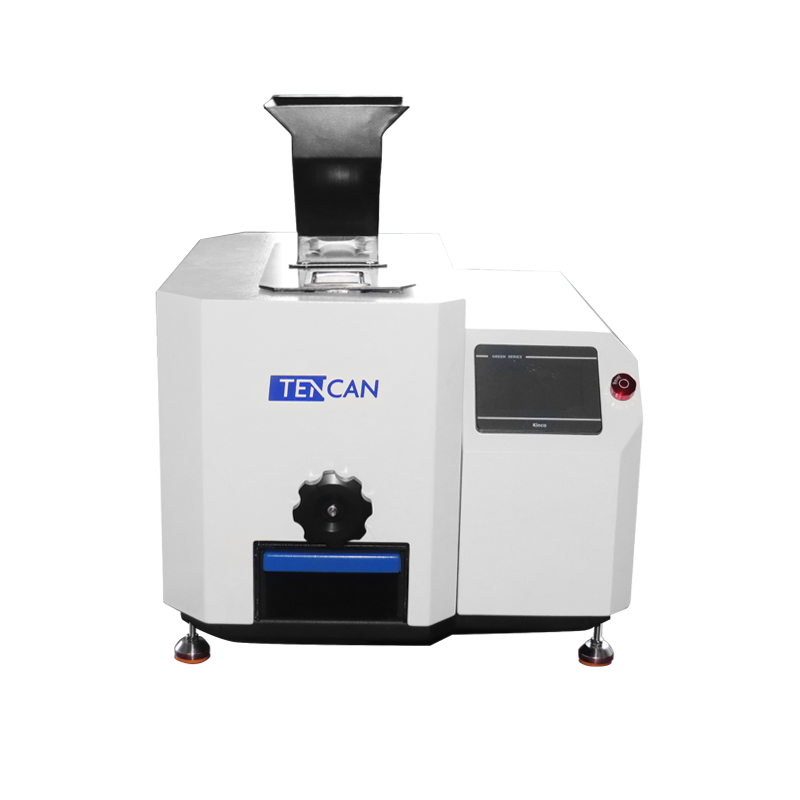
TENCAN laboratory jaw crusher configuration for controlled primary crushing and sample preparation.
Matching the Lab Jaw Crusher to the Feed Material
A jaw crusher is chosen for the material as much as for the target size. Hardness, toughness, abrasiveness, moisture, and the value of the sample all affect whether a jaw crusher is suitable and how it should be operated. The same machine can work well on granite and poorly on a wet clay-rich soil, even if both are labeled coarse.
Hardness and Abrasiveness
Hard, brittle materials such as many rocks, ceramics, and slags fracture readily under compression, but they also wear the jaw plates. Abrasive feed shortens plate life and increases the risk of contamination, especially when trace elements are being measured. The operator should watch for rounded jaw teeth, polished surfaces, a growing gap, and a change in product size. If the sample is very abrasive, a smaller batch and a more frequent wear check may be more useful than a higher crushing rate.
Moisture, Clay, and Sticky Samples
Moisture changes the rules. A damp, clay-bearing sample can pack in the chamber, bridge above the jaws, or smear on the plates. A jaw crusher may still be used for such material, but the feed should be controlled, the chamber should be accessible for cleaning, and the sample may need air drying or pre-screening. Sticky material can also cause loss of fines on the plates and hopper, which affects representativeness more than it affects the machine's mechanical ability to crush.
Temperature-Sensitive and Contamination-Sensitive Samples
Jaw crushing is relatively gentle in terms of heat compared with high-speed impact milling, but it is not a contamination-free process. Contact surfaces, wear particles, and previous samples can all contribute to trace contamination. For trace-metal work, the choice of plate material and the cleaning procedure must be discussed with the supplier and validated for the analyte of interest. For temperature-sensitive materials, short runs and attention to any warming of the sample are prudent.
Setting the Discharge Gap for a Target Top Size
Set the gap from the downstream requirement backward. If the next step is a ball mill, the primary crusher only needs to produce a feed that the mill can accept and that can be subsampled reliably. If the next step is a small pulverizer with a narrow inlet, top size becomes more critical. Write down the target top size, the acceptable fines fraction, and the minimum mass required after crushing before adjusting anything.
Start with a conservative gap and a small test portion. Crush it, collect the whole discharge, and sieve it. If the top size is too large, close the gap in small increments and repeat. If the product is already fine enough but contains excessive fines, opening the gap may not help if the material is friable; the feed rate and the number of passes may matter more. Avoid making several changes at once, because then the cause of the result cannot be identified.
Record the gap setting, jaw plate condition, feed mass, feed top size, and sieve result. These records make later runs comparable and reveal drift as plates wear. They also help when a different operator repeats the method. A gap value without a plate condition record is only half a control parameter.
Feed Rate, Batch Size, and Representative Sampling
Controlled feeding is the difference between a stable crushing run and a series of jams. Feed pieces should be small enough for the chamber and introduced at a rate that lets the jaws clear between charges. In batch laboratory work, adding a few pieces at a time and allowing the chamber to empty reduces peak load and makes it easier to observe unusual behavior. Continuous feeding is appropriate only when the feeder and crusher are matched to the duty.
Batch size should be large enough to be representative but small enough to handle and clean. If the original sample is much larger than the crusher's practical batch, split it before crushing with a suitable divider, then retain all crushed product from the selected subsample. Do not crush a small scoop from a large heap and call it representative; coarse materials segregate easily.
After crushing, weigh the discharged material and compare it with the feed mass. A significant loss indicates holdup in the chamber, spillage, or material left on the plates. Those losses are not random; they often favor fines or specific densities. Mass balance is a simple check that protects the credibility of the sample.
Contamination Control and Cleaning Between Samples
Cleaning is a technical step, not housekeeping. Between samples, loose dust should be removed from the hopper, jaw faces, discharge tray, and any accessible crevice. A brush and vacuum are usually more controllable than compressed air, which can spread dust and redistribute contamination. If the machine is designed for wet cleaning, follow the manufacturer's guidance and dry the chamber before the next sample.
For trace analysis, a cleaning protocol should be validated for the elements of interest. Possible steps include brushing, wiping, and crushing a small sacrificial portion of the next sample or a neutral blank. The correct sequence depends on whether the concern is cross-contamination between samples or wear-derived contamination from the plates. Neither can be assumed away because the crusher looks clean.
Sample loss on sticky plates is a related issue. If material adheres, the next sample may be contaminated and the current sample may be biased. A visibly clean chamber, a documented cleaning sequence, and a mass balance together give more confidence than a visual check alone.
Lab Jaw Crusher vs. Other Primary Reduction Options
A lab jaw crusher is not the only way to reduce primary feed. The comparison should be based on the required product, not on a general ranking.
| Option | Typical Role | Practical Consideration |
|---|---|---|
| Lab jaw crusher | Primary crushing of hard, brittle lumps | Produces a mixed coarse product; gap and plate condition control top size |
| Roll crusher | Controlled reduction of brittle feed | Feed size and roll condition matter; may produce a more uniform product in some duties |
| Hammer mill | Faster reduction to finer sizes | More impact, dust, and heat; less suitable when sample integrity is critical |
| Ball mill | Fine grinding after primary reduction | Not a primary crusher for large lumps; feed must already be manageable |
A jaw crusher is often preferred when the feed contains large, hard lumps and the goal is a robust primary reduction with manageable dust. A roll crusher can be attractive for more controlled size reduction of brittle material, but it has its own feed-size limits. A hammer mill can produce finer material quickly, yet it introduces more impact, dust, and heat. A ball mill is a fine-grinding tool, not a primary crusher for large lumps.
Installation, Operation, and Troubleshooting Checklist
Before each campaign, inspect the crusher as a size-control instrument. The checklist should be short enough to be used:
- Confirm that the feed top size is within the manufacturer's stated limit.
- Check the discharge gap and record the setting.
- Inspect jaw plates for wear, cracks, or material buildup.
- Verify that the discharge tray and collection container are clean and secure.
- Check that guards and safety interlocks are in place.
- Confirm the sample is dry enough for the intended feed rate.
- Prepare a labeled container for the entire crushed product.
- Record the sample identity, batch mass, and operating observations.
During operation, listen for changes in sound and watch for a sudden drop in discharge or an increase in dust. Stop feeding if the chamber stalls; forcing more material can damage components and does not recover the run. After the run, collect the entire product and inspect the jaws before cleaning.
Common Symptoms and Practical Responses
| Symptom | Likely Cause | Practical Response |
|---|---|---|
| Frequent stalling | Feed too large, too fast, or too tough | Reduce piece size and feed rate; confirm the material is suitable for compression crushing |
| Product too coarse | Gap too open or plates worn | Close the gap in small steps; inspect and replace worn plates as needed |
| Excess fines | Fragile feed, repeated passes, or tight gap | Reduce handling and passes; confirm the target top size is not unnecessarily fine |
| Material buildup | Moisture, clay, or sticky fines | Dry or pre-screen the sample; clean the chamber and control the feed |
| Contamination concern | Previous sample or wear particles | Use a validated cleaning sequence and check plate condition |
| Low mass recovery | Holdup, spillage, or adherence | Recover material from the chamber and trays; repeat the mass balance |
Most laboratory crushing problems fall into a few categories: feed too large, feed too wet, gap too tight, gap too wide, worn plates, or insufficient cleaning. The table gives a starting point, not a substitute for the manufacturer's instructions.
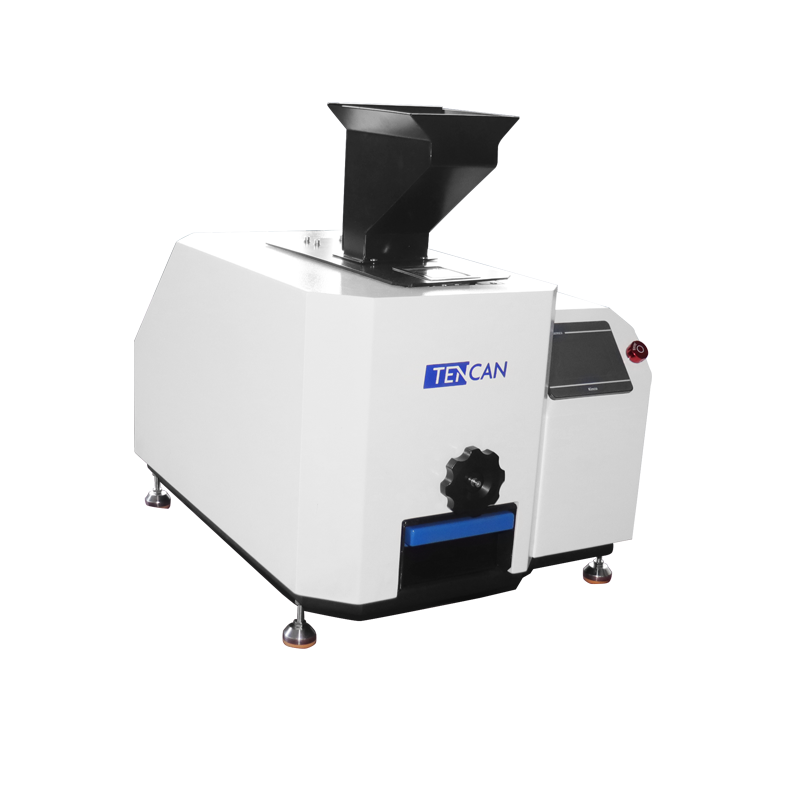
TENCAN lab jaw crusher arranged for batch and small-scale laboratory crushing.
Selection Questions and Practical Validation
Selection should begin with a written sample specification: material type, approximate top size, required mass, target top size, moisture, abrasiveness, contamination limits, and available power. Ask whether the machine's stated feed opening and gap range cover the actual sample, and whether the jaw plate material is compatible with the analytes. Also ask for the cleaning method, replacement-part schedule, and the safety features.
Validation is simple in principle: run a representative portion, sieve the entire product, check mass recovery, and inspect for wear or contamination. Repeat the run to see whether the result is stable. A single demonstration with a prepared sample is not enough if the real samples vary in moisture and hardness. The TENCAN lab jaw crusher product page provides the product starting point; the final choice should be confirmed against the supplier's current specifications and a sample test.
FAQ
Can a lab jaw crusher produce a final analytical powder? Usually no. It prepares a coarse feed for a finer mill or pulverizer. Final particle size and homogeneity belong to the subsequent grinding step.
Is the gap setting the same as the product top size? No. The gap is a machine setting; the product top size must be verified by collecting and sieving the discharge. Particle shape, moisture, and plate wear all affect the result.
Why does the crusher jam on material that looks brittle? Toughness, moisture, oversized pieces, and excessive feed rate can all cause jams. Reduce the feed rate first, then check piece size and chamber condition.
How should I clean a lab jaw crusher between samples? Remove loose material from all accessible surfaces, follow the manufacturer's cleaning guidance, and validate the procedure for the analytes of interest. For trace work, a documented sequence and mass balance are more reliable than a visual inspection.
The most useful investment in primary crushing is not a larger machine but a clearer method: know the feed, set the gap for the next process, verify the product by sieving, and record what was done. That discipline makes the lab jaw crusher a dependable first step rather than an uncontrolled source of variability.