
Multi-Dimensional Mixer for Powder Blending
A powder blend can look uniform in a sample bottle and still fail in the next process. Segregation during discharge, dead zones in the drum, attrition of fragile granules, or overmixing after the color has homogenized can all produce a result that passes visual inspection but misses the required distribution. That is why multi-dimensional mixing is often evaluated not only for blend uniformity, but also for how gently and predictably it moves the entire powder bed. The TENCAN multi-dimensional mixer is one option for laboratories and production teams working with dry powders, granules, and other free-flowing or moderately cohesive materials.
Why Powder Blending Fails Before the Mixer Is Blamed
Blending problems are rarely caused by the mixer alone. A multi-dimensional mixer may produce a uniform bed at the end of the cycle, but the sample taken from a drum, the material that leaves the discharge valve first, and the powder that reaches the tablet press or packaging line can all differ. The reason is that powder is not a simple liquid. It has a particle size distribution, a bulk density, surface roughness, moisture content, and electrostatic behavior. Each property influences how particles move, separate, and recombine.
Segregation is the most common concern. When particles differ in size or density, vibration, pouring, and even gentle tumbling can cause fines to migrate downward or coarse particles to rise. A mixer that creates a strong rolling action may blend quickly, but the same action can also encourage segregation when the drum is emptied. A multi-dimensional mixer reduces this risk by keeping the entire bed in motion rather than relying on a narrow high-shear zone, but it cannot eliminate segregation if the receiving container or discharge chute promotes separation.
Dead zones are another source of inconsistent results. These are regions where material moves slowly, remains trapped against a surface, or receives far less strain than the rest of the bed. In a poorly matched drum or at an unsuitable fill level, powder can sit in a corner while the main body circulates. The result is a blend that appears acceptable in one sample but fails when the full batch is discharged. Dead zones are especially likely when the fill level is too low, when the material is cohesive, or when the drum geometry does not encourage folding of the upper and lower layers.
Overmixing is equally important. Once a blend reaches a satisfactory distribution, additional mixing usually does not improve it. Instead, prolonged movement can cause fragile granules to break, abrasive particles to generate fines, and differences in surface energy to produce agglomerates. In some formulations, overmixing can also change flow behavior or create dust that later separates. The practical target is not the longest possible cycle; it is the shortest repeatable cycle that reaches the required uniformity and remains stable through discharge.
| Observed problem | Likely cause | What to examine |
|---|---|---|
| Uniform sample, inconsistent finished product | Segregation during discharge or transfer | Discharge height, chute design, receiving container, particle size distribution |
| Color or tracer variation | Dead zone or insufficient folding | Fill level, drum motion, loading sequence, mixing time |
| Fines increase after blending | Attrition or overmixing | Cycle time, intensity, particle fragility, media or internals |
| Sticky lumps or caking | Moisture, static, or cohesive fines | Humidity control, feedstock condition, agglomerate size |
| Batch-to-batch variation | Inconsistent loading or poor sampling | Weighing procedure, sampling method, fill volume, operator steps |
A useful diagnostic approach is to sample at several points and at several times, not only at the end of the cycle. Samples taken from the top, middle, and bottom of the drum, and from the first, middle, and last portion of the discharge, reveal more than a single spot check. If the mixer performs well in the drum but the discharge samples separate, the problem may be downstream handling rather than the mixing principle itself.
The Working Principle of a Multi-Dimensional Mixer
A multi-dimensional mixer is designed to move the powder bed through a combination of rotation, translation, and changing orientation. Instead of relying on a fast rotor, paddles, or a narrow shear gap, the drum or mixing vessel follows a path that continually folds the material over itself. Particles exchange positions as the bed slopes, cascades, and rolls, while the bulk material is transported from one part of the vessel to another. This combination of convection, diffusion, and low-intensity shear is what makes the multi-dimensional approach attractive for powders that must remain relatively intact.
The exact motion depends on the machine design, drum mounting, drive arrangement, and control system. Some systems produce a gentle three-dimensional tumbling action; others combine a rotating drum with a second rotation or a reversible movement. The common principle is that no single direction dominates. Material that would otherwise remain near the wall is repeatedly brought into the active zone, and the upper layer is folded back into the lower layer. This helps reduce the persistent dead zones that can occur in simple single-axis tumblers.
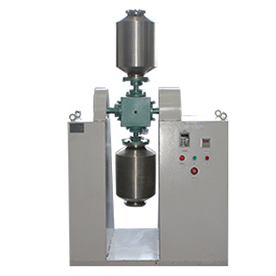
The multi-dimensional mixer uses a moving drum to create gentle, multidirectional motion in the powder bed.
Unlike a high-shear mixer, a multi-dimensional mixer generally does not depend on a small, intense mixing zone to homogenize the batch. That distinction matters for fragile materials. Granules, spray-dried powders, crystalline products, and composite particles can be sensitive to impact and compression. A low-shear, whole-bed action can reduce the probability of breakage, but it does not guarantee zero attrition. The actual result still depends on the material, the cycle time, the drum speed, and the amount of free space in the vessel.
Where the Mixing Action Comes From
Three mechanisms usually act together. Convective mixing moves groups of particles from one region to another. Diffusive mixing allows individual particles or small clusters to migrate through the bed as it deforms. Shear mixing occurs at the boundaries between moving layers, although the shear level in a gentle drum mixer is much lower than in a blade or rotor mixer. A well-matched multi-dimensional cycle balances these mechanisms so that the whole batch is exchanged without creating excessive impact.
The fill level has a strong influence on this balance. If the drum is too empty, the powder may slide rather than fold, and the active layer may remain shallow. If the drum is overfilled, there is little free space for the bed to expand and overturn, so mixing becomes slower and dead zones may develop near the top or the door. The practical optimum is normally found by trial because it depends on bulk density, angle of repose, and drum geometry. A material that flows easily may tolerate a different fill level from a cohesive powder that tends to hold its shape.
Speed should also be treated as a process variable, not simply a throughput setting. Increasing speed can shorten the time needed for macro-scale distribution, but it can also raise impact energy, dust generation, and heat input. For heat-sensitive or fragile products, a slower cycle with a longer duration may be preferable, provided the blend still reaches the required uniformity. The right combination is usually established through sampling rather than by assuming that faster is better.
Process Variables That Decide Blend Quality
Multi-dimensional mixing looks simple from the outside, but blend quality is controlled by several interacting variables. The most useful way to evaluate them is to separate variables that can be adjusted at the machine from variables that belong to the material and the surrounding process.
| Variable | Effect on the blend | Practical direction |
|---|---|---|
| Fill level | Controls free space, bed turnover, and the risk of dead zones | Test a range of working volumes; avoid both very low and excessive filling |
| Drum or vessel geometry | Determines folding patterns and discharge behavior | Match the vessel to batch size and material flow characteristics |
| Mixing speed | Changes the rate of convection and the energy transferred to particles | Use the lowest speed that achieves uniformity within a practical time |
| Cycle time | Controls the approach to uniformity and the risk of overmixing | Stop after the uniformity target is met and verified |
| Loading sequence | Affects initial stratification and the time required to distribute minor ingredients | Add small components where they can be dispersed without local overload |
| Material properties | Influence segregation, cohesion, flow, and attrition | Characterize bulk density, particle size, moisture, and fragility before selection |
Loading sequence deserves more attention than it often receives. If a small ingredient is added as a concentrated plug at the bottom of the drum, the mixer must first break up that region before it can distribute the component across the batch. Premixing the minor ingredient with a portion of the major powder can help, but it also adds handling steps and may create dust. The best sequence depends on the number of components, their relative proportions, and whether the minor ingredient tends to agglomerate.
Discharge is part of the mixing process, not a separate operation. A blend that is uniform inside the drum can separate as it falls through a chute or fills a tall container. The first material out of the vessel may be richer in fines, while the last material may contain more coarse particles. A discharge system that minimizes free fall, avoids strong air entrainment, and keeps the receiving container at a suitable height can preserve the work done by the mixer. Sampling the discharge stream is therefore essential when the product is sensitive to segregation.
Temperature and humidity are also relevant. A multi-dimensional mixer usually transfers less heat than a high-shear device, but it is not a temperature-controlled system unless the vessel or surroundings are specifically designed for that purpose. High humidity can cause cohesive powders to cake, while dry conditions can increase static and make fine particles cling to the drum wall. These effects may appear as incomplete mixing when the real cause is the environment around the process.
Matching the Mixer to the Material
Free-flowing powders and granules are the most straightforward candidates for multi-dimensional mixing. The bed deforms easily, the drum can create repeated folding, and the discharge tends to be consistent. Even in this group, differences in bulk density can cause segregation if one component is much heavier or much finer than the others. A gentle whole-bed action helps, but the formulator should still confirm that the minor component does not concentrate at the bottom during storage or transport.
Cohesive powders require more careful evaluation. Fine materials with strong interparticle forces may form lumps, coat the drum, or move as a plug rather than as individual particles. A multi-dimensional mixer can sometimes handle these materials if the drum motion provides enough folding and if the feed is pre-conditioned to a consistent agglomerate size. In other cases, a more intensive mixing principle or a different feeding strategy is needed. The presence of a multi-dimensional mixer in a equipment range does not mean it is suitable for every cohesive formulation.
Fragile granules are a common reason to consider this type of mixer. A low-shear action reduces the chance of violent impact, but damage can still occur through repeated collisions, compression at the drum wall, or prolonged tumbling. If particle size integrity is important, the trial should measure not only blend uniformity but also the change in particle size distribution before and after mixing. A blend that is uniform but has produced excessive fines may create downstream flow, dissolution, or compression problems.
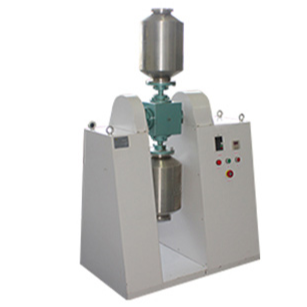
Material behavior, batch size, and discharge requirements should be reviewed before selecting a multi-dimensional mixer configuration.
Abrasive materials introduce a different concern. The mixer may perform the blending task well, but wear on the drum, seals, and discharge components can affect maintenance and product purity. The contact material, surface finish, and replaceable wear parts should be reviewed against the hardness and value of the product. Contamination control is not only about the mixer material; it also includes cleaning tools, seals, sampling devices, and the way the equipment is integrated into the room.
Moisture-sensitive or oxygen-sensitive materials add another layer of selection criteria. A standard open handling arrangement may not be appropriate if the powder must be protected from humidity or air. In those cases, the mixing system should be evaluated together with feeding, discharging, and containment. The multi-dimensional mixer itself may be only one part of a contained process train. This is why a material sample and a process description are more useful than a simple request for a drum size.
Contamination Control and Cleaning
For many powder products, cleaning is as important as mixing performance. Residue left in a corner, behind a seal, or on a rough surface can contaminate the next batch, especially when colors, active ingredients, or trace additives change between runs. A multi-dimensional mixer with smooth internal surfaces, accessible openings, and a well-designed discharge path is easier to clean than one with hidden ledges and difficult-to-reach internals. The cleaning procedure should be defined before the equipment is selected, because the required level of access affects the machine configuration.
Product contact materials should be reviewed against the formulation. Stainless steel is common in industrial powder equipment, but the specific grade and surface finish may matter for corrosion resistance, adhesion, and cleanability. Non-metallic components such as seals and gaskets should also be compatible with the cleaning agents and operating temperature. If the process requires frequent product changeovers, quick access to the drum interior and a reliable method for verifying cleanliness may be more important than a small difference in mixing speed.
Dust control is another part of contamination management. Loading and discharging a fine powder can release dust into the room, create housekeeping problems, and expose operators. A closed transfer arrangement, local exhaust ventilation, and appropriate filter selection can reduce this risk. The mixer should be evaluated as part of the containment strategy rather than as an isolated machine. This is particularly important when the powder is hazardous, highly active, or simply difficult to clean from surrounding surfaces.
Traceability also matters. A reproducible mixing cycle should record the key parameters used for the batch, such as speed, time, and load. If the same product is made repeatedly, these records help distinguish a material change from an equipment or procedure change. They also support investigation when a downstream problem appears. The goal is not paperwork for its own sake; it is a process that can be repeated and checked.
Scale-Up From Laboratory to Production
Scale-up is one of the most common reasons a laboratory blend succeeds while a production batch does not. A small multi-dimensional mixer may reach uniformity quickly because the powder bed is shallow and the travel distance between layers is short. A larger drum has a different free-surface area, a different fill pattern, and a different discharge behavior. Increasing the batch size by filling a larger vessel without reviewing the motion can change the result even when the same material and the same nominal speed are used.
A more reliable approach is to keep the mixing principle consistent while adjusting the operating window. The relationship between drum diameter, speed, fill level, and cycle time should be evaluated rather than assumed to be linear. In practice, scale-up may require a different speed, a longer time, or a modified loading sequence. If the production vessel has a different geometry from the laboratory unit, the difference should be treated as a process change and verified with samples.
Sampling is central to scale-up. A thief sample taken from one location is not enough to prove uniformity in a large batch. A sampling plan should cover multiple positions and, where possible, the discharge stream. The number of samples depends on the batch size and the risk associated with the product, but the principle is the same: the data should show that the whole batch, not only the accessible surface, meets the target. If the product is a minor component in a large batch, the sampling plan should be sensitive enough to detect local excess or deficiency.
Scale-up also affects discharge and downstream handling. A larger batch takes longer to empty, which can increase exposure to vibration and air. The receiving container may be taller, creating more opportunity for segregation. The production line may include pneumatic conveying, screening, or storage that was not present in the laboratory. These steps can undo a good blend. For that reason, the scale-up plan should include the entire powder path from loading to the next process, not only the mixer.
A Practical Selection Checklist
Before requesting a multi-dimensional mixer, define the process in terms that the equipment supplier can evaluate. The following checklist helps organize the information and reduces the risk of choosing a machine that meets a nominal capacity but not the actual material requirement.
- Batch size and bulk density: Specify the working mass and the bulk density range, not only the vessel volume. A drum that is suitable for a light powder may be unsuitable for a dense one.
- Particle size and fragility: Provide the feed particle size distribution and the acceptable change after mixing. If fines or broken granules are unacceptable, say so clearly.
- Number and proportion of components: A small minor ingredient is harder to distribute than a balanced two-component blend. Describe any tendency to agglomerate.
- Flow and cohesion: Include observations from handling, silo discharge, and feeding. A material that bridges in a hopper may also behave poorly in a mixer.
- Contamination and cleaning requirements: Define product changeover frequency, cleaning agents, and whether contained handling is needed.
- Discharge and downstream integration: Review the height, chute, receiver, and conveying method. The best mixer cannot compensate for a discharge step that causes segregation.
- Validation needs: Agree on sampling locations, analytical methods, and acceptance criteria before the trial. This prevents different interpretations of the same result.
It is also useful to distinguish must-have requirements from preferences. A must-have might be that the material remains below a certain temperature or that the drum can be cleaned without entering the vessel. A preference might be a particular control interface or a footprint that fits an existing room. Separating these points helps the supplier propose a realistic configuration and helps the buyer compare options without being distracted by features that do not affect the process.
Where a Multi-Dimensional Mixer May Not Fit
A multi-dimensional mixer is not a universal replacement for every blending operation. If the process requires high shear to break down agglomerates, disperse a liquid binder, or coat particles intensively, a different mixing principle may be more appropriate. A gentle drum action can distribute dry components well, but it may not provide the energy needed to destroy strong lumps. In such cases, pre-milling, screening, or a more intensive mixer may be needed before or instead of multi-dimensional blending.
Very cohesive materials, very small minor components, and formulations with a strong tendency to segregate may require additional measures. These can include pre-blending, controlled addition, or a different discharge strategy. The purpose of the evaluation is not to force the material into the mixer, but to determine whether the whole process can deliver a stable blend. If the answer is no, a different equipment route may be more economical than extending the mixing time.
Abrasive and high-value products also deserve a realistic maintenance review. Wear parts, seals, and cleaning access should be checked against the expected number of batches. A machine that performs well in a short trial but requires frequent attention in production may not be the lowest-cost choice over its service life. This is a normal part of equipment selection and should be discussed openly during the technical review.
Validation, Sampling, and a Sensible Trial
A trial should answer three questions: can the mixer reach the required uniformity, does it preserve the material, and can the result be repeated? Start with a representative sample rather than a idealized laboratory powder. If the production material varies, test the range that is likely to occur. Record the loading sequence, fill level, speed, time, and discharge procedure. Sample at planned intervals and stop the cycle when the target is reached, rather than assuming that a fixed time will always be correct.
The analytical method matters as much as the mixer. Image analysis, laser diffraction, sieve analysis, and chemical assays measure different things. A blend can be uniform by one measure and segregated by another. Where possible, combine a bulk uniformity check with a check of the minor component and a particle size measurement. This gives a clearer picture of what the mixer is doing and whether the result is likely to survive downstream handling.
Finally, consider the operating window rather than a single point. A mixer that works only at one exact fill level or one narrow speed may be difficult to run in production. The better choice is a configuration with a practical range that can tolerate normal variation in bulk density, feed condition, and batch size. That range should be confirmed with data, not inferred from a product brochure.
Can a multi-dimensional mixer handle cohesive powders?
It can handle some cohesive powders, but the result depends on the strength of the agglomerates, the free space in the drum, and the motion provided by the specific configuration. Pre-conditioning the feed and testing the actual material are usually necessary. If the powder moves as a plug or sticks to the wall, a different mixing approach may be more suitable.
How long should a mixing cycle last?
There is no universal time. The cycle should be long enough to reach the required uniformity and short enough to avoid unnecessary attrition or overmixing. The correct time is established by sampling at intervals with the actual formulation and fill level.
Does a multi-dimensional mixer prevent segregation?
It can reduce the risk by keeping the whole bed in motion, but it cannot prevent segregation caused by discharge, conveying, or storage. The entire powder path should be reviewed, including the receiving container and the next process step.
What information is needed for a useful equipment quotation?
Provide the batch size, bulk density, particle size range, number of components, fragility limits, moisture sensitivity, cleaning requirements, and available space. A material sample and a description of the downstream process are often more useful than a capacity figure alone. The multi-dimensional mixer product page can be used as a starting point for confirming the available configuration before a technical discussion.
The most practical next step is not to select the largest drum or the fastest cycle, but to define the blend requirement and test the material through the complete loading, mixing, sampling, and discharge sequence. A multi-dimensional mixer can be a strong fit when the powder needs gentle, whole-bed movement and repeatable distribution, but the selection should be based on representative trials and a clear understanding of how the blended powder will behave after it leaves the vessel.