
Glove Box with Purification System: A Complete Guide for Air-Sensitive Material Processing
Working with materials that react violently with moisture or oxygen — such as lithium metal, organometallic compounds, perovskites, or air-sensitive catalysts — requires a sealed environment with extremely low levels of H2O and O2. A standard desiccator or simple acrylic glove box cannot maintain the purity needed for many modern research and production processes. This is where a glove box with purification system becomes essential equipment.
In this guide, we take a close look at what a glove box with purification system is, how it works, where it is used, and what you should consider when selecting one for your laboratory or production line. We draw on practical engineering experience to help you make an informed choice without relying on marketing exaggerations.
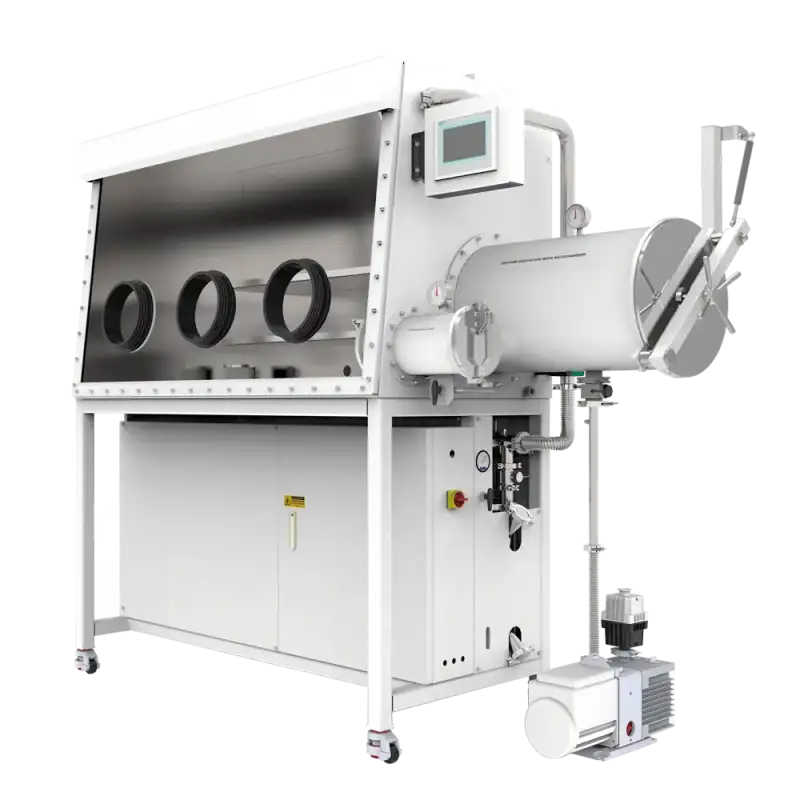
What Is a Glove Box with Purification System?
A glove box with purification system is a sealed enclosure that allows an operator to handle materials inside a controlled atmosphere through built-in gloves. Unlike a simple vacuum glove box or an acrylic glove box that only provides a physical barrier, this system actively circulates the internal gas (usually argon, nitrogen, or helium) through a purification column to remove water vapor and oxygen.
The purification column typically contains two types of adsorbents: a molecular sieve for moisture adsorption and a copper or metal-based catalyst for oxygen chemisorption. Some advanced systems also include a solvent adsorber to capture organic vapors. The gas is continuously recirculated by a blower, passing through the column until the impurity levels drop below 1 ppm (parts per million) for both H2O and O2.
How Does the Purification System Work?
Understanding the operation of a glove box purification system helps you evaluate its performance and maintenance needs. Here are the core components and their roles:
1. Gas Circulation Loop
A high-efficiency blower pulls gas from the main chamber and pushes it through the purification column. The flow rate is typically in the range of 70 m³/h or more, depending on the box volume. The entire loop is designed to have a very low leakage rate, often below 10⁻⁵ mbar·L/s to prevent contamination from outside air.
2. Purification Column
The column is filled with adsorbent materials. For moisture removal, 3A or 4A molecular sieves are commonly used. For oxygen removal, a catalyst such as copper on alumina reacts with oxygen to form copper oxide, effectively trapping O₂. When the catalyst becomes saturated, it can be regenerated by passing a mixture of inert gas with 3–5% hydrogen through the column while heating it. This reaction reduces copper oxide back to metallic copper and produces water vapor, which is then purged out of the system.
3. Regeneration Process
Regeneration is an automated or semi-automated procedure controlled by the PLC (Programmable Logic Controller). The system heats the column, introduces regeneration gas, and monitors the outlet impurities. After completion, the column is cooled and ready for normal operation. Modern controllers offer multiple regeneration modes (full auto, semi-auto, manual) and store the regeneration history.
4. Pressure Control
A glove box with purification system maintains a slight positive pressure (commonly 0–16 mbar) relative to the outside atmosphere. This prevents inward leakage of ambient air. Foot pedals or automatic regulators allow the operator to adjust pressure as needed.
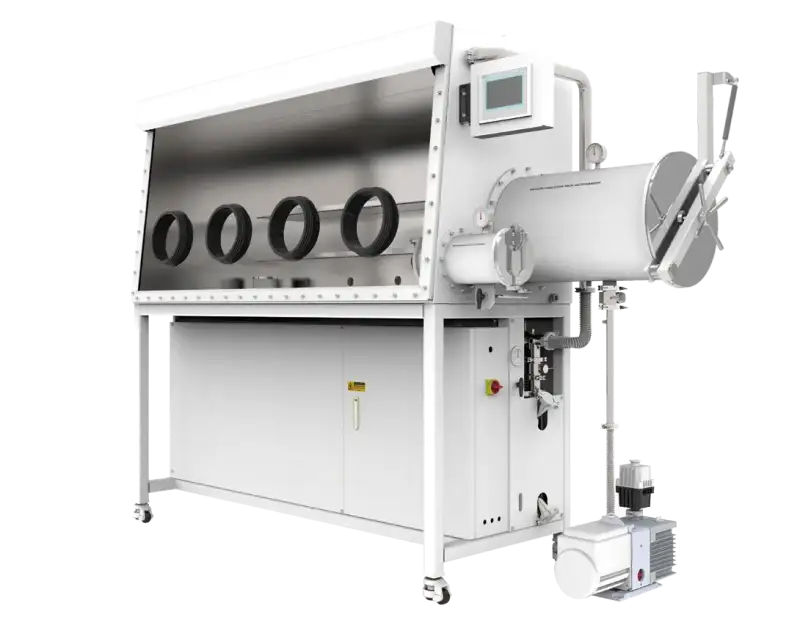
Why Do You Need a Glove Box with Purification System?
Many research and production processes require water and oxygen levels below 1 ppm. For example:
- Lithium-ion battery research – Handling electrolyte salts, lithium metal, and electrode slurries in a dry room alternative.
- Perovskite solar cell fabrication – Spin-coating and annealing organic-inorganic halide perovskites that degrade rapidly in ambient air.
- OLED and organic electronics – Encapsulation and testing of light-emitting layers that react with moisture.
- Mechanical alloying and powder processing – Milling reactive metal powders (e.g., sodium, lithium, magnesium) under inert atmosphere to prevent oxidation.
- Catalyst preparation – Air-sensitive organometallic catalysts used in polymerization or hydrogenation.
- Rare earth metal welding and storage – Avoiding oxidation during arc melting or cutting.
Using a simple vacuum glove box or a nitrogen-purged acrylic glove box is often insufficient because the oxygen and moisture levels remain in the hundreds or thousands of ppm. The continuous purification loop in a glove box with purification system ensures consistent low impurity levels even when the chamber is frequently opened for sample transfer.
Key Specifications to Consider When Selecting a Glove Box with Purification System
Choosing the right system depends on your specific application. Here are the main parameters to evaluate:
1. Chamber Size and Material
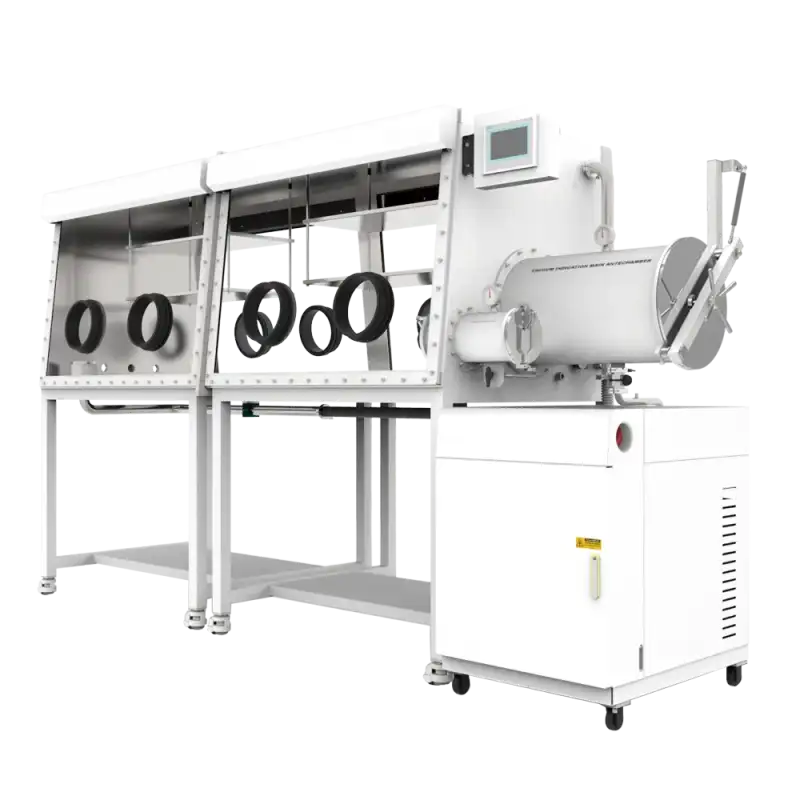
Stainless steel (SUS304 or SUS316) is the standard material for the main chamber due to its corrosion resistance and low outgassing. Acrylic chambers can be used for less demanding applications but are more prone to scratches and permeation. Common chamber sizes range from single-workstation (about 1200 mm length) to double-workstation (2400 mm) or larger custom sizes. The depth and height should accommodate your equipment (glove box ovens, coaters, balances, etc.)
2. Antechamber (Transfer Chamber)
Most systems include one or two antechambers for transferring samples in and out without contaminating the main atmosphere. The antechamber can be evacuated and refilled with inert gas multiple times. Larger antechambers (e.g., 380 mm diameter × 600 mm length) allow passing larger items such as solvent bottles or vacuum ovens. Some systems feature automatic doors and a separate evacuation pump for faster cycling.
3. Purification Capacity and Regeneration
The capacity of the purification column determines how long the system can operate before regeneration. Typical capacities are about 60 L of oxygen adsorption and 2 kg of water adsorption for a standard column. Systems with larger columns require less frequent regeneration, which can be important for continuous production. Ask the supplier about the column material, regeneration gas consumption, and cycle time.
4. Leakage Rate
A very low leakage rate (<0.001 vol%/h or <10⁻⁵ mbar·L/s) is essential for maintaining low impurity levels. The leakage rate defines how much ambient air enters the system through seals, gaskets, and gloves. Always check the manufacturer’s leakage specification and test method.
5. Control System
Modern glove boxes use a PLC with a touchscreen HMI (human-machine interface) to display real-time H2O and O2 concentrations, pressure, and regeneration status. Look for systems with data logging, remote monitoring capability, and password protection.
6. Accessories and Integration
Your system may need additional ports for electrical feedthroughs, gas inlets, vacuum ovens, freezers, microscopes, or solvent purification columns. Verify that the glove box can be customized or pre-wired for your specific tools.
Common Mistakes When Using a Glove Box with Purification System
Even a high-quality system cannot perform well if used incorrectly. Avoid these pitfalls:
- Opening the main door without proper antechamber cycling – This introduces a large burst of air that overwhelms the purification column and may require several hours to recover.
- Using the wrong glove material – Butyl rubber gloves have lower permeation rates than neoprene or latex. For long-term inert atmosphere work, butyl or Hypalon®-type gloves are recommended.
- Neglecting regular leak testing – Over time, gloves develop pinholes and seals degrade. Perform a simple pressure drop test weekly.
- Overloading the antechamber – Placing many items inside the antechamber without sufficient evacuation cycles can introduce moisture trapped in packaging or porous materials.
- Skipping regeneration – When the column is saturated, the H2O/O2 levels will rise. Schedule regeneration according to the manufacturer’s guidelines or when the impurity alarm triggers.
How to Maintain Your Glove Box with Purification System
Regular maintenance extends the life of the system and ensures stable performance:
- Daily: Check H2O and O2 readings, verify pressure, inspect gloves for damage.
- Weekly: Perform a pressure hold test to detect leaks. Clean the antechamber seals with a lint-free cloth.
- Monthly: Replace the desiccant in the antechamber breather if equipped. Inspect the blower and check for unusual noise.
- Annually: Replace gloves (depending on usage), calibrate the oxygen and moisture sensors, and service the vacuum pump (oil change, oil mist filter replacement).
The purification column typically lasts for several years before the adsorbent needs to be replaced; regeneration cycles restore most of its capacity. Keep a log of regeneration cycles to forecast column lifetime.
Comparing Glove Box Types: Which One Is Right for You?
To help you decide, here is a quick comparison between common glove box configurations:
| Feature | Acrylic Glove Box | Stainless Steel Vacuum Glove Box | Glove Box with Purification System |
|---|---|---|---|
| Atmosphere purity | Not actively purified; depends on purge cycles | Vacuum capability; no continuous purification | <1 ppm H2O & O2 |
| Material | Acrylic (polycarbonate) | Stainless steel | Stainless steel (SUS304) |
| Best for | Short-term storage, low sensitivity samples | Vacuum handling, simple inert gas backfill | Long-term ultra-low impurity environment |
| Cost | Low | Medium | Higher (but lower operating cost if used continuously) |
If your work demands consistent single-digit ppm levels for extended periods, a glove box with purification system is the only practical solution. For occasional use with less sensitive materials, an acrylic glove box or a stainless steel vacuum glove box may be sufficient.
Why Consider a Glove Box from TENCAN?
TENCAN has been manufacturing powder processing and controlled-atmosphere equipment for over 20 years. Our glove box with purification system is designed with practical engineering in mind:
- PLC-controlled automatic pressure regulation and regeneration
- Leakage rate below 10⁻⁵ mbar·L/s
- Standard H2O and O2 levels below 1 ppm
- Multiple customization options: additional ports, solvent purification, integrated ovens, freezers, and vacuum chambers
- Support for various voltages (110/220V) and frequencies (50/60 Hz)
We understand that every laboratory has unique requirements. Our technical team can help you select the correct box size, purification capacity, and accessories based on your specific materials and daily operating conditions. When requesting a quotation, it helps to provide the following information:
- Material types and sensitivity levels
- Desired H2O and O2 targets
- Main chamber dimensions needed
- Antechamber size preference
- List of equipment to be placed inside
- Working gas type (argon, nitrogen, helium)
- Local power supply details
A well-matched glove box with purification system will protect your valuable materials and improve the reproducibility of your experiments. We invite you to explore the full product line on our website and contact our engineers for a detailed discussion.
Remember: the success of your air-sensitive work depends not only on the equipment itself but also on proper operation and maintenance. With the right system and good practices, you can achieve a stable, ultra-pure inert atmosphere for years of reliable service.