
Is Your Lab Data Ruined by Invisible Oxygen? Why TENCAN Acrylic Glove Boxes Are the Ultimate Shield
Acrylic Glove Box: Models, Vacuum Levels, Applications and Selection Guide
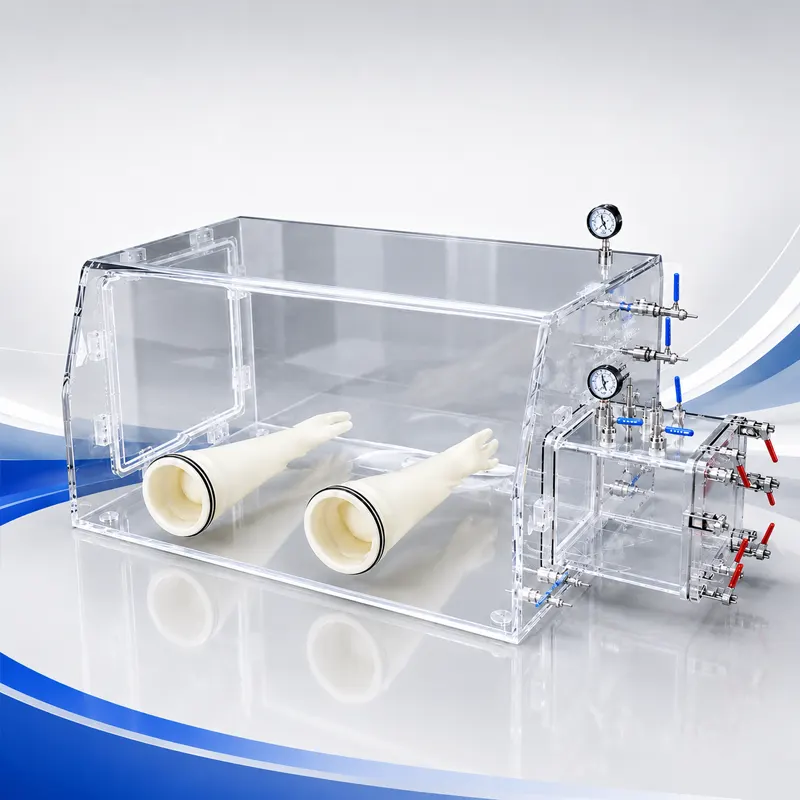
An acrylic glove box provides a transparent, enclosed workspace for handling powders, chemicals, electronic materials and other samples that should be isolated from the surrounding laboratory environment. Depending on the model, the box can serve as a simple dust-isolation enclosure, a micro-vacuum glove box, or a vacuum inert-gas operating box for atmosphere replacement.
The most important point when selecting an acrylic glove box is that not every acrylic glove box has the same atmosphere-control capability. A basic isolation model, a micro-vacuum model and a full vacuum-replacement model are different products with different intended uses.
Quick answer: TENCAN's current GBT acrylic glove-box series includes four chamber sizes—A, B, C and D—and three main construction levels. GBT-10 models are 10 mm acrylic isolation boxes without vacuum capability. GBT-15 models use 15 mm acrylic, support micro-vacuum operation and list a 240 × 240 × 240 mm transition chamber; they can also be equipped with a water/oxygen purification system. GBT-30 models use thicker acrylic and are listed for vacuum to -0.1 MPa for atmosphere replacement.
What Is an Acrylic Glove Box?
An acrylic glove box is a transparent sealed enclosure made from plexiglass / PMMA. Gloves mounted on the chamber wall allow the operator to manipulate samples inside the enclosure without opening the main chamber directly to the room.
The enclosure can be used for several different purposes depending on model:
- Basic isolation: keep dust, airborne contamination or room air separated from the sample.
- Micro-vacuum operation: reduce internal pressure and use inert-gas replacement for selected laboratory processes.
- Vacuum atmosphere replacement: evacuate the chamber and refill with nitrogen or argon to reduce oxygen and moisture.
- Optional purification: selected GBT configurations can be paired with a water/oxygen purification system when lower impurity levels are required.
This distinction matters because a simple acrylic glove box should not automatically be described as a continuous low-ppm purification glove box.
TENCAN GBT Model Structure
TENCAN's current model code combines three pieces of information:
- GBT = transparent / acrylic glove-box series
- 10 / 15 / 30 = acrylic thickness / construction level
- A / B / C / D = chamber-size family
GBT-10: Isolation and Dust Protection
GBT-10 models use 10 mm acrylic. The current product table describes them as isolated and dust-proof, with no vacuuming.
They are suitable when the main requirement is physical separation rather than vacuum atmosphere replacement.
GBT-15: Micro-Vacuum + Optional Purification
GBT-15 models use 15 mm acrylic and are listed for micro-vacuum operation. The current product page also lists a 240 × 240 × 240 mm transition chamber and states that a water/oxygen purification system can be added.
This configuration is useful when the laboratory needs more atmosphere control than a simple isolation box but does not necessarily require the heavier full-vacuum construction of the GBT-30 series.
GBT-30: Vacuum Atmosphere Replacement
GBT-30 models use thicker acrylic construction. The current TENCAN table lists these models as capable of vacuum to -0.1 MPa for oxygen/water replacement through evacuation and gas filling.
This is the more appropriate acrylic configuration when the process specifically requires vacuum-based atmosphere replacement.
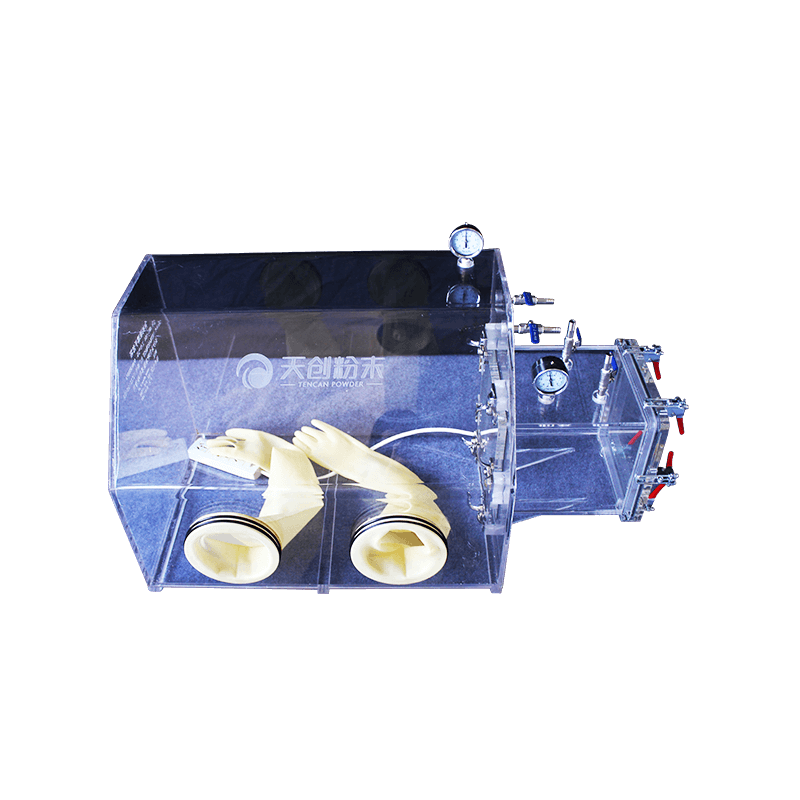
Current TENCAN GBT Chamber Sizes
| Size Family | Main Chamber Size | GBT-10 | GBT-15 | GBT-30 |
|---|---|---|---|---|
| A | 700 × 450 × 500 mm | 10 mm, isolation / dust-proof, no vacuum | 15 mm, micro-vacuum, 240 × 240 × 240 mm transition chamber, purification option | 30 mm, vacuum to -0.1 MPa |
| B | 1000 × 500 × 500 mm | 10 mm, isolation / dust-proof, no vacuum | 15 mm, micro-vacuum, 240 × 240 × 240 mm transition chamber, purification option | 30 mm, vacuum to -0.1 MPa |
| C | 1200 × 600 × 600 mm | 10 mm, isolation / dust-proof, no vacuum | 15 mm, micro-vacuum, 240 × 240 × 240 mm transition chamber, purification option | 35 mm, vacuum to -0.1 MPa |
| D | 1200 × 800 × 700 mm | 10 mm, isolation / dust-proof, no vacuum | 15 mm, micro-vacuum, 240 × 240 × 240 mm transition chamber, purification option | 35 mm, vacuum to -0.1 MPa |
TENCAN also lists customization by material, size, shape and other special requirements.
Acrylic Glove Box vs. Purification Glove Box
A frequent selection mistake is treating all glove boxes as if they provide the same oxygen and moisture performance.
| Type | Atmosphere-Control Method | Typical Use |
|---|---|---|
| GBT-10 Acrylic | Physical isolation; no vacuuming | Dust isolation, simple enclosed operations |
| GBT-15 Acrylic | Micro-vacuum / inert-gas operation; optional water/O₂ purification | Laboratory processes requiring a controlled atmosphere with compact transparent enclosure |
| GBT-30 Acrylic | Vacuum evacuation + inert-gas replacement | Processes requiring vacuum atmosphere replacement |
| GBP Purification Glove Box | Closed-loop circulation + continuous H₂O/O₂ purification | Long-term low-ppm atmosphere for highly sensitive materials |
If the process requires a documented long-term specification such as H₂O ≤1 ppm and O₂ ≤1 ppm, TENCAN's current GBP glove box with purification system is the more appropriate reference. The basic acrylic product page does not publish one universal low-ppm specification for every GBT model.
How Vacuum and Inert-Gas Replacement Work
For vacuum-capable models, the atmosphere-control logic is straightforward:
- Seal the main chamber.
- Evacuate the chamber according to the model's permitted vacuum range.
- Introduce the selected working gas such as nitrogen or argon.
- Repeat atmosphere replacement according to the equipment procedure and process requirement.
- Begin sample handling after the chamber condition is suitable for the experiment.
This method can substantially reduce the amount of room air in the chamber, but it should not be described as automatically creating a perfectly oxygen-free and moisture-free environment.
Residual oxygen and water depend on vacuum level, gas purity, number of replacement cycles, sealing, chamber contents, sample outgassing and operating procedure.
Does Vacuum Remove Moisture from the Sample Itself?
Vacuum can help remove some volatile species and surface moisture under suitable conditions, but it is not correct to assume that evacuating an acrylic glove box automatically dries every powder, porous ceramic or reagent completely.
Drying behavior depends on:
- Material composition
- Porosity
- Moisture binding strength
- Temperature
- Vacuum level
- Exposure time
If the sample requires a defined drying process, use an appropriate vacuum oven, drying protocol or material-specific preparation method rather than relying only on the glove-box evacuation cycle.
Why the Transition Chamber Matters
A transition chamber, also called an antechamber, reduces the need to open the main working chamber directly to room air.
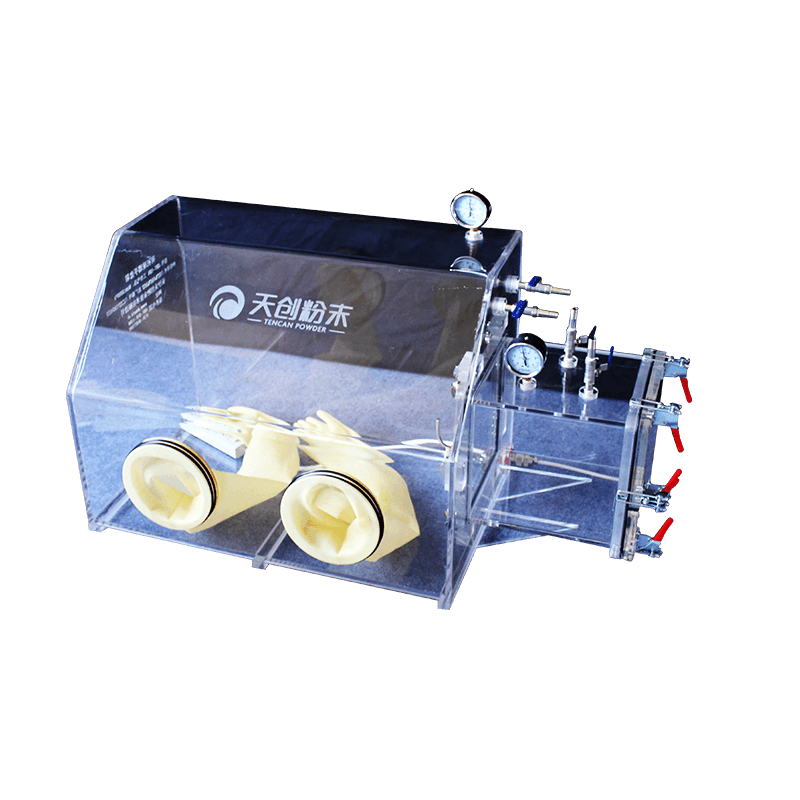
The current GBT-15 models list a 240 × 240 × 240 mm transition chamber. The basic workflow is:
- Keep the inner door closed.
- Open the outer door and place the sample inside the transition chamber.
- Close the outer door.
- Use the specified vacuum / inert-gas replacement procedure.
- Only then open the inner door and transfer the item into the main chamber.
This reduces atmosphere disturbance, but it does not mean the transition chamber becomes perfectly identical to the main-chamber atmosphere after one fixed cycle. The required transfer procedure depends on the process target and equipment configuration.
Why Choose Acrylic?
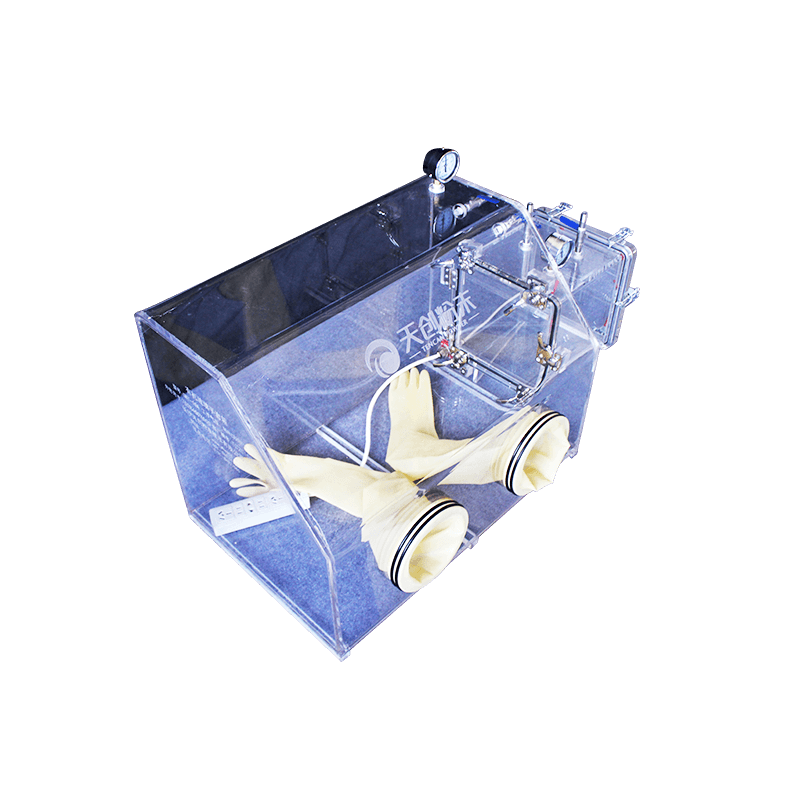
The current TENCAN product page highlights several practical advantages of acrylic / plexiglass construction:
- Simple structure
- Easy operation
- Lightweight construction
- High transparency
- Stable shape under normal conditions
- Chemical and weather resistance
- UV transmission
- Integrated multi-hole electrical sockets for laboratory equipment
The main benefit for everyday laboratory work is visibility. Operators can observe the entire working chamber from multiple directions, which is useful when manipulating small samples, instruments, containers or powder-handling tools.
Typical Applications
Battery and Energy-Material Research
Acrylic glove boxes can be useful for battery powders, electrodes, electrolyte-related preparation and other air-sensitive work when the selected model provides the atmosphere control required by the process.
However, not every battery experiment has the same oxygen and moisture tolerance. Highly sensitive lithium-metal or solid-electrolyte work may require a continuously purified glove box rather than a basic vacuum-replacement box.
Electronic and Semiconductor Materials
Some semiconductor, photovoltaic, perovskite and electronic-material processes benefit from reduced humidity or reduced oxygen exposure. The correct enclosure should be selected according to the actual process limit rather than assuming an acrylic box alone guarantees ultra-low ppm conditions.
Chemical Synthesis and Catalyst Handling
An inert-gas environment can help protect selected oxidation-sensitive reagents or catalysts. Material compatibility, solvent vapor and reaction safety should be reviewed before carrying out chemical processes inside the enclosure.
Powder Weighing, Mixing and Sample Preparation
The transparent enclosure can also be used for controlled sample preparation, powder transfer, weighing, container loading and other operations where isolation from room air or dust is desirable.
Pharmaceutical and Hygroscopic Materials
Acrylic glove boxes may be useful for handling moisture-sensitive powders in research environments, but they should not be assumed to meet pharmaceutical GMP, sterility or validated containment requirements unless the specific system has been designed and qualified for those standards.
Argon or Nitrogen?
Both nitrogen and argon can be used as protective gases in many glove-box applications, but the correct gas depends on material compatibility.
| Factor | Nitrogen | Argon |
|---|---|---|
| Availability | Often widely available | Widely used in inert-atmosphere laboratories |
| Cost | Often lower depending on local supply | Often higher depending on local supply |
| Material compatibility | Suitable for many materials but not universally inert | Noble gas; preferred when nitrogen compatibility is uncertain |
Do not select the working gas only by price. Check the chemistry of the sample and process first.
When Should You Add a Purification System?
Consider purification when:
- The process requires long-term low oxygen and moisture rather than simple gas replacement
- The chamber is opened / transferred frequently
- The sample continuously releases moisture or oxygen-containing vapors
- Atmosphere recovery time after transfer is critical
- A documented ppm target is part of the research method
The current GBT-15 product description states that a water/oxygen purification system can be equipped. For more demanding continuous purification, compare the acrylic solution with TENCAN's GBP purification glove box.
Acrylic vs. Stainless-Steel Vacuum Glove Box
TENCAN also provides a GBV stainless-steel vacuum glove box.
| Comparison | GBT Acrylic | GBV Stainless Steel |
|---|---|---|
| Visibility | Very wide transparent viewing area | Front viewing panel |
| Construction | Acrylic / plexiglass | Reinforced stainless steel |
| Weight / handling | Relatively lightweight | Heavier and more robust |
| Vacuum approach | Depends strongly on GBT-10/15/30 construction | Designed as a stainless-steel vacuum glove box |
| Selection priority | Visibility, compact lab use, customized transparent enclosure | Robust vacuum replacement and durable metal construction |
How to Choose the Right GBT Model
Step 1: Decide Whether You Need Vacuum
If you only need a closed dust-isolation environment, start with GBT-10. If you need micro-vacuum or purification compatibility, consider GBT-15. If vacuum atmosphere replacement is required, consider GBT-30.
Step 2: Choose the Chamber Size
Select A, B, C or D based on the equipment and operations that must fit inside:
- A: 700 × 450 × 500 mm
- B: 1000 × 500 × 500 mm
- C: 1200 × 600 × 600 mm
- D: 1200 × 800 × 700 mm
Step 3: Check the Largest Transfer Item
Measure the largest bottle, tool, sample holder or instrument that must enter the box. The transfer route can be a more important limitation than the main-chamber volume.
Step 4: Define the Atmosphere Target
Instead of writing “oxygen-free” or “water-free,” define a measurable requirement where possible:
- Simple isolation only
- Vacuum / purge atmosphere replacement
- Low oxygen / low moisture without continuous purification
- Continuous ppm-level water and oxygen control
Step 5: Define Internal Utilities
List the required electrical sockets, gas lines, vacuum interfaces, lighting, shelves and any internal instruments.
Step 6: Define Solvents and Chemical Exposure
Acrylic has good general chemical resistance, but not every solvent or chemical is compatible with PMMA. Confirm solvent compatibility before use.
Common Claims to Avoid
“Every acrylic glove box is completely oxygen-free and moisture-free.”
Incorrect. GBT-10, GBT-15 and GBT-30 have different atmosphere-control capabilities. Continuous low-ppm control requires an appropriate purification configuration.
“Vacuuming the glove box completely dries every sample.”
Vacuum can assist removal of some volatile moisture, but complete drying depends on the material, temperature, vacuum level and time.
“Nitrogen is chemically inert for every material.”
Nitrogen is suitable for many applications, but not universally. Use argon or another specified gas when the process is incompatible with nitrogen.
“One purge cycle creates the same atmosphere as a purification glove box.”
Vacuum replacement reduces room air but does not provide the same continuous removal of H₂O and O₂ as a closed-loop purification system.
“The transition chamber guarantees zero atmosphere disturbance.”
It reduces contamination introduced during transfer, but actual atmosphere disturbance depends on transfer procedure, vacuum level, gas purity and sample condition.
“An acrylic glove box automatically meets pharmaceutical or semiconductor cleanroom requirements.”
The enclosure can support controlled handling, but compliance, cleanliness classification and validated process requirements must be assessed separately.
FAQ: Acrylic Glove Boxes
What is the difference between GBT-10, GBT-15 and GBT-30?
GBT-10 is an isolation / dust-proof model without vacuuming. GBT-15 supports micro-vacuum operation and can be equipped with a water/oxygen purification system. GBT-30 is the thicker vacuum model listed for vacuum to -0.1 MPa for atmosphere replacement.
What chamber sizes are available?
The current A/B/C/D chamber sizes are 700 × 450 × 500 mm, 1000 × 500 × 500 mm, 1200 × 600 × 600 mm and 1200 × 800 × 700 mm.
Does the acrylic glove box have a transition chamber?
The current GBT-15 models list a 240 × 240 × 240 mm transition chamber. Final transfer-chamber configuration should be confirmed for the selected model.
Can an acrylic glove box be equipped with purification?
Yes. TENCAN states that the GBT-15 configuration can be equipped with a water and oxygen removal purification system.
Can the acrylic glove box reach ≤1 ppm oxygen and moisture?
The basic acrylic product page does not publish one universal ≤1 ppm guarantee for all GBT models. If stable low-ppm performance is mandatory, compare the selected acrylic configuration with the dedicated GBP purification glove box.
Can nitrogen and argon both be used?
Both are common protective gases, but the correct gas depends on the sample chemistry and process requirement.
Is acrylic suitable for solvent use?
It depends on the solvent. PMMA is not compatible with every organic solvent, so chemical compatibility should be confirmed before use.
Can the glove box be customized?
Yes. TENCAN lists customization by material, size, shape and other special requirements.
What information should I provide before requesting a quotation?
Provide the application, required chamber size, vacuum requirement, oxygen/moisture target, working gas, largest transfer item, internal equipment, chemical or solvent exposure and required interfaces.
Conclusion
The main advantage of a TENCAN acrylic glove box is its combination of transparent visibility, configurable chamber size and multiple atmosphere-control levels.
The GBT range should not be treated as one single glove-box specification. GBT-10 is a basic isolation enclosure, GBT-15 adds micro-vacuum capability and optional purification, while GBT-30 uses thicker acrylic for vacuum atmosphere replacement.
For many laboratories, this modular structure makes it easier to choose the level of atmosphere control that actually matches the experiment rather than paying for a more complex system than necessary. When the process requires stable, documented low-ppm oxygen and moisture over extended operation, a dedicated purification glove box should be considered instead.
Need help selecting a GBT acrylic glove box?
Send TENCAN your application, chamber-size requirement, vacuum level, target atmosphere, working gas, largest transfer item and internal equipment. Contact TENCAN for a suitable glove-box configuration »