
Vertical Square Planetary Ball Mill: A Complete Guide for Laboratory Grinding and Material Processing
Why Choose a Vertical Square Planetary Ball Mill for Your Laboratory?
When you are working with powders in a research or quality control laboratory, achieving consistent particle size reduction, mixing, or mechanical alloying often requires a reliable and versatile grinding system. Conventional ball mills can be bulky, inefficient, or difficult to clean between experiments. The vertical square planetary ball mill has become a popular choice for many labs because it combines the high-energy milling action of planetary motion with a compact, stable footprint that fits neatly on a bench top. If you are looking for a machine that can handle everything from soft minerals to hard ceramics, this design deserves your attention.
How Does a Vertical Square Planetary Ball Mill Work?
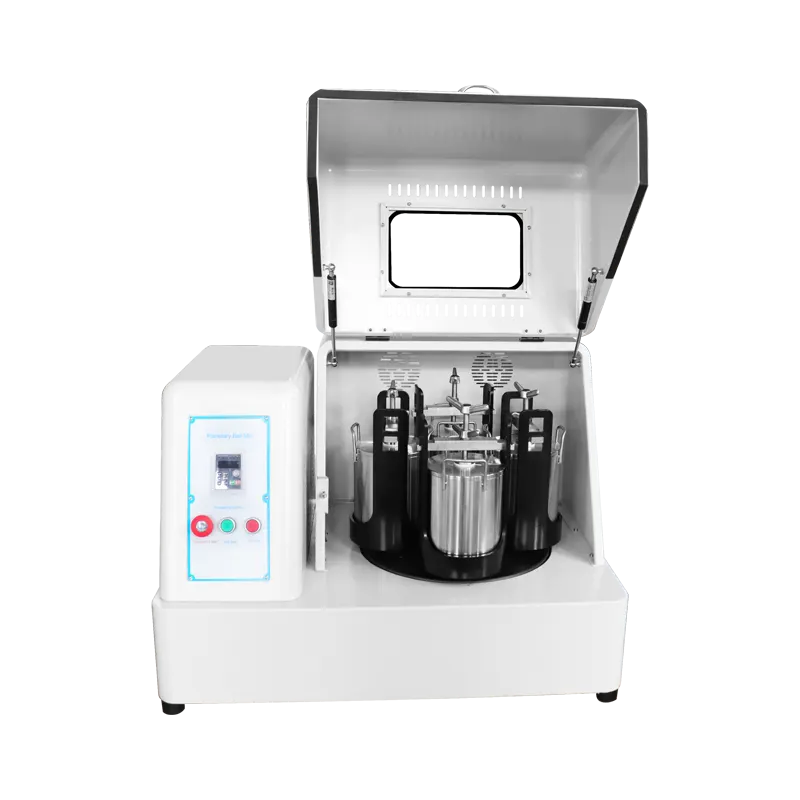
The name "planetary ball mill" comes from the motion of the grinding jars. The main rotating disk (the sun wheel) carries four or more jars, which spin on their own axes in the opposite direction. This creates a combination of centrifugal and Coriolis forces that drive the grinding balls against the inner wall of the jar, generating intense impact, friction, and shear. In a vertical square planetary ball mill, the jars are mounted vertically, and the overall machine housing is square-shaped, which provides additional stability during high-speed operation. The square design also makes it easier to integrate with other lab equipment, such as glove boxes or vacuum systems, when you need to process air-sensitive materials.
Key Differences from Horizontal or Round Models
Compared to horizontal planetary mills, the vertical orientation allows the jars to experience a more uniform gravitational field, which can reduce powder accumulation at one end of the jar. The square housing also offers better structural rigidity, minimizing vibration and noise at higher speeds. Many users find that the vertical square model is simpler to access for loading and unloading jars, especially when using lock clamps or quick-release mechanisms.
Key Features of the Vertical Square Planetary Ball Mill from TENCAN
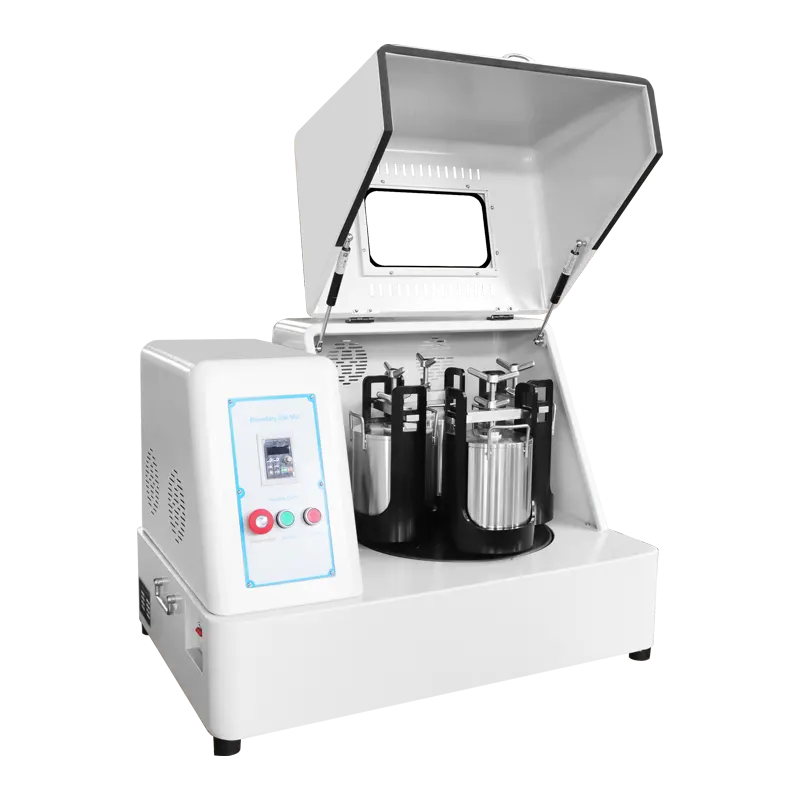
At TENCAN, we have developed a range of vertical square planetary ball mills that combine practical engineering with research-grade performance. The following features are commonly integrated into these machines:
- Compact and robust square housing – Made of corrosion-resistant steel, the body provides excellent stability even during prolonged runs at maximum speed.
- Multiple jar capacities – Standard models accept jars from 50 mL to 1 L per station, with four stations available, giving you a total effective capacity of up to 4 L depending on the jar size.
- Variable speed control – The rotational speed of the sun wheel can typically be adjusted from 50 to 600 rpm, allowing you to optimize the energy input for different materials.
- Programmable operation – Many models include a digital timer and programmable cycles for forward/reverse rotation, pauses, and multi-step grinding, which is especially useful for temperature-sensitive samples or mechanical alloying.
- Vacuum and inert gas compatibility – With optional vacuum jars, you can grind samples under vacuum or a protective atmosphere (argon, nitrogen) to prevent oxidation or moisture absorption.
- Safety interlock – The lid is designed with an interlock switch that stops the machine if the cover is opened during operation, protecting users from moving parts.
Common Applications in Research and Industry
The vertical square planetary ball mill is widely used in fields such as:
- Material science – Preparing nanoparticles, synthesizing advanced ceramics, and studying mechanical alloying of metals.
- Battery research – Grinding electrode materials (e.g., lithium cobalt oxide, graphite, silicon) for lithium-ion batteries and solid-state electrolytes.
- Geology and mining – Pulverizing rock samples, ores, and minerals for X-ray diffraction (XRD) or X-ray fluorescence (XRF) analysis.
- Chemical engineering – Mixing catalysts, pigments, and pharmaceutical powders with controlled particle size distribution.
- Environmental analysis – Preparing soil and sediment samples for heavy metal detection or organic pollutant extraction.
Because the machine can handle both dry and wet grinding, it is adaptable to a wide variety of sample types. Wet grinding with a liquid medium (such as ethanol, water, or isopropanol) can help reduce agglomeration and produce finer particles in many cases.
Important Factors to Consider When Selecting a Vertical Square Planetary Ball Mill
Choosing the right equipment for your lab involves more than just looking at the price tag. Here are several technical aspects you should evaluate:
1. Jar Material and Grinding Media
The jar material must be compatible with your sample to avoid contamination. Common options include stainless steel, zirconia (ZrO₂), agate (SiO₂), alumina (Al₂O₃), tungsten carbide, and nylon. For example, if you are grinding a hard ceramic like silicon carbide, tungsten carbide jars and balls are often recommended because they minimize wear. For biological or soft materials, agate or zirconia may be more suitable. The grinding balls should be made of the same or a harder material than the jar to prevent excessive wear.
2. Ball-to-Powder Ratio (BPR)
The ratio of the mass of grinding balls to the mass of the powder sample significantly affects milling efficiency. For many laboratory applications, a BPR of 10:1 to 20:1 is commonly used. However, this depends on the material density and target particle size. A higher BPR can increase impact energy but may also generate more heat and cause faster wear.
3. Rotational Speed and Milling Time
Faster speeds generally produce finer particles, but they also raise the temperature inside the jar. For materials that are heat-sensitive or prone to phase transformation, you may need to use a lower speed and longer milling time, or incorporate pauses (e.g., 10 minutes run, 5 minutes rest) to allow cooling. The vertical square design helps dissipate heat slightly better than fully enclosed horizontal models because the jar surface is more exposed to ambient air.
4. Capacity and Throughput
If you are processing small batches less than 50 grams, a micro planetary mill may be sufficient. For routine sample preparation of 100–500 grams per batch, a vertical square mill with 500 mL jars is a sensible choice. For larger volumes, consider a production-scale vertical planetary mill. Remember that the actual usable volume of a jar is about 60–70% of its total capacity, because you need space for the grinding balls and the powder to move freely.
5. Voltage and Power Supply
Laboratory equipment is often shipped globally, so confirm that the motor voltage (110V or 220V) and frequency (50/60 Hz) match your local supply. Most TENCAN models are available with dual-voltage options or can be customized for different regions.
Practical Tips for Successful Grinding
Even with a high-quality vertical square planetary ball mill, achieving the desired particle size requires careful attention to process parameters. Here are some suggestions based on common laboratory experience:
- Start with a small test batch – Use a small jar (e.g., 50 mL) to optimize parameters before processing larger quantities.
- Use graded ball sizes – A mixture of 10–20 mm balls provides strong impact, while 3–5 mm balls increase contact points for finer grinding. A combination often works better than a single size.
- Consider wet grinding for sticky materials – If your powder tends to agglomerate or adhere to the jar walls, add a small amount of liquid (typically enough to cover the powder) to improve dispersion.
- Monitor temperature rise – For materials like polymers or certain sulfides, excessive heat can cause melting or decomposition. Use intermittent operation and allow the jar to cool between cycles.
- Clean jars and balls thoroughly – Cross-contamination between samples can compromise your results. Dedicate specific jars to specific material families if possible.
Final Thoughts on the Vertical Square Planetary Ball Mill
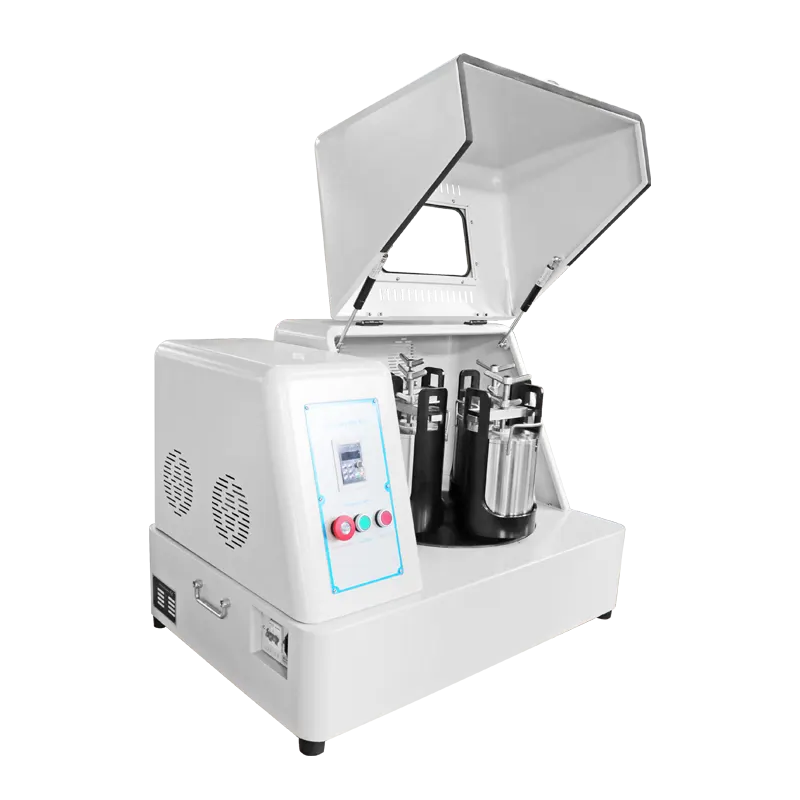
The vertical square planetary ball mill is a workhorse in many laboratories because it offers a balance of power, versatility, and ease of use. Whether you are developing new battery materials, studying mechanical alloying, or simply preparing routine samples for analysis, this type of mill can deliver consistent results. TENCAN has been manufacturing planetary ball mills for years, and our vertical square series is designed with the feedback of researchers from universities and industry. If you need assistance selecting the right jar size, grinding media, or vacuum configuration, our technical team can help you based on your specific material and process requirements. When you are ready to discuss your application, the information you will need to share includes: the material name and composition, initial particle size, target particle size, batch quantity, preferred jar material, and whether you need vacuum or inert gas protection. That way, we can recommend the most suitable model and accessories for your work.