
Vertical Square Planetary Ball Mill Guide
Laboratory grinding rarely fails because a mill lacks power. It fails because the chosen jar, ball set, load, and protocol push the sample in a direction the operator did not intend. A vertical square planetary ball mill is a useful platform for small-batch size reduction, mixing, and mechanochemical work, but its results depend on how the whole grinding system is matched to the material. The machine supplies motion; the jar and media define the contact mechanics; the protocol decides whether those contacts produce a narrow particle size distribution or unwanted heat, contamination, and agglomeration.
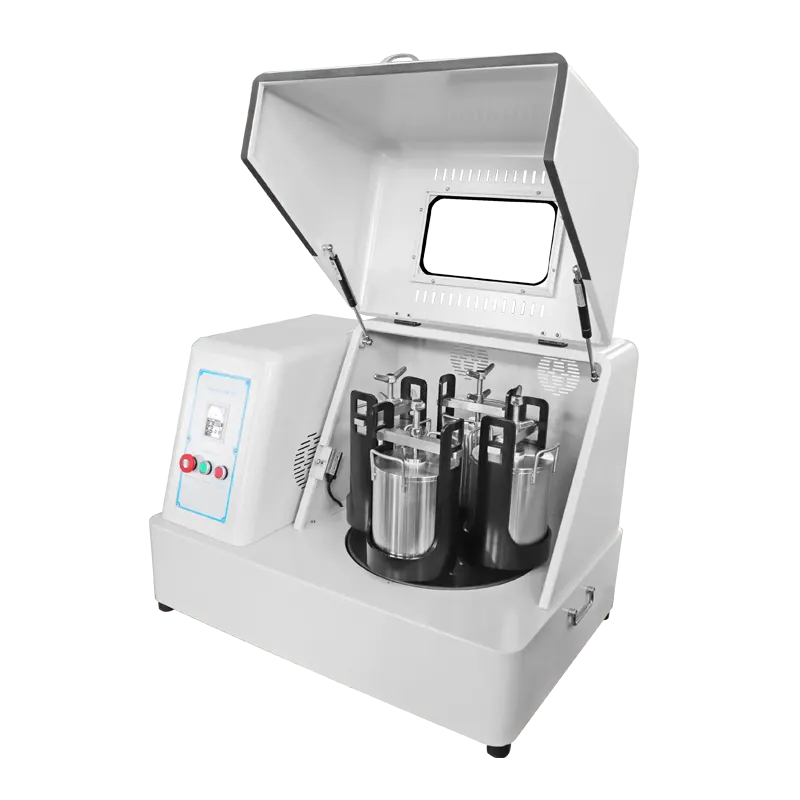
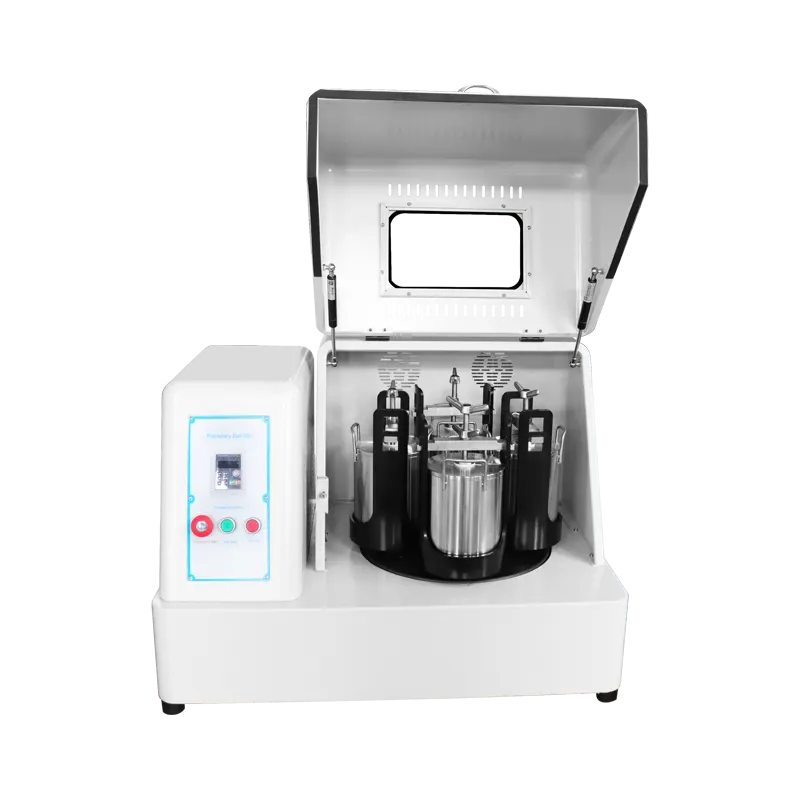
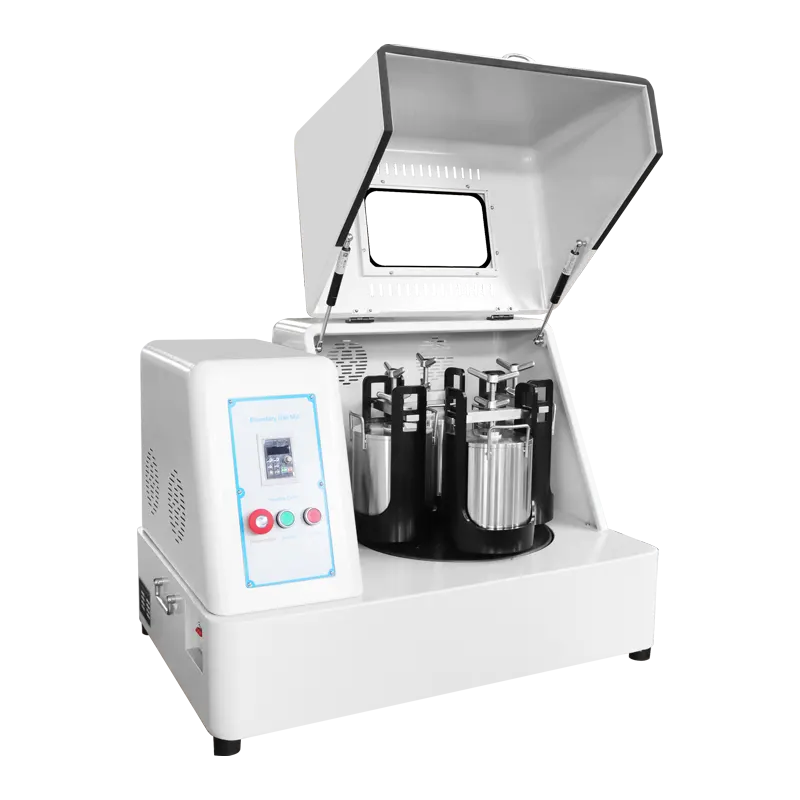
TENCAN supplies the vertical square planetary ball mill as part of its planetary ball mill range. The product page is the right place to confirm the available jar materials, electrical configuration, and accessory set for a specific order, because those details can change by configuration. This guide focuses on the process decisions that sit around the machine: jar selection, ball selection, loading, wet versus dry operation, contamination control, and the checks that make a laboratory result reproducible.
A planetary mill is not a universal particle-size reducer. It is a high-energy batch tool whose performance is bounded by the sample, the grinding set, and the protocol. That distinction matters when comparing a vertical square planetary ball mill with a stirred media mill, a jet mill, or a vibratory mill. Each device applies energy differently, and each has a different place in the laboratory workflow. The planetary mill is often chosen when a researcher needs compact batch processing, multiple jar configurations, and enough energy to reach fine sizes in a small sample.
What the Vertical Square Planetary Ball Mill Does in a Lab
Planetary milling takes its name from the motion of the jars. Each jar sits on a carrier that rotates around a central axis while the jar itself rotates in the opposite direction. The combination creates centripetal and Coriolis effects inside the jar. Grinding balls are lifted against the jar wall, then travel across the charge and strike or shear it. The result is a mix of impact, attrition, and friction. In a laboratory planetary mill, those mechanisms can be intense for a small sample, which is why the technique is used for fine comminution, homogenization, alloying, and mechanochemical reactions.
The “vertical square” part of the name describes the product configuration rather than a separate grinding principle. It should not be read as a promise of a particular particle size or throughput. The same fundamental questions apply: what is the jar volume, what material is the jar, what media are used, how much powder is loaded, and how are speed and time controlled? A buyer who starts with those questions will make a better decision than one who compares only the outer dimensions of the machine.
The mill is not a continuous production device in the same sense as a stirred media mill or a jet mill. It works in batches. That batch character is an advantage in research because it allows several small samples, different jar materials, or parallel conditions to be tested on one compact platform. It is a limitation when a project needs kilograms per hour. For process development, the vertical square planetary ball mill is most valuable as a controlled environment for learning how a material responds to energy input before the process is transferred to a larger scale.
In a typical laboratory sequence, the mill may be used for coarse pre-grinding, fine grinding, mixing of powders, or activation of a surface. Those tasks are related but not identical. Coarse size reduction benefits from larger, denser media and sufficient impact energy. Fine grinding and dispersion depend more on contact frequency, media surface area, and the rheology of the charge. Mechanochemical activation may require a specific energy dose rather than the smallest possible particle size. Treating all three as the same grinding job is a common source of disappointing results.
The vertical square planetary ball mill also needs to be understood as part of a sample-preparation chain. Feed size, sample moisture, and the method used to assess the product all influence the conclusion. A mill can produce a fine powder that immediately agglomerates during handling or measurement, making the result look worse than the comminution actually was. Likewise, a sample that is already fine may show little apparent size change while its surface area, crystallinity, or reactivity has changed substantially. The operator should define the success criterion before the first run, not after the powder is removed from the jar.
Jar Material and Grinding Media Decide the Contamination Risk
The jar and balls are not neutral. They are the surfaces that transfer energy to the sample, and they are also the most likely source of wear contamination. A jar that is perfectly acceptable for a mineral sample may be a poor choice for a battery cathode precursor or a high-purity oxide. The decision is not simply “hard jar versus soft jar.” It is a balance among hardness, toughness, chemical compatibility, thermal behavior, cleaning requirements, and the value of the sample.
Jar material selection
Agate, zirconia, corundum, tungsten carbide, stainless steel, PTFE, nylon, and polyurethane are common laboratory jar options for different reasons. Dense ceramic jars resist wear during hard-mineral grinding, but they can add their own trace elements to the sample. Polymer jars reduce the risk of metal contamination and are useful for soft or chemically sensitive materials, although they may wear faster or tolerate less heat. Stainless steel is convenient and robust, but it is not appropriate when iron or chromium contamination would invalidate the analysis. The final choice should be made against the analytical method: if the measurement cannot tolerate the jar's wear products, the jar is unsuitable even if it grinds quickly.
Jar volume is another practical constraint. A jar that is too large for the available sample wastes energy and makes recovery difficult. A jar that is too small limits media movement and may overheat. The working volume should leave free space for the balls and powder to move; a jar packed to the lid cannot reproduce the same collision pattern as a properly loaded jar. When ordering a vertical square planetary ball mill, confirm which jar sizes and materials are available for the intended sample range rather than assuming that all laboratory jar types are interchangeable.
Ball size, density, and ball-to-powder ratio
Grinding balls transfer energy through collisions and surface contacts. Larger balls deliver more impact, which helps break coarse or hard particles. Smaller balls create more contact points and more shear, which can improve fine grinding and mixing, but they also require more careful separation from the product. A narrow ball-size range gives a more predictable collision spectrum. A mixed charge can improve packing or fill space between large balls, but it complicates reproducibility because the effective contact pattern is less well defined.
Ball density matters as much as ball size. High-density media carry more kinetic energy at a given rotational speed, but they also increase wear on the jar and can raise the temperature of the charge. Low-density media are gentler, yet they may not supply enough energy for a hard material. The right compromise depends on the target particle size and on how much contamination the analysis can tolerate.
Ball-to-powder ratio is one of the most important variables to record. A high ratio increases the number of ball-to-particle contacts per unit of powder and can shorten the time needed to reach a given fineness, but it also increases heat, jar wear, and the risk of over-grinding. A low ratio may leave too much powder cushioning the collisions. There is no universal ratio that can be copied from one material to another. The useful approach is to fix the jar, media, and sample mass, then change one variable at a time and measure the result.
Wet and dry grinding
Dry grinding is simpler because it avoids solvent handling, drying, and jar-pressure concerns. It can be effective for brittle materials that do not cake. Its weaknesses appear with fine powders: particles may stick to the jar wall, fill the spaces between balls, and reduce collision efficiency. Dry grinding can also generate dust during loading and recovery, which is a concern for toxic or high-value materials.
Wet grinding can reduce caking and improve dispersion because the liquid helps transport particles and dissipate heat. It is often useful for fine grinding and for materials that would cold-weld or agglomerate in a dry charge. However, the liquid introduces new variables. Its viscosity changes as fines are produced. It may react with the sample, soften the jar, or create pressure in a sealed jar. The product then needs separation and drying, which can cause agglomeration or change the surface chemistry. For a vertical square planetary ball mill, wet operation should be planned with the same attention to jar sealing, gasket compatibility, and cleaning as the dry route.
Process Variables That Shift Particle Size Distribution
Particle size distribution is more informative than a single average size. A sample can have the same median size but a different amount of fines or coarse tail, and those differences affect flow, sintering, reactivity, and suspension stability. When evaluating a planetary ball mill run, the operator should ask not only “how fine is it?” but also “how wide is the distribution, and did the fine fraction form by comminution or by agglomeration?” The answer determines whether the next step is more energy, less energy, a different medium, or a different measurement method.
Rotational speed and energy input
Increasing rotational speed raises the energy of each collision and the frequency of contacts. Up to a point, this can accelerate size reduction. Beyond that point, the balance shifts. Heat builds up, jar wear increases, and fine particles may re-agglomerate or adhere to the media. A higher speed is not automatically a better speed. For heat-sensitive materials, a lower speed with longer duration or with programmed pauses may produce a more useful product than a short, intense run.
The speed also interacts with jar size and media load. A small jar with dense media may reach an effective energy level at a lower setting than a large jar with light media. This is why a protocol cannot be transferred between machines without verification. The vertical square planetary ball mill should be commissioned with a small design-of-experiments set: two or three speeds, a fixed media charge, and a measured response. That small investment prevents weeks of inconclusive grinding.
Milling time and the point of diminishing returns
In many laboratory grinding curves, particle size falls quickly at first, then more slowly, and finally reaches a plateau. Continuing beyond the plateau may not reduce the primary particle size. Instead, it can increase contamination, change crystallinity, and promote agglomeration. The apparent size may even rise if the measurement detects agglomerates rather than primary particles. A time series is therefore more useful than a single long run. It shows where the useful grinding window ends for that material and that jar.
Fill ratio and jar loading
A jar needs free volume for the media to move and for the powder to be caught between them. Overloading the jar with powder cushions the balls and reduces impact energy. Overloading it with balls leaves too little space for the sample and raises the risk of jamming or excessive heat. Underloading can also be inefficient because much of the energy is spent on ball-to-ball collisions rather than on the powder.
Loading should be recorded by mass, not by eye. The same “half-full” jar can contain very different masses of media depending on material density. If the process is transferred to another operator, a mass-based record is the only reliable way to reproduce the charge. The same principle applies to the sample: a small change in sample mass can change the ball-to-powder ratio enough to shift the result.
Temperature, atmosphere, and sensitive samples
Planetary milling adds energy to the sample, and much of that energy becomes heat. Temperature-sensitive polymers, pharmaceuticals, and some hydrated minerals may degrade, soften, or transform during a long run. Intermittent milling, lower speed, a smaller jar, or a cooled environment can reduce the thermal load. The correct choice depends on how the material responds, not on a generic rule.
Air-sensitive materials add another layer. A standard jar is not automatically a controlled-atmosphere vessel. If the sample must be protected from oxygen or moisture, the jar design, gasket, and loading procedure need to be confirmed with the supplier. The same caution applies to solvents: a sealed jar that is suitable for one liquid may not be suitable for another. Compatibility should be checked before the first run, not after a leak or deformation appears.
Matching Material Behavior to a Milling Strategy
Material properties should drive the grinding strategy. Hardness tells you how much energy is needed to initiate fracture. Toughness tells you whether fracture will propagate or whether the material will deform. Ductility and stickiness tell you whether the powder will cold-weld, coat the media, or bridge the jar. Thermal sensitivity and chemical reactivity tell you how much heat and contamination the sample can tolerate. A single “standard” protocol ignores all of these differences.
Hard and brittle ceramics and minerals
Hard, brittle materials usually respond well to impact-dominated grinding. Dense media and a sufficiently high energy input can initiate cracks and reduce particle size. As the powder becomes finer, the balance may shift toward smaller media and more surface contact. The tradeoff is contamination: the same hardness that makes the sample difficult to grind also wears the jar and balls. A wear-resistant ceramic set may be appropriate, but the analyst should confirm that the resulting trace elements do not interfere with the measurement.
Soft, sticky, and ductile materials
Soft or ductile materials can deform instead of fracturing. They may coat the balls and jar wall, reducing the efficiency of subsequent collisions. In extreme cases, the powder cold-welds into larger masses. Dry grinding may be possible with short cycles and careful loading, but wet grinding or a different media size can sometimes improve dispersion. The operator should inspect the jar after a short trial rather than committing to a long run. If the charge is already coated at five minutes, extending the run is unlikely to solve the problem.
Battery, catalyst, and fine chemical samples
These materials often combine a small batch size with a strict contamination budget. Iron, chromium, zirconium, or other wear products may be unacceptable even at low levels. A polymer-lined jar or a ceramic set may reduce metal contamination, but it may also change the achievable particle size or introduce other trace species. The correct choice depends on the analytical limit and on the chemistry of the sample. Moisture and oxygen sensitivity may require a controlled-atmosphere procedure that is validated separately from the grinding step.
Small or high-value samples
When the sample is scarce or expensive, recovery and dead volume become part of the process design. A jar that is easy to clean and a media set that is easy to separate can matter more than a small gain in grinding speed. The operator should account for hold-up on the jar wall, gasket, and balls. A mass balance before and after milling is a simple quality check. If recovery is poor, the nominal batch size is misleading.
| Material challenge | Practical response | What to verify |
|---|---|---|
| Hard, brittle particles | Use dense media and a staged grinding protocol | Jar wear and trace contamination |
| Soft or ductile particles | Short cycles, lower energy, or wet processing | Coating on media and cold welding |
| Heat-sensitive sample | Lower speed, pauses, or smaller batches | Temperature rise and product stability |
| High-purity sample | Dedicated jar and compatible media | Blank run and detection limits |
Contamination Control and Cleaning Discipline
Contamination in planetary milling comes from several places: jar wear, media wear, gasket contact, airborne dust, and carryover from a previous sample. The largest source is often the grinding set itself, especially when hard media are run at high energy for a long time. A second source is inadequate cleaning between materials. A third is the sample handling step, where fine powder can be lost or picked up from a shared glove box, sieve, or spatula.
Dedicated jars and traceability
For demanding work, a dedicated jar and media set per material family is easier to defend than a shared set with a cleaning record. Dedicated sets reduce the risk of cross-contamination and make wear trends easier to see. If shared jars are unavoidable, the cleaning procedure should be validated with a blank run or a wipe test. The jar identity, media type, and previous sample should be recorded in the batch log. This is especially important when the vertical square planetary ball mill is used for both development samples and customer projects.
Cleaning without damaging the jar
Cleaning methods must match the jar material. A brush and dry wipe may be enough for a dry mineral sample, while a polymer jar may require a gentler procedure to avoid scratches that trap fines. Solvents should be selected for compatibility with the jar, gasket, and sample. After cleaning, the jar should be fully dry before the next charge; residual solvent can change the rheology of a wet grind or react with a sensitive powder. Gaskets and sealing surfaces deserve particular attention because they are easily overlooked and can carry fines from one run to the next.
Wear checks
Media and jar wear are gradual, so the change may go unnoticed until a result drifts. A simple inspection routine helps: look for discoloration, pitting, chipped edges, flattened balls, or a gasket that no longer seals cleanly. Track the mass of the media set if the application is sensitive. Replace worn parts before they become a source of variability. A mill that is mechanically sound but fitted with worn media is not a reliable process tool.
Scale-Up, Reproducibility, and Maintenance Checks
Scale-up from a laboratory planetary mill is not a simple multiplication of batch size. Jar diameter, media size, fill ratio, speed, and heat removal all change with scale. A protocol that produces a fine powder in a small jar may overheat or stall in a larger vessel. The practical route is to treat the laboratory result as a process window, then verify it in a larger unit with the same material and a measured response. The vertical square planetary ball mill is most useful in this phase when the operating variables are recorded well enough to be transferred.
From a lab jar to a larger batch
A scale-up trial should keep the material chemistry and media material constant while changing one mechanical variable at a time. If the larger run cannot match the energy input, it may need a different media size or a longer residence time. If it matches the energy but not the heat removal, it may need pauses or a lower speed. The goal is not to copy the laboratory numbers; it is to reproduce the useful contact mechanism. That distinction is often missed when a buyer compares mills only by motor power.
Building a repeatable SOP
A reproducible milling record should include the jar material and volume, media material and size, media mass, sample mass, ball-to-powder ratio, liquid and additive amounts, rotational speed, total time, pause pattern, atmosphere, and cleaning method. It should also include the measurement method and the sampling procedure. Results can differ simply because one operator sieved the product and another measured it by laser diffraction. The SOP should define how the sample is sub-sampled and how the instrument is prepared.
For a vertical square planetary ball mill, the SOP should also state how jars are seated and checked before the run. An incorrectly seated jar can create noise, vibration, or uneven wear. The operator should confirm that the lid, gasket, and clamp are compatible and properly closed. These checks take less time than a failed batch and are especially important when the mill is shared by several research groups.
Routine maintenance
Routine maintenance should focus on the parts that affect motion and sealing. Listen for new noise, feel for unusual vibration, and check for loosened clamps or worn gaskets. Keep the jar seating surfaces clean. If the mill has a cooling or ventilation requirement, confirm that it is not blocked. Electrical and control checks should follow the manufacturer's instructions. Maintenance records are useful because they show whether a change in grinding performance followed a mechanical event.
Selection checklist
- Define the target particle size and the acceptable particle size distribution, not just a single average.
- Confirm the maximum feed size and whether pre-crushing is needed before planetary milling.
- Select a jar material that is compatible with the sample and the analytical method.
- Choose a media material and size that can supply the required energy without exceeding the contamination budget.
- Decide between dry and wet processing, including solvent compatibility, sealing, and drying.
- Plan a ball-to-powder ratio and working volume that leave room for media movement.
- Check whether the process needs cooling, pauses, a controlled atmosphere, or a glove box.
- Confirm the available jar sizes, gaskets, and accessories for the exact vertical square planetary ball mill configuration.
The most useful next step is usually a small, instrumented trial rather than a larger purchase. Run a representative sample at two or three energy levels, inspect the jar for coating or wear, and measure the product with the same method that will be used for the final specification. TENCAN's planetary ball mill product page provides the starting point for confirming the machine configuration, while the material and process data determine whether that configuration is appropriate. A well-matched protocol, not a single machine specification, is what turns a vertical square planetary ball mill into a reliable laboratory tool.