
PU Planetary Mill Jar: Material, Fit, and Use
Choosing a milling jar often looks like a simple accessory decision until a batch is contaminated, a lid leaks, or a polymer jar deforms under a heavy media charge. In a planetary ball mill, the jar is part of the process chamber: it receives the sample, contains the grinding media, transfers impact energy, and controls the environment around the powder. A PU planetary mill jar can be a practical choice for certain laboratory applications, but it is not a universal replacement for ceramic, agate, stainless steel, or PTFE jars. The useful question is not whether polyurethane is better in general, but whether its mechanical and chemical behavior fits the sample, the mill, and the analytical method that follows.
TENCAN supplies a PU planetary mill jar for laboratories that need a polymer milling container rather than a ceramic or metal jar. The material choice affects more than purchase price. It influences wear debris, sealing, cleaning time, permitted solvents, grinding energy, and the way a method is validated. This guide treats the jar as a process component and explains where polyurethane is a reasonable fit, where it needs testing, and which checks should happen before a method is released.
What a PU Planetary Mill Jar Is and What It Is Not
A PU planetary mill jar is a milling container made with polyurethane and used with a planetary ball mill. The jar body, lid, and sealing arrangement form the closed chamber in which sample and media collide. In many laboratory setups the jar is clamped in a sun wheel or planetary carrier and rotated around its own axis while the carrier turns in the opposite direction. The resulting motion lifts the media, throws it against the sample and the jar wall, and generates friction. The jar therefore has to hold the charge, transfer energy, and keep the contents inside.
Polyurethane is a family of polymers rather than a single material. The name indicates the general chemistry of the jar, not its hardness, filler content, stiffness, or resistance to a specific solvent. Two products described as PU jars may behave differently because the formulation and manufacturing method differ. That is why a technical discussion should start with the actual jar and its supplier data, not with a generic assumption that all polyurethane is the same.
The distinction matters because the jar sees repeated impact, sliding abrasion, torque at the lid, and temperature rise. A jar that works for a short trial may still creep or wear during long campaigns. Conversely, a jar that shows surface marks after a few runs may be behaving normally. The question is whether the wear is acceptable for the application and whether the jar remains dimensionally stable, sealable, and cleanable.
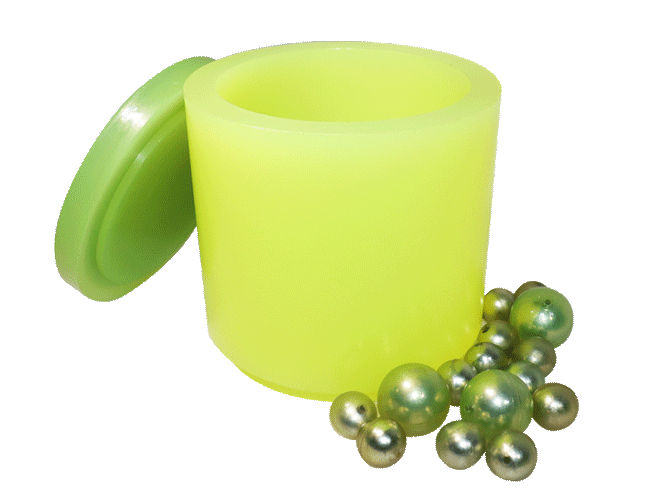
A PU planetary mill jar for laboratory sample milling; exact dimensions and sealing details should be confirmed for the mill model.
A PU jar should not be treated as a high-energy ceramic jar with a polymer appearance. It is not automatically suitable for hard abrasive minerals, aggressive solvents, high-temperature reactions, or trace-metal-sensitive work simply because it is not metallic. Polyurethane can reduce some concerns associated with metal jars, but it can introduce its own wear particles, swelling, softening, or static effects. Those risks need to be assessed with the sample chemistry and the analytical method in mind.
Where a Polymer Jar Fits in the Laboratory
The most sensible starting point is a sample that is soft to moderately hard, compatible with the polymer, and not so abrasive that jar wear becomes the dominant cost. Laboratories often examine polymer jars when they want to avoid direct contact with stainless steel or when a ceramic jar is unnecessarily brittle for the duty. They also use them for mixing, homogenization, and size reduction where the target is a fine powder but not an extreme comminution duty.
Applications may include polymer powders, pigments, some organic materials, and composite mixtures, but these examples are not approvals. Each material still requires a compatibility test. A powder that is chemically inert may still abrade the jar; a solvent that looks mild may swell the polymer; a soft material may become sticky as the jar warms. The selection process should combine material data, a small trial, and a cleaning check rather than relying on a single label such as PU.
What the jar is not is equally important. It is not a substitute for agate when the priority is extremely low contamination in a brittle, non-metallic system. It is not a substitute for zirconia or another wear-resistant ceramic when the feed is hard and abrasive. It is not a substitute for PTFE when broad chemical inertness is the main requirement, and it is not a substitute for a metal jar when impact energy and mechanical toughness dominate. Each material has a different balance of contamination, wear, cost, and chemical resistance.
Why Polyurethane Changes the Milling Decision
Polyurethane is viscoelastic. It does not behave like a rigid ceramic or steel wall. Under the repeated impacts of grinding media it can absorb part of the energy, deform locally, and recover. That behavior can be useful when the sample is sensitive to hard impacts or when a less brittle container is preferred. It also changes the energy budget: some of the mill input goes into the jar rather than into fracturing the sample. The practical result depends on media mass, mill speed, jar size, and feed hardness, so a PU jar should not be expected to reproduce the grinding curve of a denser ceramic jar without adjustment.
Contamination and Sample Integrity
Contamination has several sources in a planetary mill: the jar, the lid, the seal, the grinding media, the atmosphere, and the sampling tools. A polymer jar avoids the direct metallic wear that can occur with a steel jar, but it does not eliminate contamination. Polyurethane can generate polymer wear particles, especially at edges, sealing surfaces, and areas hit by media. The amount may be small, yet it can matter in trace analysis, spectroscopy, or any method with a low detection limit.
A blank run is the simplest way to find out. Mill the intended media with a representative solvent or with the same sample matrix, then analyze the blank using the same method that will be used for the sample. If the blank shows polymer fragments, color bodies, or interfering peaks, the jar is not suitable for that method even if it appears visually clean. Visual inspection is useful for damage, but it cannot prove the absence of sub-visible wear.
Seal material deserves separate attention. The jar body may be polyurethane while the sealing element is a different elastomer. A solvent that is compatible with the body may attack the seal, and a seal that swells can make the lid difficult to remove or leave a gap. Ask for the wetted materials, not just the jar material, and test the assembled polyurethane planetary mill jar with the actual solvent before running valuable sample.
Mechanical Behavior Under Planetary Milling
Planetary mills can generate strong centrifugal forces, and the media charge can be heavy relative to the jar. A polymer wall can flex slightly under those conditions. Small flexure is not necessarily a problem, but repeated flexure at a lid thread, groove, or clamp contact point can lead to creep. The user should check the jar after each run for loose fit, a changed lid profile, or a sealing surface that no longer sits flat. A jar that has become tight or oval should be taken out of service rather than forced back into the mill.
Media selection strongly influences this risk. Large, dense, sharp media deliver more impact and abrasion than small, rounded media. If a PU jar is used with an aggressive media charge, the polymer may wear faster at the impact zone. A more conservative starting point is to use media that is appropriate for the target size and compatible with the polymer, then increase energy only after inspecting the jar and the sample. The jar should not be used as a test bed for media that is clearly too large or too sharp for its wall thickness.
Chemical and Thermal Boundaries
Polyurethane formulations differ in resistance to acids, bases, oils, alcohols, ketones, and aromatic solvents. A material that swells in one solvent may be stable in another. Because the product name does not define the formulation, the supplier should be asked for chemical compatibility information for the specific jar, and the user should confirm it with a small exposure test. Swelling, softening, tackiness, color change, or a strong odor after exposure are reasons to stop and reassess.
Temperature is another boundary. Planetary milling generates heat through friction and impact, and a sealed polymer jar can retain that heat. A long run at high energy may warm the sample and the jar more than a short trial. If the method is temperature-sensitive, run in short intervals, monitor the jar exterior, and allow cooling between cycles. Do not assume that a polyurethane jar is suitable for elevated-temperature processing just because it feels tough at room temperature.
When the application requires broad solvent resistance, very high wear resistance, or a tightly controlled trace-metal profile, a different jar material may be the better engineering choice. That is not a criticism of PU; it is a recognition that material selection is a compromise. The correct decision is the one that matches the sample and the analytical requirement, not the one that uses the most chemically resistant or hardest material by default.
Matching the Jar to the Mill, Media, and Sample
A jar is only part of a milling system. The mill clamp, the jar seat, the lid height, the media charge, and the sample volume all interact. A PU jar that fits one planetary mill may not fit another even if the nominal volume sounds similar. Before ordering, confirm the jar diameter, height, lid profile, and clamping method against the mill model. A jar that sits too high, too low, or off-center can run with vibration, damage the lid, or create an inconsistent grinding path.
Fit, Sealing, and Pressure
The sealing system should be inspected before every run. A flat gasket, an O-ring, and a threaded lid each have different sensitivities to torque and contamination. Powder on the sealing surface can create a leak path; over-tightening can distort a polymer lid; under-tightening can allow fine powder to escape. Clean the sealing surfaces, seat the gasket correctly, and tighten according to the supplier instruction rather than by feel alone.
Sealed jars can develop internal pressure when the sample or solvent releases vapor or when the milling process warms the contents. The risk depends on the solvent, fill level, and temperature. Do not fill a jar completely, and do not use a volatile solvent without confirming that the jar and seal are suitable. If the lid becomes hard to remove or shows bulging, stop the run and allow the jar to reach a safe condition before opening. A pressure release should never be improvised by loosening a lid while the jar is in motion.
Grinding Media and Jar Wall Interaction
Media density, diameter, shape, and loading determine the energy delivered to the powder. Dense media can shorten milling time but also increase impact on the jar wall. Small media create more contact points and may be better for fine grinding, while large media are more effective for breaking coarse particles. The right balance is found by testing, not by assuming that more media or larger media will always improve the result.
For a polymer jar, the media should be compatible with the jar material as well as the sample. Sharp, worn, or corroded media can scratch the polymer and create sites for further wear. Media that is too large for the jar diameter may concentrate impact in a small area. Media that is too small may not have enough mass to reduce the feed. Inspect media regularly, remove cracked or deformed pieces, and keep a separate media supply for each material family when cross-contamination matters.
The media-to-powder ratio is another variable. Too little powder can leave the media colliding with the jar and with each other, increasing wear and heat. Too much powder can cushion the media and slow breakage. A practical starting point is to fill the jar with media and powder so that the media can move freely, then adjust based on particle size and temperature. There is no universal ratio that applies to every sample.
Dry and Wet Processing
Wet milling can improve dispersion, reduce dust, and help control temperature, but it adds a solvent compatibility question. The liquid must be compatible with the PU jar, the lid, and the seal, and it must be removable from the sample without changing the product. A solvent that swells the polymer may change the jar dimensions or leave a residue. A solvent that is too volatile may build pressure. A solvent that reacts with the powder may alter the chemistry rather than simply suspend it.
Dry milling avoids solvent removal but can create more dust, heat, and coating on the jar wall. A polymer jar may develop static, causing fine powder to cling to the lid and walls. That is not necessarily a defect, but it affects recovery and sampling. If static is a problem, allow the jar to settle, use a grounded handling procedure where appropriate, and avoid dry brushing that generates a dust cloud. The method should specify how the jar is opened and how the powder is recovered.
Speed, Time, and Fill Level
Higher speed increases impact energy, but it also increases heat and jar stress. A long high-speed run is not automatically better than a shorter run at a moderate speed. For a polymer jar, the conservative approach is to start below the maximum capability of the mill, run a small trial, and inspect both the sample and the jar. If the jar becomes warm, soft, or marked at the contact points, reduce the energy input or shorten the interval.
Fill level should leave room for media movement. An overfilled jar can behave like a paste, reducing collision energy and raising torque. An underfilled jar wastes capacity and may increase media-to-media impact. The right level depends on bulk density, media size, and whether the process is dry or wet. Record the fill level, media charge, speed, and time so the method can be repeated.
Particle Size, Temperature, and Process Control
Target particle size is a specification, not a promise. A PU jar can be used in a milling method that reaches fine particles, but the result depends on feed hardness, feed size, media, speed, time, and the energy lost to the polymer wall. The same jar and media combination may produce different distributions for two materials. A trial should measure the distribution, not just the median size, because a narrow or broad span can matter more than a single D50 value.
Feed Size and Pre-Treatment
Planetary ball mills are often used for laboratory-scale fine grinding, but they are not the first choice for very large feed. A coarse feed should be crushed or pre-milled by a method that is appropriate for the material. If the feed contains large hard particles, the media may not be able to fracture them efficiently, and the jar wall may receive unnecessary impact. Reducing the feed size before planetary milling can shorten the run and reduce wear.
Feed size also affects sampling. A small laboratory jar holds a limited amount of powder, and a coarse, heterogeneous feed may not be representative after a short run. If the sample is a composite or a mineral with several phases, the harder component may concentrate in the coarse fraction while the softer component breaks first. Particle size results should therefore be interpreted together with composition and sampling method.
Heat, Agglomeration, and Polymer Limits
Heat is one of the main practical limits in high-energy ball milling. Friction and impact warm the jar, the media, and the powder. A polymer jar has a lower thermal tolerance than a ceramic or metal jar in many formulations, and the exact limit should be obtained from the supplier rather than assumed. If the method is sensitive to temperature, use shorter cycles, lower speed, or a cooling pause. Do not open a warm jar immediately if the contents may be under pressure or sensitive to air.
Fine particles can agglomerate, especially in dry milling. Agglomerates may look like a coarse fraction in a particle size measurement even when the primary particles are fine. Wet milling with a suitable dispersant can reduce this effect, but the dispersant becomes part of the method and must be removed or accounted for. In dry processing, gentle sieving or a controlled dispersion step before analysis can reveal whether the measured size is real or an artifact.
Sampling and Distribution Checks
A single spot sample from the jar may not represent the batch. Powder can stratify by size or density, and fine material may cling to the lid or the wall. Take a representative sample after mixing, or follow a documented sampling procedure. For method development, measure at least the median and the spread, and compare the shape of the distribution rather than only one number. A change in the fine tail can matter for flow, sintering, or reactivity even when the median is unchanged.
Repeatability should be checked with the same jar, media, and operating sequence. If the result shifts after several runs, inspect the jar for wear and the media for damage. A worn jar may change the energy transfer, and worn media may change the collision frequency. Replacing one component without checking the others can make the source of variation difficult to identify.
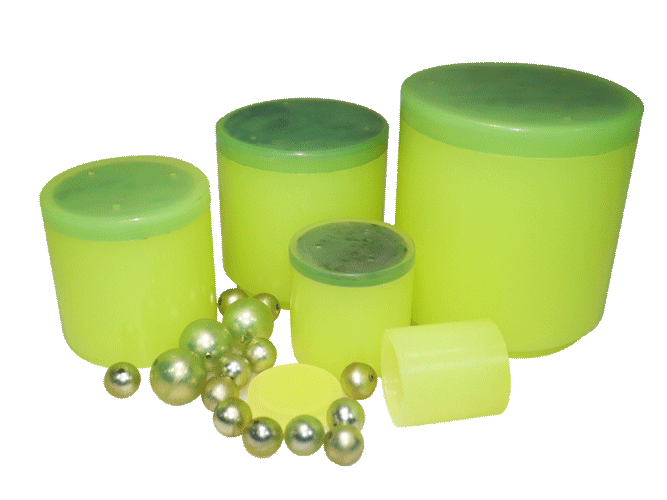
Polyurethane jars should be checked for sealing, wear, and solvent compatibility before a method is released.
Cleaning, Reuse, and Maintenance Checks
Cleaning a PU jar requires a balance between removing residue and damaging the polymer. Soft brushes, mild compatible cleaning agents, and careful rinsing are generally safer than abrasive pads or sharp scrapers. The correct solvent depends on the sample and the jar formulation, so the supplier compatibility guidance should be followed. A solvent that removes the sample quickly may also swell or soften the jar, especially at the sealing groove and lid threads.
Cleaning Procedure and Drying
A practical cleaning sequence is to remove loose powder with a soft tool, wash with a compatible cleaning solution, rinse with a compatible solvent or water, and dry completely before reassembly. The jar should not be closed while wet if trapped moisture can affect the next batch or the seal. Pay attention to the lid, the groove, and the area around the gasket. These are the places where fine powder and cleaning liquid collect.
Do not use metal scrapers, wire brushes, or highly abrasive cleaning compounds on a polymer jar. They can create scratches that hold powder and accelerate wear. If a residue cannot be removed with a soft method, do not assume that harsher cleaning is safe. The jar may need to be dedicated to that material, or the method may need a different jar material.
Inspection Before Reuse
Inspect the jar in good light after cleaning. Look for cracks, deep scratches, discoloration, deformation at the rim, a loose lid fit, or a seal that no longer sits properly. A small surface mark may be cosmetic, but a crack or a changed sealing surface is a reason to replace the jar. Do not use a damaged polymer jar for a sealed run with solvent or reactive powder.
Check the lid and seal as separate items. A jar body may look sound while the seal is compressed, swollen, or hardened. If the seal is replaceable, follow the supplier replacement guidance. If the seal is not replaceable, the jar assembly should be assessed as a unit. A leaking jar can lose sample, release dust, or allow air and moisture to enter, so the seal is part of the technical specification rather than a disposable accessory.
Cross-Contamination and Storage
Dedicate a jar to one material family when trace contamination matters. Labels on the jar and lid, a log of previous samples, and a separate storage location reduce the chance of mixing. Store the jar clean and dry with the lid off or loosely fitted if the supplier permits, so residual solvent can escape and the seal is not compressed for long periods. Keep it away from sharp objects and direct heat.
For regulated or trace-level work, cleaning should be validated rather than assumed. A cleaning blank can be run with the same solvent and procedure, then analyzed for the target residue. This is especially important when the previous sample contained a metal, a dye, or a biologically active compound. The validation should cover the lid and seal, not only the jar body.
A Practical Selection Checklist for Lab Buyers
The buying decision should be based on the process, not on a generic material ranking. Use the checklist below to turn the application into questions that the supplier and the laboratory can answer. If an answer is unknown, treat it as a test requirement rather than an assumption.
| Decision area | Question to ask | Why it matters |
|---|---|---|
| Mill fit | Does the jar diameter, height, and lid profile match the planetary mill? | Poor fit can cause vibration, seal damage, or inconsistent motion. |
| Sample chemistry | Is the powder compatible with the PU body and the seal? | Swelling or softening can change dimensions and contaminate the batch. |
| Abrasion | Is the feed hard enough to wear the polymer? | Wear creates particles and may shorten jar life. |
| Solvent | Will the liquid attack the jar or build pressure? | Solvent compatibility must be confirmed for the assembled jar. |
| Media | Are media size and density suitable for the wall thickness? | Aggressive media can concentrate impact and damage the jar. |
| Analysis | What blank level is acceptable for the method? | A jar can be visually clean but still affect trace results. |
| Cleaning | Can the residue be removed without abrasive tools? | Poor cleaning leads to carryover and surface damage. |
Questions to Ask Before Ordering
- What wetted materials are used in the jar body, lid, and seal?
- Which mill models and clamping arrangements are known to fit the jar?
- What cleaning agents and solvents are acceptable?
- Are replacement seals or lids available?
- What inspection points indicate that the jar should be retired?
A Small Validation Plan
- Run a blank with the intended media and liquid, then analyze it by the final method.
- Mill a small representative sample and check particle size, recovery, and visible wear.
- Clean the jar by the proposed procedure and repeat the blank to check carryover.
- Inspect the lid and sealing surface after each cycle and record any change.
- Repeat the method at least three times before releasing it for routine work.
A PU jar is a reasonable laboratory tool when the sample is compatible, the mill fit is correct, and the method includes a blank and a wear check. It is a poor choice when the feed is highly abrasive, the solvent is aggressive, or the analytical limit leaves no room for polymer wear. Testing the assembled jar, not just the material name, is the most reliable way to decide.
For method development, review the actual PU planetary mill jar for laboratory milling and confirm its dimensions, sealing arrangement, and compatibility guidance against the mill and sample. That step turns a generic material question into a documented process decision.
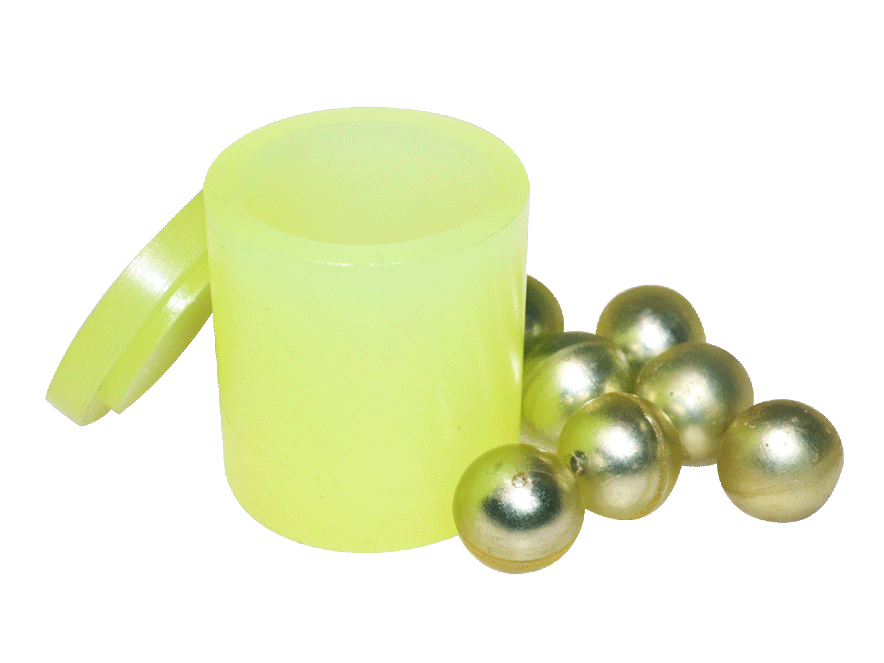
Confirm the jar assembly, including lid and seal, before using a PU jar in a validated milling method.