
Small Ball Mill with Ceramic Jar: Lab Guide
A common failure in laboratory milling is not a broken motor or a worn bearing. It is a batch that looks correct but no longer matches the baseline because the jar, grinding media, or cleaning procedure introduced a small amount of foreign material. The problem is easy to miss during a visual check, yet it can shift sintering behavior, catalytic activity, electrochemical performance, color, or analytical results. For laboratories working with small samples, the choice of mill and jar is therefore a contamination-control decision as much as a size-reduction decision.
Contamination can enter a sample from several directions: the feed material, the grinding media, the jar wall, the atmosphere, and the tools used to recover the powder. The jar is especially important because it is a large wear surface in direct contact with the charge. A small ball mill with a ceramic jar is often selected when metal pickup must be reduced and batch sizes must remain manageable. The principle is straightforward: the jar rotates on a roller base, the grinding media inside transfers energy to the powder, and the ceramic surface limits the introduction of metallic wear products. The practical result still depends on the ceramic grade, media choice, material hardness, milling time, and cleaning discipline.
TENCAN supplies a small ball mill with a ceramic jar for laboratory-scale grinding and mixing. The product page should be used to confirm the exact jar and accessory configuration rather than assuming a universal specification. The notes below focus on process logic: why a ceramic jar is used, where its limits appear, and how to evaluate whether it fits a given material and analytical workflow.
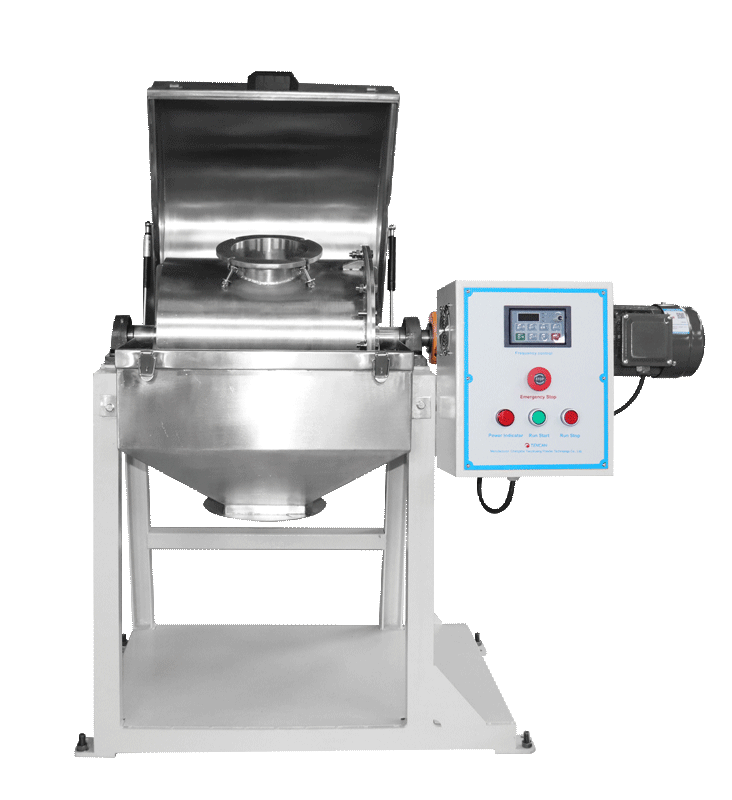
TENCAN small ball mill with a ceramic jar for laboratory-scale milling.
Why Contamination Control Begins at the Jar
The jar is not a passive container. Every rotation exposes the inner surface to sliding particles, tumbling media, and, in wet processes, a liquid phase that may be acidic, alkaline, or rich in dissolved salts. Wear occurs through abrasion, impact, and corrosion, and the relative importance of each mechanism changes with the material. A hard, angular ceramic powder can scratch a softer jar surface. Dense media can cause impact wear at the ends and along the cylindrical wall. A reactive slurry can attack grain boundaries or leach specific components from the jar. These mechanisms do not always produce visible damage before they affect trace chemistry.
A metal jar may offer toughness and thermal conductivity, but it can also contribute iron, chromium, nickel, or other alloy elements to the sample. That does not make every metal jar unsuitable. For coarse size reduction before a final analytical step, a small amount of metallic wear may be tolerable. It becomes a serious concern when the milled powder is used directly for sintering, catalysis, battery research, optical materials, or trace-element analysis. A ceramic jar changes the contamination profile, usually reducing metallic pickup, but it does not create a zero-wear system. Ceramic particles can also enter the batch, so the target chemistry must be considered before the jar material is selected.
Cleaning is part of the same problem. A jar that is visually clean may retain fine powder in surface features, especially if the ceramic is unglazed or has a matte finish. Carryover from a previous batch can be more significant than wear from the current one. Laboratories that change materials frequently should treat jars as dedicated consumables where practical, or establish a validated cleaning procedure with a blank run before critical work. The cost of an additional jar is often small compared with the cost of repeating an experiment or rejecting an analytical result.
Where wear and contamination come from
Abrasive wear is driven by the hardness ratio between the feed and the jar surface. If the feed contains hard phases such as certain oxides, carbides, or minerals, the jar experiences scratching and polishing. The wear rate increases with rotation speed, milling time, and the presence of sharp particles. Impact wear is more closely related to media size, media density, and the way the charge tumbles. Corrosive wear depends on the liquid phase, temperature, and the chemical stability of the jar material. In many real batches, all three mechanisms act at once, which is why a simple material compatibility table is not enough on its own.
The grinding media deserve equal attention. Media made from a different ceramic or from a dense oxide can wear at a different rate from the jar. If the media is harder than the jar, the jar may wear preferentially. If the jar is harder, the media may wear instead. The total contamination is the sum of both contributions, plus any material picked up from the milling tools and the recovery step. A clean ceramic jar paired with an unsuitable media can therefore produce a worse result than expected. The media should be selected as part of the same contamination budget as the jar.
Recovery is another overlooked source. Scraping a milled powder from a ceramic jar with a metal spatula can introduce the very contamination the jar was chosen to avoid. Sampling tools, sieves, and storage containers should be reviewed with the same care as the mill. For trace work, a short blank milling run with the same jar, media, and cleaning procedure can reveal whether the overall workflow is suitable. The blank should be analyzed using the same method as the sample, because a contamination level that is invisible to one technique may be significant to another.
What a ceramic jar changes and what it does not
A ceramic jar changes the wear chemistry. Instead of relying on a metal alloy surface, the mill uses a ceramic material that may be selected for hardness, chemical resistance, or low metallic content. This can be valuable for oxide powders, geological samples, catalysts, pigments, and other materials where iron or nickel pickup is undesirable. The jar also provides electrical insulation and can be easier to clean when the surface finish is appropriate. These are practical advantages, but they should be described as contamination reduction rather than contamination elimination.
Ceramic jars have limits. They can chip if handled roughly, and a chipped surface may retain powder or shed fragments. They may be less tolerant of thermal shock than metal jars, and their weight can affect how easily a small jar is handled during loading and unloading. Some ceramic compositions are more resistant to acids than others, so the exact grade matters. The user should confirm chemical compatibility with the supplier and avoid assuming that the word ceramic implies universal inertness. For aggressive chemistry or high-temperature work, a different jar material or a lined jar may be more appropriate.
The decision framework is therefore condition-based. If the main risk is metallic contamination and the process is moderate in pH and temperature, a ceramic jar is a logical starting point. If the analysis is sensitive to silicon, aluminum, zirconium, or other ceramic elements, the same jar may create a different interference. If the material is extremely abrasive, wear will still occur and should be monitored. The correct question is not whether ceramic is better in general, but whether its wear profile is acceptable for the specific sample and analytical method.
How a Small Ball Mill with a Ceramic Jar Works
A roller-type small ball mill uses a horizontal jar supported by rotating rollers. The jar is filled with sample and grinding media, closed, and placed on the rollers. As the rollers turn, friction rotates the jar. The media inside rises along the wall and then falls or rolls back into the charge. Breakage occurs through impact when media collide and through shear and attrition when particles are caught between moving surfaces. The mill has no internal shaft passing through the jar, which simplifies cleaning and reduces the number of surfaces that contact the sample.
The energy input is mechanical, but not all of it is used for size reduction. Some energy becomes heat, sound, and friction between the jar and the rollers. The useful work depends on how the media move, how often they contact the powder, and whether the powder remains dispersed in the active zone. A jar that is underloaded may have plenty of free space but too few collisions. An overloaded jar may look full and productive while the media motion is damped. Small mills are particularly sensitive to these details because the absolute energy per batch is low and small changes in fill can alter the result.
The small working volume is an advantage for expensive or scarce materials. It also makes representative sampling important. If the powder is not homogeneous after milling, a small analytical aliquot may not represent the batch. The mill should be run long enough to distribute the powder and media, but not so long that wear or agglomeration changes the result. The operating window is usually established experimentally rather than taken from a single catalogue value.
Rotation, media motion, and energy transfer
Jar rotation speed is the first variable most operators adjust. At low speed, the media charge may slide or cascade without much impact. As speed increases, the media are lifted higher and then fall more energetically, which usually improves breakage of coarser particles. At a sufficiently high speed, the media can be pinned to the wall by centrifugal force and lose their tumbling action. The threshold depends on jar diameter, media size, and fill, so a speed that works well in one jar may not transfer directly to another. The practical approach is to observe media motion and then verify fineness, not to rely on a single rpm value taken out of context.
Media size and density determine the scale of the energy transfer. Larger or denser media carry more momentum and are useful for breaking coarse particles, but they produce fewer contact points and may create deeper damage or more jar wear. Smaller media provide more contacts and can improve fine grinding, provided they have enough energy to fracture the particles. A mixture of media sizes is sometimes used to balance coarse breakage and fine attrition, but the mixture must be reproducible. If the media distribution changes from batch to batch, the milling result will change as well.
The fill level of the jar has two components: media fill and powder fill. Too little media reduces the number of collisions. Too much media can restrict motion and leave little room for the powder. The powder volume must also be controlled because the powder occupies space between the media and affects how freely the charge moves. A practical operating procedure should record the media mass or volume, the powder mass, and the jar size so that the same filling condition can be repeated. Without these records, a successful trial is difficult to reproduce.
Wet and dry milling in a ceramic jar
Dry milling is convenient when the final powder must remain dry or when the downstream process cannot tolerate a solvent. It can be effective for brittle materials, but fine dry powders often agglomerate, coat the jar and media, and become difficult to discharge. In a small ceramic jar, dry milling may also generate dust when the jar is opened. The operator should allow the powder to settle and use appropriate containment. Dry milling is less suitable when the target is a very fine, well-dispersed suspension or when the material is sensitive to static charging.
Wet milling uses a liquid to disperse the powder and media. The liquid can improve particle wetting, reduce dust, and help keep fine particles from re-agglomerating. It can also change the mechanics of the charge: a low-viscosity liquid allows media motion, while a thick slurry dampens it. The liquid must be compatible with the jar, the media, and the sample, and it must be removable without altering the powder. If the liquid remains in the final product, its purity and drying behavior matter. For reactive or air-sensitive materials, the choice of liquid and atmosphere may be more important than the jar itself.
Both routes require a realistic cleaning plan. Wet milling may leave a film on the jar wall, while dry milling may leave compacted powder in corners. A ceramic jar should be inspected for chips, cracks, and discoloration before each use. Cleaning agents should be selected for the ceramic grade and for the residue being removed. If the same jar is used for different materials, a blank run after cleaning can confirm that carryover is below the relevant detection limit. This is especially important when the mill supports trace analysis or when the next batch is chemically sensitive.
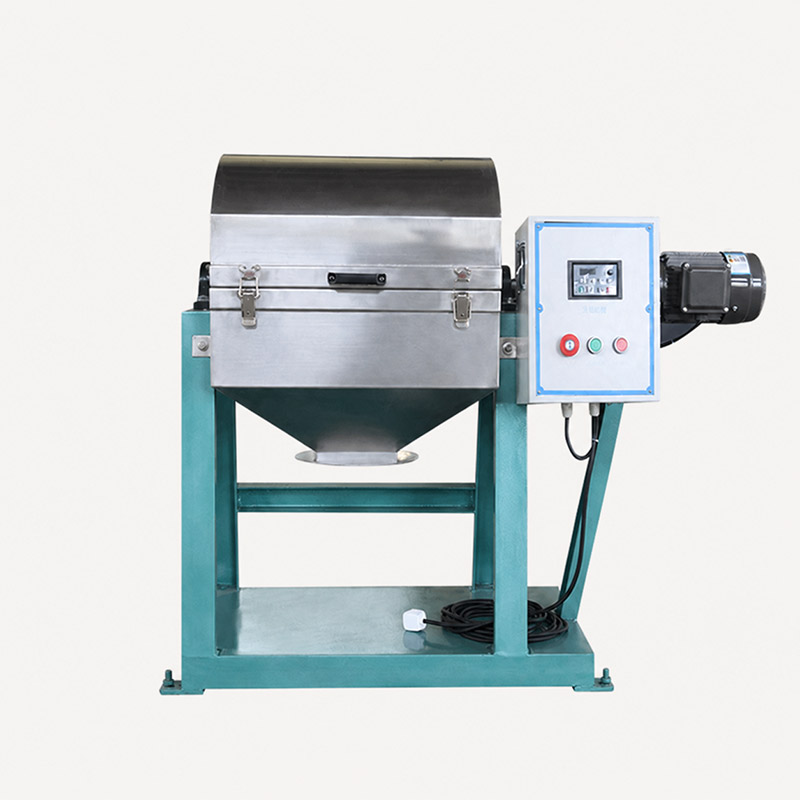
Ceramic jar ball mill configuration for small-batch laboratory work.
Matching Material Properties to Jar and Media Selection
Material selection should start with a written description of the feed, not with a favourite jar or media. The description should include the chemical composition or at least the main phases, the feed particle size, the target particle size, the acceptable contamination level, and the downstream analytical method. Hardness, toughness, density, moisture content, and reactivity all influence the milling route. A material that is easy to grind in one laboratory may be difficult in another because the target fineness or contamination limit is different. The mill must be matched to the duty, not the other way around.
Hardness, toughness, and feed size
Hardness is a useful first indicator, but it does not describe fracture behavior. A hard brittle material may fracture quickly once cracks are initiated, while a softer ductile material may flatten, coat the media, and resist size reduction. Tough materials can absorb impact energy and require more attrition or a different mill type. In a small ball mill, the feed size must be compatible with the media size and the jar dimensions. Large particles may not be nipped between small media, and a very coarse feed can cause uneven loading or local wear. Pre-crushing or a two-stage milling approach may be more efficient than extending the milling time.
The feed size also affects the number of particles and the surface area. A fine feed has more surface to wet and may agglomerate more readily, while a coarse feed requires more breakage events. If the feed is already close to the target size, the mill may only need to de-agglomerate or homogenize, which is a different objective from comminution. Mixing and grinding should not be treated as interchangeable. A batch that needs uniform distribution may not need the same energy as a batch that needs a specific top size.
Target particle size and distribution
The target size should be stated as a distribution, not only as an average. A D50 value alone can hide a coarse tail that affects sintering or a fine fraction that changes flowability. For many laboratory projects, the relevant specification includes a top size, a median, and an acceptable width. The analytical method should be chosen before milling begins, because laser diffraction, sieving, sedimentation, and microscopy respond differently to agglomerates and fines. If the method is changed after milling, comparisons with earlier batches may be misleading.
Over-milling is a common problem. Fineness may improve for a period and then plateau while wear, heat, and agglomeration continue to increase. The result can be a narrower or broader distribution depending on the material and the stabilization mechanism. In a ceramic jar, longer milling also increases the opportunity for jar and media wear, so there is a trade-off between reaching the target and keeping contamination low. A time-ladder trial with sampling at intervals is more informative than a single long run. The trial should record the particle size distribution, the color, the flow behavior, and any visible wear.
Chemical compatibility and downstream analysis
Chemical compatibility includes the powder, the liquid, the atmosphere, and the jar. An acidic or alkaline slurry may attack a ceramic surface that is otherwise hard and wear resistant. The same slurry may dissolve or leach elements from the powder, changing the very composition being studied. If the process requires a reactive liquid, a short compatibility test on a small sample can reveal discoloration, gas generation, or a change in pH. The jar supplier should be asked for the relevant chemical resistance data when the application is outside ordinary aqueous conditions.
Downstream analysis can be the most sensitive part of the workflow. X-ray diffraction may detect a crystalline contaminant that is invisible in a bulk assay. X-ray fluorescence may show a shift in an element that is also a major component of the jar. Inductively coupled plasma methods can detect trace metal pickup at very low levels. The acceptable contamination level should be defined in the units and detection limit of the chosen method. A ceramic jar that is suitable for one analysis may be unsuitable for another. This is not a reason to avoid ceramic jars; it is a reason to validate the complete workflow.
Where possible, the jar and media should be reserved for one material family. Dedicated tooling reduces the risk of cross contamination and makes it easier to interpret changes in the product. If dedicated jars are not practical, a documented cleaning and blank-run procedure is the next best option. The procedure should include a visual inspection, a cleaning agent appropriate to the residue, a rinse step, a drying step, and a check for retained powder. The record should identify the jar, the media, and the cleaning batch so that an unexpected result can be traced.
Process Variables That Affect Particle Size and Reproducibility
Two laboratories can use the same model of small ball mill and obtain different results because the operating variables are not the same. The important variables are not limited to speed and time. They include media size, media density, media fill, powder fill, ball-to-powder ratio, liquid phase, viscosity, temperature, atmosphere, and cleaning. A useful experiment changes one variable at a time and records the others in enough detail to repeat the batch. The table below summarizes the main factors and the verification steps that make them visible.
| Factor | Effect on milling | Verification step |
|---|---|---|
| Jar rotation speed | Changes media motion, impact energy, and the balance between cascading and centrifuging | Run a speed ladder and observe media motion before comparing fineness |
| Media size and density | Larger or denser media break coarser particles; smaller media provide more contacts for fine grinding | Compare two media conditions at the same fill and milling time |
| Media fill | Too little media reduces collisions; too much media restricts motion | Record media volume or mass and keep the jar size constant |
| Powder fill | Changes the free space, the powder-to-media contact, and the discharge behavior | Use a fixed powder mass for each trial and note the occupied volume |
| Ball-to-powder ratio | More media per powder increases energy input but may reduce the amount of powder in the active zone | Trial a ratio range and compare both fineness and contamination |
| Milling time | Fineness may improve and then plateau while wear and heat continue | Sample at intervals and stop at the target distribution |
| Liquid phase and viscosity | Wet milling can improve dispersion, but a thick slurry dampens media motion | Measure solids loading and observe slurry movement in a transparent trial jar if available |
| Temperature and atmosphere | Heat, oxygen, and moisture can alter the powder or the jar surface | Monitor jar temperature and use pauses or a controlled atmosphere when needed |
| Cleaning and carryover | Residue from a previous batch can dominate a trace result | Use a dedicated jar or run a blank after the cleaning procedure |
Speed, fill, and ball-to-powder ratio
Speed is easy to change and easy to misinterpret. A higher speed does not automatically produce a finer powder. It may increase impact energy, but it may also increase wall wear, heat, and the tendency of the charge to centrifuge. The useful range should be identified by observing the media. If the media remain at the bottom and barely move, the speed is too low. If they are pinned to the wall and no longer cascade, the speed is too high. Between these limits, the operator can compare fineness at controlled time intervals. The optimum is the condition that reaches the target distribution with acceptable wear and repeatability.
The ball-to-powder ratio is a convenient way to describe the amount of media relative to the powder, but it is not a complete description. The same ratio can behave differently if the jar size or media size changes. A high ratio increases the number of media contacts per unit of powder, which can speed breakage, but it also leaves less room for the powder and can increase contamination. A low ratio may require a longer time, which also increases wear. The ratio should be optimized together with fill and time, not treated as an independent setting. For reproducibility, the method should state the jar size, media size, media mass, powder mass, and fill condition.
Fill is often the least documented variable in laboratory milling. An operator may fill a jar by eye, which is acceptable for a rough mix but not for a validated process. The media bed should have enough freedom to move, and the powder should be able to occupy the spaces between the media without packing the jar. If the jar is too full, the lid may compact powder or the media may not tumble. If it is too empty, the media may fall onto a thin powder layer and produce uneven grinding. A simple fill record, combined with a photograph of the charged jar, can prevent many reproducibility problems.
Media size, liquid phase, and material loss
Media size should be chosen for the feed size and the target size. Media that are too small may not break coarse particles, while media that are too large may create a coarse grind with a wide distribution. In a small ceramic jar, the media must also be compatible with the jar material so that wear does not introduce an unexpected element. Spherical media are common because they roll and wear relatively uniformly, but the actual shape and grade should be confirmed. Media that are cracked or irregular should be removed because they can damage the jar and change the milling behavior.
In wet milling, the liquid phase affects both breakage and sampling. A liquid that wets the powder well can reduce agglomeration, but a viscous slurry may slow media motion and trap particles in dead zones. The solids loading should be high enough to provide productive collisions and low enough to allow movement. If a dispersant is used, it must be compatible with the downstream process and must not interfere with the analytical method. The same applies to pH adjusters and antifoam agents. Each additive becomes part of the process and should be recorded.
Material loss is a practical reproducibility issue. Powder can remain on the jar wall, in the lid seal, between media, and on the recovery tool. A loss that is small in absolute terms can be large relative to a small batch. The recovery procedure should be standardized, including the number of rinses if wet milling is used and the method for dislodging powder from the media. If the powder is recovered by sieving the media, the sieve should be checked for contamination and for retention of fines. The mass balance should be recorded so that an unexpected loss can be detected.
Temperature, atmosphere, and cleaning
Milling generates heat through friction and impact. In a small jar, the temperature rise may be modest, but it can still affect a thermosensitive material, a binder, or a liquid with a low boiling point. The outside of the jar may feel cool while the powder or the media surface is warmer. If temperature is a concern, the process can be run in shorter intervals with pauses, or the jar can be allowed to cool between runs. The effect of temperature on the product should be checked rather than assumed. For materials that oxidize or absorb moisture, the atmosphere inside the jar may be as important as the jar material.
Atmosphere control can range from simply closing the jar promptly to purging with an inert gas or handling the jar in a glove box. The choice depends on the sensitivity of the powder. A ceramic jar is not automatically airtight, and the lid or seal may be the limiting component. If the process requires low oxygen or low moisture, the complete jar assembly should be tested under the intended conditions. The same principle applies to light-sensitive materials and to powders that react with the cleaning solvent.
Cleaning should be treated as a process step with its own variables. A soft brush may remove loose powder without scratching a glazed ceramic surface. A solvent may dissolve a binder but leave a residue. Water may be suitable for an aqueous system but inappropriate for a moisture-sensitive one. After cleaning, the jar should be dry before the next charge, and the drying method should not leave lint or introduce contamination. Inspection for chips and cracks should be routine. A damaged ceramic jar should be removed from service because the damage can change both the milling action and the contamination profile.
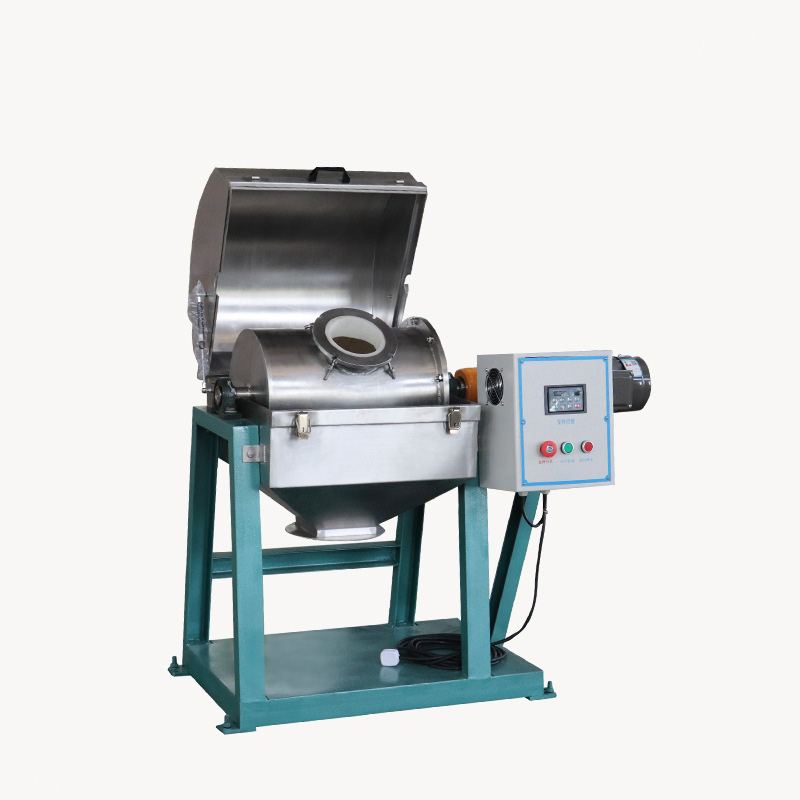
Roller base and ceramic jar arrangement for a small laboratory ball mill.
A Practical Selection and Validation Checklist
A structured trial is more useful than a collection of anecdotal settings. The goal is to show that the chosen small ball mill with ceramic jar can reach the required size distribution, stay within the contamination limit, and reproduce the result across operators. The checklist below can be adapted to the material and the analytical method. It is not a substitute for supplier data or a formal risk assessment, but it helps organize the decisions that matter most.
- Define the purpose: coarse breakage, fine grinding, de-agglomeration, mixing, or a combination. The required energy and end point differ.
- Characterize the feed: composition, main phases, feed size, moisture, hardness, and any prior treatment.
- Set the target: median size, top size, distribution width, and the analytical method that will be used to judge it.
- Check contamination sensitivity: identify elements that would interfere with the product or the analysis and estimate the acceptable level.
- Select the jar and media: confirm the ceramic grade, media material, media size, and chemical compatibility with the process.
- Run a blank: mill an empty or representative blank with the same jar, media, and cleaning procedure and analyze it by the relevant method.
- Run a time ladder: sample at intervals and record fineness, color, temperature, and visible wear instead of relying on one end point.
- Document the method: jar size, media mass, powder mass, fill condition, speed, time, liquid, atmosphere, cleaning, and recovery.
The first trial should be conservative. A moderate speed, a moderate fill, and a short time ladder will reveal whether the material responds at all and whether the jar is compatible. A second trial can then optimize the energy input and the media size. If the material is valuable or hazardous, the trial size should be kept small and the containment should be planned before the jar is opened. The product page for the ceramic jar ball mill can be used to confirm the available configuration, but the process window still has to be established with the actual material.
Scale-up from a small jar to a larger mill is not a simple multiplication of speed or time. The media motion, the number of collisions, the powder-to-media ratio, and the heat removal all change with geometry. A laboratory result is best treated as a material response under specific conditions, not as a guarantee of production performance. If the laboratory mill is used to support a larger process, the key output is often the relationship between energy input, size distribution, and contamination, rather than a single set of settings. That relationship can be used to design a pilot trial with a larger mill.
A final technical reminder is to verify the jar before and after every critical batch. Look for chips, cracks, discoloration, and retained powder. Check the media for wear and breakage. Confirm that the cleaning procedure was followed and that the blank result is still acceptable. These checks take little time compared with the cost of a failed analysis. When the application is sensitive to metallic contamination, a ceramic jar is a practical starting point, but the decision should be supported by the material chemistry, the target size distribution, and a documented validation run. The most reliable mill is the one whose wear profile is understood and whose operating window has been demonstrated on the actual sample.